Test yourself on Properties of Triangles with exam style questions, marked instantly.
Flashcards that come back just before you would forget them.
A revision plan that remembers what you know and shows what to do next.
See which topics you have nailed and which need another look.
Quiz yourself on Properties of TrianglesGet your flashcardsBuild my revision planTrack my progressThe 180° Rule
Visual: Types of Triangles
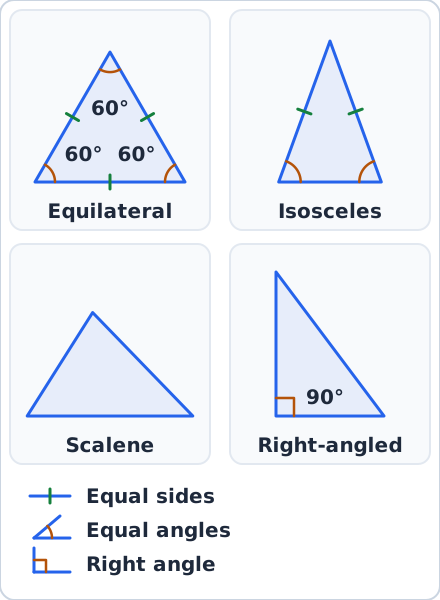
Tip: Equal sides have matching tick marks, equal angles have matching arcs
Types of Triangles
| Type | Sides | Angles | Key Feature |
|---|---|---|---|
| Equilateral | All 3 equal | All 60° | 3 lines of symmetry, rotational order 3 |
| Isosceles | At least 2 equal | At least 2 equal (base angles) | 1 line of symmetry (3 if all sides are equal) |
| Scalene | All different | All different | No symmetry |
| Right-angled | Scalene or isosceles; never all three sides equal | One 90° angle | Other two angles add to 90° |
Triangle Angle Rules
| Rule | Description |
|---|---|
| Interior angles sum | Always add up to 180° |
| Exterior angle | Equals the sum of the two opposite interior angles |
| Isosceles base angles | The two angles opposite the equal sides are equal |
Worked Example 1: Finding a Missing Angle
A triangle has angles of 65° and 48°. Find the third angle.
Step 1 Use the angle sum rule
Angles in a triangle sum to 180°
65° + 48° + x = 180°
Step 2 Solve
113° + x = 180°
x = 180° − 113° = 67°
Worked Example 2: Isosceles Triangle
An isosceles triangle has a top angle of 40°. Find the two base angles.
Step 1 Set up the equation
Let each base angle = x
40° + x + x = 180°
40° + 2x = 180°
Step 2 Solve for x
2x = 180° − 40° = 140°
x = 70°
Each base angle = 70°
Worked Example 3: Exterior Angle
A triangle has interior angles of 55° and 72°. Find the exterior angle at the third vertex.
Step 1 Use the exterior angle theorem
Exterior angle = sum of opposite interior angles
Exterior = 55° + 72° = 127°
Common Mistakes
Practice Questions
Q1 Find angle x in a triangle where the other angles are 72° and 53°.
72° + 53° + x = 180°
x = 180° − 125° = 55°
Q2 An isosceles triangle has a top angle of 56°. Find each base angle.
56° + 2x = 180°
2x = 124°
x = 62°
Q3 Find the exterior angle at C if the interior angles at A and B are 53° and 65°.
Exterior at C = sum of opposite angles
Exterior = 53° + 65° = 118°
Q4 What is each angle in an equilateral triangle?
All angles equal, sum to 180°
Each angle = 180° ÷ 3 = 60°
Make this stick
Signing in gives access to all PrepWise features.