Test yourself on Simplifying Expressions with exam style questions, marked instantly.
Flashcards that come back just before you would forget them.
A revision plan that remembers what you know and shows what to do next.
See which topics you have nailed and which need another look.
Quiz yourself on Simplifying ExpressionsGet your flashcardsBuild my revision planTrack my progressWhat Does "Simplify" Mean?
Visual Guide
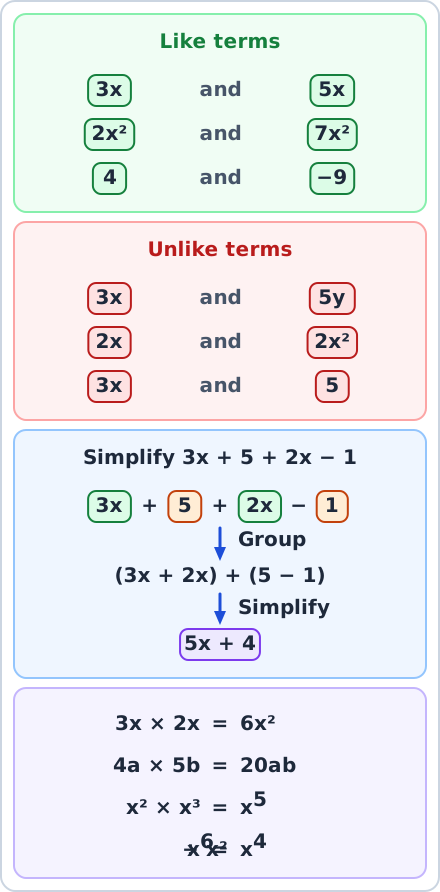
Like terms have the same letters with the same powers. 3x and 5x have the same variable, 2x² and 7x² have the same power, and 4 and −9 are both constants. Unlike terms differ: 3x and 5y have different variables, 2x and 2x² have different powers, and 3x and 5 differ because one has a variable and one does not. In the example, the green terms are like terms (both have x) and the orange terms are like terms (both are constants). To multiply terms, multiply the numbers and add the powers. With different letters, keep both. Add the powers when multiplying and subtract them when dividing.
What Are "Like Terms"?
Like terms have exactly the same variable(s) with the same power(s)
| Terms | Like or Unlike? | Why? |
|---|---|---|
| 3x and 7x | Like ✓ | Same variable (x) |
| 5y² and −2y² | Like ✓ | Same variable and power (y²) |
| 4 and 9 | Like ✓ | Both constants (numbers only) |
| 3x and 3y | Unlike ✗ | Different variables |
| 2x and 2x² | Unlike ✗ | Different powers |
| 5xy and 3yx | Like ✓ | Same! (xy = yx, order doesn't matter) |
Method: Collecting Like Terms
Look for: x terms, x² terms, y terms, constants, etc.
Collect all x terms, then all y terms, then constants
3x + 5x = 8x (just add 3 + 5, keep the x)
Highest power first, then alphabetically: x² terms, x terms, y terms, constants
Worked Example 1: Basic Simplification
Simplify: 5x + 3 + 2x − 7
Step 1 Identify term types
x terms: 5x and 2x
Constants: +3 and −7
Step 2 Collect like terms
x terms: 5x + 2x = 7x
Constants: 3 − 7 = −4
Final Answer
7x − 4
Worked Example 2: Multiple Variables
Simplify: 4a + 3b − 2a + 5b − 1
Step 1 Identify term types
a terms: 4a and −2a
b terms: 3b and 5b
Constants: −1
Step 2 Collect each type
a terms: 4a − 2a = 2a
b terms: 3b + 5b = 8b
Constants: −1
Final Answer
2a + 8b − 1
Worked Example 3: With Powers
Simplify: 3x² + 4x − x² + 2x − 5
Step 1 Identify term types
x² terms: 3x² and −x²
x terms: 4x and 2x
Constants: −5
Remember: x² and x are NOT like terms!
Step 2 Collect each type
x² terms: 3x² − x² = 2x²
x terms: 4x + 2x = 6x
Constants: −5
Final Answer
2x² + 6x − 5
(Written with highest power first)
Common Mistakes to Avoid
What is Substitution?
Method: How to Substitute
Copy it exactly as given
Use brackets around the number, especially for negatives!
Brackets, Indices, Division/Multiplication, Addition/Subtraction
Check it makes sense!
Key Rules to Remember
| Expression | Meaning | If x = 3 |
|---|---|---|
| 2x | 2 × x | 2 × 3 = 6 |
| x² | x × x | 3 × 3 = 9 |
| x³ | x × x × x | 3 × 3 × 3 = 27 |
| 2x² | 2 × (x × x) | 2 × 9 = 18 |
| xy | x × y | If y = 4: 3 × 4 = 12 |
Worked Example 4: Basic Substitution
Find the value of 3a + 2b when a = 4 and b = 5
Step 1 Write the expression
3a + 2b
Step 2 Substitute the values
= 3(4) + 2(5)
Replace a with 4 and b with 5
Step 3 Calculate using BIDMAS
= 12 + 10
= 22
Worked Example 5: With Powers
Find the value of x² + 2x − 5 when x = 3
Step 1 Substitute x = 3
= (3)² + 2(3) − 5
Step 2 Work out powers first (BIDMAS)
= 9 + 2(3) − 5
3² = 9
Step 3 Then multiplication
= 9 + 6 − 5
= 10
Worked Example 6: Negative Values (Tricky!)
Find the value of 2x² − 3x when x = −2
Step 1 Substitute x = −2 with brackets!
= 2(−2)² − 3(−2)
Always use brackets around negative numbers!
Step 2 Work out the power
(−2)² = (−2) × (−2) = 4
= 2(4) − 3(−2)
Step 3 Complete the calculation
= 8 − (−6)
= 8 + 6
= 14
Remember: subtracting a negative = adding!
Substitution: Common Mistakes to Avoid
Words to Algebra
Key Translations
| Words | Algebra |
|---|---|
| "a number" / "something" | x (or any letter) |
| "double" / "twice" | 2x |
| "three times" | 3x |
| "5 more than" / "add 5" | + 5 |
| "3 less than" | − 3 |
| "the sum of" | + |
| "the product of" | × |
| "squared" | x² |
| "is" / "equals" / "gives" | = |
Worked Example 7: Age Problem
Sarah is x years old. Tom is 3 years older. Their combined age is 27. Form and solve an equation to find Sarah's age.
Step 1 Write expressions
Sarah's age = x
Tom's age = x + 3
Step 2 Form equation
Combined age = 27
x + (x + 3) = 27
Step 3 Solve
2x + 3 = 27
2x = 24
x = 12
Sarah is 12 years old
Worked Example 8: Consecutive Numbers
Three consecutive numbers add up to 45. Find the numbers.
Solution
Let the numbers be n, n+1, n+2
n + (n+1) + (n+2) = 45
3n + 3 = 45
3n = 42
n = 14
Numbers are 14, 15, 16
Make this stick
Signing in gives access to all PrepWise features.