Test yourself on Box Plots with exam style questions, marked instantly.
Flashcards that come back just before you would forget them.
A revision plan that remembers what you know and shows what to do next.
See which topics you have nailed and which need another look.
Quiz yourself on Box PlotsGet your flashcardsBuild my revision planTrack my progress📦 The Five-Number Summary
Imagine you're comparing the performance of two basketball teams and need to quickly see which has more consistent scoring. A box plot is like a visual summary that shows you the "box of performance" - where the middle 50% of scores lie, plus the whiskers that extend to show the full range. With just one glance, you can see which team is more consistent, which has higher typical scores, and whether there are any unusual outliers that might skew your analysis.
Key Facts About Box Plots
- Five-number summary: Minimum, Q1, Median, Q3, Maximum
- Box: Shows the interquartile range (middle 50% of data)
- Whiskers: Extend to the minimum and maximum values
- Median line: Vertical line inside the box showing the middle value
- Outliers: Values much bigger or smaller than the rest of the data
- Compact display: Shows distribution in a small space
- Easy comparison: Multiple box plots can be easily compared side by side
Anatomy of a Box Plot
Creating Box Plots
Step 1: Find the Five-Number Summary
- Arrange data in order: Sort from smallest to largest
- Find the median (Q2): Middle value of the dataset
- Find Q1: Median of the lower half
- Find Q3: Median of the upper half
- Identify minimum and maximum: Smallest and largest values
Example: Finding Five-Number Summary
Step-by-step:
• n = 11 (odd number)
• Median (Q2): 6th value = 28
• Lower half: 12, 15, 18, 22, 25 → Q1 = 18
• Upper half: 30, 35, 38, 42, 45 → Q3 = 38
• Minimum: 12
• Maximum: 45
Five-number summary: 12, 18, 28, 38, 45
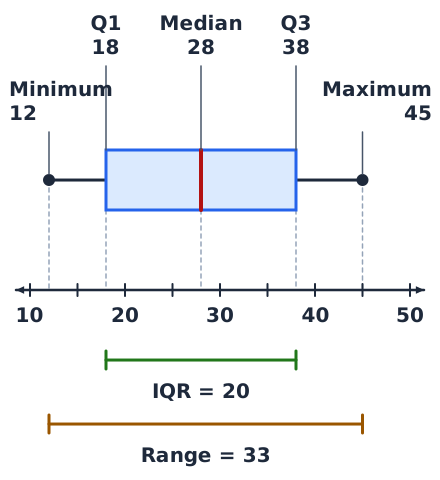
Drawing the Box Plot
Interpreting Box Plots
What Each Part Tells You
- Box width (IQR): Spread of middle 50% of data
- Median position in box: Symmetry of middle 50%
- Whisker lengths: Spread of extreme values
- Overall width: Total range of data
Skewness from Box Plots
- Symmetric: Median in centre of box, equal whisker lengths
- Positive skew: Median left of centre, longer right whisker
- Negative skew: Median right of centre, longer left whisker
Comparing Distributions
Spread: Compare IQRs for consistency
Range: Compare whisker spans for extremes
Shape: Compare skewness patterns
Comparing Two Distributions
💡 Exam Tips for Box Plots
Drawing Box Plots:
- Use a ruler: Draw neat, straight lines
- Equal scale: Use consistent spacing on your number line
- Clear markers: Mark all five values clearly
- Proper proportions: Box and whisker lengths should reflect actual data
- Vertical alignment: Keep everything at the same height
Finding Quartiles:
- Even n: Split data exactly in half, find medians of each half
- Odd n: Exclude the overall median, find medians of each half
- Double-check: Q1 ≤ Median ≤ Q3 always
- Calculator method: Learn your calculator's quartile functions
Interpretation:
- Compare medians: For typical values
- Compare IQRs: For consistency
- Look at skewness: Position of median in box
- Consider context: What do the numbers represent?
Special Cases and Outliers
Outliers
An outlier is a value that is much bigger or much smaller than the rest of the data. It makes one whisker much longer:
- A very low value stretches the lower whisker a long way
- A very high value stretches the upper whisker a long way
Example data: most scores are between 15 and 60, but one score is 2
Effect: the range is large because of the 2, but the IQR is still 20
Conclusion: the IQR describes the spread of the typical values better
Comparing When There Is an Outlier
When an outlier is present:
- Say that the range is affected by the outlier
- Compare the IQRs, because the IQR is much less affected
- Mention the outlier in your answer
⚠️ Common Mistakes to Avoid
Calculation Errors:
- ❌ Wrong quartile method: Including/excluding median incorrectly
- ❌ Unsorted data: Not arranging data in order first
- ❌ Mixed up quartiles: Q1 should be smaller than Q3
Drawing Errors:
- ❌ Wrong scale: Not using consistent spacing
- ❌ Box proportions: Making box too wide or narrow
- ❌ Median outside box: Median must be inside the Q1-Q3 box
Interpretation Errors:
- ❌ Confusing IQR with range: IQR is Q3-Q1, range is max-min
- ❌ Overinterpreting small differences: Consider the context and scale
- ❌ Ignoring outliers: Outliers can significantly affect conclusions
Make this stick
Signing in gives access to all PrepWise features.