Test yourself on Bounds & Error Intervals with exam style questions, marked instantly.
Flashcards that come back just before you would forget them.
A revision plan that remembers what you know and shows what to do next.
See which topics you have nailed and which need another look.
Quiz yourself on Bounds & Error IntervalsGet your flashcardsBuild my revision planTrack my progressThe Hidden Range
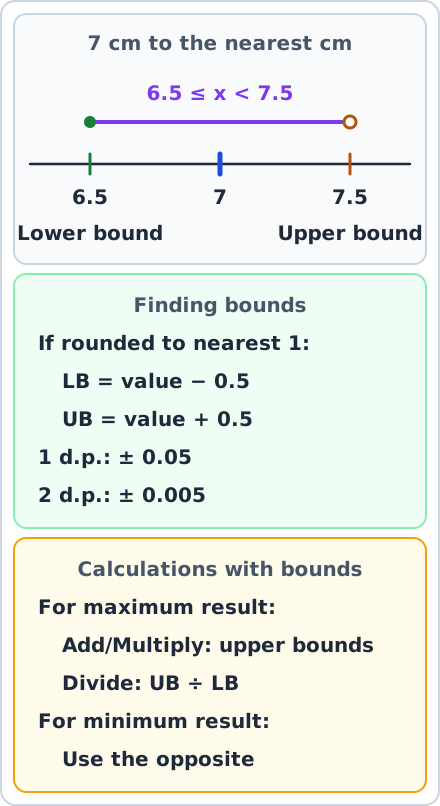
When a value is rounded, the true value lies in a range. The lower bound is the smallest value that rounds to the given value. The upper bound is the smallest value that would round up to the next value (8 cm), so the true value is always less than 7.5. The open circle shows that 7.5 is not included. For the maximum of A − B, use the upper bound of A and the lower bound of B.
Key Terminology
| Term | Meaning | Example (8.3 to 1 d.p.) |
|---|---|---|
| Lower Bound (LB) | Smallest value that rounds to the given value | 8.25 |
| Upper Bound (UB) | Smallest value that would round UP | 8.35 |
| Error Interval | Range written as inequality | 8.25 ≤ x < 8.35 |
Note: Lower bound uses ≤ (could be exactly this), Upper bound uses < (never reaches this)
Finding Bounds
| Rounded to... | Half interval | Example: 50 |
|---|---|---|
| Nearest whole number | ±0.5 | LB=49.5, UB=50.5 |
| 1 decimal place | ±0.05 | LB=49.95, UB=50.05 |
| Nearest 10 | ±5 | LB=45, UB=55 |
| Nearest 100 | ±50 | For 100: LB=50, UB=150 |
Worked Example 1
A length is 4.7 m correct to 1 decimal place. Write down the error interval.
Step 1 Find half the accuracy
1 d.p. means accuracy of 0.1 m
Half = 0.05 m
Step 2 Calculate bounds
LB = 4.7 − 0.05 = 4.65
UB = 4.7 + 0.05 = 4.75
Step 3 Write error interval
4.65 ≤ length < 4.75
Higher Level: Bounds in Calculations (Key for Exam!)
| To find... | Use... |
|---|---|
| Maximum of A + B | UB(A) + UB(B) |
| Minimum of A + B | LB(A) + LB(B) |
| Maximum of A − B | UB(A) − LB(B) |
| Minimum of A − B | LB(A) − UB(B) |
| Maximum of A × B | UB(A) × UB(B) |
| Minimum of A × B | LB(A) × LB(B) |
| Maximum of A ÷ B | UB(A) ÷ LB(B) |
| Minimum of A ÷ B | LB(A) ÷ UB(B) |
Memory trick: For division, it's the OPPOSITE - to make a fraction big, make the top big and bottom small!
Higher Level: Worked Example 2: Bounds in Division
Distance = 100 km (nearest 10 km), Time = 2 hours (nearest hour). Find the minimum speed.
Step 1 Find bounds for each
Distance: LB = 95, UB = 105
Time: LB = 1.5, UB = 2.5
Step 2 For minimum speed = min distance ÷ max time
Min speed = LB(distance) ÷ UB(time)
= 95 ÷ 2.5 = 38 km/h
Make this stick
Signing in gives access to all PrepWise features.