Test yourself on BIDMAS with exam style questions, marked instantly.
Flashcards that come back just before you would forget them.
A revision plan that remembers what you know and shows what to do next.
See which topics you have nailed and which need another look.
Quiz yourself on BIDMASGet your flashcardsBuild my revision planTrack my progressWhy Order Matters
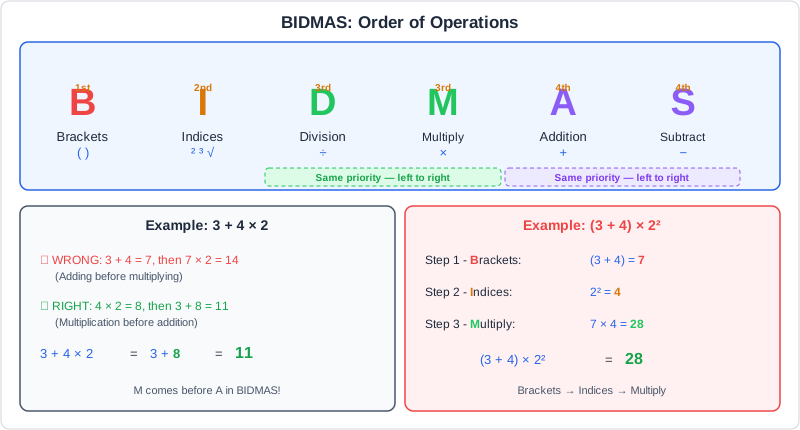
Division and multiplication have the same priority, and so do addition and subtraction: work left to right within each pair. The cross marks the wrong working, adding before multiplying. The tick marks the right working, multiplication before addition, because M comes before A in BIDMAS. In the second example work through Brackets, then Indices, then Multiply.
BIDMAS Order
Work through calculations in this order:
- Brackets - solve everything inside brackets first
- Indices - powers and roots (e.g., x², √16, 2³)
- Division and Multiplication - equal priority, work left to right
- Addition and Subtraction - equal priority, work left to right
Alternative names: BODMAS (Orders), PEMDAS (Parentheses, Exponents)
Common BIDMAS Mistakes
❌ Mistake 1: Working purely left to right
2 + 3 × 4 = 5 × 4 = 20 WRONG!
✅ Multiplication first: 2 + (3 × 4) = 2 + 12 = 14
❌ Mistake 2: Treating division and multiplication as separate priorities
12 ÷ 3 × 2 = 12 ÷ 6 = 2 WRONG!
✅ Left to right: (12 ÷ 3) × 2 = 4 × 2 = 8
❌ Mistake 3: Ignoring brackets with indices
2 × (3 + 1)² = 2 × 3 + 1² = 7 WRONG!
✅ Brackets first: 2 × (4)² = 2 × 16 = 32
Foundation Example
Calculate: 5 + 3 × 2
Step 1 Apply BIDMAS order
Multiplication before addition
M comes before A in BIDMAS
Step 2 Calculate multiplication
3 × 2 = 6
So we have: 5 + 6
Step 3 Calculate addition
5 + 6 = 11
Standard Example
Calculate: 3 + 4 × 2² - (6 - 2)
Step 1 Brackets first
= 3 + 4 × 2² - 4
(6 - 2) = 4
Step 2 Indices (powers)
= 3 + 4 × 4 - 4
2² = 2 × 2 = 4
Step 3 Multiplication
= 3 + 16 - 4
4 × 4 = 16
Step 4 Addition and Subtraction (left to right)
= 19 - 4 = 15
3 + 16 = 19, then 19 - 4 = 15
Challenge Example
Calculate: 2 × (3 + 4)² ÷ 7 - √16 + 12 ÷ 3 × 2
Step 1 Brackets first
= 2 × 7² ÷ 7 - √16 + 12 ÷ 3 × 2
(3 + 4) = 7
Step 2 Indices (powers and roots)
= 2 × 49 ÷ 7 - 4 + 12 ÷ 3 × 2
7² = 49, √16 = 4
Step 3 Division and Multiplication (left to right)
= 98 ÷ 7 - 4 + 12 ÷ 3 × 2
= 14 - 4 + 4 × 2
= 14 - 4 + 8
2 × 49 = 98, 98 ÷ 7 = 14, 12 ÷ 3 = 4, 4 × 2 = 8
Step 4 Addition and Subtraction (left to right)
= 10 + 8 = 18
14 - 4 = 10, then 10 + 8 = 18
Exam Tips
- Show your working: Write each step clearly to avoid mistakes and gain partial marks
- Use brackets for clarity: (3 × 4) + 2 is clearer than 3 × 4 + 2
- Check equal priority operations: For ÷ and ×, or + and -, always work left to right
- Double-check indices: 2³ = 8, not 6. Powers are multiplication, not addition
- Nested brackets: Work from inside out: 2 × (3 + (4 × 5)) = 2 × (3 + 20) = 2 × 23 = 46
Real-World Applications
Calculator Usage
Most scientific calculators follow BIDMAS automatically, but basic calculators might not. Always use brackets to be sure: (2+3)×4 instead of 2+3×4.
Formula Evaluation
In science formulas like E = mc², the order matters: Energy equals mass times the speed of light squared, not (mass times speed of light) squared.
Programming
Computer programming languages use operator precedence (their version of BIDMAS) to evaluate expressions correctly.
Make this stick
Signing in gives access to all PrepWise features.