Test yourself on Linear Inequalities with exam style questions, marked instantly.
Flashcards that come back just before you would forget them.
A revision plan that remembers what you know and shows what to do next.
See which topics you have nailed and which need another look.
Quiz yourself on Linear InequalitiesGet your flashcardsBuild my revision planTrack my progressNot Just Equals!
Equations give you ONE answer: x = 5. But life often needs ranges! "You must be at least 16 to drive" means age ≥ 16. "The bag must weigh less than 23kg" means weight < 23. Inequalities describe these ranges - and we can solve them just like equations (with one important twist!).
Visual: Number Line Representations
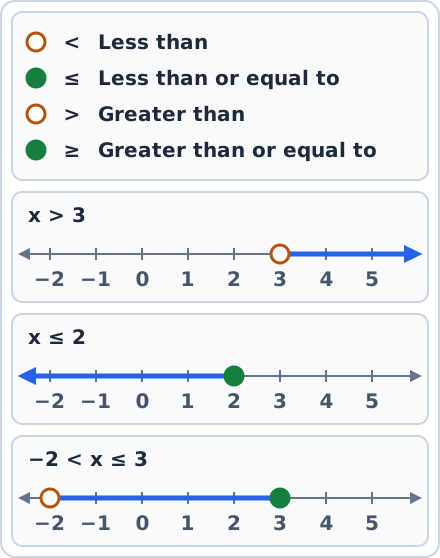
The Four Inequality Symbols
| Symbol | Meaning | Circle Type | Example |
|---|---|---|---|
| < | Less than | Open ○ | x < 5 means x can be 4.9, 4, 0, -10... |
| ≤ | Less than or equal to | Closed ● | x ≤ 5 means x can be 5, 4, 0, -10... |
| > | Greater than | Open ○ | x > 5 means x can be 5.1, 6, 100... |
| ≥ | Greater than or equal to | Closed ● | x ≥ 5 means x can be 5, 6, 100... |
Solving Inequalities (Like Equations!)
- Same rules as equations: add, subtract, multiply, divide both sides
- Keep the inequality sign pointing the same way... EXCEPT:
- When multiplying/dividing by a NEGATIVE, FLIP the sign!
- Simplify until you have x on its own
- Check: pick a value in your solution and verify it works
Worked Example 1: Simple Inequality
Solve: 3x + 7 < 19
Step 1 Subtract 7 from both sides
3x + 7 - 7 < 19 - 7
3x < 12
Step 2 Divide both sides by 3
3x ÷ 3 < 12 ÷ 3
x < 4
Step 3 Check with x = 3
3(3) + 7 = 16, and 16 < 19 ✓
Worked Example 2: Negative Coefficient (FLIP!)
Solve: 5 - 2x ≥ 11
Step 1 Subtract 5 from both sides
-2x ≥ 6
Step 2 Divide by -2 (FLIP THE SIGN!)
-2x ÷ (-2) ≤ 6 ÷ (-2)
x ≤ -3
⚠️ The ≥ became ≤ because we divided by negative!
Worked Example 3: Compound Inequality
Solve: -3 < 2x + 1 ≤ 7
Step 1 Subtract 1 from ALL three parts
-3 - 1 < 2x + 1 - 1 ≤ 7 - 1
-4 < 2x ≤ 6
Step 2 Divide ALL three parts by 2
-4 ÷ 2 < 2x ÷ 2 ≤ 6 ÷ 2
-2 < x ≤ 3
Step 3 List integer solutions
Integer solutions: -1, 0, 1, 2, 3
(Not -2 because x > -2, but includes 3 because x ≤ 3)
Common Mistakes to Avoid
Wrong:
-2x > 6 becomes x > -3
Right:
-2x > 6 becomes x < -3 (flip when dividing by negative!)
Wrong:
Using closed circle for x < 5
Right:
Open circle for < and >, closed for ≤ and ≥
Wrong:
Integer solutions for -2 < x ≤ 3 include -2
Right:
-2 is NOT included (strict <), integers are -1, 0, 1, 2, 3
Make this stick
Signing in gives access to all PrepWise features.