Test yourself on Ratio Sharing with exam style questions, marked instantly.
Flashcards that come back just before you would forget them.
A revision plan that remembers what you know and shows what to do next.
See which topics you have nailed and which need another look.
Quiz yourself on Ratio SharingGet your flashcardsBuild my revision planTrack my progressFair Sharing
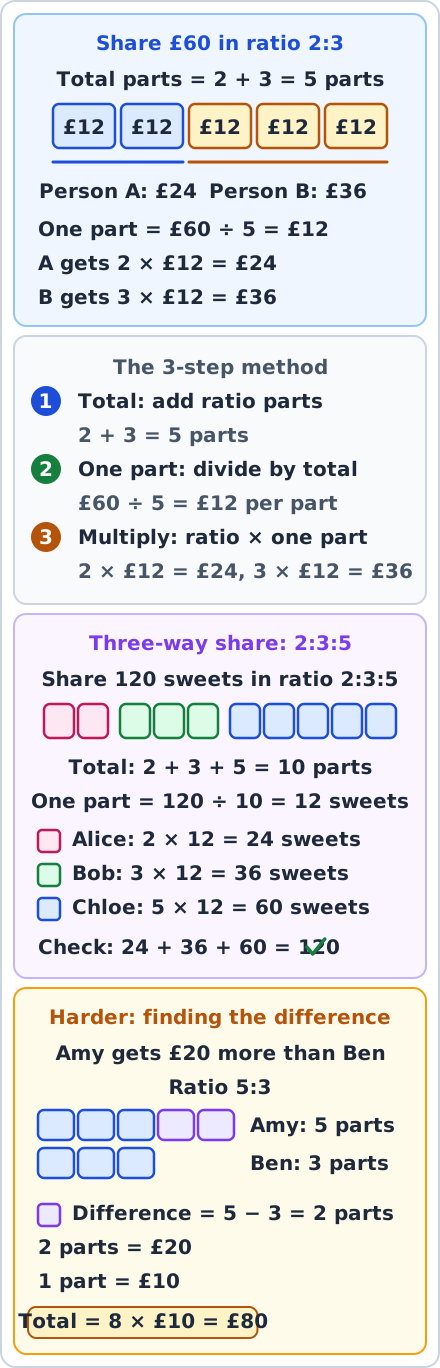
Work out the total of the ratio parts first, then one part, then each share. In the harder example the difference in parts gives the value of one part.
The "Parts" Method
Think of a ratio as PARTS of a whole
For the ratio 3:2:
- Person A gets 3 parts
- Person B gets 2 parts
- Total = 3 + 2 = 5 parts
Method: The 3-Step Process
Worked Example 1: Two-Way Share
Share £60 in the ratio 2:3
Step 1 Find total parts
2 + 3 = 5 parts
Step 2 Find value of ONE part
£60 ÷ 5 = £12 per part
Step 3 Multiply for each share
First share: 2 × £12 = £24
Second share: 3 × £12 = £36
Check Verify total
£24 + £36 = £60 ✓
Worked Example 2: Three-Way Share
Share 120 sweets between Alice, Bob and Chloe in the ratio 2:3:5
Step 1 Total parts
2 + 3 + 5 = 10 parts
Step 2 One part
120 ÷ 10 = 12 sweets per part
Step 3 Each person's share
Alice: 2 × 12 = 24 sweets
Bob: 3 × 12 = 36 sweets
Chloe: 5 × 12 = 60 sweets
Check Verify
24 + 36 + 60 = 120 ✓
Worked Example 3: Finding the Difference
Amy and Ben share some money in the ratio 5:3. Amy gets £20 more than Ben. How much do they share in total?
Step 1 Find the "difference in parts"
Amy has 5 parts, Ben has 3 parts
Difference = 5 - 3 = 2 parts
Step 2 Work out one part
2 parts = £20
1 part = £20 ÷ 2 = £10
Step 3 Find total
Total parts = 5 + 3 = 8
Total money = 8 × £10 = £80
Common Mistakes
Practice Questions
Q1 Share £70 in the ratio 2:3 [2 marks]
Q2 Share 90 marbles in the ratio 2:5:8 [3 marks]
Q3 Tom and Sara share money in ratio 4:5. Sara gets £20 more. Find the total. [3 marks]
Q4 £120 is shared in ratio 3:7. Find the larger share. [2 marks]
Q5 Share £40 in the ratio 1:3 [2 marks]
Q6 Share 100 sweets between Alice and Ben in the ratio 3:2 [3 marks]
Q7 £150 is divided in the ratio 2:3. Find both shares. [3 marks]
Q8 Share 60 marbles between Tom, Dick and Harry in the ratio 1:2:3 [3 marks]
Q9 £80 is shared 5:3. Find the smaller share. [2 marks]
Q10 Three friends win £240. They share it in the ratio 2:3:7. How much does each person get? [4 marks]
Q11 A and B share money in ratio 3:5. B gets £40 more than A. How much does B get? [4 marks]
Q12 Tom invests £3000, Sarah invests £5000. They share £400 profit in the same ratio as their investments. How much profit does each get? [5 marks]
Q13 400g of sweets are shared in the ratio 1:2:3:4. Find the largest share. [4 marks]
Q14 An amount is shared 2:5:8. The smallest share is £60. Find the total amount. [5 marks]
Q15 £50,000 is shared between 3 children in the ratio of their ages: 5:6:9. Find each share. [5 marks]
Examiner says: Always check your shares add up to the original total - here £12,500 + £15,000 + £22,500 = £50,000 ✓
Q16 Concrete is made from cement, sand and gravel in the ratio 1:2:4. How much sand is in 35 kg of concrete? [4 marks]
Q17 Money is shared 3:7:10. The difference between the largest and smallest share is £140. Find the total. [5 marks] Challenge
Q18 Three partners invested £20,000, £30,000 and £50,000. Profit of £15,000 is shared in the ratio of their investments. How much profit does the middle partner get? [6 marks] Challenge
Q19 £300 is shared in ratio 2:5:8. Find the middle share. [5 marks] Challenge
Q20 Money is shared 3:7. What percentage of the total does the person with the smaller share receive? [5 marks] Challenge
Q21 180g of flour, water and eggs are mixed in ratio 5:3:4. How much of each ingredient? [4 marks]
Q22 A football team scored 63 goals. Three strikers scored in ratio 2:4:3. How many goals did the top scorer get? [4 marks]
Q23
£500 is shared between Amy, Ben and Cal in ratio 3:4:6.
(a) How much does Amy get? [3 marks]
(b) How much more does Cal get than Ben? [3 marks]
[6 marks] Challenge
(a) Amy's share:
(b) Difference:
Examiner says: For part (b), you can find the difference directly from parts (6-4=2) without calculating individual shares first. This saves time!
Q24 Three angles of a triangle are in ratio 2:3:4. Find the largest angle. [5 marks] Challenge
Q25 Three workers share £720 wages in ratio 5:8:11. The worker with the middle wage gets how much? [5 marks]
Q26 A 3000 m² plot is divided into gardens in ratio 2:3:5. The largest garden is how much bigger than the smallest? [6 marks] Challenge
Q27 A 5-litre paint mix uses red, blue and white in ratio 1:3:6. What percentage is blue? [6 marks] Challenge
Examiner says: Notice the actual volume (5 litres) wasn't needed - ratio to percentage questions only need the ratio parts!
Q28 A 3-hour exam has questions worth marks in ratio 2:3:7. How many minutes for the section worth 3 parts? [5 marks]
Q29 An amount is shared 3:7:10. The middle share is £210. Find the total. [5 marks] Challenge
Q30 A charity receives £12,000. It splits funds between research, education and aid in ratio 5:3:12. If education receives an extra £600 donation, what is the new ratio? [7 marks] Challenge
Examiner says: Multi-step ratio problems require careful tracking. Find the actual amounts first, apply changes, then convert back to a simplified ratio.
Make this stick
Signing in gives access to all PrepWise features.