Test yourself on Angles in Parallel Lines with exam style questions, marked instantly.
Flashcards that come back just before you would forget them.
A revision plan that remembers what you know and shows what to do next.
See which topics you have nailed and which need another look.
Quiz yourself on Angles in Parallel LinesGet your flashcardsBuild my revision planTrack my progressThe Transversal Detective
Visual: Angles in Parallel Lines
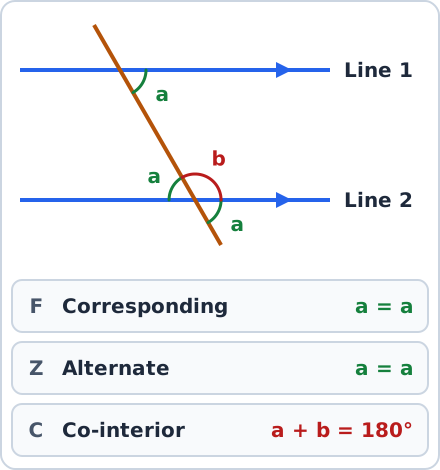
The Three Key Rules
| Angle Type | Position | Relationship | Memory Trick |
|---|---|---|---|
| Corresponding | Same position at each intersection | EQUAL (make F shape) | F for "Fidentical" |
| Alternate | Opposite sides, between parallel lines | EQUAL (make Z shape) | Z for "Zee same" |
| Co-interior | Same side, between parallel lines | ADD to 180° (make C shape) | C for "C them add up" |
Also called: Co-interior angles = Allied angles = Interior angles
How to Find Missing Angles
Worked Example 1: Corresponding Angles
Two parallel lines are cut by a transversal. One angle is 65°. Find the corresponding angle.
Step 1 Identify the relationship
Corresponding angles make an F-shape
They are in the same position at each intersection
Step 2 Apply the rule
Corresponding angles are EQUAL
Missing angle = 65°
Reason: Corresponding angles on parallel lines
Worked Example 2: Alternate Angles
Find angle x if the alternate angle is 118°.
Step 1 Recall the rule for alternate angles
Alternate angles make a Z-shape
Alternate angles are EQUAL
Step 2 Find x
x = 118°
Reason: Alternate angles on parallel lines
Worked Example 3: Co-interior Angles
Angle a = 72°. Find the co-interior angle b.
Step 1 Recall the rule for co-interior angles
Co-interior angles make a C-shape
Co-interior angles add up to 180°
Step 2 Calculate b
a + b = 180°
72° + b = 180°
b = 180° − 72° = 108°
Reason: Co-interior angles on parallel lines
Common Mistakes
Practice Questions
Q1 Two parallel lines are cut by a transversal. If the corresponding angle is 52°, what is angle x?
Corresponding angles are equal
x = 52°
Q2 Find the co-interior angle if one angle is 56°.
Co-interior angles sum to 180°
x = 180° − 56° = 124°
Q3 The alternate angle is 137°. Find angle y.
Alternate angles are equal (Z-shape)
y = 137°
Q4 Angle a = 113°. Find the co-interior angle b.
Co-interior angles sum to 180°
b = 180° − 113° = 67°
Make this stick
Signing in gives access to all PrepWise features.