Test yourself on Linear Equations with exam style questions, marked instantly.
Flashcards that come back just before you would forget them.
A revision plan that remembers what you know and shows what to do next.
See which topics you have nailed and which need another look.
Quiz yourself on Linear EquationsGet your flashcardsBuild my revision planTrack my progressThe Golden Rule of Equations
Think of an equation like a perfectly balanced scale. Whatever you do to one side, you MUST do to the other side to keep it balanced. Want to remove the +7? Subtract 7 from BOTH sides. Want to get rid of the "times 3"? Divide BOTH sides by 3. The goal: get x completely alone on one side.
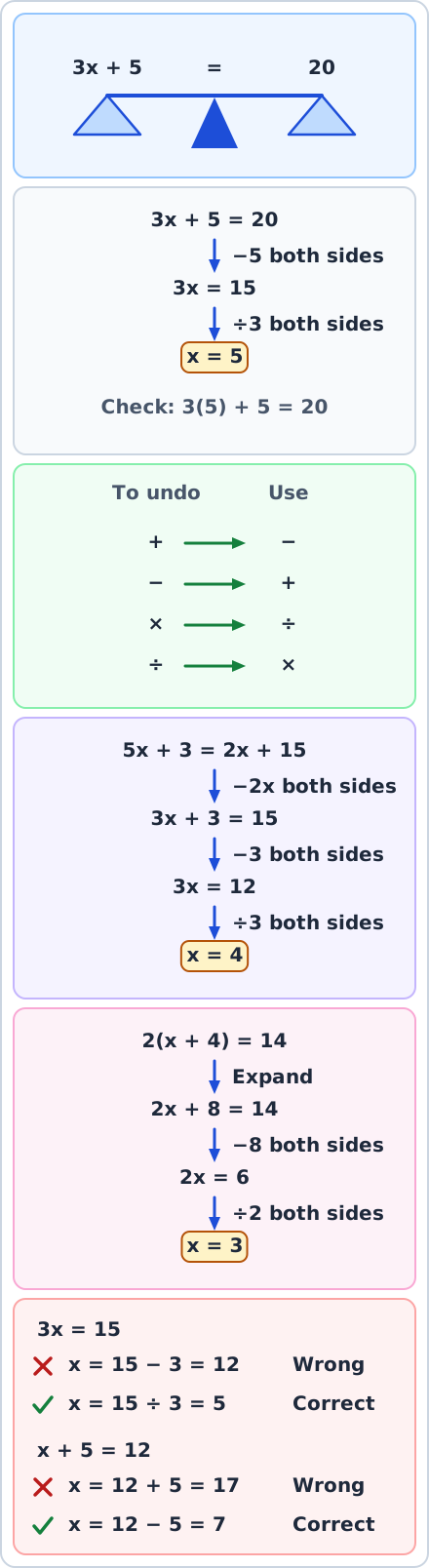
Whatever you do to one side of an equation, you must do to the other. In the last panel, undo a multiplication by dividing and undo an addition by subtracting. Do not subtract 3 from 15 when 3x = 15, and do not add 5 to 12 when x + 5 = 12.
Method: Solving ax + b = c
- Step 1: Deal with the + or - first (inverse operation)
- Step 2: Deal with the × or ÷ (inverse operation)
- Step 3: Check by substituting your answer back in
Inverse operations:
- + and - are inverses
- × and ÷ are inverses
Worked Example 1: Two-Step Equation
Solve: 3x + 7 = 22
Step 1 Subtract 7 from both sides
3x + 7 - 7 = 22 - 7
3x = 15
Step 2 Divide both sides by 3
3x ÷ 3 = 15 ÷ 3
x = 5
Check Substitute back
3(5) + 7 = 15 + 7 = 22 ✓
Answer:
x = 5
Worked Example 2: Unknowns on Both Sides
Solve: 5x - 3 = 2x + 12
Step 1 Get all x terms on one side (subtract 2x from both)
5x - 2x - 3 = 2x - 2x + 12
3x - 3 = 12
Step 2 Add 3 to both sides
3x = 15
Step 3 Divide by 3
x = 5
Answer:
x = 5
Common Mistakes to Avoid
- WRONG: 3x + 7 = 22, so x = 22/3 + 7 (Forgetting to deal with +7 first)
- WRONG: Doing an operation to only ONE side (Must do the same to BOTH sides)
- RIGHT: Always do inverse operations in reverse order of BIDMAS
Make this stick
Signing in gives access to all PrepWise features.