Test yourself on Quadratic Formula with exam style questions, marked instantly.
Flashcards that come back just before you would forget them.
A revision plan that remembers what you know and shows what to do next.
See which topics you have nailed and which need another look.
Quiz yourself on Quadratic FormulaGet your flashcardsBuild my revision planTrack my progressWhen Factorising Fails
Visual: The Discriminant and Number of Solutions
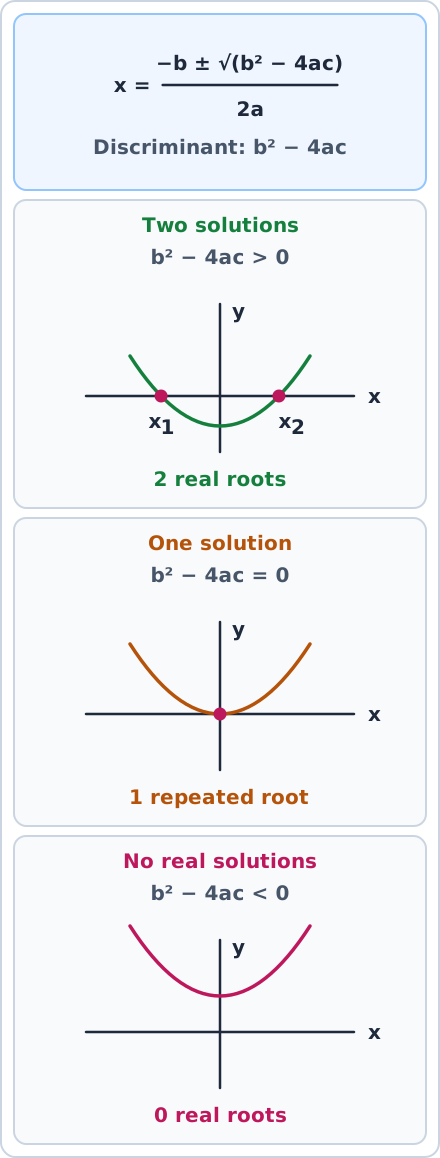
The discriminant b² − 4ac tells you how many solutions there are before you solve: positive means 2, zero means 1, negative means 0.
THE Formula (Printed on the Higher Tier Formula Sheet)
For ax² + bx + c = 0:
x = (-b ± √(b² - 4ac)) / 2a
What each letter means:
- a = coefficient of x² (number in front of x²)
- b = coefficient of x (number in front of x)
- c = constant term (the number on its own)
The ± symbol means you do TWO calculations: once with + and once with -. This gives your two solutions!
Method: Using the Quadratic Formula
Worked Example 1: Clean Numbers
Solve: x² + 5x + 6 = 0 using the quadratic formula
Step 1 Identify a, b, c
a = 1, b = 5, c = 6
Step 2 Calculate b² - 4ac
b² - 4ac = 5² - 4(1)(6)
= 25 - 24 = 1
Step 3 Apply the formula
x = (-5 ± √1) / 2(1)
x = (-5 ± 1) / 2
Step 4 Find both solutions
x = (-5 + 1) / 2 = -4/2 = -2
x = (-5 - 1) / 2 = -6/2 = -3
Worked Example 2: Surd Answer
Solve: x² + 4x - 1 = 0, giving answers in surd form
Step 1 Identify a, b, c
a = 1, b = 4, c = -1
Step 2 Calculate b² - 4ac
b² - 4ac = 4² - 4(1)(-1)
= 16 + 4 = 20
Step 3 Apply the formula
x = (-4 ± √20) / 2
Simplify √20 = √(4×5) = 2√5
x = (-4 ± 2√5) / 2
x = -2 ± √5
The Discriminant: b² - 4ac
This tells you how many solutions exist:
| Value of b² - 4ac | What it means | Type of roots |
|---|---|---|
| Positive (> 0) | Two different real solutions | Graph crosses x-axis twice |
| Zero (= 0) | One repeated solution | Graph touches x-axis once |
| Negative (< 0) | No real solutions | Graph doesn't cross x-axis |
Common Mistakes to Avoid
- WRONG: Forgetting the negative in front of b → writing b instead of -b
- WRONG: Writing -b² instead of (-b)² when b is negative (Use brackets!)
- WRONG: Forgetting to divide the WHOLE top by 2a
- RIGHT: Calculate b² - 4ac separately first, then substitute
Make this stick
Signing in gives access to all PrepWise features.