Pearson Edexcel GCSE Mathematics Paper 1Non-calculator (Higher Tier): every question, answered
Pearson Edexcel GCSE Mathematics (1MA1) Higher Tier Paper 1 is the non-calculator paper. We analysed every sitting we could obtain the real question paper and mark scheme for: June 2019, June 2022 and June 2023 (June 2018 could not be located in Pearson's public archive, and June 2020 and June 2021 do not exist as normal exam sittings, since GCSE exams were cancelled in both years because of the pandemic). Unlike a science paper with a handful of long discursive questions, a maths paper is around 20 to 24 short questions worth 1 to 7 marks each, covering a huge spread of separate skills. Below is what each recurring skill has actually asked across the three sittings we have, with a complete worked answer written to the mark scheme for each one, every paragraph explained.
Questions © Pearson Education Ltd, quoted for analysis. Diagrams and figures described or recreated in our own words, not reproduced verbatim. Mark scheme content translated into plain English, not copied. PrepWise is independent and not endorsed by Pearson or Edexcel.
The paper is a template
Same 17 question types, every sitting“Two of the three sittings we have full papers for test the laws of indices directly, and June 2023 tests it twice in the same paper, once with numbers and once with algebra.”
Every version rewards the same underlying rule, that a negative index means reciprocal and a fractional index means root then power, whether the question uses plain numbers or letters.
1×asked“Given that 2.3 to the power 6 equals 148 correct to 3 significant figures, find the value of 0.23 to the power 6 correct to 3 significant figures. Then find the value of 5 to the power negative 2.”
“Given that 2.3 to the power 6 equals 148 correct to 3 significant figures, find the value of 0.23 to the power 6 correct to 3 significant figures. Then find the value of 5 to the power negative 2.”
What it’s really asking
Spot that 0.23 is 2.3 divided by 10, so its sixth power is the given fact divided by 10 to the power 6, then apply the negative index rule to 5 to the power negative 2 separately.
The full worked answer — June 2019
Since 0.23 equals 2.3 divided by 10, 0.23 to the power 6 equals (2.3 to the power 6) divided by (10 to the power 6), which is 148 divided by 1000000, giving 0.000148.
5 to the power negative 2 means 1 divided by 5 squared, which is 1 divided by 25, so the value is 1 over 25, or 0.04.
Could you have written this? Every fact in this answer is drilled in our quizzes — the writing is the easy part once the evidence is automatic.
Practise index laws questionsWhat the mark scheme rewarded
- 0.000148 or an equivalent value written in standard form (1 mark)
- 1 over 25 or 0.04 for 5 to the power negative 2 (1 mark)
- Spot the scaling relationship between 0.23 and 2.3 rather than raising 0.23 to the power 6 from scratch without a calculator
- Convert any negative index into a reciprocal before evaluating, since 5 to the power negative 2 is not negative 25
Traps examiners saw
- Losing track of how many powers of 10 to divide by, giving an answer with the wrong number of zeros
- Reading a negative index as making the value negative, rather than as a reciprocal
Full-mark self-check 0 of 3
1×asked“(a) Write 1 over 16 in the form 4 to the power n, where n is an integer. (b) Work out the value of 8 to the power five thirds minus 9 to the power three halves.”
“(a) Write 1 over 16 in the form 4 to the power n, where n is an integer. (b) Work out the value of 8 to the power five thirds minus 9 to the power three halves.”
What it’s really asking
Recognise 1/16 as 4 to a negative power, then evaluate each fractional index by taking the root first and the power second before subtracting.
The full worked answer — June 2023
1 over 16 equals 1 over 4 squared, which is 4 to the power negative 2, so n equals negative 2.
8 to the power five thirds means the cube root of 8, raised to the power 5: the cube root of 8 is 2, and 2 to the power 5 is 32. 9 to the power three halves means the square root of 9, raised to the power 3: the square root of 9 is 3, and 3 cubed is 27.
32 minus 27 equals 5.
Could you have written this? Every fact in this answer is drilled in our quizzes — the writing is the easy part once the evidence is automatic.
Practise index laws questionsWhat the mark scheme rewarded
- n equals negative 2 (1 mark)
- 8 to the power five thirds correctly evaluated as 32, using the cube root then the power (up to 2 marks)
- The final value, 5, from 32 minus 27 (1 mark)
- Take the root indicated by the denominator of the fractional index first, then apply the power on top, since rooting first keeps the numbers small
- Convert a unit fraction like 1/16 into a single negative power by first spotting it as 1 over a power of the base
Traps examiners saw
- Raising 8 to the power 5 before taking the cube root, producing an unmanageable number instead of the small, correct one
- Writing n as positive 2 instead of negative 2, since 4 to the power 2 is 16, not 1/16
Full-mark self-check 0 of 3
1×asked“Write (6x to the power 5, y cubed, all squared) divided by (3x squared y to the power 7 times 4xy to the power negative 3), in the form a x to the power b, y to the power c, where a, b and c are integers.”
“Write (6x to the power 5, y cubed, all squared) divided by (3x squared y to the power 7 times 4xy to the power negative 3), in the form a x to the power b, y to the power c, where a, b and c are integers.”
What it’s really asking
Expand the squared bracket first, then divide the x-powers and y-powers separately from the numbers.
The full worked answer — June 2023
Squaring the bracket on top, (6x to the power 5, y cubed) squared equals 36, x to the power 10, y to the power 6, since each factor inside the bracket is squared separately.
Multiplying the two brackets on the bottom, 3x squared y to the power 7 times 4xy to the power negative 3 equals 12, x cubed, y to the power 4, combining the numbers and adding the matching powers.
Dividing 36 x to the power 10 y to the power 6 by 12 x cubed y to the power 4 gives 3 x to the power 7 y squared, dividing the numbers and subtracting the powers of each letter separately.
Could you have written this? Every fact in this answer is drilled in our quizzes — the writing is the easy part once the evidence is automatic.
Practise index laws questionsWhat the mark scheme rewarded
- Correct full evaluation of either the numerator or the denominator, such as 36x to the power 10 y to the power 6, or 12x cubed y to the power 4 (up to 2 marks)
- The fully correct simplified expression, 3x to the power 7 y squared (1 mark)
- Square every factor inside a bracket, the number and both letters, not just the letters
- Combine the two factors on the bottom into one single term before dividing top by bottom
Traps examiners saw
- Forgetting to square the 6 in the numerator's bracket, only squaring the letters
- Adding the powers on the bottom instead of multiplying the numbers, or subtracting the wrong way round when dividing
Full-mark self-check 0 of 3
The method for every Q8b-c (Jun19) / Q11, Q14 (Jun23) — same every sittingMark bands, steps, timing
What this question type rewards
The topic changes by sitting — the mark scheme never does. Learn this once, then open your question above for that sitting’s sources and a full worked answer.
- Recognising that a negative index means take the reciprocal of the positive power
- Recognising that a fractional index m over n means take the nth root, then raise to the power m
- Applying the multiplication and division index laws correctly to algebraic terms, including their coefficients
The steps
- Rewrite any negative index as a reciprocal, or any fractional index as a root and a power
- Evaluate the root first then the power, since the numbers are usually smaller that way round
- For algebraic terms, deal with the numbers, the x-powers and the y-powers separately
- Check the final answer matches the exact form the question asks for
Which of these is equivalent to a³ × a⁵?
Laws of indices questions come up in two of the three sittings we have, and June 2023 tests it twice. Practise negative and fractional indices until converting them is instant.
Practise index laws questions“Two of the three sittings we have full papers for open with a pure non-calculator arithmetic question, and June 2023 tests it twice in the first two questions of the paper.”
Every version rewards converting to a common form first, whether that is improper fractions or a clear decimal method, before combining the values.
1×asked“Work out 3 and one half multiplied by 1 and three fifths. Give your answer as a mixed number in its simplest form.”
“Work out 3 and one half multiplied by 1 and three fifths. Give your answer as a mixed number in its simplest form.”
What it’s really asking
Convert both mixed numbers to improper fractions, multiply them, then convert the result back to a mixed number.
The full worked answer — June 2019
Converting to improper fractions, 3 and one half equals seven over two, and 1 and three fifths equals eight over five.
Multiplying the two improper fractions, seven over two times eight over five equals fifty six over ten, which simplifies to twenty eight over five.
Twenty eight over five equals 5 and three fifths as a mixed number, since twenty eight divided by five is 5 remainder 3.
Could you have written this? Every fact in this answer is drilled in our quizzes — the writing is the easy part once the evidence is automatic.
Practise non-calculator arithmetic questionsWhat the mark scheme rewarded
- Writing at least one mixed number correctly as an improper fraction, such as seven over two or eight over five (1 mark)
- Multiplying the improper fractions correctly, such as fifty six over ten or 5 and three fifths seen unsimplified (1 mark)
- The fully simplified mixed number, 5 and three fifths (1 mark)
- Always convert a mixed number to an improper fraction before multiplying, never multiply the whole number parts and fraction parts separately
- Simplify the final fraction before converting back to a mixed number
Traps examiners saw
- Multiplying the whole number parts and the fraction parts of each mixed number separately, which does not give the correct product
- Leaving the answer as an unsimplified improper or mixed fraction when the question asks for simplest form
Full-mark self-check 0 of 3
1×asked“Work out 8.46 divided by 0.15”
“Work out 8.46 divided by 0.15”
What it’s really asking
Scale both numbers by the same power of 10 to remove the decimal points, then divide as whole numbers.
The full worked answer — June 2023
Multiplying both 8.46 and 0.15 by 100 turns the calculation into 846 divided by 15, since scaling both numbers by the same amount does not change the answer.
846 divided by 15 gives 56 remainder 6, since 15 times 56 equals 840.
The remainder 6 out of 15 equals 0.4, so the full answer is 56.4.
Could you have written this? Every fact in this answer is drilled in our quizzes — the writing is the easy part once the evidence is automatic.
Practise non-calculator arithmetic questionsWhat the mark scheme rewarded
- A correct method that removes the decimal points, such as 846 divided by 15, leading to a first correct digit of 5 (1 mark)
- The digits 564 correctly identified from the division (1 mark)
- The decimal point placed correctly in the final answer, 56.4 (1 mark)
- Multiply both numbers in a division by the same power of 10 to clear the decimals before dividing
- Keep track of exactly how many places the decimal point moves so it can be placed correctly at the end
Traps examiners saw
- Multiplying only one of the two numbers by 100, which changes the value of the calculation
- Losing track of the decimal point and writing 5.64 or 564 instead of 56.4
Full-mark self-check 0 of 3
1×asked“Work out 7 and three eighths minus 2 and one half. Give your answer as a mixed number.”
“Work out 7 and three eighths minus 2 and one half. Give your answer as a mixed number.”
What it’s really asking
Convert both mixed numbers to a common denominator, then subtract.
The full worked answer — June 2023
Converting both mixed numbers to improper fractions, 7 and three eighths equals fifty nine over eight, and 2 and one half equals twenty over eight.
Subtracting the two improper fractions, fifty nine over eight minus twenty over eight equals thirty nine over eight.
Thirty nine over eight equals 4 and seven eighths as a mixed number, since thirty nine divided by eight is 4 remainder 7.
Could you have written this? Every fact in this answer is drilled in our quizzes — the writing is the easy part once the evidence is automatic.
Practise non-calculator arithmetic questionsWhat the mark scheme rewarded
- Both mixed numbers converted to a common denominator, with at least one correct improper fraction (1 mark for the method, up to 2 marks overall for the full subtraction)
- The correct final mixed number, 4 and seven eighths (1 mark)
- Convert both mixed numbers to a common denominator before subtracting, rather than subtracting the whole numbers and fractions separately when borrowing is needed
- Convert the final improper fraction back into a mixed number, since the question specifically asks for that form
Traps examiners saw
- Subtracting three eighths minus four eighths directly and getting a negative fraction without borrowing correctly from the whole number
- Leaving the answer as an improper fraction instead of converting to the mixed number the question asks for
Full-mark self-check 0 of 3
The method for every Q9 (Jun19) / Q1, Q2 (Jun23) — same every sittingMark bands, steps, timing
What this question type rewards
The topic changes by sitting — the mark scheme never does. Learn this once, then open your question above for that sitting’s sources and a full worked answer.
- Converting mixed numbers to improper fractions, or working with decimals directly, before combining them
- Using a non-calculator method that keeps every step of working visible
- Simplifying or converting the final answer into the exact form the question asks for
The steps
- Convert any mixed number into an improper fraction, or line up any decimal calculation clearly
- Multiply, divide, add or subtract using a reliable non-calculator method
- Simplify the result, or convert it back to a mixed number if that is what is asked for
- Check the final answer against the form the question specifically requests
Which of these fractions is the largest? ⅔ ¾ ⅗ ⅝
Pure non-calculator arithmetic with fractions and decimals opens the paper in two of the three sittings we have. Practise these methods until they are automatic, since they set the tone for the rest of the paper.
Practise non-calculator arithmetic questions“All three sittings we have full papers for build a ratio question around a real-life context, each combining the ratio with an extra fact before the final quantity can be found.”
Every version needs the ratio parts combined with a second piece of information, a total, a fraction, or another ratio, before the specific quantity asked for can be isolated.
1×asked“A shop sells packs of black pens with 2 pens in each pack, packs of red pens with 5 pens in each pack, and packs of green pens with 6 pens in each pack. On Monday, the number of packs of black pens sold, the number of packs of red pens sold and the number of packs of green pens sold were in the ratio 7 : 3 : 4. A total of 212 pens were sold that day. Work out the number of green pens sold.”
“A shop sells packs of black pens with 2 pens in each pack, packs of red pens with 5 pens in each pack, and packs of green pens with 6 pens in each pack. On Monday, the number of packs of black pens sold, the number of packs of red pens sold and the number of packs of green pens sold were in the ratio 7 : 3 : 4. A total of 212 pens were sold that day. Work out the number of green pens sold.”
What it’s really asking
Turn the ratio of packs sold into a ratio of pens sold, then share 212 pens in that ratio.
The full worked answer — June 2019
Since the packs were sold in the ratio 7 : 3 : 4 and each pack contains 2, 5 and 6 pens, the number of pens sold is in the ratio (2 times 7) : (5 times 3) : (6 times 4), which is 14 : 15 : 24.
Adding the parts of this pen ratio, 14 plus 15 plus 24 equals 53 parts in total, and 212 pens divided by 53 parts gives 4 pens per part.
The green pens make up 24 parts, so the number of green pens sold is 24 times 4, which equals 96.
Could you have written this? Every fact in this answer is drilled in our quizzes — the writing is the easy part once the evidence is automatic.
Practise ratio problem questionsWhat the mark scheme rewarded
- The ratio of packs correctly converted into a ratio of pens, 14 : 15 : 24 (1 mark)
- The correct proportion set up to find the value of one part, using the total of 212 pens (1 mark)
- A complete method reaching the number of green pens (1 mark)
- The correct final answer, 96 (1 mark)
- Convert a ratio of packs into a ratio of the actual items inside them before using a total that counts the items, not the packs
- Add all the parts of the ratio together first to find what one part is worth
Traps examiners saw
- Sharing the 212 pens using the original pack ratio, 7 : 3 : 4, instead of converting it to the pen ratio, 14 : 15 : 24, first
- Finding the value of one part correctly but then multiplying by the wrong number of parts for green
Full-mark self-check 0 of 3
1×asked“A delivery company has a total of 160 cars and vans, with the number of cars to the number of vans in the ratio 3 : 7. Each car and each van uses electricity, diesel or petrol. One eighth of the cars use electricity. 25% of the cars use diesel. The rest of the cars use petrol. Work out the number of cars that use petrol. You must show all your working.”
“A delivery company has a total of 160 cars and vans, with the number of cars to the number of vans in the ratio 3 : 7. Each car and each van uses electricity, diesel or petrol. One eighth of the cars use electricity. 25% of the cars use diesel. The rest of the cars use petrol. Work out the number of cars that use petrol. You must show all your working.”
What it’s really asking
Find the number of cars from the ratio first, then take away the electricity and diesel shares to leave the petrol cars.
The full worked answer — June 2022
Sharing 160 vehicles in the ratio 3 : 7 gives 160 divided by 10 equals 16 per part, so the number of cars is 3 times 16, which equals 48.
One eighth of the 48 cars use electricity, which is 6 cars, and 25% of the 48 cars use diesel, which is 12 cars.
The remaining petrol cars are the 48 cars minus the 6 that use electricity minus the 12 that use diesel, which is 48 minus 6 minus 12, equals 30.
Could you have written this? Every fact in this answer is drilled in our quizzes — the writing is the easy part once the evidence is automatic.
Practise ratio problem questionsWhat the mark scheme rewarded
- The total number of cars correctly found from the ratio, 48 (1 mark)
- The number of electricity cars or diesel cars correctly found (1 mark each, up to 2 marks)
- A complete process to find the petrol cars by subtracting both other groups from the total (1 mark)
- The correct final answer, 30, with no marks awarded for a correct answer with no supportive working shown (1 mark)
- Find the number of cars from the vehicle ratio before applying any fraction or percentage, since those apply to cars only, not the combined total of cars and vans
- Show every stage of working clearly, since this question specifically requires it and an unsupported correct answer scores no marks
Traps examiners saw
- Applying the fraction or percentage to the total of 160 vehicles instead of the 48 cars
- Forgetting to subtract both the electricity and diesel cars, only removing one of the two groups
Full-mark self-check 0 of 4
1×asked“7 kg of carrots and 5 kg of tomatoes cost a total of 480 pence. The cost of 1 kg of carrots to the cost of 1 kg of tomatoes is in the ratio 5 : 9. Work out the cost of 1 kg of carrots and the cost of 1 kg of tomatoes.”
“7 kg of carrots and 5 kg of tomatoes cost a total of 480 pence. The cost of 1 kg of carrots to the cost of 1 kg of tomatoes is in the ratio 5 : 9. Work out the cost of 1 kg of carrots and the cost of 1 kg of tomatoes.”
What it’s really asking
Write the two unit costs in terms of the ratio, form an equation using the total cost, then solve for the value of one ratio part.
The full worked answer — June 2023
Since the cost per kilogram is in the ratio 5 : 9, let the cost of 1 kg of carrots be 5m pence and the cost of 1 kg of tomatoes be 9m pence, for some value m.
The total cost equation is 7 times 5m plus 5 times 9m equals 480, which simplifies to 35m plus 45m equals 480, or 80m equals 480, giving m equals 6.
The cost of 1 kg of carrots is 5 times 6, which equals 30 pence, and the cost of 1 kg of tomatoes is 9 times 6, which equals 54 pence.
Could you have written this? Every fact in this answer is drilled in our quizzes — the writing is the easy part once the evidence is automatic.
Practise ratio problem questionsWhat the mark scheme rewarded
- Setting up an equation using both the ratio and the total cost, such as 7(5m) plus 5(9m) equals 480 (1 mark)
- A process to eliminate m from the correct equation, such as combining to 80m equals 480 (1 mark)
- A process to isolate m, or find one of the two costs directly (1 mark)
- Both correct final costs, 30 pence for carrots and 54 pence for tomatoes (1 mark)
- Use a single unknown, m, to represent the value of one part of the ratio, so both unit costs can be written and combined algebraically
- Substitute the value of m back into both expressions to find both unit costs, since the question asks for both
Traps examiners saw
- Setting up the total cost equation using the wrong quantities, such as swapping which weight goes with which ratio part
- Finding the value of m correctly but then forgetting to find both final costs, stopping after only one
Full-mark self-check 0 of 3
The method for every Q6 (Jun19) / Q3 (Jun22) / Q18 (Jun23) — same every sittingMark bands, steps, timing
What this question type rewards
The topic changes by sitting — the mark scheme never does. Learn this once, then open your question above for that sitting’s sources and a full worked answer.
- Combining the given ratio correctly with the extra information in the question, rather than using either fact alone
- Finding the value of one share, or the total number of shares, before scaling up to the specific quantity asked for
- Carrying out every stage of a multi-step problem in the right order
The steps
- Identify every piece of information given: the ratio, and any total, fraction or percentage alongside it
- Combine them to find the value of one share, or the total number of shares
- Scale up to find the specific quantity the question actually asks for
- Check the final answer against the original context, such as the total given
A recipe uses flour and sugar in the ratio 5:2. What fraction of the mixture is flour?
Multi-stage ratio problems set in a real-life context come up in all three sittings we have. Practise combining a ratio with a total, a fraction or a percentage until the extra step feels automatic.
Practise ratio problem questions“Two of the three sittings we have full papers for combine a ratio of items with a probability fact to find an unknown count, either after items are added to the group or as a direct algebraic ratio.”
Every version needs the probability turned into a ratio of counts before an equation can be formed and solved.
1×asked“There are only r red counters and g green counters in a bag. A counter is taken at random from the bag. The probability that the counter is green is three sevenths. The counter is put back in the bag. Then 2 more red counters and 3 more green counters are put in the bag. A counter is taken at random from the bag. The probability that the counter is green is now six thirteenths. Find the number of red counters and the number of green counters that were in the bag originally.”
“There are only r red counters and g green counters in a bag. A counter is taken at random from the bag. The probability that the counter is green is three sevenths. The counter is put back in the bag. Then 2 more red counters and 3 more green counters are put in the bag. A counter is taken at random from the bag. The probability that the counter is green is now six thirteenths. Find the number of red counters and the number of green counters that were in the bag originally.”
What it’s really asking
Turn each probability into an equation linking r and g, before and after the counters are added, then solve the two equations together.
The full worked answer — June 2019
The first probability gives g over (r plus g) equals three sevenths, which rearranges to 7g equals 3r plus 3g, or 4g equals 3r.
After the counters are added, the second probability gives (g plus 3) over (r plus g plus 5) equals six thirteenths, which rearranges to 13g plus 39 equals 6r plus 6g plus 30, or 7g plus 9 equals 6r.
Substituting r equals four thirds g from the first equation into the second gives 7g plus 9 equals 6 times four thirds g, which is 8g, so 9 equals g.
Since 4g equals 3r, r equals 4 times 9 divided by 3, which is 12, so there were originally 12 red counters and 9 green counters.
Could you have written this? Every fact in this answer is drilled in our quizzes — the writing is the easy part once the evidence is automatic.
Practise ratio and probability questionsWhat the mark scheme rewarded
- A correct relationship between r and g from the first probability, such as 4g equals 3r (1 mark)
- A correct relationship between r and g from the second probability, after the counters are added (1 mark)
- A process to start solving the pair of equations, such as eliminating one variable (1 mark)
- A complete process to solve for g or r (1 mark)
- Both correct final counts, 12 red and 9 green (1 mark)
- Write out both probability facts as separate equations in r and g before trying to solve anything, since there are two unknowns
- Remember the total changes to r plus g plus 5 after the counters are added, not just g plus 3
Traps examiners saw
- Forgetting that the total also increases by 5 when the extra counters are added, only changing the green count
- Solving only one of the two equations and guessing the other value, rather than solving them together
Full-mark self-check 0 of 3
1×asked“Cormac has some sweets in a bag. The sweets are lime flavoured, strawberry flavoured or orange flavoured, in the ratio 9 : 4 : x. Cormac is going to take a sweet at random from the bag. The probability that he takes a lime flavoured sweet is three sevenths. Work out the value of x.”
“Cormac has some sweets in a bag. The sweets are lime flavoured, strawberry flavoured or orange flavoured, in the ratio 9 : 4 : x. Cormac is going to take a sweet at random from the bag. The probability that he takes a lime flavoured sweet is three sevenths. Work out the value of x.”
What it’s really asking
Write the probability of lime as 9 over the total number of ratio parts, then solve for x.
The full worked answer — June 2022
The probability of lime is 9 over (9 plus 4 plus x), which is 9 over (13 plus x), and this equals three sevenths.
Cross multiplying, 9 times 7 equals 3 times (13 plus x), which is 63 equals 39 plus 3x.
Subtracting 39 from both sides gives 3x equals 24, so x equals 8.
Could you have written this? Every fact in this answer is drilled in our quizzes — the writing is the easy part once the evidence is automatic.
Practise ratio and probability questionsWhat the mark scheme rewarded
- A correct fraction for the probability of lime in terms of x, such as 9 over (13 plus x) (1 mark)
- A correct equation formed without fractions, such as 63 equals 39 plus 3x (1 mark)
- The correct value, x equals 8 (1 mark)
- Add all three parts of the ratio together to find the total number of parts before writing the probability as a fraction
- Clear the fraction by cross multiplying rather than trying to solve it with a fraction still in place
Traps examiners saw
- Writing the total number of parts as 9 plus 4, forgetting to include x
- Setting the probability equal to nine over thirteen instead of nine over thirteen plus x
Full-mark self-check 0 of 3
The method for every Q22 (Jun19) / Q11 (Jun22) — same every sittingMark bands, steps, timing
What this question type rewards
The topic changes by sitting — the mark scheme never does. Learn this once, then open your question above for that sitting’s sources and a full worked answer.
- Turning a probability into a ratio of the item asked for compared with the total
- Forming a correct equation from the probability, either before or after a change to the numbers
- Solving the resulting equation, or pair of equations, for the unknown count or counts
The steps
- Write each given probability as a fraction of the item asked for over the total
- Form an equation from each probability fact given, including any change described in the question
- Solve the equation, or eliminate between two equations if there are two unknowns
- Check the final answer satisfies every probability fact given in the question
A recipe uses flour and sugar in the ratio 5:2. What fraction of the mixture is flour?
Combining a ratio with a probability fact comes up in two of the three sittings we have. Practise turning a probability straight into a ratio of counts.
Practise ratio and probability questions“All three sittings we have full papers for test proportion directly, and two of the three combine a direct and an inverse relationship into a single formula.”
Every version needs the constant of proportionality found from a pair of matching values before the final formula or value can be reached.
1×asked“h is inversely proportional to p. p is directly proportional to the square root of t. Given that h = 10 and t = 144 when p = 6, find a formula for h in terms of t.”
“h is inversely proportional to p. p is directly proportional to the square root of t. Given that h = 10 and t = 144 when p = 6, find a formula for h in terms of t.”
What it’s really asking
Find the constant for each proportionality statement separately, then combine them into a single formula linking h and t.
The full worked answer — June 2019
Since h is inversely proportional to p, h equals k over p for some constant k. Substituting h equals 10 and p equals 6 gives k equals 60, so h equals 60 over p.
Since p is directly proportional to the square root of t, p equals K times the square root of t for some constant K. Substituting p equals 6 and t equals 144 gives 6 equals K times 12, since the square root of 144 is 12, so K equals 0.5, and p equals 0.5 times the square root of t.
Substituting this expression for p into h equals 60 over p gives h equals 60 over (0.5 times the square root of t), which simplifies to h equals 120 over the square root of t.
Could you have written this? Every fact in this answer is drilled in our quizzes — the writing is the easy part once the evidence is automatic.
Practise proportion questionsWhat the mark scheme rewarded
- A correct proportionality statement between h and p, such as h equals k over p (1 mark)
- A correct process to substitute values into at least one relationship, finding a constant (1 mark)
- A full process combining both relationships, using the constants found (1 mark)
- The final formula, h equals 120 over the square root of t (1 mark)
- Give each proportionality relationship its own constant before substituting anything, since mixing up k and K leads to an incorrect combined formula
- Substitute the second relationship into the first, so the final formula only contains h and t, with p eliminated
Traps examiners saw
- Treating p as directly proportional to t itself rather than to the square root of t, missing the root entirely
- Combining the two relationships before finding either constant, which loses track of what each constant represents
Full-mark self-check 0 of 3
1×asked“y is directly proportional to the square root of t. y = 15 when t = 9. t is inversely proportional to the cube of x. t = 8 when x = 2. Find a formula for y in terms of x. Give your answer in its simplest form.”
“y is directly proportional to the square root of t. y = 15 when t = 9. t is inversely proportional to the cube of x. t = 8 when x = 2. Find a formula for y in terms of x. Give your answer in its simplest form.”
What it’s really asking
Find each constant of proportionality in turn, then substitute the expression for t into the expression for y.
The full worked answer — June 2022
Since y is directly proportional to the square root of t, y equals k times the square root of t. Substituting y equals 15 and t equals 9 gives 15 equals k times 3, so k equals 5, and y equals 5 times the square root of t.
Since t is inversely proportional to the cube of x, t equals K over x cubed. Substituting t equals 8 and x equals 2 gives 8 equals K over 8, so K equals 64, and t equals 64 over x cubed.
Substituting this into y equals 5 times the square root of t gives y equals 5 times the square root of (64 over x cubed), which simplifies to y equals 40 over x to the power three halves, since the square root of 64 is 8.
Could you have written this? Every fact in this answer is drilled in our quizzes — the writing is the easy part once the evidence is automatic.
Practise proportion questionsWhat the mark scheme rewarded
- A correct proportionality statement between y and t, with a constant (1 mark)
- A correct process to substitute values into at least one relationship (1 mark)
- A full process combining both relationships, using the constants found (1 mark)
- The final formula, y equals 40 over x to the power three halves, or an equivalent form that includes the 40 (1 mark)
- Keep the two constants of proportionality separate until both are found, then combine the relationships
- Simplify the square root of x cubed carefully, since it becomes x to the power three halves, not x squared or x cubed
Traps examiners saw
- Combining y and x directly without going through t, missing the two-step chain the question sets up
- Simplifying the square root of 64 over x cubed incorrectly, losing track of the power on x
Full-mark self-check 0 of 3
1×asked“y is directly proportional to x. y = 24 when x = 1.5. Work out the value of y when x = 5.”
“y is directly proportional to x. y = 24 when x = 1.5. Work out the value of y when x = 5.”
What it’s really asking
Find the constant of proportionality from the given pair of values, then use it to find y at the new value of x.
The full worked answer — June 2023
Since y is directly proportional to x, y equals k times x. Substituting y equals 24 and x equals 1.5 gives k equals 24 divided by 1.5, which is 16.
Using y equals 16x with x equals 5 gives y equals 16 times 5, which equals 80.
Could you have written this? Every fact in this answer is drilled in our quizzes — the writing is the easy part once the evidence is automatic.
Practise proportion questionsWhat the mark scheme rewarded
- A correct proportionality statement with a constant, such as y equals kx, and a process to find k (1 mark)
- A correct process to substitute the new value of x, such as y equals 16 times 5 (1 mark)
- The correct final value, 80 (1 mark)
- Find the constant of proportionality first from the given pair of values, rather than trying to scale directly between the two x values
Traps examiners saw
- Scaling x and y using a ratio without first finding the constant, which is more error-prone with awkward numbers like 1.5
- Dividing instead of multiplying when finding k, giving 1.5 divided by 24 instead of 24 divided by 1.5
Full-mark self-check 0 of 3
The method for every Q20 (Jun19) / Q17 (Jun22) / Q13 (Jun23) — same every sittingMark bands, steps, timing
What this question type rewards
The topic changes by sitting — the mark scheme never does. Learn this once, then open your question above for that sitting’s sources and a full worked answer.
- Writing each proportionality statement correctly, using k for a direct relationship and k over the variable for an inverse one
- Substituting the given matching values to find each constant of proportionality
- Combining two proportionality statements into a single formula when the question links three variables
The steps
- Write each proportionality statement using a constant, k for direct or k over the variable for inverse
- Substitute the given values to find the value of k for each relationship
- Combine the relationships if there are two, substituting one into the other
- Simplify to reach the formula or value the question actually asks for
Which of the following correctly reads the mathematical statement y ∝ x?
Proportion questions, including combined direct and inverse proportion, come up in all three sittings we have. Practise finding the constant of proportionality confidently before combining two relationships together.
Practise proportion questions“Two of the three sittings we have full papers for test surds directly, once as a short simplification and once as a fuller rationalising question.”
Every version rewards breaking a surd into a square factor and a remaining factor before combining or rationalising.
1×asked“Express the square root of 3 plus the square root of 12 in the form a times the square root of 3, where a is an integer.”
“Express the square root of 3 plus the square root of 12 in the form a times the square root of 3, where a is an integer.”
What it’s really asking
Break the square root of 12 into a square factor times the square root of 3, so it can be combined directly with the square root of 3 already there.
The full worked answer — June 2019
The square root of 12 equals the square root of 4 times 3, which equals 2 times the square root of 3, since 4 is a square factor of 12.
Adding this to the square root of 3 already in the expression gives the square root of 3 plus 2 times the square root of 3, which equals 3 times the square root of 3.
Could you have written this? Every fact in this answer is drilled in our quizzes — the writing is the easy part once the evidence is automatic.
Practise surds questionsWhat the mark scheme rewarded
- Working with the square root of 12 unambiguously, such as writing it as the square root of 4 times the square root of 3, or as 2 times the square root of 3 (1 mark)
- The correct final answer, 3 times the square root of 3, so a equals 3 (1 mark)
- Look for the largest square factor of the number under the root, since that gives the simplest possible surd form in one step
- Combine like surd terms the same way like algebraic terms are combined, adding the numbers in front of a matching root
Traps examiners saw
- Splitting the square root of 12 using a non-square factor, such as 2 times 6, which does not simplify the surd
- Adding the square root of 3 and the square root of 12 as if they were unlike terms, without simplifying the square root of 12 first
Full-mark self-check 0 of 3
1×asked“Write 3 times the square root of 3 over (4 minus the square root of 3), minus 2 over the square root of 3, in the form (a times the square root of 3 plus b) over c, where a, b and c are integers.”
“Write 3 times the square root of 3 over (4 minus the square root of 3), minus 2 over the square root of 3, in the form (a times the square root of 3 plus b) over c, where a, b and c are integers.”
What it’s really asking
Rationalise each fraction separately, then combine them onto a common denominator.
The full worked answer — June 2023
Rationalising the first fraction by multiplying top and bottom by 4 plus the square root of 3 gives (3 times the square root of 3 times (4 plus the square root of 3)) over (16 minus 3), which is (12 times the square root of 3 plus 9) over 13.
Rationalising the second fraction by multiplying top and bottom by the square root of 3 gives 2 times the square root of 3 over 3.
Writing both fractions over a common denominator of 39 and subtracting, the result simplifies to (10 times the square root of 3 plus 27) over 39.
Could you have written this? Every fact in this answer is drilled in our quizzes — the writing is the easy part once the evidence is automatic.
Practise surds questionsWhat the mark scheme rewarded
- Rationalising the first fraction correctly, reaching an expression such as (12 times the square root of 3 plus 9) over 13 (1 mark)
- Rationalising the second fraction correctly, reaching 2 times the square root of 3 over 3 (1 mark)
- Combining both fractions onto a correct common denominator (1 mark)
- The fully simplified final answer, (10 times the square root of 3 plus 27) over 39 (1 mark)
- Rationalise each fraction separately first, using the matching expression for each different denominator, before trying to combine them
- Use 13 times 3, or 39, as the common denominator, since 13 and 3 share no common factor
Traps examiners saw
- Multiplying by the wrong rationalising expression, such as 4 minus the square root of 3 again instead of 4 plus the square root of 3
- Making an arithmetic slip when combining the two fractions onto the common denominator of 39
Full-mark self-check 0 of 3
The method for every Q18a (Jun19) / Q23 (Jun23) — same every sittingMark bands, steps, timing
What this question type rewards
The topic changes by sitting — the mark scheme never does. Learn this once, then open your question above for that sitting’s sources and a full worked answer.
- Splitting a surd into the largest square factor and a remaining factor, so it can be simplified
- Rationalising a denominator by multiplying by an appropriate form of 1, matching the surd expression underneath
- Combining surd terms correctly onto a single common denominator
The steps
- Break any surd into a square factor times a remaining factor, so it can be simplified to a times the square root of b
- For a denominator containing a surd, multiply top and bottom by a matching expression to remove the surd underneath
- Combine any resulting fractions onto a common denominator
- Check the final answer is in the exact form the question asks for
Which of these is the simplified form of √48?
Surds come up in two of the three sittings we have, from a short simplification to a full rationalising question. Practise spotting square factors and rationalising denominators until both are automatic.
Practise surds questions“Two of the three sittings we have full papers for use the perpendicular gradient rule, once to find a tangent to a circle and once to find an unknown constant in a line's equation.”
Every version needs a gradient found first, then the negative reciprocal taken, before the final equation or constant can be reached.
1×asked“The centre of a circle is the point with coordinates (negative 1, 3). The point A with coordinates (6, 8) lies on the circle. Find an equation of the tangent to the circle at A. Give your answer in the form ax + by + c = 0, where a, b and c are integers.”
“The centre of a circle is the point with coordinates (negative 1, 3). The point A with coordinates (6, 8) lies on the circle. Find an equation of the tangent to the circle at A. Give your answer in the form ax + by + c = 0, where a, b and c are integers.”
What it’s really asking
Find the gradient of the radius to A, take its negative reciprocal for the tangent, then form the tangent's equation.
The full worked answer — June 2022
The gradient of the radius from the centre (negative 1, 3) to A (6, 8) is (8 minus 3) over (6 minus negative 1), which is 5 over 7.
Since the tangent at A is perpendicular to this radius, its gradient is the negative reciprocal of 5 over 7, which is negative 7 over 5.
Using the point A (6, 8) and gradient negative 7 over 5 gives y minus 8 equals negative 7 over 5 times (x minus 6), which rearranges to 7x plus 5y minus 82 equals 0.
Could you have written this? Every fact in this answer is drilled in our quizzes — the writing is the easy part once the evidence is automatic.
Practise perpendicular gradient questionsWhat the mark scheme rewarded
- The correct gradient of the radius, 5 over 7 (1 mark)
- Using the fact that perpendicular gradients multiply to negative 1 to find the tangent's gradient (1 mark)
- Substituting the point A and the tangent's gradient into an equation of a line (1 mark)
- The final equation, correctly rearranged into the form ax plus by plus c equals 0 with integer coefficients (1 mark)
- Find the gradient between the centre and the given point first, since the tangent is always perpendicular to the radius at that point
- Rearrange carefully into the exact form asked for, checking every coefficient is an integer
Traps examiners saw
- Using the gradient of the radius itself for the tangent, forgetting that a tangent is perpendicular to the radius, not parallel to it
- Making a sign error when taking the negative reciprocal, giving 7 over 5 instead of negative 7 over 5
Full-mark self-check 0 of 3
1×asked“The equation of line L1 is y = 2x minus 5. The equation of line L2 is 6y + kx minus 12 = 0. L1 is perpendicular to L2. Find the value of k. You must show all your working.”
“The equation of line L1 is y = 2x minus 5. The equation of line L2 is 6y + kx minus 12 = 0. L1 is perpendicular to L2. Find the value of k. You must show all your working.”
What it’s really asking
Find the gradient of L2 in terms of k, then use the fact that it must be the negative reciprocal of L1's gradient.
The full worked answer — June 2023
Rearranging L2 into the form y equals mx plus c gives 6y equals 12 minus kx, so y equals 2 minus (k over 6) times x, meaning L2 has gradient negative k over 6.
Since L1 has gradient 2 and the two lines are perpendicular, their gradients multiply to negative 1, so 2 times (negative k over 6) equals negative 1.
This simplifies to negative k over 3 equals negative 1, so k equals 3.
Could you have written this? Every fact in this answer is drilled in our quizzes — the writing is the easy part once the evidence is automatic.
Practise perpendicular gradient questionsWhat the mark scheme rewarded
- L2 correctly rearranged to find its gradient in terms of k (1 mark)
- The perpendicular gradient condition correctly set up, using L1's gradient of 2 (1 mark)
- The correct final value, k equals 3 (1 mark)
- Rearrange L2 into y equals mx plus c form first, so its gradient can be read off directly in terms of k
- Use the rule that perpendicular gradients multiply to give negative 1, not that they are equal or add to a fixed value
Traps examiners saw
- Reading the gradient of L2 straight from the equation without rearranging it first, missing the division by 6
- Setting the two gradients equal to each other, as if the lines were parallel rather than perpendicular
Full-mark self-check 0 of 3
The method for every Q20 (Jun22) / Q15 (Jun23) — same every sittingMark bands, steps, timing
What this question type rewards
The topic changes by sitting — the mark scheme never does. Learn this once, then open your question above for that sitting’s sources and a full worked answer.
- Finding the gradient of a given line or a line joining two given points
- Using the fact that two perpendicular lines have gradients whose product is negative 1
- Forming and simplifying the equation of a line, or solving for an unknown constant within one
The steps
- Find the gradient of any line already given, either from its equation or from two known points
- Take the negative reciprocal of that gradient for the perpendicular line
- Use a known point and the perpendicular gradient to form the equation of the line, or to solve for an unknown constant
- Rearrange into the exact form the question asks for
Which of the following is true about two parallel straight lines?
Perpendicular gradients come up in two of the three sittings we have, both times used to reach a full linear equation. Practise the negative reciprocal rule until it is instant.
Practise perpendicular gradient questions“All three sittings we have full papers for test volume or surface area of a 3D shape, and June 2023 tests it twice, once each way round.”
Every version needs the correct formula for each part of the solid, applied with the correct radius or side length, before the parts can be combined.
1×asked“The diagram shows a solid shape made from a cone on top of a hemisphere. The height of the cone is 10 cm. The base of the cone has a diameter of 6 cm. The hemisphere also has a diameter of 6 cm. The total volume of the shape is k times pi cm cubed, where k is an integer. Work out the value of k.”
“The diagram shows a solid shape made from a cone on top of a hemisphere. The height of the cone is 10 cm. The base of the cone has a diameter of 6 cm. The hemisphere also has a diameter of 6 cm. The total volume of the shape is k times pi cm cubed, where k is an integer. Work out the value of k.”
What it’s really asking
Find the volume of the cone and the volume of the hemisphere separately using the shared radius, then add them together.
What the sources actually showed — June 2019
A solid formed from a cone of height 10 cm sitting on top of a hemisphere, where both the cone's base and the hemisphere share the same diameter of 6 cm. The formulae for the volume of a cone and the volume of a sphere are given alongside the diagram.
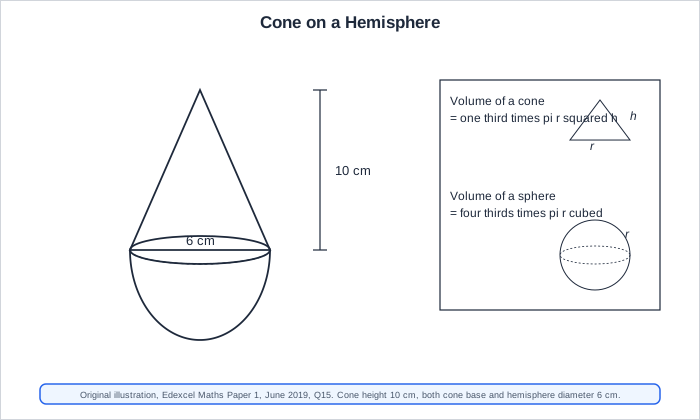
The full worked answer — June 2019
Both the cone and the hemisphere share a radius of 3 cm, since the diameter given for each is 6 cm.
The volume of the cone is one third times pi times 3 squared times 10, which equals 30 pi cm cubed.
The volume of the hemisphere is half of four thirds times pi times 3 cubed, which equals 18 pi cm cubed.
Adding the two volumes together, 30 pi plus 18 pi equals 48 pi cm cubed, so k equals 48.
Could you have written this? Every fact in this answer is drilled in our quizzes — the writing is the easy part once the evidence is automatic.
Practise 3D shape questionsWhat the mark scheme rewarded
- A correct substitution into the volume formula for the cone or the hemisphere, using radius 3 (1 mark for each, up to 2 marks)
- A correct partial simplification of at least one volume, such as 30 pi or 18 pi (1 mark)
- The correct final value, k equals 48 (1 mark)
- Halve the diameter to get the radius before substituting into either formula, since both formulae use radius, not diameter
- Remember the hemisphere is exactly half the volume of a full sphere with the same radius
Traps examiners saw
- Substituting the diameter, 6, directly into the volume formulae instead of the radius, 3
- Using the full sphere volume formula without halving it for the hemisphere
Full-mark self-check 0 of 3
1×asked“A cube is placed on top of a cuboid to form a solid, as shown in the diagram. The cube has edges of length 4 cm. The cuboid has dimensions 7 cm by 6 cm by 5 cm. Work out the total surface area of the solid.”
“A cube is placed on top of a cuboid to form a solid, as shown in the diagram. The cube has edges of length 4 cm. The cuboid has dimensions 7 cm by 6 cm by 5 cm. Work out the total surface area of the solid.”
What it’s really asking
Find every face area of the cuboid, then work out which faces disappear or reduce where the cube sits on top before adding the cube's own exposed faces.
What the sources actually showed — June 2022
A solid formed from a cube of edge 4 cm sitting centrally on top of a cuboid measuring 7 cm by 6 cm by 5 cm.
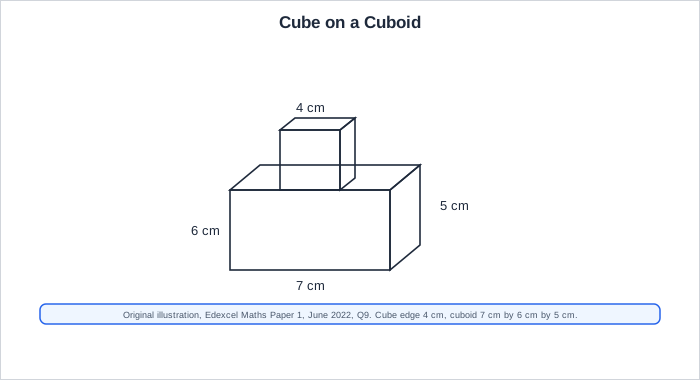
The full worked answer — June 2022
The cuboid has three pairs of matching faces: two faces of 7 times 6 equals 42, two faces of 7 times 5 equals 35, and two faces of 6 times 5 equals 30.
The cube's base, 4 times 4 equals 16, sits inside the cuboid's top face, so only the remaining part of the top face, 42 minus 16, is still exposed.
The total surface area is the four side faces of the cuboid (35 times 2 plus 30 times 2), plus the cuboid's full bottom face (42), plus its exposed top (42 minus 16), plus the cube's own 5 exposed faces, 4 sides and a top (16 times 5): 70 plus 60 plus 42 plus 26 plus 80, which equals 278 cm squared.
Could you have written this? Every fact in this answer is drilled in our quizzes — the writing is the easy part once the evidence is automatic.
Practise 3D shape questionsWhat the mark scheme rewarded
- At least 3 of the individual face areas correctly found, such as 35, 30 and 16 (1 mark)
- A complete process combining every exposed face of both solids, correctly accounting for the hidden cube base and covered part of the cuboid's top (1 mark)
- The correct final answer, 278 cm squared (1 mark)
- Picture the net of each solid separately, then work out which faces disappear where the cube meets the cuboid
- The cuboid's top face loses exactly the cube's base area, 16, since that part is now inside the solid, not on its surface
Traps examiners saw
- Adding the full surface area of the cube and the full surface area of the cuboid without removing the two hidden faces where they join
- Forgetting the cube's own top face is still exposed, only removing its base
Full-mark self-check 0 of 3
1×asked“A cube has a total surface area of 150 cm squared. Work out the volume of the cube.”
“A cube has a total surface area of 150 cm squared. Work out the volume of the cube.”
What it’s really asking
Find the area of one face first, then the side length, before cubing it for the volume.
The full worked answer — June 2023
A cube has 6 identical faces, so one face has area 150 divided by 6, which equals 25 cm squared.
Since one face is a square of area 25 cm squared, the side length is the square root of 25, which is 5 cm.
The volume of the cube is 5 times 5 times 5, which equals 125 cm cubed.
Could you have written this? Every fact in this answer is drilled in our quizzes — the writing is the easy part once the evidence is automatic.
Practise 3D shape questionsWhat the mark scheme rewarded
- A correct process to find the area of one face, dividing the total surface area by 6 (1 mark)
- A correct process to find the side length from that face area, using a square root (1 mark)
- A complete process to find the volume from the side length (1 mark)
- The correct final answer, 125 cm cubed (1 mark)
- Divide the total surface area by 6 first to isolate a single face, since every face of a cube is identical
- Take a square root to go from a face area to a side length, then cube that side length for the volume
Traps examiners saw
- Forgetting a cube has 6 faces and dividing by the wrong number, such as 4 or 5
- Using the face area directly as the side length, skipping the square root step
Full-mark self-check 0 of 3
1×asked“Here is a sphere with radius r. The surface area of a sphere is 4 pi r squared. Three eighths of the surface area of this sphere is 75 pi cm squared. Find the diameter of the sphere. Give your answer in the form a times the square root of b, where a is an integer and b is a prime number.”
“Here is a sphere with radius r. The surface area of a sphere is 4 pi r squared. Three eighths of the surface area of this sphere is 75 pi cm squared. Find the diameter of the sphere. Give your answer in the form a times the square root of b, where a is an integer and b is a prime number.”
What it’s really asking
Scale up the given fraction of the surface area to find the whole surface area, then solve for the radius and double it.
What the sources actually showed — June 2023
A sphere with its radius labelled r, alongside the given formula for the surface area of a sphere, 4 pi r squared.
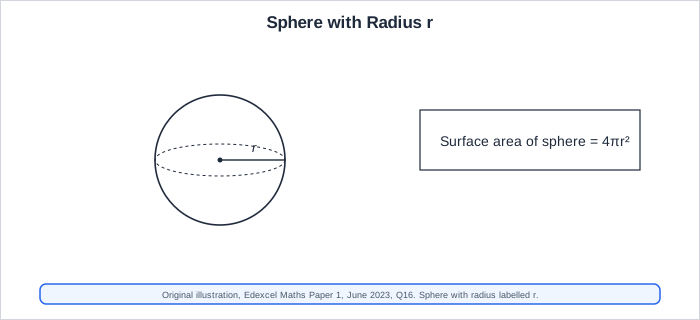
The full worked answer — June 2023
Scaling up, the whole surface area is 75 pi divided by three eighths, which is 75 pi times eight thirds, giving 200 pi cm squared.
Setting 4 pi r squared equal to 200 pi gives r squared equals 50, so r equals the square root of 50.
The square root of 50 simplifies to 5 times the square root of 2, since 50 equals 25 times 2, so the radius is 5 times the square root of 2 cm, and the diameter, twice the radius, is 10 times the square root of 2 cm.
Could you have written this? Every fact in this answer is drilled in our quizzes — the writing is the easy part once the evidence is automatic.
Practise 3D shape questionsWhat the mark scheme rewarded
- A correct process to scale three eighths of the surface area up to the whole surface area, 200 pi (1 mark)
- A correct process to find r squared from the surface area formula (1 mark)
- A correct process to find the radius, simplifying the surd (1 mark)
- The correct final diameter, 10 times the square root of 2 cm (1 mark)
- Scale the given fraction up to the whole surface area before substituting into the formula, rather than trying to work with three eighths of the formula directly
- Remember the question asks for the diameter, not the radius, so double the radius at the very last step
Traps examiners saw
- Substituting 75 pi directly as the whole surface area, forgetting it is only three eighths of it
- Giving the radius, 5 times the square root of 2, as the final answer instead of doubling it for the diameter
Full-mark self-check 0 of 3
The method for every Q15 (Jun19) / Q9 (Jun22) / Q3, Q16 (Jun23) — same every sittingMark bands, steps, timing
What this question type rewards
The topic changes by sitting — the mark scheme never does. Learn this once, then open your question above for that sitting’s sources and a full worked answer.
- Using the correct volume or surface area formula for each part of a composite solid
- Substituting the correct radius, diameter or side length into each formula
- Combining or comparing the parts correctly to reach the final total
The steps
- Identify the separate simple shapes that make up the solid, if it is a composite one
- Substitute the correct dimensions into the volume or surface area formula for each part
- Combine the parts correctly, adding or subtracting overlapping faces where needed
- Simplify the final answer into the exact form the question asks for
What is the formula for the volume of a sphere with radius r?
Volume and surface area of 3D shapes come up in all three sittings we have, and June 2023 tests it twice. Practise matching the correct formula to each part of a composite solid.
Practise 3D shape questions“Two of the three sittings we have full papers for start from a grouped frequency table and ask for a statistic or a graph built from it.”
Every version needs the midpoint or the running total of each class handled correctly before any estimate or graph can be trusted.
1×asked“The table shows the amount of snow, in cm, that fell each day for 30 days, grouped into 5 class intervals from 0 up to 50 cm. Work out an estimate for the mean amount of snow per day.”
“The table shows the amount of snow, in cm, that fell each day for 30 days, grouped into 5 class intervals from 0 up to 50 cm. Work out an estimate for the mean amount of snow per day.”
What it’s really asking
Multiply each class midpoint by its frequency, add these together, then divide by the total number of days.
What the sources actually showed — June 2022
A frequency table for 30 days of snowfall, with class intervals 0 up to 10 cm, 10 up to 20 cm, 20 up to 30 cm, 30 up to 40 cm and 40 up to 50 cm, with frequencies 8, 10, 7, 2 and 3.
| Amount of snow (s cm) | Frequency |
|---|---|
| 0 ≤ s < 10 | 8 |
| 10 ≤ s < 20 | 10 |
| 20 ≤ s < 30 | 7 |
| 30 ≤ s < 40 | 2 |
| 40 ≤ s < 50 | 3 |
The full worked answer — June 2022
The midpoints of the five classes are 5, 15, 25, 35 and 45. Multiplying each by its frequency gives 8 times 5 equals 40, 10 times 15 equals 150, 7 times 25 equals 175, 2 times 35 equals 70, and 3 times 45 equals 135.
Adding these products gives 40 plus 150 plus 175 plus 70 plus 135, which equals 570, and adding the frequencies gives 8 plus 10 plus 7 plus 2 plus 3, which equals 30 days in total.
Dividing the total, 570, by the number of days, 30, gives an estimated mean of 19 cm.
Could you have written this? Every fact in this answer is drilled in our quizzes — the writing is the easy part once the evidence is automatic.
Practise grouped data questionsWhat the mark scheme rewarded
- At least 3 of the 5 class midpoints correctly multiplied by their frequency (1 mark)
- The sum of all 5 products divided by the total frequency, 30 (1 mark)
- The correct final estimate, 19 cm (1 mark)
- Use the midpoint of each class, never its lower or upper boundary, when estimating a mean from grouped data
- Divide by the total frequency, not the number of classes, at the final step
Traps examiners saw
- Using a class's lower or upper boundary instead of its midpoint in the multiplication
- Dividing by the number of classes, 5, instead of the total number of days, 30
Full-mark self-check 0 of 3
1×asked“The table shows information about the profit made each day at a cricket club on 100 days, grouped into 6 class intervals from £0 up to £300. (a) Complete the cumulative frequency table. (b) Draw a cumulative frequency graph for this information. (c) Use your graph to find an estimate for the number of days on which the profit was less than £125. (d) Use your graph to find an estimate for the interquartile range.”
“The table shows information about the profit made each day at a cricket club on 100 days, grouped into 6 class intervals from £0 up to £300. (a) Complete the cumulative frequency table. (b) Draw a cumulative frequency graph for this information. (c) Use your graph to find an estimate for the number of days on which the profit was less than £125. (d) Use your graph to find an estimate for the interquartile range.”
What it’s really asking
Build the running total first, plot it against each class's upper boundary, then read the curve at £125 and at the quartile positions.
What the sources actually showed — June 2022
A frequency table for 100 days of profit at a cricket club, with class intervals £0 up to £50, £50 up to £100, £100 up to £150, £150 up to £200, £200 up to £250 and £250 up to £300, with frequencies 10, 15, 25, 30, 5 and 15.
| Profit (£x) | Frequency |
|---|---|
| 0 ≤ x < 50 | 10 |
| 50 ≤ x < 100 | 15 |
| 100 ≤ x < 150 | 25 |
| 150 ≤ x < 200 | 30 |
| 200 ≤ x < 250 | 5 |
| 250 ≤ x < 300 | 15 |
A blank grid with the profit in pounds, from 0 to 300, along the horizontal axis, and cumulative frequency, from 0 to 100, up the vertical axis, ready for the cumulative frequency curve to be drawn.
The full worked answer — June 2022
Adding each frequency to the running total gives cumulative frequencies of 10, 25, 50, 80, 85 and 100 at profits of £50, £100, £150, £200, £250 and £300.
Plotting these six points at their upper class boundaries and joining them with a smooth curve gives the cumulative frequency graph.
Reading across from £125 up to the curve, which sits between the points at £100 and £150, gives an estimate of around 37 days with profit less than £125.
For the interquartile range, the lower quartile is read at a cumulative frequency of 25, which is £100, and the upper quartile is read at a cumulative frequency of 75, which is approximately £192, giving an interquartile range of about £92.
Could you have written this? Every fact in this answer is drilled in our quizzes — the writing is the easy part once the evidence is automatic.
Practise grouped data questionsWhat the mark scheme rewarded
- Cumulative frequency table correctly completed by a running total (1 mark)
- A correct graph with 5 or 6 points plotted correctly from the table, joined with a smooth curve (1 mark for plotting, 1 mark for a fully correct graph)
- An estimate in the range 35 to 39 days, read consistently from the graph (1 mark)
- An estimate for the interquartile range in the range 85 to 93, read consistently from the graph (1 mark for the method, 1 mark for the final value)
- Build the running total by adding, never by copying each class frequency straight across
- Plot each cumulative frequency against the upper boundary of its class, not the midpoint
- Find the lower quartile at one quarter of the total frequency and the upper quartile at three quarters, then subtract for the interquartile range
Traps examiners saw
- Copying the original frequencies onto the graph instead of building a genuine cumulative total first
- Reading the quartiles at the wrong cumulative frequency value, such as at 100 and 0 instead of 75 and 25
Full-mark self-check 0 of 4
1×asked“The table shows information about the daily rainfall in a town for 60 days, grouped into 5 class intervals from 0 mm up to 25 mm. Draw a frequency polygon for this information.”
“The table shows information about the daily rainfall in a town for 60 days, grouped into 5 class intervals from 0 mm up to 25 mm. Draw a frequency polygon for this information.”
What it’s really asking
Plot each class's frequency at its midpoint, then join the points with straight lines.
What the sources actually showed — June 2023
A frequency table for 60 days of rainfall, with class intervals 0 up to 5 mm, 5 up to 10 mm, 10 up to 15 mm, 15 up to 20 mm and 20 up to 25 mm, with frequencies 8, 24, 13, 11 and 4.
| Rainfall (R mm) | Frequency |
|---|---|
| 0 ≤ R < 5 | 8 |
| 5 ≤ R < 10 | 24 |
| 10 ≤ R < 15 | 13 |
| 15 ≤ R < 20 | 11 |
| 20 ≤ R < 25 | 4 |
A blank grid with rainfall in millimetres, from 0 to 25, along the horizontal axis, and frequency, from 0 to 30, up the vertical axis, ready for the frequency polygon to be plotted.
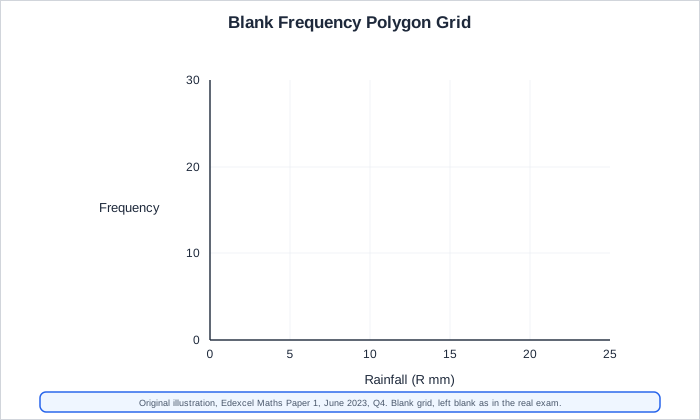
The full worked answer — June 2023
The midpoints of the five rainfall classes are 2.5, 7.5, 12.5, 17.5 and 22.5 mm.
Plotting frequency against midpoint gives the five points (2.5, 8), (7.5, 24), (12.5, 13), (17.5, 11) and (22.5, 4).
Joining these five points with straight line segments, in order, gives the completed frequency polygon.
Could you have written this? Every fact in this answer is drilled in our quizzes — the writing is the easy part once the evidence is automatic.
Practise grouped data questionsWhat the mark scheme rewarded
- All five points plotted at the correct midpoints and correct frequency heights (1 mark, or partial credit for most points correct)
- All five points joined correctly with straight line segments, not a smooth curve (1 mark)
- Plot a frequency polygon at the midpoint of each class, never at its lower or upper boundary
- Join the points with straight lines, not a smooth curve, since a frequency polygon is always drawn with straight segments
Traps examiners saw
- Plotting the points at the class boundaries instead of the midpoints, which shifts the whole shape sideways
- Drawing a smooth curve through the points instead of straight line segments
Full-mark self-check 0 of 3
The method for every Q8, Q10 (Jun22) / Q4 (Jun23) — same every sittingMark bands, steps, timing
What this question type rewards
The topic changes by sitting — the mark scheme never does. Learn this once, then open your question above for that sitting’s sources and a full worked answer.
- Using the midpoint of each class when estimating a mean from grouped data
- Building a genuine running total when constructing a cumulative frequency table, not copying each frequency across
- Plotting points at the correct position, whether that is a class midpoint or a class upper boundary, and reading estimates consistently
The steps
- Identify what each class of the grouped table needs: its midpoint for a mean, its running total for cumulative frequency
- Carry out the necessary calculation or start the running total, class by class
- Plot any required graph, at midpoints for a frequency polygon or upper boundaries for cumulative frequency
- Read off, or calculate, the value the question actually asks for
A frequency table uses the class intervals shown below. | Speed, s (mph) | Frequency | |---|---| | 0 < s ≤ 20 | 4 | | 20 < s ≤ 40 | 11 | | 40 < s ≤ 60 | 9 | | 60 < s ≤ 80 | 2 | A car travels at exactly 40 mph. Which class interval does this value belong to?
Working with a grouped frequency table, whether to estimate the mean or to build a graph, comes up in two of the three sittings we have. Practise handling midpoints and running totals correctly.
Practise grouped data questions“Two of the three sittings we have full papers for test systematic counting, once for a combination lock and once for a restaurant menu.”
Every version needs the number of choices at each independent stage multiplied together, and June 2019 also needs one part adjusted for choices that cannot repeat.
1×asked“There are three dials on a combination lock. Each dial can be set to one of the numbers 1, 2, 3, 4 or 5. The three digit number 553 is one way the dials can be set, as an example. (a) Work out the number of different three digit numbers that can be set for the combination lock. (b) How many of the possible three digit numbers have three different digits?”
“There are three dials on a combination lock. Each dial can be set to one of the numbers 1, 2, 3, 4 or 5. The three digit number 553 is one way the dials can be set, as an example. (a) Work out the number of different three digit numbers that can be set for the combination lock. (b) How many of the possible three digit numbers have three different digits?”
What it’s really asking
Multiply the 5 choices for each of the 3 dials together for part (a), then reduce the choices for later dials for part (b), since digits cannot repeat.
What the sources actually showed — June 2019
Three dials, each showing the numbers 1 to 5, with the dials shown set to display the example number 553.
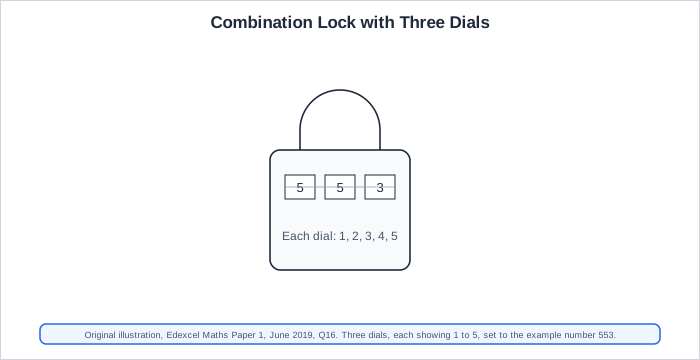
The full worked answer — June 2019
For part (a), each of the 3 dials can independently show any of 5 numbers, so the total number of different three digit numbers is 5 times 5 times 5, which equals 125.
For part (b), the first dial can still be any of 5 numbers, but the second dial must avoid repeating it, leaving 4 choices, and the third dial must avoid both previous digits, leaving 3 choices.
Multiplying these together, 5 times 4 times 3 equals 60 three digit numbers with three different digits.
Could you have written this? Every fact in this answer is drilled in our quizzes — the writing is the easy part once the evidence is automatic.
Practise counting outcomes questionsWhat the mark scheme rewarded
- A correct method for part (a), such as 5 cubed or an equivalent (1 mark for method, 1 for the final value 125)
- A correct method for part (b), reducing the choices at each later dial (1 mark for method, 1 for the final value 60)
- Multiply the number of independent choices at each stage together, since each dial is set separately
- Reduce the number of remaining choices by one at each later stage when digits are not allowed to repeat
Traps examiners saw
- Using 5 times 5 times 5 for part (b) as well, forgetting that repeated digits are no longer allowed
- Subtracting instead of multiplying the number of choices at each stage
Full-mark self-check 0 of 3
The method for every Q16 (Jun19) / Q19 (Jun23) — same every sittingMark bands, steps, timing
What this question type rewards
The topic changes by sitting — the mark scheme never does. Learn this once, then open your question above for that sitting’s sources and a full worked answer.
- Identifying the number of independent choices available at each stage
- Multiplying the number of choices at every stage together for the total count
- Reducing the number of choices at later stages when repeats are not allowed
The steps
- List the number of choices available at each separate stage
- Multiply the number of choices at every stage together for the total count
- If repeats are not allowed, reduce the number of choices at each later stage by one for each item already used
- Check the final count answers exactly what the question asks for
A fair coin is flipped and a fair die (numbered 1 to 6) is rolled. How many possible outcomes are there in total?
Counting the number of possible outcomes using the product rule comes up in two of the three sittings we have. Practise multiplying independent choices together confidently.
Practise counting outcomes questions“Two of the three sittings we have full papers for build a question around inverse and composite functions together, one proving a quadratic equation and one solving for a specific value.”
Every version needs the inverse function found correctly first, since it either feeds directly into the composite function or is used to reverse the final step of the calculation.
1×asked“The functions f and g are such that f(x) = 3x minus 1 and g(x) = x squared plus 4. (a) Find f inverse of x. (b) Given that fg(x) = 2gf(x), show that 15x squared minus 12x minus 1 = 0.”
“The functions f and g are such that f(x) = 3x minus 1 and g(x) = x squared plus 4. (a) Find f inverse of x. (b) Given that fg(x) = 2gf(x), show that 15x squared minus 12x minus 1 = 0.”
What it’s really asking
Find f inverse algebraically for part (a), then build both composite functions fg(x) and gf(x) separately for part (b) and set them equal as instructed.
The full worked answer — June 2019
For part (a), writing y equals 3x minus 1 and swapping x and y gives x equals 3y minus 1, which rearranges to y equals (x plus 1) over 3, so f inverse of x equals (x plus 1) over 3.
For part (b), fg(x) means substituting g(x) into f, which gives 3 times (x squared plus 4) minus 1, equal to 3x squared plus 11. gf(x) means substituting f(x) into g, which gives (3x minus 1) squared plus 4, equal to 9x squared minus 6x plus 5.
Setting fg(x) equal to 2 times gf(x) gives 3x squared plus 11 equals 2 times (9x squared minus 6x plus 5), which is 18x squared minus 12x plus 10.
Rearranging so everything is on one side, 0 equals 18x squared minus 12x plus 10 minus 3x squared minus 11, which simplifies to 15x squared minus 12x minus 1 equals 0, exactly as required.
Could you have written this? Every fact in this answer is drilled in our quizzes — the writing is the easy part once the evidence is automatic.
Practise functions questionsWhat the mark scheme rewarded
- The correct inverse function, (x plus 1) over 3 (2 marks)
- A correct method to find fg(x) (1 mark)
- A correct method to find gf(x) (1 mark)
- The correct equation set up, fg(x) equals 2gf(x) (1 mark)
- Correct expansion of the squared bracket in gf(x) (1 mark)
- The given result shown fully, with no algebraic errors, 15x squared minus 12x minus 1 equals 0 (1 mark)
- Build fg(x) and gf(x) completely separately before combining them, since substituting in the wrong order gives a different, incorrect expression
- Show every step of the expansion and rearrangement clearly, since this is a show-that question and the mark scheme checks the working, not just the final line
Traps examiners saw
- Swapping the order of the composite functions, calculating gf(x) where fg(x) was needed, or the reverse
- Making a sign error expanding (3x minus 1) squared, especially losing the middle term negative 6x
Full-mark self-check 0 of 3
1×asked“For x greater than or equal to 0, the functions f and g are such that f(x) = 3x + 4 and g(x) = (the square root of x, plus 2), all over 5. (a) Find g inverse of x. (b) Solve gf(x) = 3.”
“For x greater than or equal to 0, the functions f and g are such that f(x) = 3x + 4 and g(x) = (the square root of x, plus 2), all over 5. (a) Find g inverse of x. (b) Solve gf(x) = 3.”
What it’s really asking
Find g inverse algebraically for part (a), then use it to reverse the equation in part (b) rather than building the full composite function from scratch.
The full worked answer — June 2023
For part (a), writing y equals (the square root of x, plus 2), all over 5, and swapping x and y gives x equals (the square root of y, plus 2), all over 5, so 5x minus 2 equals the square root of y, and squaring both sides gives g inverse of x equals (5x minus 2) squared.
For part (b), gf(x) equals 3 means g inverse can be used in reverse: applying g inverse to both sides of gf(x) equals 3 gives f(x) equals g inverse of 3, which is (5 times 3 minus 2) squared, equal to 13 squared, or 169.
Since f(x) equals 3x plus 4, setting 3x plus 4 equal to 169 gives 3x equals 165, so x equals 55.
Could you have written this? Every fact in this answer is drilled in our quizzes — the writing is the easy part once the evidence is automatic.
Practise functions questionsWhat the mark scheme rewarded
- The correct inverse function, (5x minus 2) squared (2 marks)
- A correct method to find f(x) using the inverse relationship, such as (5 times 3 minus 2) squared (1 mark)
- A correct method to solve as far as two steps away from x, such as 3x plus 4 equals 169 (1 mark)
- The correct final value, x equals 55 (1 mark)
- Once g inverse of x is found, use it to reverse gf(x) equals 3 directly into f(x) equals g inverse of 3, avoiding building the full composite function gf(x) from scratch
- Square both sides carefully when finding g inverse, since the square root only applies to x plus 2, not the whole fraction
Traps examiners saw
- Building the composite function gf(x) from scratch and getting tangled in nested roots, rather than using the inverse function to reverse the equation directly
- Forgetting to square both sides correctly when rearranging for g inverse, or squaring only part of the expression
Full-mark self-check 0 of 3
The method for every Q21 (Jun19) / Q20 (Jun23) — same every sittingMark bands, steps, timing
What this question type rewards
The topic changes by sitting — the mark scheme never does. Learn this once, then open your question above for that sitting’s sources and a full worked answer.
- Finding the inverse of a function correctly, by swapping x and y and rearranging
- Substituting one function into another correctly to find a composite function
- Setting up and solving an equation, or proving a stated result, using the composite functions found
The steps
- Find the inverse function asked for by swapping x and y in the original function, then rearranging to make y the subject
- Substitute one given function into another to find each composite function needed
- Set up the equation described in the question using these composite functions
- Solve the equation, or complete the algebra to prove the result exactly as stated
What does f⁻¹(x) represent?
Inverse and composite functions come up together in two of the three sittings we have. Practise finding an inverse function confidently, since it often unlocks a shortcut through a nested composite equation.
Practise functions questions“All three sittings we have full papers for use an algebraic method on a quadratic, and each sitting tests a different specific technique.”
Every version rewards recognising which quadratic technique fits the question, whether that is comparing coefficients, clearing fractions first, or finding critical values.
1×asked“Given that x squared minus 6x plus 1 = (x minus a) squared minus b for all values of x, (i) find the value of a and the value of b. (ii) Hence write down the coordinates of the turning point on the graph of y = x squared minus 6x plus 1.”
“Given that x squared minus 6x plus 1 = (x minus a) squared minus b for all values of x, (i) find the value of a and the value of b. (ii) Hence write down the coordinates of the turning point on the graph of y = x squared minus 6x plus 1.”
What it’s really asking
Expand the completed square form and compare coefficients with the original expression to find a and b, then read the turning point straight from the completed square form.
The full worked answer — June 2019
Expanding (x minus a) squared minus b gives x squared minus 2ax plus a squared minus b. Comparing the x term with the original expression, negative 2a equals negative 6, so a equals 3.
Comparing the constant terms, a squared minus b equals 1, so 9 minus b equals 1, giving b equals 8.
Since y equals (x minus 3) squared minus 8, the turning point of the graph is at (3, negative 8), reading the x-coordinate as a and the y-coordinate as negative b directly from the completed square form.
Could you have written this? Every fact in this answer is drilled in our quizzes — the writing is the easy part once the evidence is automatic.
Practise quadratics questionsWhat the mark scheme rewarded
- The correct value, a equals 3, seen in working or as part of an expression such as (x minus 3) squared (1 mark)
- Both correct values, a equals 3 and b equals 8 (1 mark)
- The correct turning point, (3, negative 8), following through from part (i) (1 mark)
- Compare the coefficient of x first to find a, since it only depends on the negative 2a term, before using the constant term to find b
- Read the turning point directly from the completed square form, since the x-coordinate is a and the y-coordinate is negative b, with no further working needed
Traps examiners saw
- Making a sign error finding b, forgetting the completed square form has a minus b, not plus b
- Writing the turning point as (negative 3, 8) or (3, 8), getting a sign wrong on either coordinate
Full-mark self-check 0 of 3
1×asked“Solve 1 over (2x minus 1) plus 3 over (x minus 1) = 1. Give your answer in the form (p plus or minus the square root of q) over 2, where p and q are integers.”
“Solve 1 over (2x minus 1) plus 3 over (x minus 1) = 1. Give your answer in the form (p plus or minus the square root of q) over 2, where p and q are integers.”
What it’s really asking
Clear the fractions to reach a quadratic equation, then use the quadratic formula since it will not factorise neatly.
The full worked answer — June 2022
Multiplying every term by (2x minus 1)(x minus 1) to clear the fractions gives (x minus 1) plus 3(2x minus 1) equals (2x minus 1)(x minus 1).
Expanding both sides, 7x minus 4 equals 2x squared minus 3x plus 1, which rearranges to 2x squared minus 10x plus 5 equals 0.
Using the quadratic formula with a equals 2, b equals negative 10 and c equals 5 gives x equals (10 plus or minus the square root of (100 minus 40)) over 4, which is (10 plus or minus the square root of 60) over 4.
Simplifying, since the square root of 60 equals 2 times the square root of 15, this becomes (5 plus or minus the square root of 15) over 2.
Could you have written this? Every fact in this answer is drilled in our quizzes — the writing is the easy part once the evidence is automatic.
Practise quadratics questionsWhat the mark scheme rewarded
- A correct method using a common denominator to clear the fractions (1 mark)
- Correct expansion and rearrangement to a three term quadratic equal to zero, such as 2x squared minus 10x plus 5 (1 mark)
- A correct method to solve the quadratic, such as substituting into the quadratic formula (1 mark)
- The correct final answer, (5 plus or minus the square root of 15) over 2 (1 mark)
- Clear every fraction using the full common denominator before expanding anything, since a partial clearing leads to a much harder equation
- Simplify the surd in the quadratic formula's answer fully, since the question specifically asks for a denominator of 2, not 4
Traps examiners saw
- Multiplying only one of the two fractions by the common denominator, leaving a fraction still in the equation
- Leaving the final answer with a denominator of 4 instead of simplifying the surd to reach the denominator of 2 the question asks for
Full-mark self-check 0 of 3
1×asked“Find the set of possible values of x for which 4x squared minus 25 less than 0 and 12 minus 5x minus 3x squared greater than 0. You must show all your working.”
“Find the set of possible values of x for which 4x squared minus 25 less than 0 and 12 minus 5x minus 3x squared greater than 0. You must show all your working.”
What it’s really asking
Find the critical values of each quadratic inequality separately, then combine the two resulting ranges to find where both are true at once.
The full worked answer — June 2023
4x squared minus 25 factorises as (2x minus 5)(2x plus 5), giving critical values of x equals 2.5 and x equals negative 2.5. Since the quadratic opens upwards, it is less than 0 between its roots, so negative 2.5 less than x less than 2.5.
12 minus 5x minus 3x squared can be rearranged as 3x squared plus 5x minus 12 less than 0, which factorises as (3x minus 4)(x plus 3), giving critical values of x equals four thirds and x equals negative 3. Since this quadratic also opens upwards, negative 3 less than x less than four thirds.
Combining both conditions, the values of x satisfying both inequalities at once lie in the overlap of the two ranges, which is negative 2.5 less than x less than four thirds.
Could you have written this? Every fact in this answer is drilled in our quizzes — the writing is the easy part once the evidence is automatic.
Practise quadratics questionsWhat the mark scheme rewarded
- Correct critical values found for the first inequality, negative 2.5 and 2.5 (1 mark for method, 1 mark for the correct range)
- Correct critical values found for the second inequality, negative 3 and four thirds (1 mark for method, 1 mark for the correct range)
- The correct final combined range, negative 2.5 less than x less than four thirds (1 mark)
- Rearrange the second inequality so the x squared term is positive before factorising, flipping the inequality sign if you multiply through by negative 1
- Sketch or picture both ranges on a single number line to find where they overlap, rather than trying to combine them purely algebraically
Traps examiners saw
- Forgetting to flip the inequality sign when rearranging 12 minus 5x minus 3x squared greater than 0 into a positive quadratic form
- Combining the two ranges incorrectly, for example taking the union instead of the overlap where both conditions hold at once
Full-mark self-check 0 of 3
The method for every Q19 (Jun19) / Q19 (Jun22) / Q24 (Jun23) — same every sittingMark bands, steps, timing
What this question type rewards
The topic changes by sitting — the mark scheme never does. Learn this once, then open your question above for that sitting’s sources and a full worked answer.
- Comparing coefficients correctly when a quadratic is given in a completed square form
- Clearing fractions or brackets correctly to reach a quadratic equation set to zero
- Finding the critical values of a quadratic using factorising or the quadratic formula, then applying them correctly to an inequality
The steps
- Rearrange the given equation or inequality into a standard quadratic form, clearing any fractions first
- Factorise the quadratic, complete the square, or use the quadratic formula as appropriate
- For an inequality, find both critical values, then decide which region satisfies the original inequality
- State the final solution in the exact form the question asks for
For the equation 3x² − 5x + 2 = 0, what are the values of a, b, and c in the quadratic formula?
Working algebraically with a quadratic, whether completing the square, using the formula, or solving an inequality, comes up in all three sittings we have. Practise recognising which technique fits which question.
Practise quadratics questions“Two of the three sittings we have full papers for give the graphs of two straight lines already drawn, and ask for the simultaneous solution to be read directly from where they cross.”
Every version rewards reading the intersection point correctly and stating both coordinates in the right order, whether the crossing point is an exact grid point or needs to be estimated.
1×asked“The graphs with equations 3y + 2x = one half and 2y minus 3x = negative 113 over 12 have been drawn on the grid below. Using the graphs, find estimates of the solutions of these simultaneous equations.”
“The graphs with equations 3y + 2x = one half and 2y minus 3x = negative 113 over 12 have been drawn on the grid below. Using the graphs, find estimates of the solutions of these simultaneous equations.”
What it’s really asking
Read the coordinates of the single point where the two drawn lines cross.
What the sources actually showed — June 2019
A grid showing the two straight lines with equations 3y + 2x = one half and 2y minus 3x = negative 113 over 12 already drawn, crossing at a single point.
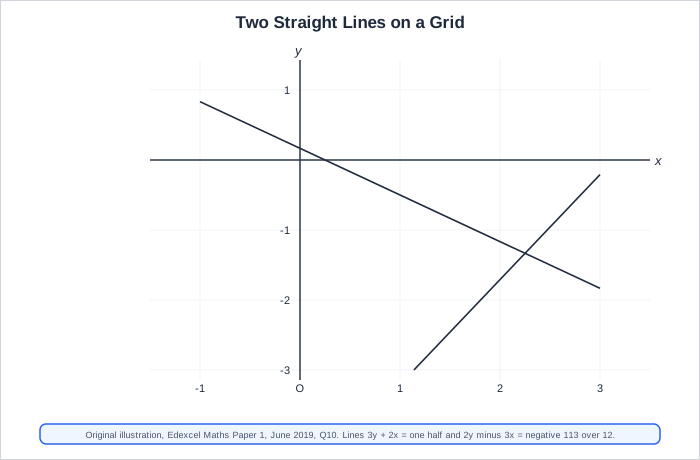
The full worked answer — June 2019
The solution to the simultaneous equations is the point where the two lines cross on the grid.
Reading across to the point of intersection gives an estimate of x in the range 2.2 to 2.3, and reading down gives an estimate of y in the range negative 1.3 to negative 1.4.
Could you have written this? Every fact in this answer is drilled in our quizzes — the writing is the easy part once the evidence is automatic.
Practise graphical solution questionsWhat the mark scheme rewarded
- Recognition that the intersection point gives the solution, with one of the two coordinates given, even if reversed or given as a coordinate pair (1 mark)
- Both x and y given within the accepted range read from the graph (1 mark)
- The single crossing point of the two lines is always the solution to the simultaneous equations, since it is the one point that satisfies both equations at once
- Read both coordinates from the same point, rather than reading the axis intercepts of either line separately
Traps examiners saw
- Reading the x and y values from where each line crosses the axes instead of from where the two lines cross each other
- Swapping the x and y values around when stating the final coordinates
Full-mark self-check 0 of 3
1×asked“The graphs of 2 minus 2y = x and 2y = 3x minus 22 are shown on a grid, each labelled with its equation. Use these graphs to solve these simultaneous equations.”
“The graphs of 2 minus 2y = x and 2y = 3x minus 22 are shown on a grid, each labelled with its equation. Use these graphs to solve these simultaneous equations.”
What it’s really asking
Read the exact coordinates of the single grid point where the two labelled lines cross.
What the sources actually showed — June 2023
A grid showing two intersecting straight lines, one labelled 2 minus 2y = x and the other labelled 2y = 3x minus 22, crossing at a single grid point.
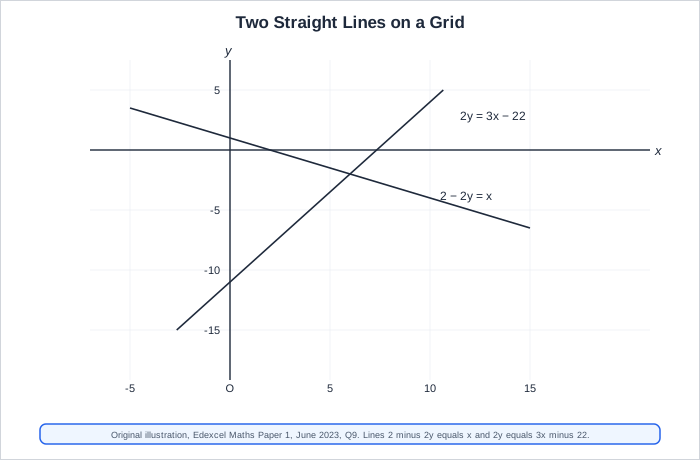
The full worked answer — June 2023
The solution to the simultaneous equations is the point where the two labelled lines cross on the grid.
Since the two lines cross exactly on a grid point, the coordinates can be read directly as x equals 6 and y equals negative 2.
Could you have written this? Every fact in this answer is drilled in our quizzes — the writing is the easy part once the evidence is automatic.
Practise graphical solution questionsWhat the mark scheme rewarded
- Both correct values, x equals 6 and y equals negative 2, read directly from the intersection point (1 mark)
- Since this question is worth only 1 mark, the lines are drawn to cross exactly on a grid point, so both coordinates should be read as exact values, not estimates
Traps examiners saw
- Reading the intersection point as an estimate rather than the exact grid values it actually sits on
- Swapping the x and y values around when stating the final coordinates
Full-mark self-check 0 of 2
The method for every Q10 (Jun19) / Q9 (Jun23) — same every sittingMark bands, steps, timing
What this question type rewards
The topic changes by sitting — the mark scheme never does. Learn this once, then open your question above for that sitting’s sources and a full worked answer.
- Correctly identifying the single point where the two given lines cross
- Reading both coordinates of that point accurately from the grid
- Stating which coordinate is x and which is y correctly
The steps
- Find the point where the two drawn lines intersect
- Read the x-coordinate of that point from the horizontal axis
- Read the y-coordinate of that point from the vertical axis
- State both values clearly, matching them to x and y correctly
A straight line y = 3x − 6 is plotted on a graph. Where does the solution to 3x − 6 = 0 appear on the graph?
Reading a simultaneous solution from two graphs already drawn comes up in two of the three sittings we have. Practise reading intersection points accurately from a grid.
Practise graphical solution questions“Two of the three sittings we have full papers for combine an angle-sum fact with a ratio between two unknown angles.”
Every version needs the total to share between the unknown angles found first, before the given ratio can be used to split it.
1×asked“Here is a regular hexagon and a regular pentagon, joined together along one common side. Where the two shapes meet at a single point, their interior angles and the angle marked x together make one complete turn. Work out the size of the angle marked x. You must show all your working.”
“Here is a regular hexagon and a regular pentagon, joined together along one common side. Where the two shapes meet at a single point, their interior angles and the angle marked x together make one complete turn. Work out the size of the angle marked x. You must show all your working.”
What it’s really asking
Find the interior angle of each regular shape, then use the fact that angles around a point add to 360 degrees to find what is left for x.
What the sources actually showed — June 2022
A regular hexagon and a regular pentagon drawn joined along a common side, meeting at a point where the angle marked x completes the full turn around that point.
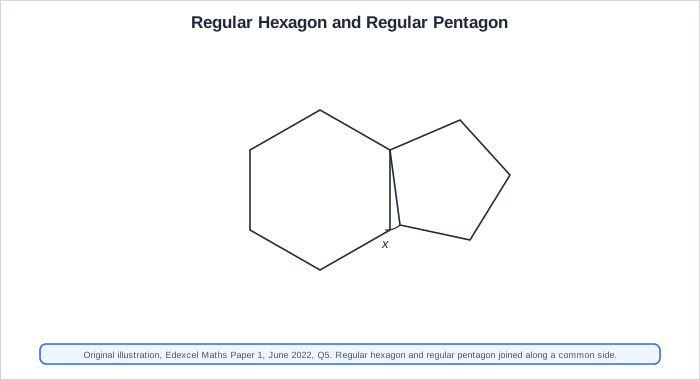
The full worked answer — June 2022
The interior angle of a regular hexagon is 180 times (6 minus 2) divided by 6, which equals 120 degrees. The interior angle of a regular pentagon is 180 times (5 minus 2) divided by 5, which equals 108 degrees.
Since the two interior angles and x together make one complete turn around the shared point, x equals 360 minus 120 minus 108, which equals 132 degrees.
Could you have written this? Every fact in this answer is drilled in our quizzes — the writing is the easy part once the evidence is automatic.
Practise polygon angle questionsWhat the mark scheme rewarded
- A correct interior or exterior angle found for either the hexagon or the pentagon (1 mark)
- A complete method combining both interior angles with the angle sum at a point (1 mark)
- The correct final answer, 132 degrees (1 mark)
- Use the interior angle formula, 180 times (n minus 2) divided by n, for a regular polygon with n sides, rather than trying to recall each value separately
- Remember the angles around a full point always add to 360 degrees, whatever shapes are meeting there
Traps examiners saw
- Using the exterior angle formula when the interior angle is needed, or the reverse
- Forgetting to subtract both interior angles from 360, only subtracting one of them
Full-mark self-check 0 of 3
1×asked“Here is a pentagon ABCDE. Angle EAB is 120 degrees. Angle BCD is 110 degrees. Angle CDE is 135 degrees. Angle AED = 4 times angle ABC. Work out the size of angle AED. You must show all your working.”
“Here is a pentagon ABCDE. Angle EAB is 120 degrees. Angle BCD is 110 degrees. Angle CDE is 135 degrees. Angle AED = 4 times angle ABC. Work out the size of angle AED. You must show all your working.”
What it’s really asking
Find the total of the two unknown angles using the pentagon's angle sum, then split that total using the given ratio between them.
What the sources actually showed — June 2023
A pentagon ABCDE with angle EAB marked 120 degrees, angle BCD marked 110 degrees and angle CDE marked 135 degrees, with angles ABC and AED left unmarked.
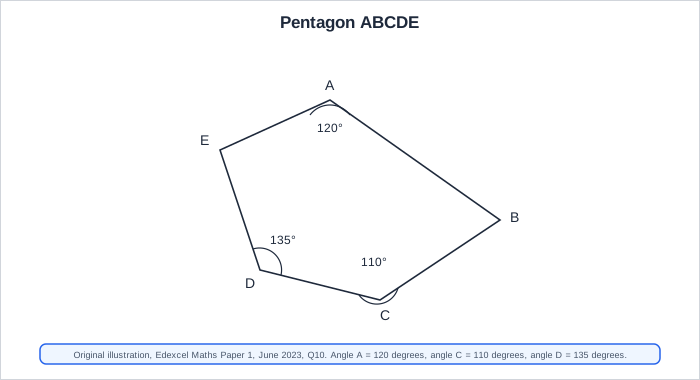
The full worked answer — June 2023
The sum of the interior angles of a pentagon is 180 times (5 minus 2), which equals 540 degrees.
Subtracting the three known angles, 540 minus 120 minus 110 minus 135, leaves 175 degrees for angle ABC and angle AED together.
Since angle AED equals 4 times angle ABC, the total of 175 degrees splits into 5 equal parts, so angle ABC is 175 divided by 5, which is 35 degrees, and angle AED is 4 times 35, which equals 140 degrees.
Could you have written this? Every fact in this answer is drilled in our quizzes — the writing is the easy part once the evidence is automatic.
Practise polygon angle questionsWhat the mark scheme rewarded
- A correct process to find the sum of interior angles of a pentagon, 540 degrees (1 mark)
- A correct process using the ratio 4:1 between the two unknown angles, once the remaining total is found (1 mark)
- A correct process to find angle ABC or angle AED (1 mark)
- The correct final answer, 140 degrees, with no marks for a correct answer with no supporting working (1 mark)
- Find the total left over for the two unknown angles first, by subtracting all the known angles from the full pentagon angle sum
- Treat the ratio between the two unknown angles as 4 parts to 1 part, splitting the remaining total into 5 equal shares
Traps examiners saw
- Using the wrong angle sum for a pentagon, such as 360 degrees instead of 540 degrees
- Splitting the remaining total in the wrong ratio, or finding angle ABC but forgetting to then multiply by 4 for angle AED
Full-mark self-check 0 of 3
The method for every Q5 (Jun22) / Q10 (Jun23) — same every sittingMark bands, steps, timing
What this question type rewards
The topic changes by sitting — the mark scheme never does. Learn this once, then open your question above for that sitting’s sources and a full worked answer.
- Finding the interior or exterior angle of a regular polygon correctly
- Using the angle sum at a point, on a straight line, or inside a polygon, to find the total left over for the unknown angles
- Using the given ratio to split that total correctly between the unknown angles
The steps
- Find any angle fact needed for a regular polygon, such as its interior or exterior angle
- Use the angle sum rule that applies, at a point, on a line, or inside the polygon, to find the total for the remaining unknown angles
- Split that total using the given ratio between the two unknown angles
- State the specific angle the question actually asks for
What is the sum of the interior angles of a hexagon?
Combining a polygon's angle sum with a given ratio between two angles comes up in two of the three sittings we have. Practise the interior angle formula until it is instant recall.
Practise polygon angle questions“Two of the three sittings we have full papers for use a compound measure formula, once for density and once for pressure.”
Every version needs one quantity found first from the given information, before the compound measure formula can be applied directly.
1×asked“Here are two cubes, A and B. Cube A has sides of length 3 cm and a mass of 81 g. Cube B has sides of length 4 cm and a mass of 128 g. Work out the density of cube A to the density of cube B. Give your answer in the form a : b, where a and b are integers.”
“Here are two cubes, A and B. Cube A has sides of length 3 cm and a mass of 81 g. Cube B has sides of length 4 cm and a mass of 128 g. Work out the density of cube A to the density of cube B. Give your answer in the form a : b, where a and b are integers.”
What it’s really asking
Find the volume of each cube first, then use density equals mass divided by volume for each cube before writing the ratio.
What the sources actually showed — June 2022
Two cubes labelled A and B, with cube A having sides of length 3 cm and cube B having sides of length 4 cm.
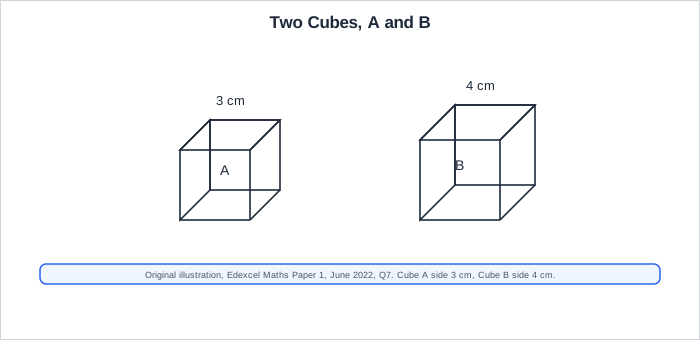
The full worked answer — June 2022
The volume of cube A is 3 cubed, which equals 27 cm cubed. The volume of cube B is 4 cubed, which equals 64 cm cubed.
The density of cube A is 81 divided by 27, which equals 3, and the density of cube B is 128 divided by 64, which equals 2.
The ratio of the density of cube A to the density of cube B is therefore 3 : 2.
Could you have written this? Every fact in this answer is drilled in our quizzes — the writing is the easy part once the evidence is automatic.
Practise compound measures questionsWhat the mark scheme rewarded
- Either volume correctly found, 27 or 64 (1 mark)
- Density of cube A or cube B correctly found using mass divided by volume (1 mark)
- The correct final ratio, 3 : 2 (1 mark)
- Find the volume of each cube first, since density needs both mass and volume, not just the mass given
- Keep the ratio in the same order the question asks for, density of A to density of B, not the reverse
Traps examiners saw
- Using the side length directly instead of cubing it to find the volume
- Writing the final ratio the wrong way round, as 2 : 3 instead of 3 : 2
Full-mark self-check 0 of 3
1×asked“The diagram shows a solid cylinder on a horizontal floor. Pressure equals force divided by area. The cylinder has a volume of 1200 cm cubed and a height of 40 cm. The cylinder exerts a force of 90 newtons on the floor. Work out the pressure on the floor due to the cylinder.”
“The diagram shows a solid cylinder on a horizontal floor. Pressure equals force divided by area. The cylinder has a volume of 1200 cm cubed and a height of 40 cm. The cylinder exerts a force of 90 newtons on the floor. Work out the pressure on the floor due to the cylinder.”
What it’s really asking
Find the area of the cylinder's base from its volume and height, then use pressure equals force divided by area.
What the sources actually showed — June 2023
A solid cylinder standing upright on a horizontal floor, with its height labelled as 40 cm, alongside the formula pressure equals force divided by area.
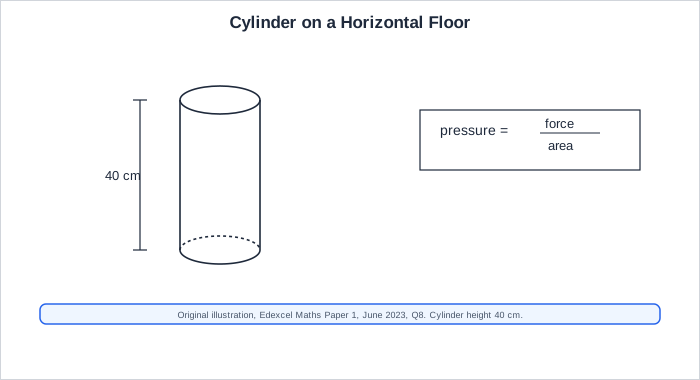
The full worked answer — June 2023
Since volume equals area of base times height, the area of the base is 1200 divided by 40, which equals 30 cm squared.
Using pressure equals force divided by area, the pressure on the floor is 90 divided by 30, which equals 3 newtons per cm squared.
Could you have written this? Every fact in this answer is drilled in our quizzes — the writing is the easy part once the evidence is automatic.
Practise compound measures questionsWhat the mark scheme rewarded
- A correct process to find the area of the base from the volume and height, 30 (1 mark)
- A correct process to find the pressure, dividing force by that area (1 mark)
- The correct final answer, 3 newtons per cm squared (1 mark)
- Find the base area from the volume and height first, since the pressure formula needs area, not volume
- Divide force by area, in that order, never area by force
Traps examiners saw
- Using the volume directly in the pressure formula instead of first finding the base area
- Dividing the height by the volume instead of the volume by the height when finding the base area
Full-mark self-check 0 of 3
The method for every Q7 (Jun22) / Q8 (Jun23) — same every sittingMark bands, steps, timing
What this question type rewards
The topic changes by sitting — the mark scheme never does. Learn this once, then open your question above for that sitting’s sources and a full worked answer.
- Finding the missing quantity needed for the compound measure formula, such as a volume or an area
- Applying the compound measure formula correctly, dividing the two quantities in the right order
- Simplifying the final result into the exact form the question asks for
The steps
- Identify which quantity is missing before the compound measure formula can be used
- Calculate that missing quantity from the information given
- Apply the compound measure formula, dividing carefully in the correct order
- State the final answer in the units or form the question asks for
Which formula correctly shows how density (D), mass (M) and volume (V) are related?
Compound measure formulas, such as density and pressure, come up in two of the three sittings we have. Practise finding a missing quantity first before applying the formula.
Practise compound measures questions“Two of the three sittings we have full papers for test combined probability of independent events, once forwards using a tree diagram and once backwards from a stated combined probability.”
Every version needs every relevant combination of outcomes considered, whether that means adding several routes together or setting up an equation from a stated total probability.
1×asked“A first aid test has two parts, a theory test and a practical test. The probability of passing the theory test is 0.75. The probability of passing only one of the two parts is 0.36. The two events are independent. Work out the probability of passing the practical test.”
“A first aid test has two parts, a theory test and a practical test. The probability of passing the theory test is 0.75. The probability of passing only one of the two parts is 0.36. The two events are independent. Work out the probability of passing the practical test.”
What it’s really asking
Write an equation for the probability of passing only one part, in terms of the unknown practical pass probability, then solve it.
The full worked answer — June 2022
Let the probability of passing the practical test be q. Passing only one part means either passing theory and failing practical, or failing theory and passing practical: 0.75 times (1 minus q) plus 0.25 times q.
Setting this equal to 0.36 gives 0.75 minus 0.75q plus 0.25q equals 0.36, which simplifies to 0.75 minus 0.5q equals 0.36.
Rearranging, 0.5q equals 0.39, so q equals 0.78.
Could you have written this? Every fact in this answer is drilled in our quizzes — the writing is the easy part once the evidence is automatic.
Practise combined probability questionsWhat the mark scheme rewarded
- A correct product using 0.75 or 0.25 in a relevant term, such as 0.75 times (1 minus q) (1 mark)
- Both relevant products combined into a single equation (1 mark)
- A correct equation in one variable formed, such as 0.75(1 minus q) plus 0.25q equals 0.36 (1 mark)
- The correct final value, q equals 0.78 (1 mark)
- Passing only one part means exactly one success and one failure, so both orders, theory-then-fail-practical and fail-theory-then-practical, must be added together
- Use one clear letter for the unknown probability throughout, to avoid confusing it with the given probability of 0.75
Traps examiners saw
- Only considering one of the two ways to pass exactly one part, missing half of the possible outcomes
- Setting up the equation with the probabilities the wrong way round, multiplying 0.75 with q instead of with (1 minus q)
Full-mark self-check 0 of 3
1×asked“Martha plays a game twice. The probability tree diagram shows the probabilities that Martha will win or lose each game: in the first game, P(win) is five eighths and P(lose) is three eighths; in the second game, whichever the result of the first game, P(win) is two ninths and P(lose) is seven ninths. Find the probability that Martha will lose at least one game.”
“Martha plays a game twice. The probability tree diagram shows the probabilities that Martha will win or lose each game: in the first game, P(win) is five eighths and P(lose) is three eighths; in the second game, whichever the result of the first game, P(win) is two ninths and P(lose) is seven ninths. Find the probability that Martha will lose at least one game.”
What it’s really asking
Find the probability that Martha wins both games, then subtract this from 1 to find the probability she loses at least one.
What the sources actually showed — June 2023
A probability tree diagram for Martha playing a game twice, showing first-game branches of win (five eighths) and lose (three eighths), each followed by second-game branches of win (two ninths) and lose (seven ninths).
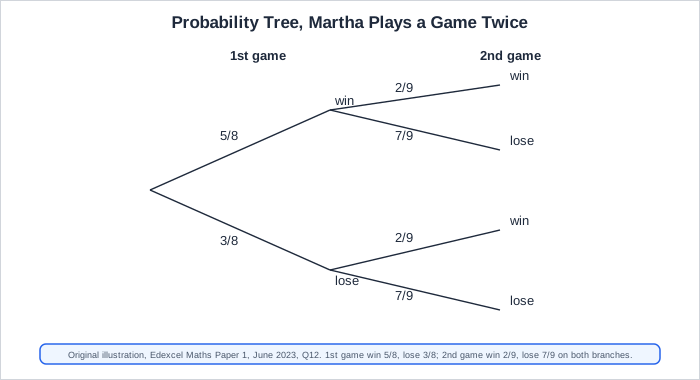
The full worked answer — June 2023
The only way Martha does not lose at least one game is if she wins both games, with probability five eighths times two ninths, which equals ten seventy-seconds.
The probability that she loses at least one game is therefore 1 minus ten seventy-seconds, which equals sixty-two seventy-seconds.
Simplifying sixty-two seventy-seconds by dividing top and bottom by 2 gives thirty-one thirty-sixths.
Could you have written this? Every fact in this answer is drilled in our quizzes — the writing is the easy part once the evidence is automatic.
Practise combined probability questionsWhat the mark scheme rewarded
- A correct product for one route through the tree, such as five eighths times two ninths (1 mark)
- A complete method to find the probability of losing at least one game, either by adding every losing route or by using the complement of winning both (1 mark)
- The correct final answer, thirty-one thirty-sixths, or an equivalent fraction (1 mark)
- Spot that losing at least one game is the complement of winning both games, which needs only one multiplication rather than adding three separate routes
- Simplify the final fraction fully, checking for a common factor between the numerator and denominator
Traps examiners saw
- Adding only some of the losing routes, missing that losing the first game and winning the first game both contribute to losing at least one overall
- Forgetting to subtract from 1 after finding the probability of winning both games, giving the probability of winning instead of losing
Full-mark self-check 0 of 3
The method for every Q16 (Jun22) / Q12 (Jun23) — same every sittingMark bands, steps, timing
What this question type rewards
The topic changes by sitting — the mark scheme never does. Learn this once, then open your question above for that sitting’s sources and a full worked answer.
- Multiplying probabilities along independent events correctly to find the probability of a specific combination
- Considering every route that leads to the outcome asked for, not just the most obvious one
- Setting up and solving an equation when working backwards from a given combined probability
The steps
- Identify every separate combination of outcomes that leads to the event asked for
- Multiply the probabilities along each separate combination
- Add the probabilities of every separate combination together, or use the complement if that is quicker
- Check the final probability against every combination the question describes
A fair coin is flipped twice. In a tree diagram, what must the probabilities on the branches from the same point always add up to?
Finding the combined probability of independent events comes up in two of the three sittings we have. Practise spotting when the complement gives a quicker route to the answer.
Practise combined probability questions“Two of the three sittings we have full papers for ask for a full proof, once about odd and even integers and once about the areas of semicircles on a right-angled triangle.”
Every version needs a complete, convincing chain of reasoning written down, since no marks are given for stating the correct conclusion alone.
1×asked“Given that n can be any integer such that n is greater than or equal to 1, prove that n squared minus n is never an odd number.”
“Given that n can be any integer such that n is greater than or equal to 1, prove that n squared minus n is never an odd number.”
What it’s really asking
Factorise n squared minus n into a product of two consecutive integers, then argue why that product must always be even.
The full worked answer — June 2019
n squared minus n factorises as n times (n minus 1), the product of two consecutive integers.
Out of any two consecutive integers, one must always be even and the other odd, since they cannot both be odd or both be even.
Since the product includes at least one even factor, n times (n minus 1) must always be even, so n squared minus n can never be an odd number.
Could you have written this? Every fact in this answer is drilled in our quizzes — the writing is the easy part once the evidence is automatic.
Practise proof questionsWhat the mark scheme rewarded
- Factorising n squared minus n as n(n minus 1), or giving a correct case-by-case argument for n odd and n even separately (1 mark)
- A complete and convincing argument that reaches the conclusion, using the fact that consecutive integers include one even number (1 mark)
- Factorise the expression into two consecutive integers first, since that instantly reveals one of them must be even
- State clearly why one of any two consecutive integers must be even, rather than assuming it is obvious
Traps examiners saw
- Testing only a few specific numerical values of n and treating that as a proof, rather than arguing for every possible integer
- Factorising correctly but not explaining why the product must be even, leaving the argument incomplete
Full-mark self-check 0 of 3
1×asked“A right-angled triangle is formed by the diameters of three semicircular regions, A, B and C, as shown in the diagram. Show that the area of region A equals the area of region B plus the area of region C.”
“A right-angled triangle is formed by the diameters of three semicircular regions, A, B and C, as shown in the diagram. Show that the area of region A equals the area of region B plus the area of region C.”
What it’s really asking
Use Pythagoras' theorem on the right-angled triangle, then link the diameters to the semicircle area formula to show the same relationship holds for the three areas.
What the sources actually showed — June 2022
A right-angled triangle whose three sides are each the diameter of a semicircular region, labelled A, B and C, with region A drawn on the side opposite the right angle.
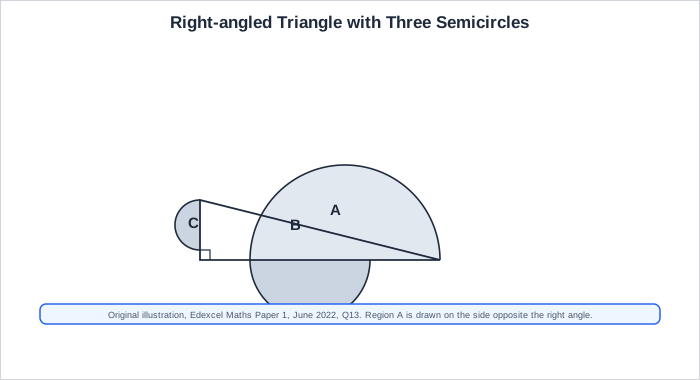
The full worked answer — June 2022
Since the triangle is right-angled, Pythagoras' theorem gives (diameter of A) squared equals (diameter of B) squared plus (diameter of C) squared, because region A sits on the side opposite the right angle.
The area of a semicircle with diameter d is one half times pi times (d over 2) squared, which equals pi times d squared over 8, so each region's area is directly proportional to the square of its own diameter.
Since the areas are each pi over 8 times the square of their diameter, and the diameters satisfy (diameter of A) squared equals (diameter of B) squared plus (diameter of C) squared, multiplying this relationship through by pi over 8 shows directly that the area of region A equals the area of region B plus the area of region C.
Could you have written this? Every fact in this answer is drilled in our quizzes — the writing is the easy part once the evidence is automatic.
Practise proof questionsWhat the mark scheme rewarded
- Use of Pythagoras' theorem correctly linking the three diameters, such as (diameter A) squared equals (diameter B) squared plus (diameter C) squared (1 mark)
- Correct expressions formed for the area of at least two of the three semicircles, in terms of their diameters (1 mark)
- A fully correct and convincing chain of reasoning linking the Pythagorean relationship to the area relationship (1 mark)
- Recognise that region A must sit on the hypotenuse, the longest side, since Pythagoras' theorem only applies with the right angle correctly identified
- Show that every semicircle's area is the same constant, pi over 8, multiplied by the square of its own diameter, since that is what turns the Pythagorean relationship between diameters directly into a relationship between areas
Traps examiners saw
- Assuming which side is the hypotenuse without checking the right angle is actually shown on the diagram between the other two sides
- Working only with specific numbers rather than keeping the diameters as general algebraic quantities, which does not prove the result for every possible right-angled triangle
Full-mark self-check 0 of 3
The method for every Q13 (Jun19) / Q13 (Jun22) — same every sittingMark bands, steps, timing
What this question type rewards
The topic changes by sitting — the mark scheme never does. Learn this once, then open your question above for that sitting’s sources and a full worked answer.
- Setting up the proof using a general algebraic expression or a known geometric relationship, not a single numerical example
- Carrying every step of the reasoning through correctly, with no gaps or unjustified jumps
- Reaching the exact conclusion stated in the question, with the reasoning made fully explicit
The steps
- Identify the general relationship or expression that captures every possible case, not just one example
- Carry out the algebraic or geometric reasoning needed, showing every step clearly
- Link the steps together into one continuous, convincing chain of reasoning
- State the conclusion exactly as the question asks, showing it follows directly from the working
Which expression represents an even number for all integer values of n?
Proving a mathematical statement, whether algebraic or geometric, comes up in two of the three sittings we have. Practise writing a complete, general argument rather than checking a single example.
Practise proof questionsWhat is guaranteed to come up, and what genuinely varies
Across the three sittings we have full papers for, Paper 1's overall structure and total marks (80) never changed, and the same handful of skills recur every year, though the exact numbers and context are different every time.
Not seen as a standalone, cleanly repeating question on Paper 1 in the three sittings we have full papers for
Reading a probability from a table and using it with a matching-counts fact to find a total, tested only in June 2019 · Finding the highest common factor of two numbers by listing factors or prime factors, tested only in June 2019 · Sketching a 3D solid from its plan and elevations, tested only in June 2019 · Combining a reflection and a translation to find an unknown translation vector, tested only in June 2019 · Using the area and the perimeter of two related rectangles together to find a missing length, tested only in June 2019 · Estimating the value of a calculation by rounding every number to 1 significant figure, tested only in June 2019 · Comparing two data sets using their median and their range or interquartile range, with a reason required for each comparison, tested only in June 2019 · Finding a volume as a fraction of another after two successive percentage increases, tested only in June 2019 · Using a given ratio to set up and solve a quadratic equation, tested only in June 2019 · Standard form conversions and calculations, tested only in June 2022 · Solving a plain linear inequality with no ratio or real-life context attached, tested only in June 2022 · Writing a number as a product of its prime factors, tested only in June 2022 · Completing a table of values and plotting a quadratic graph, then reading its roots from the graph, tested only in June 2022 · Reading a gradient as a rate, and interpreting the area under a speed-time graph, from a real-life graph, tested only in June 2022 · Using vectors to prove three points are collinear, then finding a ratio of lengths along a line, tested only in June 2022 · Finding the area of shaded regions formed by overlapping circles, tested only in June 2022 · Completing a Venn diagram from set definitions and finding a probability from it, tested only in June 2023 · Describing the correlation shown on a scatter graph and using a line of best fit to estimate a value, tested only in June 2023 · Reverse percentage, working backwards from a stated increase to find an original price, tested only in June 2023 · Rearranging a formula to make a letter that appears twice the subject, tested only in June 2023 · Circle theorems, including the alternate segment theorem, tangent properties and angles at the centre, tested only in June 2023 · Finding the exact value of a combination of trigonometric ratios, tested only in June 2019, and using trigonometry to find an angle in a 3D solid, tested only in June 2023 (though this specific 3D diagram could not be reconstructed with full confidence from the extracted text, and is flagged separately as a risk area rather than authored)
These topics genuinely appeared in at least one of the three sittings, but we could not find a single sub-question shape that repeated across sittings with a diagram or structure we could verify from the real paper, so there is no dedicated cluster on this page for them. Do not assume any of the specific facts below are safe to skip, only that we have not found clean repeat evidence, or a diagram we could confidently read, for a dedicated page section.
Before you revise
Does Paper 1 always have the same structure?
Yes, in all three sittings we have full papers for. Every sitting totalled 80 marks in 1 hour 30 minutes, with no calculator allowed, and every paper covered a similarly broad spread of number, algebra, ratio, geometry, probability and statistics questions. Always check your own paper's front cover to confirm, since Pearson can make real changes in any future series.
Is a calculator allowed on Paper 1?
No, in any of the three sittings we have full papers for. Paper 1 is explicitly the non-calculator paper, which is why every question on this page, from index laws to surds, is designed to be worked out by hand.
Why is there no June 2018, June 2020 or June 2021 paper on this page?
June 2018's paper could not be located in Pearson's public past paper archive, so we could not verify it against a real question paper and mark scheme. June 2020 and June 2021 do not exist as normal sittings at all, since GCSE exams were cancelled in both years due to the pandemic. Our three sittings, June 2019, June 2022 and June 2023, are the most recent full sittings we could obtain both the real question paper and the real mark scheme for.
Was a Formulae Sheet always provided?
No. June 2022 and June 2023 both list a Formulae Sheet as an enclosed insert in the materials for this paper, and June 2023's version is reproduced in full at the end of the question paper, covering the quadratic formula, trigonometric ratios, the sine and cosine rules, and compound interest. June 2019 does not mention a Formulae Sheet in its materials list, meaning more formulae had to be memorised in that earlier sitting. Always check your own paper's materials list, since this has changed once already.
How is a maths paper actually marked, compared to a paper with long written answers?
Nearly every question on this paper is marked using process marks (P) and method marks (M), which reward a correct approach even if the final answer is wrong, and accuracy marks (A), which reward the correct final value following a correct method. Showing your working matters a great deal on a non-calculator paper, since several questions on these three sittings specifically state that no marks are awarded for a correct answer with no supporting working shown.
What is the single biggest way marks are lost on this paper?
According to the real mark schemes for these three sittings, marks are very often lost by skipping the working on a question that specifically requires it, since a correct final answer with no supporting working scores zero on several of these questions. On multi-stage ratio and proportion questions, marks are also commonly lost by applying a fraction, a percentage or a ratio to the wrong quantity partway through a calculation.
Practise the questions that are guaranteed to come up
Every skill on this page has practice questions waiting in the app, built the way Edexcel actually structures Paper 1.
Start revising free