Test yourself on Direct Proportion with exam style questions, marked instantly.
Flashcards that come back just before you would forget them.
A revision plan that remembers what you know and shows what to do next.
See which topics you have nailed and which need another look.
Quiz yourself on Direct ProportionGet your flashcardsBuild my revision planTrack my progressWhat is Direct Proportion?
Visual Guide
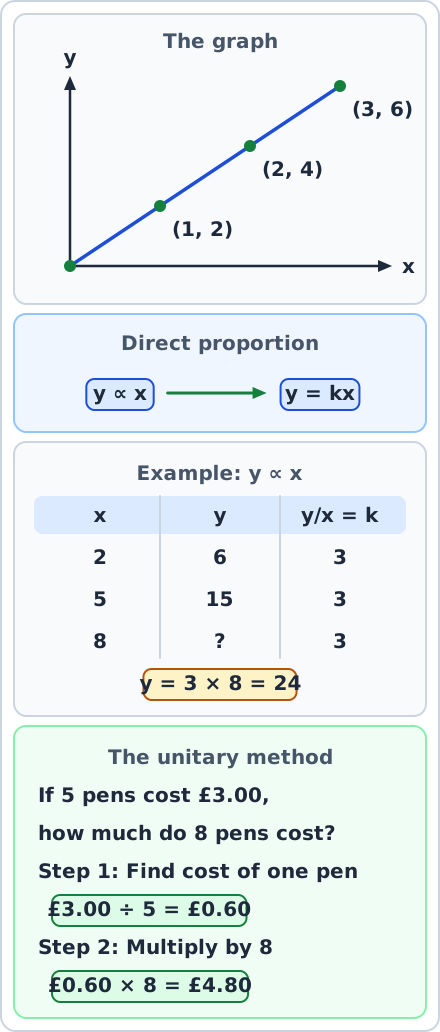
The graph is a straight line through the origin (0, 0). As x increases, y increases, and the ratio y/x is always constant. We write y ∝ x, which means y is proportional to x. In y = kx, k is the constant of proportionality: to find k, divide any y value by its x value.
Key Features of Direct Proportion
We write y ∝ x to mean "y is directly proportional to x"
This means y = kx where k is a constant
| Feature | What it means |
|---|---|
| Graph shape | Straight line through the origin (0,0) |
| When x doubles | y also doubles |
| Ratio y/x | Always the same (equals k) |
| The constant k | k = y ÷ x (the gradient of the line) |
Method 1: The Multiplier Method
What did you multiply x by to get the new x?
In direct proportion, y changes by the same factor
Method 2: The Unitary Method
Divide to find what 1 of x gives you
Multiply by how many you actually need
Worked Example 1: Using the Formula
y is directly proportional to x. When x = 4, y = 20. Find y when x = 7.
Step 1 Find the constant k
y = kx, so k = y ÷ x
k = 20 ÷ 4 = 5
Step 2 Write the formula
y = 5x
Step 3 Substitute x = 7
y = 5 × 7 = 35
Worked Example 2: Unitary Method
6 bottles of water cost £4.50. How much do 10 bottles cost?
Step 1 Find cost of 1 bottle
1 bottle = £4.50 ÷ 6 = £0.75
Step 2 Find cost of 10 bottles
10 bottles = £0.75 × 10 = £7.50
Worked Example 3: Best Buy Problem
Shop A: 5 apples for £1.20. Shop B: 8 apples for £2.00. Which is better value?
Step 1 Find price per apple at each shop
Shop A: £1.20 ÷ 5 = £0.24 per apple
Shop B: £2.00 ÷ 8 = £0.25 per apple
Step 2 Compare
Shop A is better value (cheaper per apple)
Common Mistakes to Avoid
Make this stick
Signing in gives access to all PrepWise features.