Test yourself on Proof with exam style questions, marked instantly.
Flashcards that come back just before you would forget them.
A revision plan that remembers what you know and shows what to do next.
See which topics you have nailed and which need another look.
Quiz yourself on ProofGet your flashcardsBuild my revision planTrack my progressProving It's ALWAYS True
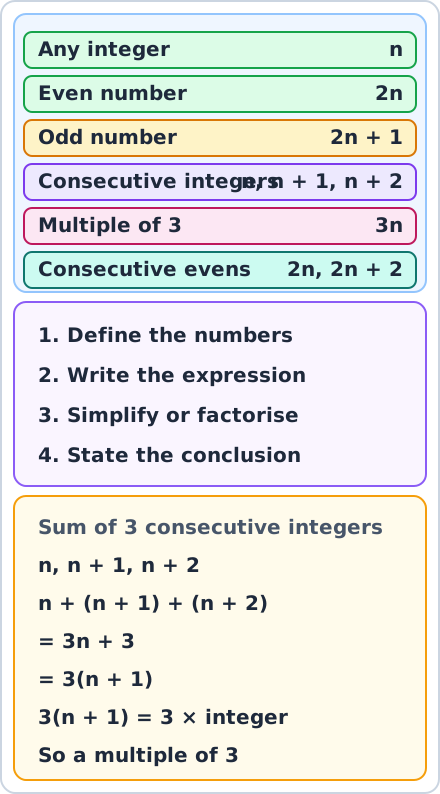
2n is always even, because 2n has a factor of 2. 2n + 1 is always odd, because it is one more than an even number. n and n + 1 are consecutive, because whatever n is, n + 1 is the next integer. In a proof, define your numbers (for example "Let the integers be n and n + 1"), write the expression for what you are proving ("Sum = n + (n + 1) = 2n + 1"), simplify and factorise if needed ("= 2n + 1, which is odd, the form 2k + 1"), then state your conclusion clearly. Tip: to show "multiple of k", factorise to get k × (something). To show "even", factorise to get 2 × (something).
Key Representations
| Type of Number | Algebraic Form |
|---|---|
| Any integer | n |
| Even number | 2n |
| Odd number | 2n + 1 |
| Consecutive integers | n, n + 1, n + 2 |
| Consecutive even numbers | 2n, 2n + 2, 2n + 4 |
| Consecutive odd numbers | 2n + 1, 2n + 3, 2n + 5 |
| Multiple of 3 | 3n |
Worked Example
Prove that the sum of any two odd numbers is always even.
Solution
Let the two odd numbers be (2a + 1) and (2b + 1)
Sum = (2a + 1) + (2b + 1)
= 2a + 2b + 2
= 2(a + b + 1)
This is 2 × (integer), so it is always even.
Make this stick
Signing in gives access to all PrepWise features.