Test yourself on Sequences with exam style questions, marked instantly.
Flashcards that come back just before you would forget them.
A revision plan that remembers what you know and shows what to do next.
See which topics you have nailed and which need another look.
Quiz yourself on SequencesGet your flashcardsBuild my revision planTrack my progressWhat's a Pattern?
Visual Guide
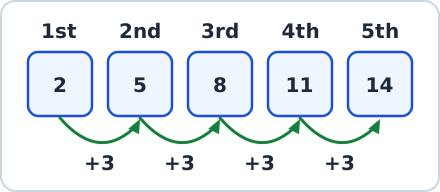
The number added each time is the common difference.
Key Vocabulary
| Term | Meaning | Example |
|---|---|---|
| Sequence | A list of numbers following a pattern | 2, 5, 8, 11, 14, ... |
| Term | Each number in a sequence | 1st term, 2nd term, etc. |
| Common difference (d) | The amount added each time | In 2, 5, 8... d = 3 |
| Arithmetic sequence | A sequence with a constant difference | 4, 7, 10, 13... (d = 3) |
| Pattern | The rule that generates the sequence | Start at 2, add 3 each time |
Types of Sequences
Add the same number each time: 3, 7, 11, 15, 19... (+4)
Multiply by the same number each time: 2, 6, 18, 54... (×3)
Add the previous two terms: 1, 1, 2, 3, 5, 8, 13...
Perfect squares: 1, 4, 9, 16, 25... (1², 2², 3²...)
Worked Example 1: Identifying Patterns
Find the pattern in the sequence: 5, 9, 13, 17, 21, ...
Step 1 Find the differences
9 − 5 = 4
13 − 9 = 4
17 − 13 = 4
Common difference = 4
Step 2 Describe the pattern
Start with 5, add 4 each time
This is an arithmetic sequence
Step 3 Find the next terms
21 + 4 = 25
25 + 4 = 29
Next terms: 25, 29
Worked Example 2: Different Sequence Types
Identify the type of sequence: 3, 6, 12, 24, 48, ...
Step 1 Check differences
6 − 3 = 3
12 − 6 = 6
24 − 12 = 12
Differences are not constant
Step 2 Check ratios
6 ÷ 3 = 2
12 ÷ 6 = 2
24 ÷ 12 = 2
Common ratio = 2
Step 3 Identify type
This is a geometric sequence (multiply by 2)
Next term: 48 × 2 = 96
Common Mistakes to Avoid
Make this stick
Signing in gives access to all PrepWise features.