AQA GCSE Mathematics Paper 2Calculator (Higher Tier): every question, answered
AQA GCSE Mathematics (8300) Higher Tier Paper 2 is the calculator paper. We analysed every sitting we could obtain the real question paper and mark scheme for: June 2018, June 2019, June 2022 and June 2023 (June 2020 and June 2021 do not exist as normal exam sittings, since GCSE exams were cancelled in both years because of the pandemic). A calculator paper still has around 25 to 30 short questions covering a huge spread of separate skills, but a calculator being allowed does not mean working can be skipped: the real mark schemes below show that method marks are very often withheld from students who show no working, even when a calculator got them to the right number. Below is what each recurring skill has actually asked across the four sittings we have, with a complete worked answer written to the mark scheme for each one, every paragraph explained.
Questions © AQA, quoted for analysis. Diagrams and figures described or recreated in our own words, not reproduced verbatim. Mark scheme content translated into plain English, not copied. PrepWise is independent and not endorsed by AQA.
The paper is a template
Same 21 question types, every sitting“Two of the four sittings we have full papers for give a scale drawing or grid and ask for a loci region to be constructed with compasses and correctly identified.”
Each version needs a genuine compass construction, never a ruler estimate, to find a boundary, then correctly identifies which side or overlap of that boundary satisfies the stated condition, either the overlap of two reach-distances (June 2019) or the overlap of a distance condition and a nearer-to condition (June 2019).
1×asked“The scale drawing represents a garden. Water from a sprinkler at P reaches up to 20 metres from P. Water from a sprinkler at Q reaches up to 25 metres from Q. Using a pair of compasses, show the region that water from both sprinklers reaches. [2 marks]”
“The scale drawing represents a garden. Water from a sprinkler at P reaches up to 20 metres from P. Water from a sprinkler at Q reaches up to 25 metres from Q. Using a pair of compasses, show the region that water from both sprinklers reaches. [2 marks]”
What it’s really asking
Convert each sprinkler's real reach into a scale-drawing radius using the scale, 1 cm representing 5 m, draw both arcs with compasses, then identify only the overlapping region that both sprinklers can reach.
What the sources actually showed — June 2018
A rectangular garden shown on a plain grid with a scale of 1 cm representing 5 m. Two points, P and Q, are marked at different positions inside the garden. This source is a construction diagram, not a data table or graph, so no numeric table or chart applies here.
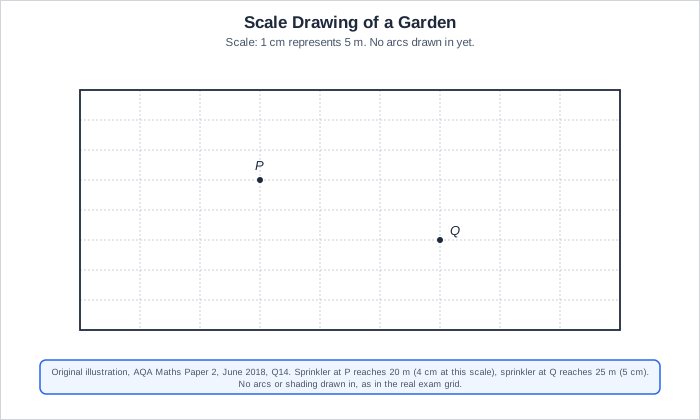
The full worked answer — June 2018
Using the scale of 1 cm representing 5 m, the 20 m reach from P converts to a compass radius of 4 cm, and the 25 m reach from Q converts to a compass radius of 5 cm. Setting compasses to 4 cm and drawing an arc centred on P earns the first mark, since an arc drawn at the correct radius from either centre is creditworthy on its own.
Resetting the compasses to 5 cm and drawing a second arc centred on Q completes both boundaries. The region that water from both sprinklers reaches is the overlap between the two arcs, not the total area covered by either sprinkler alone, so only this overlapping region should be shaded or labelled to earn the final mark.
Could you have written this? Every fact in this answer is drilled in our quizzes — the writing is the easy part once the evidence is automatic.
Practise loci construction questionsWhat the mark scheme rewarded
- 1 mark for drawing an arc at the correct radius from either P or Q using compasses, and 1 mark, building on the first, for drawing both arcs at the correct radius and shading or labelling only the region reached by both sprinklers.
- Converting a real-world distance into a scale-drawing length using the given scale before any construction begins
- A region reached by both sprinklers is the overlap, the intersection, of the two circles, never the combined, union, area covered by either one
Traps examiners saw
- Drawing the arcs at a radius of 20 cm or 25 cm by forgetting to apply the scale
- Shading the whole area covered by either sprinkler instead of only the overlapping region reached by both
Full-mark self-check 0 of 3
1×asked“Using ruler and compasses, show the region inside the grid that is less than 4 cm from A and nearer to B than to C. Label the region R. Show all your construction lines. [3 marks]”
“Using ruler and compasses, show the region inside the grid that is less than 4 cm from A and nearer to B than to C. Label the region R. Show all your construction lines. [3 marks]”
What it’s really asking
Construct an arc of radius 4 cm from A to bound the distance condition, construct the perpendicular bisector of BC to bound the nearer-to condition, then label only the region satisfying both conditions at once as R.
What the sources actually showed — June 2019
A plain square grid showing three labelled points, A, B and C, at different fixed positions, with no separate scale given other than the grid squares themselves. This source is a construction diagram, not a data table or graph.
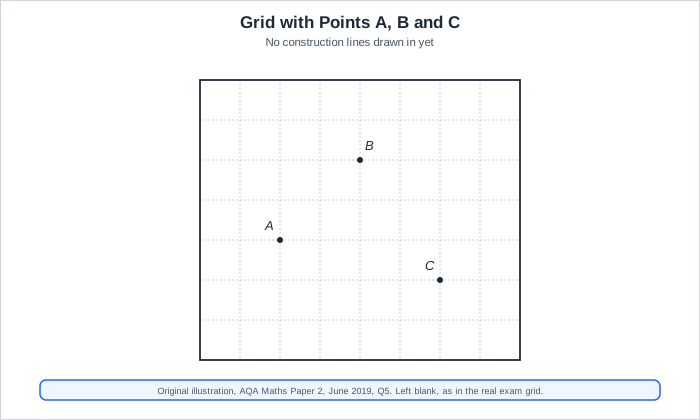
The full worked answer — June 2019
Setting compasses to a radius of exactly 4 cm and drawing an arc centred on A earns the first mark. Every point inside this arc is less than 4 cm from A, which is the first condition.
Constructing the perpendicular bisector of BC, using compass arcs centred on B and on C that cross above and below the line, then drawing a straight line through both crossing points, earns the second mark. Every point on this line is exactly the same distance from B and from C, so the side of the line closer to B is nearer to B than to C.
The region R is the part of the grid that is inside the 4 cm arc from A and on the B side of the perpendicular bisector of BC at the same time. Labelling only this overlapping area as R earns the final mark; a region that only satisfies one of the two conditions does not score full marks.
Could you have written this? Every fact in this answer is drilled in our quizzes — the writing is the easy part once the evidence is automatic.
Practise loci construction questionsWhat the mark scheme rewarded
- 1 mark for a compass arc of radius 4 cm centred on A, 1 mark for the perpendicular bisector of BC constructed with genuine compass arcs through the correct grid points, and 1 mark for correctly labelling the region satisfying both conditions as R.
- Less than a fixed distance from a point is always bounded by a compass arc of that radius
- The locus of points equidistant from two points is the perpendicular bisector of the line joining them, constructed with compass arcs centred on each point
Traps examiners saw
- Using a ruler to estimate the perpendicular bisector instead of constructing it with compass arcs from B and C
- Labelling the side of the bisector further from B, which is nearer to C, as region R
Full-mark self-check 0 of 3
The method for every Q14 (Jun18) / Q5 (Jun19) — same every sittingMark bands, steps, timing
What this question type rewards
The topic changes by sitting — the mark scheme never does. Learn this once, then open your question above for that sitting’s sources and a full worked answer.
- Drawing an arc at the correct radius using compasses, converted from a real distance using the scale where needed
- Constructing a genuine perpendicular bisector using compass arcs from each point, not a ruler estimate
- Correctly identifying the region that satisfies every condition at once, not just one of them
The steps
- Convert any real-world distances into the scale drawing's units using the given scale
- Set compasses to the correct radius and draw each arc accurately
- For a nearer to X than Y condition, construct the perpendicular bisector of XY with compass arcs from each point
- Shade or label only the region that satisfies every condition at the same time
Which of the following best defines a locus (plural: loci)?
Loci constructions come up in two of the four sittings we have. Practise converting distances with a scale and constructing genuine compass loci, never a ruler estimate.
Practise loci construction questions“All four sittings we have full papers for test bounds or error intervals, and every version requires choosing the correct combination of upper and lower bounds for the specific operation involved.”
Each version gives one or more rounded values and requires either stating the error interval directly (June 2018), substituting bounds into a formula to find a lower bound (June 2019), using the worst-case bounds to prove a claim (June 2022), or substituting bounds to find an upper bound of an expression with a subtraction in it (June 2023).
1×asked“The length of each side of a regular pentagon is 8.4 cm to 1 decimal place. (a) Complete the error interval for the length of one side. [2 marks] (b) Complete the error interval for the perimeter. [1 mark]”
“The length of each side of a regular pentagon is 8.4 cm to 1 decimal place. (a) Complete the error interval for the length of one side. [2 marks] (b) Complete the error interval for the perimeter. [1 mark]”
What it’s really asking
Halve the degree of accuracy (1 decimal place) to find the error interval for one side, then multiply both bounds by 5, the number of sides, to find the error interval for the perimeter.
The full worked answer — June 2018
A length of 8.4 cm rounded to 1 decimal place could be anywhere from 0.05 below to 0.05 up to but not including 0.05 above. The lower bound is 8.4 minus 0.05, which is 8.35 cm, and the upper bound is 8.4 plus 0.05, which is 8.45 cm, giving the error interval 8.35 is less than or equal to length, which is less than 8.45.
The perimeter of a regular pentagon is 5 times the side length, so the lower bound of the perimeter is 5 times 8.35, which is 41.75 cm, and the upper bound is 5 times 8.45, which is 42.25 cm, giving 41.75 is less than or equal to perimeter, which is less than 42.25.
Could you have written this? Every fact in this answer is drilled in our quizzes — the writing is the easy part once the evidence is automatic.
Practise bounds and error interval questionsWhat the mark scheme rewarded
- 2 marks for the correct error interval for one side, 8.35 up to but not including 8.45, and 1 mark for the correct error interval for the perimeter following through from that answer.
- A value rounded to 1 decimal place could be anywhere within 0.05 of the stated value, since anything closer would round to a different first decimal digit
- The upper bound of an error interval always uses a strict less-than sign, since a value equal to the upper bound would round up, not stay at the stated value
Traps examiners saw
- Using the wrong inequality sign on the upper bound, writing less-than-or-equal-to instead of strictly less-than
- Forgetting to multiply both bounds by 5 for the perimeter and reusing the side's error interval instead
Full-mark self-check 0 of 3
1×asked“m = (p minus 2b) divided by 2. p = 68.3, correct to 1 decimal place. b = 8.7, correct to 1 decimal place. Work out the lower bound for m. [3 marks]”
“m = (p minus 2b) divided by 2. p = 68.3, correct to 1 decimal place. b = 8.7, correct to 1 decimal place. Work out the lower bound for m. [3 marks]”
What it’s really asking
Work out which combination of upper and lower bounds for p and b makes m as small as possible, since b is subtracted, then substitute those bounds into the formula.
The full worked answer — June 2019
The bounds for p, rounded to 1 decimal place, are 68.25 up to but not including 68.35, and the bounds for b are 8.65 up to but not including 8.75.
In the formula, m gets smaller when p is smaller and when b is larger, since b is being subtracted after being doubled, so the lower bound for m uses the lower bound of p, 68.25, together with the upper bound of b, 8.75, not the lower bound of both.
Substituting these values gives m equals 68.25 minus 2 times 8.75, all divided by 2, which is 68.25 minus 17.5, divided by 2, which is 50.75 divided by 2, giving 25.375.
Could you have written this? Every fact in this answer is drilled in our quizzes — the writing is the easy part once the evidence is automatic.
Practise bounds and error interval questionsWhat the mark scheme rewarded
- 1 mark for correctly stating the bounds of p and b, 1 mark for combining the lower bound of p with the upper bound of b in the formula, and 1 mark for the correct final value, 25.375.
- When a variable is subtracted in a formula, using its upper bound makes the overall result smaller, the opposite of what happens with a variable that is added
- Always check the sign of each variable in the formula before deciding whether its upper or lower bound minimises or maximises the result
Traps examiners saw
- Automatically using the lower bound for every variable without checking whether it is added or subtracted in the formula
- Halving the wrong amount, using 0.1 instead of 0.05 as the distance from the rounded value to each bound
Full-mark self-check 0 of 3
1×asked“To be rented, a bedroom must have a floor area of at least 6.51 square metres. A bedroom has a rectangular floor. The floor measures 2.4 m by 2.9 m, each correct to 2 significant figures. Show that the bedroom can be rented. [3 marks]”
“To be rented, a bedroom must have a floor area of at least 6.51 square metres. A bedroom has a rectangular floor. The floor measures 2.4 m by 2.9 m, each correct to 2 significant figures. Show that the bedroom can be rented. [3 marks]”
What it’s really asking
Find the lower bound of each side length, since these give the smallest possible area, and show that even this smallest possible area still meets the required minimum.
The full worked answer — June 2022
Rounded to 2 significant figures, 2.4 m has a lower bound of 2.35 m and 2.9 m has a lower bound of 2.85 m, since each true length could be up to 0.05 below the stated value before it would round differently.
The smallest possible area of the floor is 2.35 times 2.85, which is 6.6975 square metres. Since 6.6975 is still greater than the required 6.51 square metres, even the worst-case measurements show the bedroom can be rented.
Could you have written this? Every fact in this answer is drilled in our quizzes — the writing is the easy part once the evidence is automatic.
Practise bounds and error interval questionsWhat the mark scheme rewarded
- 1 mark for identifying the lower bound of at least one length, 1 mark for multiplying the two lower bounds correctly to reach 6.6975, and 1 mark for concluding that this satisfies the minimum requirement of 6.51.
- For an area calculation, using the lower bound of every length gives the smallest possible area; if even this smallest possible area still meets the requirement, the claim is proven for every possible true measurement
- A significant-figure bound is found the same way as a decimal-place bound, by halving the gap between consecutive values at that level of accuracy
Traps examiners saw
- Using the upper bounds instead of the lower bounds, which would only prove the claim for the largest possible floor, not the worst case
- Comparing 6.6975 to 6.51 without stating a conclusion, since a show-that question needs the comparison made explicit
Full-mark self-check 0 of 3
1×asked“a = 65 to the nearest integer. b = 30 to 1 significant figure. Work out the upper bound for 2a squared minus b squared. You must show your working. [3 marks]”
“a = 65 to the nearest integer. b = 30 to 1 significant figure. Work out the upper bound for 2a squared minus b squared. You must show your working. [3 marks]”
What it’s really asking
Use the upper bound of a, since it is squared and added, together with the lower bound of b, since it is squared and subtracted, to make the whole expression as large as possible.
The full worked answer — June 2023
The bounds for a, rounded to the nearest integer, are 64.5 up to but not including 65.5, so the upper bound is 65.5. The bounds for b, rounded to 1 significant figure, are 25 up to but not including 35, so the lower bound is 25.
To maximise 2 times a squared minus b squared, a should be as large as possible, since it is added, so use the upper bound 65.5; b should be as small as possible, since b squared is subtracted, so use the lower bound 25, not its upper bound.
Substituting gives 2 times 65.5 squared minus 25 squared, which is 2 times 4290.25 minus 625, which is 8580.5 minus 625, giving 7955.5 as the upper bound.
Could you have written this? Every fact in this answer is drilled in our quizzes — the writing is the easy part once the evidence is automatic.
Practise bounds and error interval questionsWhat the mark scheme rewarded
- 1 mark for correctly stating the bounds of a and b, 1 mark for combining the upper bound of a with the lower bound of b, and 1 mark for the correct final value, 7955.5.
- In an expression with a term that is subtracted, that term's own bound must be chosen to minimise its value in order to maximise the whole expression, which usually means the lower bound of the variable being subtracted
- Squaring a bound before comparing it to another squared bound does not change which bound (upper or lower) should be chosen; the sign in the original expression decides that
Traps examiners saw
- Using the upper bound of b as well as a, which would minimise rather than maximise the expression
- Rounding to the nearest integer treated the same as rounding to 1 significant figure without checking the actual gap each implies for that specific number
Full-mark self-check 0 of 3
The method for every Q9 (Jun18) / Q17 (Jun19) / Q27 (Jun22) / Q24 (Jun23) — same every sittingMark bands, steps, timing
What this question type rewards
The topic changes by sitting — the mark scheme never does. Learn this once, then open your question above for that sitting’s sources and a full worked answer.
- Halving the degree of accuracy to find how far a rounded value could be from its true value
- Writing the error interval with the correct inequality signs, since a value could round up but never round down to the boundary above it
- Choosing the correct combination of upper and lower bounds depending on whether the operation increases or decreases the result
The steps
- Find half the degree of accuracy the value was rounded to
- Add and subtract this half to find the upper and lower bound
- Write the error interval using a less-than-or-equal-to sign on the lower bound and a strict less-than sign on the upper bound
- For a calculation, decide whether each bound should be the upper or lower value to get the largest or smallest possible answer
A length is 240 cm to the nearest 10 cm. What is the lower bound of the length?
Bounds and error intervals come up in every one of the four sittings we have. Practise choosing the correct combination of upper and lower bounds for the operation in front of you.
Practise bounds and error interval questions“Three of the four sittings we have full papers for test the relationship between length, area and volume scale factors for similar shapes.”
Each version starts from one type of scale factor and asks for a different one, from volume to area (June 2018), from area to volume (June 2019), or from length to volume (June 2022), always via the length scale factor as the connecting step.
1×asked“Solids X and Y are similar. X has volume 64 cubic cm. Y has volume 343 cubic cm. The surface area of X is 176 square cm. Work out the surface area of Y. [3 marks]”
“Solids X and Y are similar. X has volume 64 cubic cm. Y has volume 343 cubic cm. The surface area of X is 176 square cm. Work out the surface area of Y. [3 marks]”
What it’s really asking
Find the length scale factor by taking the cube root of the volume ratio, then square that length scale factor to find the area scale factor, and apply it to the known surface area.
The full worked answer — June 2018
The volume ratio of X to Y is 64 to 343. Since 64 is 4 cubed and 343 is 7 cubed, the length scale factor from X to Y is the cube root of the volume ratio, which is 4 to 7.
The area scale factor is the length scale factor squared, so 4 squared to 7 squared, which is 16 to 49.
Applying this scale factor to the surface area of X, 176 times 49 over 16 gives 539 square cm as the surface area of Y.
Could you have written this? Every fact in this answer is drilled in our quizzes — the writing is the easy part once the evidence is automatic.
Practise similar shapes questionsWhat the mark scheme rewarded
- 1 mark for taking the cube root of the volume ratio to find the length scale factor 4 to 7, 1 mark (dependent) for squaring this to find the area scale factor 16 to 49, and 1 mark for the correct final surface area, 539 square cm.
- For similar shapes, the length scale factor is found from a volume ratio by taking a cube root, since volume scales with the cube of length
- The area scale factor is always the length scale factor squared, never the volume scale factor squared or used directly
Traps examiners saw
- Applying the volume ratio, 64 to 343, directly to the surface area instead of converting to the area scale factor first
- Squaring the volume ratio instead of the length scale factor, which produces a badly wrong answer
Full-mark self-check 0 of 3
1×asked“A and B are similar cuboids. Surface area of A to surface area of B equals 16 to 25. Work out volume of A to volume of B. Circle your answer. [1 mark]”
“A and B are similar cuboids. Surface area of A to surface area of B equals 16 to 25. Work out volume of A to volume of B. Circle your answer. [1 mark]”
What it’s really asking
Find the length scale factor by taking the square root of the area ratio, then cube that length scale factor to find the volume ratio.
What the sources actually showed — June 2019
Four ratios to choose from: 4 to 5, 16 to 25, 64 to 125, and 256 to 625.
The full worked answer — June 2019
The area ratio 16 to 25 has square roots 4 and 5, since 4 squared is 16 and 5 squared is 25, so the length scale factor of A to B is 4 to 5. Cubing this length scale factor gives the volume ratio, 4 cubed to 5 cubed, which is 64 to 125.
Could you have written this? Every fact in this answer is drilled in our quizzes — the writing is the easy part once the evidence is automatic.
Practise similar shapes questionsWhat the mark scheme rewarded
- 1 mark for selecting 64 to 125, reached by taking the square root of the area ratio to find the length scale factor, then cubing it for the volume ratio.
- An area ratio's square root gives the length scale factor, since area scales with the square of length
- The volume ratio is the length scale factor cubed, which is why 16 to 25 (area) becomes 64 to 125 (volume), not 25 to 16 cubed or the area ratio unchanged
Traps examiners saw
- Selecting 16 to 25 itself, mistaking the given area ratio for the volume ratio
- Selecting 256 to 625, which comes from squaring the area ratio instead of finding the length scale factor first
Full-mark self-check 0 of 3
1×asked“The actual cornets that the cafe sells are similar to the plastic one. For the actual cornets, the cone and the hemisphere each have radius 2 cm (the plastic cornet's cone and hemisphere each have radius 24 cm). How many times greater is the volume of the plastic cornet than an actual cornet? [3 marks]”
“The actual cornets that the cafe sells are similar to the plastic one. For the actual cornets, the cone and the hemisphere each have radius 2 cm (the plastic cornet's cone and hemisphere each have radius 24 cm). How many times greater is the volume of the plastic cornet than an actual cornet? [3 marks]”
What it’s really asking
Find the length scale factor between the two cornets from their radii, then cube it to find how many times greater the plastic cornet's volume is.
What the sources actually showed — June 2022
A large plastic ice cream cornet outside a cafe, made of a hemisphere sitting on top of a cone, both with radius 24 cm and the cone with perpendicular height 117 cm. A smaller, actual cornet sold by the cafe is similar in shape but has radius 2 cm for both the cone and hemisphere.
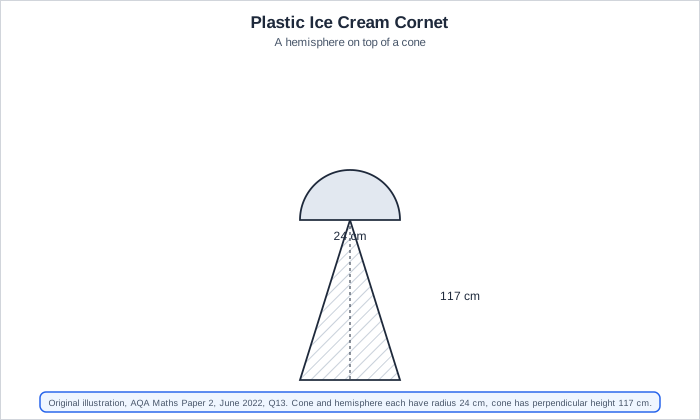
The full worked answer — June 2022
The length scale factor from the actual cornet to the plastic cornet is found by dividing the radii, 24 divided by 2, which is 12.
The volume scale factor is the length scale factor cubed, so 12 cubed, which is 1728.
So the volume of the plastic cornet is 1728 times greater than the volume of an actual cornet.
Could you have written this? Every fact in this answer is drilled in our quizzes — the writing is the easy part once the evidence is automatic.
Practise similar shapes questionsWhat the mark scheme rewarded
- 1 mark for finding the length scale factor, 12, from the two radii, 1 mark (dependent) for cubing it, and 1 mark for the correct final value, 1728.
- Because the two cornets are described as similar, every linear measurement scales by the same factor, so the length scale factor can be found from the radii alone without needing the full composite volume
- Volume always scales with the cube of the length scale factor for similar 3D shapes, whatever composite shape they are made from
Traps examiners saw
- Working out the full composite volume of both cornets and dividing, which is valid but far slower and more error-prone than using the length-to-volume scale factor shortcut
- Squaring the length scale factor instead of cubing it, confusing this with an area scale factor question
Full-mark self-check 0 of 3
The method for every Q23 (Jun18) / Q23 (Jun19) / Q13b (Jun22) — same every sittingMark bands, steps, timing
What this question type rewards
The topic changes by sitting — the mark scheme never does. Learn this once, then open your question above for that sitting’s sources and a full worked answer.
- Finding the length scale factor first, using a cube root if starting from volumes or a square root if starting from areas
- Squaring the length scale factor to move to an area scale factor, or cubing it to move to a volume scale factor
- Applying the correct scale factor to the correct starting quantity
The steps
- Identify which type of ratio is given: length, area or volume
- Convert this to the length scale factor using a cube root (from volume) or a square root (from area), or leave it as is (from length)
- Square the length scale factor for an area scale factor, or cube it for a volume scale factor
- Multiply the given starting quantity by the correct scale factor to find the unknown quantity
Which of the following is NOT a valid congruence condition for triangles?
Similar shape scale factors come up in three of the four sittings we have. Practise converting cleanly between length, area and volume scale factors.
Practise similar shapes questions“Two of the four sittings we have full papers for combine a hemisphere volume calculation with a rate word problem answered as a yes or no decision, supported by working.”
Each version gives the sphere volume formula, halves it for the hemisphere, then compares a filling rate to either a time target (June 2018) or a percentage-filled target (June 2023).
1×asked“Volume of a sphere = 4 over 3 times pi times r cubed, where r is the radius. A container is a hemisphere of radius 30 cm. Sand fills the container at a rate of 4000 cubic cm per minute. Does it take less than a quarter of an hour to fill the container? You must show your working. [3 marks]”
“Volume of a sphere = 4 over 3 times pi times r cubed, where r is the radius. A container is a hemisphere of radius 30 cm. Sand fills the container at a rate of 4000 cubic cm per minute. Does it take less than a quarter of an hour to fill the container? You must show your working. [3 marks]”
What it’s really asking
Find the volume of the hemisphere, divide by the filling rate to find the actual time needed in minutes, then compare this to a quarter of an hour, 15 minutes.
The full worked answer — June 2018
The volume of a full sphere of radius 30 cm is 4 over 3 times pi times 30 cubed, which is 36000 pi. The hemisphere is half of this, so 18000 pi, which is approximately 56 549 cubic cm.
Dividing this volume by the filling rate of 4000 cubic cm per minute gives approximately 14.1 minutes to fill the container.
A quarter of an hour is 15 minutes, and 14.1 minutes is less than 15 minutes, so yes, it does take less than a quarter of an hour to fill the container.
Could you have written this? Every fact in this answer is drilled in our quizzes — the writing is the easy part once the evidence is automatic.
Practise sphere and hemisphere volume questionsWhat the mark scheme rewarded
- 1 mark for the hemisphere volume, approximately 56 549 cubic cm, 1 mark (dependent) for dividing by 4000 to get approximately 14.1 minutes, and 1 mark for the correct yes conclusion, comparing this correctly to 15 minutes.
- A hemisphere's volume is always half of the full sphere volume formula's result for the same radius
- A quarter of an hour must be converted to 15 minutes before comparing, since the filling rate is given per minute, not per hour
Traps examiners saw
- Forgetting to halve the sphere volume formula's result, using the full sphere's volume for the hemisphere instead
- Comparing the time in minutes to a quarter of an hour written as 0.25 without converting it to 15 minutes first, or comparing the wrong way round
Full-mark self-check 0 of 3
1×asked“Volume of a sphere = 4 over 3 times pi times r cubed. A bowl is a hemisphere with radius 12 cm. Water is poured into the bowl at a rate of 325 cubic cm per second for 8 seconds. Does the water fill more than 70% of the bowl? You must show your working. [4 marks]”
“Volume of a sphere = 4 over 3 times pi times r cubed. A bowl is a hemisphere with radius 12 cm. Water is poured into the bowl at a rate of 325 cubic cm per second for 8 seconds. Does the water fill more than 70% of the bowl? You must show your working. [4 marks]”
What it’s really asking
Find the total volume of water poured in, find the hemisphere's full volume, then work out what percentage of the bowl the water fills and compare it to 70%.
The full worked answer — June 2023
The volume of a full sphere of radius 12 cm is 4 over 3 times pi times 12 cubed, which is 2304 pi. The hemisphere is half of this, so 1152 pi, which is approximately 3619 cubic cm.
The total volume of water poured in is the rate multiplied by the time, 325 times 8, which is 2600 cubic cm.
The percentage of the bowl filled is 2600 divided by approximately 3619, multiplied by 100, which is approximately 72%. Since 72% is more than 70%, yes, the water does fill more than 70% of the bowl.
Could you have written this? Every fact in this answer is drilled in our quizzes — the writing is the easy part once the evidence is automatic.
Practise sphere and hemisphere volume questionsWhat the mark scheme rewarded
- 1 mark for the hemisphere's full volume, approximately 3619 cubic cm, 1 mark for the volume of water poured, 2600 cubic cm, 1 mark (dependent) for dividing to find approximately 72%, and 1 mark for the correct yes conclusion.
- To find what percentage of a container is filled, divide the volume of liquid poured in by the container's own full volume, then multiply by 100
- A hemisphere's full volume is always half of the full sphere volume formula's result, never the whole sphere volume
Traps examiners saw
- Comparing the volume of water poured in, 2600 cubic cm, directly to 70% of 3619 without actually calculating the percentage that 2600 represents
- Using the full sphere volume, 4 over 3 times pi times r cubed, instead of halving it for the hemisphere
Full-mark self-check 0 of 3
The method for every Q10 (Jun18) / Q11 (Jun23) — same every sittingMark bands, steps, timing
What this question type rewards
The topic changes by sitting — the mark scheme never does. Learn this once, then open your question above for that sitting’s sources and a full worked answer.
- Halving the sphere volume formula correctly to find the hemisphere's volume
- Working consistently in the same units throughout, since a mixed-up unit or time conversion loses marks even with correct volume working
- Stating a clear yes or no conclusion, not just a number, since the question asks a decision question
The steps
- Substitute the radius into the given sphere volume formula, then halve the result for the hemisphere
- Use the given rate and time (or the target percentage) to find the comparison quantity
- Compare the two values directly
- State a clear yes or no conclusion supported by the numbers
What is the formula for the volume of a sphere with radius r?
Hemisphere volume word problems come up in two of the four sittings we have. Practise halving the sphere formula correctly and working with consistent units.
Practise sphere and hemisphere volume questions“All four sittings we have full papers for combine Pythagoras or right-angled trigonometry with a second calculation, an area, a perimeter or a further angle, in a composite shape made of two joined pieces.”
Each version needs a missing side or angle worked out first, using Pythagoras (June 2019, June 2022) or a trig ratio (June 2018, June 2023), before that value can be used to answer the actual question asked.
1×asked“A pentagon is made from a square and an isosceles triangle sitting on top, sharing one side. The pentagon's interior angle where the square meets the triangle is 125 degrees, and the shared side (the square's side) is 12 cm. Work out the perimeter of the pentagon. [4 marks]”
“A pentagon is made from a square and an isosceles triangle sitting on top, sharing one side. The pentagon's interior angle where the square meets the triangle is 125 degrees, and the shared side (the square's side) is 12 cm. Work out the perimeter of the pentagon. [4 marks]”
What it’s really asking
Split the isosceles triangle into two right-angled triangles by dropping a perpendicular from its apex, use the base angle and half the base to find the slant side length with cosine, then add up all five sides of the pentagon.
What the sources actually showed — June 2018
A pentagon made from a square with an isosceles triangle attached to its top side. The diagram is marked not drawn accurately. The square's side is 12 cm, shared with the base of the isosceles triangle, and the pentagon's interior angle at that vertex is 125 degrees.
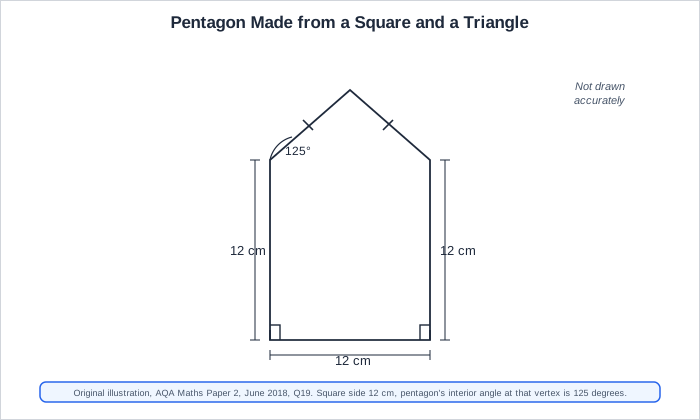
The full worked answer — June 2018
The marked 125 degree angle is the pentagon's interior angle at that vertex, made up of the square's 90 degree corner plus the isosceles triangle's base angle, so the base angle is 125 minus 90, which is 35 degrees. Dropping a perpendicular from the apex of the isosceles triangle then splits it into two identical right-angled triangles, each with a base of 6 cm, half of the 12 cm shared side, and this base angle of 35 degrees.
In this right-angled triangle, the 6 cm side is adjacent to the 35 degree angle and the slant side of the pentagon is the hypotenuse, so cosine of 35 degrees equals 6 divided by the slant side, giving a slant side of 6 divided by cosine 35, which is approximately 7.33 cm.
The pentagon's perimeter is made from three remaining sides of the square, 3 times 12, which is 36 cm, plus the two equal slant sides of the triangle, 2 times approximately 7.33, which is approximately 14.65 cm, giving a total perimeter of approximately 50.6 cm.
Could you have written this? Every fact in this answer is drilled in our quizzes — the writing is the easy part once the evidence is automatic.
Practise Pythagoras and trigonometry questionsWhat the mark scheme rewarded
- 1 mark for correctly identifying the base angle, 35 degrees, or the equivalent top angle, 1 mark (dependent) for a correct trigonometric equation for the slant side, 1 mark (dependent) for the value of the slant side, approximately 7.33 cm, and 1 mark for the final perimeter, in the range 50.6 to 50.65 cm.
- Dropping a perpendicular from the apex of an isosceles triangle to its base always creates two congruent right-angled triangles, each with half the original base
- The perimeter of a composite shape only includes the outer boundary; any side shared between the two joined shapes is internal and must not be counted
Traps examiners saw
- Counting all four sides of the square, forgetting that the side shared with the triangle is internal to the pentagon and not part of its perimeter
- Mixing up which side is adjacent and which is the hypotenuse when setting up the cosine ratio, leading to the reciprocal of the correct slant side
Full-mark self-check 0 of 3
1×asked“The diagram shows rectangle ABDE and right-angled triangle ABC. AC = 17 cm. BC = 8 cm. BC to CD equals 1 to 2. Work out the area of rectangle ABDE. [4 marks]”
“The diagram shows rectangle ABDE and right-angled triangle ABC. AC = 17 cm. BC = 8 cm. BC to CD equals 1 to 2. Work out the area of rectangle ABDE. [4 marks]”
What it’s really asking
Use Pythagoras in right-angled triangle ABC to find AB, then use the given ratio BC to CD to find CD, add BC and CD to find the rectangle's length, and multiply by AB.
What the sources actually showed — June 2019
A composite figure showing rectangle ABDE joined to right-angled triangle ABC along side AB, marked not drawn accurately. Points B, C and D lie on the same straight line, with C between B and D. AC = 17 cm and BC = 8 cm.
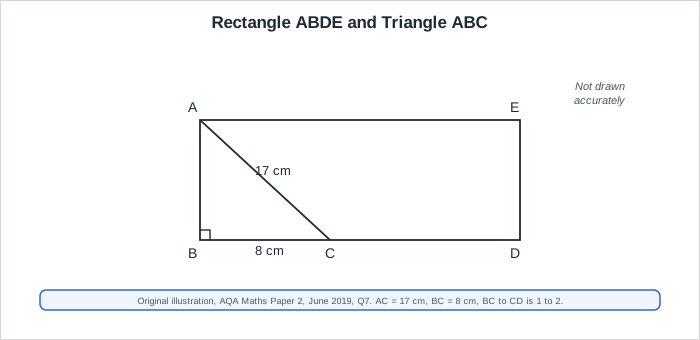
The full worked answer — June 2019
Triangle ABC is right-angled at B, with AC as the hypotenuse. Using Pythagoras, AB squared equals AC squared minus BC squared, which is 17 squared minus 8 squared, 289 minus 64, giving 225, so AB equals the square root of 225, which is 15 cm.
Since BC to CD equals 1 to 2 and BC is 8 cm, CD is twice 8, which is 16 cm. The rectangle's length, BD, is BC plus CD, 8 plus 16, which is 24 cm.
The area of rectangle ABDE is AB times BD, 15 times 24, which is 360 square cm.
Could you have written this? Every fact in this answer is drilled in our quizzes — the writing is the easy part once the evidence is automatic.
Practise Pythagoras and trigonometry questionsWhat the mark scheme rewarded
- 1 mark for squaring 17 and 8 correctly, 1 mark (dependent) for AB equals 15 cm, 1 mark (dependent) for a correct method for the rectangle's total area using the ratio, and 1 mark for the final answer, 360 square cm.
- In a right-angled triangle, Pythagoras relates the two shorter sides to the hypotenuse, so the hypotenuse must be correctly identified, the longest side, opposite the right angle, before rearranging the formula
- A ratio such as BC to CD equals 1 to 2 means CD is a direct multiple of BC's actual value, not of the whole line BD
Traps examiners saw
- Treating AB, not AC, as the hypotenuse, which would set up Pythagoras incorrectly
- Using AC instead of BC when applying the ratio 1 to 2 to find CD
Full-mark self-check 0 of 3
1×asked“A shape is made by joining a right-angled triangle to a rectangle. The right-angled triangle has legs 16 cm and 30 cm; the hypotenuse of the triangle is shared with one side of the rectangle, whose other side is 52 cm. Work out the area of the shape. [5 marks]”
“A shape is made by joining a right-angled triangle to a rectangle. The right-angled triangle has legs 16 cm and 30 cm; the hypotenuse of the triangle is shared with one side of the rectangle, whose other side is 52 cm. Work out the area of the shape. [5 marks]”
What it’s really asking
Use Pythagoras on the right-angled triangle to find the length of its hypotenuse, which is shared with the rectangle, then add the area of the triangle to the area of the rectangle.
What the sources actually showed — June 2022
A composite shape, marked not drawn accurately, made by joining a right-angled triangle to a rectangle along the triangle's hypotenuse. The triangle's two shorter sides are 16 cm and 30 cm, and the rectangle's other side is 52 cm.
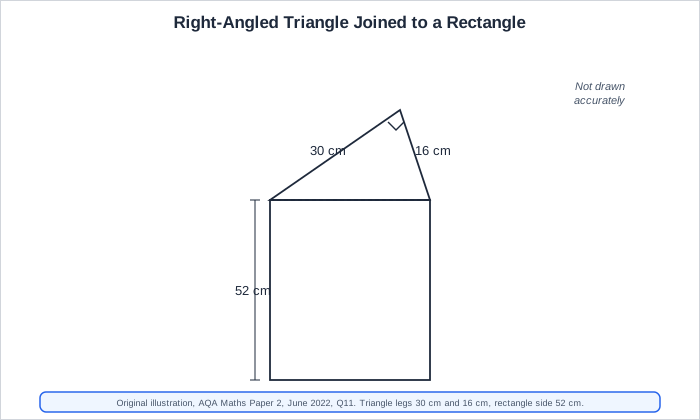
The full worked answer — June 2022
Using Pythagoras on the right-angled triangle, the hypotenuse squared equals 16 squared plus 30 squared, which is 256 plus 900, giving 1156, so the hypotenuse equals the square root of 1156, which is 34 cm.
The rectangle's area is 52 times 34, which is 1768 square cm, since the shared side, 34 cm, is one of the rectangle's own sides.
The triangle's area is a half times 16 times 30, which is 240 square cm. Adding the two areas together, 1768 plus 240, gives a total area of 2008 square cm.
Could you have written this? Every fact in this answer is drilled in our quizzes — the writing is the easy part once the evidence is automatic.
Practise Pythagoras and trigonometry questionsWhat the mark scheme rewarded
- 1 mark for squaring 16 and 30 correctly, 1 mark (dependent) for the hypotenuse equals 34 cm, 1 mark (dependent) for the rectangle's area, 1768 square cm, 1 mark for the triangle's area, 240 square cm, and 1 mark for the correct total, 2008 square cm.
- When two shapes in a composite figure share a side, a length found in one shape (here, the triangle's hypotenuse) becomes a known side of the other shape (the rectangle)
- The area of a right-angled triangle always uses its two shorter sides, never the hypotenuse, since these two sides meet at the right angle
Traps examiners saw
- Using the hypotenuse, 34 cm, as one of the triangle's own sides when calculating the triangle's area, instead of the two legs, 16 and 30
- Forgetting to add both areas together and stopping after finding only the rectangle's or only the triangle's area
Full-mark self-check 0 of 3
1×asked“A composite shape is made from two right-angled triangles sharing a common side. One triangle has a hypotenuse of 4 cm and includes a 37 degree angle; the other has a hypotenuse of 9.3 cm. Work out the size of angle x. [4 marks]”
“A composite shape is made from two right-angled triangles sharing a common side. One triangle has a hypotenuse of 4 cm and includes a 37 degree angle; the other has a hypotenuse of 9.3 cm. Work out the size of angle x. [4 marks]”
What it’s really asking
Use cosine in the first right-angled triangle to find the shared side from its 4 cm hypotenuse and 37 degree angle, then use that shared side with the 9.3 cm hypotenuse in the second triangle to find angle x with sine.
What the sources actually showed — June 2023
A figure, marked not drawn accurately, made of two right-angled triangles sharing a common side. One triangle has hypotenuse 4 cm and a marked angle of 37 degrees; the other, larger triangle has hypotenuse 9.3 cm and the unknown angle x marked at its vertex.
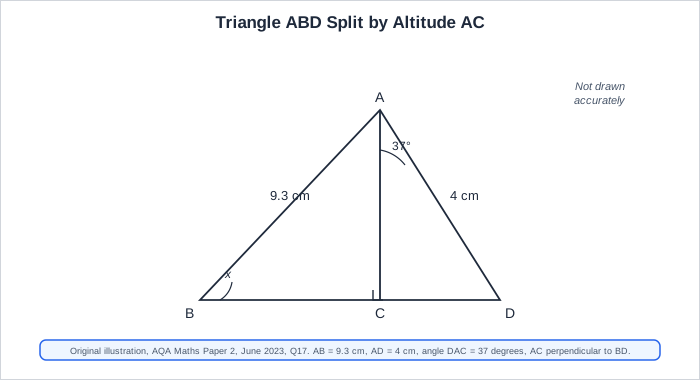
The full worked answer — June 2023
In the smaller right-angled triangle, the shared side is adjacent to the 37 degree angle and the 4 cm side is the hypotenuse, so cosine of 37 degrees equals the shared side divided by 4, giving a shared side of 4 times cosine 37, which is approximately 3.19 cm.
In the larger right-angled triangle, this shared side of approximately 3.19 cm is opposite angle x, and the 9.3 cm side is the hypotenuse, so sine of x equals approximately 3.19 divided by 9.3.
Taking the inverse sine gives x equals approximately 20.0 degrees.
Could you have written this? Every fact in this answer is drilled in our quizzes — the writing is the easy part once the evidence is automatic.
Practise Pythagoras and trigonometry questionsWhat the mark scheme rewarded
- 1 mark for a correct trigonometric equation in the first triangle, 1 mark (dependent) for the shared side, approximately 3.19 to 3.2 cm, 1 mark (dependent) for a correct trigonometric equation in the second triangle, and 1 mark for the final angle, in the range 19.87 to 20.13 degrees.
- A length found by trigonometry in one right-angled triangle can become a known side of a second, connected right-angled triangle, allowing the second triangle to be solved in turn
- Always check which side is adjacent, opposite or the hypotenuse relative to the angle actually being used before choosing sine, cosine or tangent
Traps examiners saw
- Using the shared side as the hypotenuse in the second triangle instead of correctly identifying it as the side opposite angle x
- Rounding the shared side too early, to a whole number of centimetres, before using it in the second triangle, which loses accuracy in the final angle
Full-mark self-check 0 of 3
The method for every Q19 (Jun18) / Q7 (Jun19) / Q11 (Jun22) / Q17 (Jun23) — same every sittingMark bands, steps, timing
What this question type rewards
The topic changes by sitting — the mark scheme never does. Learn this once, then open your question above for that sitting’s sources and a full worked answer.
- Identifying the right-angled triangle hidden inside the composite shape and correctly labelling which side is the hypotenuse
- Using Pythagoras to find a missing side when two sides of a right-angled triangle are already known
- Using a right-angled trig ratio, sine, cosine or tangent, when one side and one angle of a right-angled triangle are known
- Using the found length or angle correctly in the second half of the calculation, an area, a perimeter or a further angle
The steps
- Identify the right-angled triangle within the composite shape and label the known sides or angles
- Decide whether Pythagoras or a trig ratio is needed, based on what is known and what is missing
- Work out the missing length or angle
- Use this value to complete the actual quantity the question asks for
In a right-angled triangle with legs a and b and hypotenuse c, which formula is Pythagoras' theorem?
Composite shapes needing Pythagoras or trigonometry come up in every one of the four sittings we have. Practise spotting the hidden right-angled triangle inside a bigger shape.
Practise Pythagoras and trigonometry questions“Three of the four sittings we have full papers for give a multi-stage ratio word problem involving money, needing several linked calculations rather than a single ratio share.”
Each version links a ratio to a real money total in a different way: forming and solving an equation from a weekly-saving ratio (June 2018), using a three-part ratio with known prices to find an unknown price (June 2022), or using a multiplier ratio with a total to find an unknown coin value (June 2023).
1×asked“Theo starts with savings of 18 pounds. James starts with no savings. Each week from now, Theo will save 4.50 pounds and James will save 4 pounds. In how many weeks will Theo and James have savings in the ratio 15 to 8? [3 marks]”
“Theo starts with savings of 18 pounds. James starts with no savings. Each week from now, Theo will save 4.50 pounds and James will save 4 pounds. In how many weeks will Theo and James have savings in the ratio 15 to 8? [3 marks]”
What it’s really asking
Write expressions for both people's savings after x weeks, set their ratio equal to 15 to 8, then solve the resulting equation for x.
The full worked answer — June 2018
After x weeks, Theo has 18 plus 4.5x pounds and James has 4x pounds. Setting their ratio equal to 15 to 8 gives 18 plus 4.5x, all over 4x, equals 15 over 8.
Cross-multiplying eliminates the fractions, giving 8 times 18 plus 4.5x equals 15 times 4x, which is 144 plus 36x equals 60x.
Rearranging gives 144 equals 60x minus 36x, which is 144 equals 24x, so x equals 6. After 6 weeks, Theo and James's savings will be in the ratio 15 to 8.
Could you have written this? Every fact in this answer is drilled in our quizzes — the writing is the easy part once the evidence is automatic.
Practise ratio word problem questionsWhat the mark scheme rewarded
- 1 mark for a correct equation linking the ratio to the two savings expressions, 1 mark (dependent) for eliminating the fractions correctly, and 1 mark for the final answer, 6 weeks.
- A ratio between two changing amounts over time can be written as a fraction equal to the ratio's own fraction, and solved as an equation
- Cross-multiplying a ratio equation is the standard way to eliminate the fractions before solving for the unknown
Traps examiners saw
- Writing James's savings as 4x plus 18 by mistake, incorrectly giving him the same starting amount as Theo
- Setting up the ratio the wrong way round, 4x over 18 plus 4.5x equals 15 over 8, which would give a different, incorrect equation
Full-mark self-check 0 of 3
1×asked“Amol received 6660 pounds from selling 3000 sandwiches in June. The numbers of sandwiches sold were in the ratio meat to cheese to vegan equals 9 to 4 to 7. The price of a meat sandwich is 2.39 pounds. The price of a cheese sandwich is 1.89 pounds. Work out the price of a vegan sandwich. [4 marks]”
“Amol received 6660 pounds from selling 3000 sandwiches in June. The numbers of sandwiches sold were in the ratio meat to cheese to vegan equals 9 to 4 to 7. The price of a meat sandwich is 2.39 pounds. The price of a cheese sandwich is 1.89 pounds. Work out the price of a vegan sandwich. [4 marks]”
What it’s really asking
Use the ratio to find how many of each sandwich were sold, work out the total money from meat and cheese sandwiches, subtract this from the overall total to find the vegan revenue, then divide by the number of vegan sandwiches sold.
The full worked answer — June 2022
The ratio 9 to 4 to 7 has 20 parts in total, and 3000 sandwiches were sold, so each part represents 3000 divided by 20, which is 150 sandwiches. This gives 9 times 150, which is 1350 meat sandwiches, and 4 times 150, which is 600 cheese sandwiches.
The money from meat sandwiches is 1350 times 2.39, which is 3226.50 pounds, and the money from cheese sandwiches is 600 times 1.89, which is 1134 pounds, giving a combined total of 4360.50 pounds.
The money from vegan sandwiches is 6660 minus 4360.50, which is 2299.50 pounds. There were 7 times 150, which is 1050 vegan sandwiches sold, so the price of a vegan sandwich is 2299.50 divided by 1050, which is 2.19 pounds.
Could you have written this? Every fact in this answer is drilled in our quizzes — the writing is the easy part once the evidence is automatic.
Practise ratio word problem questionsWhat the mark scheme rewarded
- 1 mark for finding one part of the ratio, 150 sandwiches, 1 mark for the combined income from meat and cheese sandwiches, 1 mark (dependent) for a correct method to isolate the vegan income and divide by the number of vegan sandwiches, and 1 mark for the final price, 2.19 pounds.
- In a three-part ratio applied to a real total, finding the value of one part first unlocks every other quantity needed
- When a total income is split between several products, the unknown product's income can be found by subtracting the known products' income from the overall total
Traps examiners saw
- Working out the price per sandwich overall, 6660 divided by 3000, and mistakenly treating that as the vegan price
- Forgetting to divide the vegan revenue by the actual number of vegan sandwiches sold, 1050, and dividing by the wrong quantity instead
Full-mark self-check 0 of 3
1×asked“Jess saves 2p, 5p and 10p coins. She has 45 10p coins, 8 times as many 2p coins as 10p coins, and 17.70 pounds in total. Work out total value of 2p coins to total value of 5p coins. Give your answer in its simplest form. [4 marks]”
“Jess saves 2p, 5p and 10p coins. She has 45 10p coins, 8 times as many 2p coins as 10p coins, and 17.70 pounds in total. Work out total value of 2p coins to total value of 5p coins. Give your answer in its simplest form. [4 marks]”
What it’s really asking
Find the number and value of the 2p coins using the multiplier, find the value of the 5p coins by subtracting the known values from the total, then write the two values as a ratio in simplest form.
The full worked answer — June 2023
There are 45 10p coins, so there are 8 times 45, which is 360, 2p coins. The value of the 2p coins is 360 times 2p, which is 720p, or 7.20 pounds.
The value of the 10p coins is 45 times 10p, which is 450p, or 4.50 pounds. The value of the 5p coins is the total, 17.70 pounds, minus the value of the 2p coins, 7.20 pounds, minus the value of the 10p coins, 4.50 pounds, which is 6.00 pounds.
The ratio of total value of 2p coins to total value of 5p coins is 7.20 to 6.00, which simplifies to 6 to 5.
Could you have written this? Every fact in this answer is drilled in our quizzes — the writing is the easy part once the evidence is automatic.
Practise ratio word problem questionsWhat the mark scheme rewarded
- 1 mark for the number of 2p coins, 360, 1 mark (dependent) for the value of the 2p coins, 7.20 pounds, 1 mark (dependent) for the value of the 5p coins found by subtraction, 6.00 pounds, and 1 mark for the fully simplified ratio, 6 to 5.
- When a total is split between three types of coin and two are directly calculable, the third can always be found by subtracting the known values from the overall total
- A ratio of money values must be simplified the same way as any other ratio, by dividing both parts by their highest common factor
Traps examiners saw
- Confusing the number of coins with their value, forgetting to multiply the count of 2p coins by 2p rather than leaving it as a count of coins
- Working entirely in pence but then subtracting from a total left in pounds, causing a units mismatch
Full-mark self-check 0 of 3
The method for every Q8 (Jun18) / Q16b (Jun22) / Q5 (Jun23) — same every sittingMark bands, steps, timing
What this question type rewards
The topic changes by sitting — the mark scheme never does. Learn this once, then open your question above for that sitting’s sources and a full worked answer.
- Setting up a correct equation or expression linking the ratio to the actual amounts involved
- Working through each stage in the correct order, since later steps depend on earlier ones
- Keeping track of which quantity, a number of items, a total value, or a price, is being worked out at each stage
The steps
- Identify what the given ratio actually describes, amounts of money, numbers of items, or a rate over time
- Set up an equation or a series of calculations linking the ratio to the known total or known values
- Solve step by step, checking each intermediate value makes sense
- Answer the specific quantity the question actually asks for, not an intermediate value
A recipe uses flour and sugar in the ratio 5:2. What fraction of the mixture is flour?
Multi-stage ratio word problems involving money come up in three of the four sittings we have. Practise working through each linked step in the correct order.
Practise ratio word problem questions“Two of the four sittings we have full papers for present a character's percentage reasoning and ask students to judge whether it is correct, rather than simply calculating a percentage.”
Each version tests a genuine percentage misconception: that the same absolute increase represents the same percentage change from two different starting amounts (June 2018), or that a bigger percentage change always outweighs a smaller one regardless of what it is a percentage of (June 2022).
1×asked“The table shows the population of a city was 420 000 in 2001 and 480 000 in 2011. Liam claims, from 2011 to 2021 the population of the city will increase by the same percentage as from 2001 to 2011. He works out the population increase from 2001 to 2011 as 480 000 minus 420 000, which is 60 000, then the population in 2021 as 480 000 plus 60 000, which is 540 000. Does the population of 540 000 match his claim? You must show your working. [3 marks]”
“The table shows the population of a city was 420 000 in 2001 and 480 000 in 2011. Liam claims, from 2011 to 2021 the population of the city will increase by the same percentage as from 2001 to 2011. He works out the population increase from 2001 to 2011 as 480 000 minus 420 000, which is 60 000, then the population in 2021 as 480 000 plus 60 000, which is 540 000. Does the population of 540 000 match his claim? You must show your working. [3 marks]”
What it’s really asking
Work out the percentage that 60 000 represents of 420 000, and separately what percentage 60 000 represents of 480 000, then check whether these two percentages are actually the same.
The full worked answer — June 2018
The increase from 2001 to 2011 was 60 000, which as a percentage of the 2001 population is 60 000 divided by 420 000, which is 1 seventh, or approximately 14.3%.
Liam's method adds the same absolute amount, 60 000, onto the 2011 population, 480 000. As a percentage of 480 000, this same 60 000 represents 60 000 divided by 480 000, which is 1 eighth, or 12.5%.
Since 1 seventh (approximately 14.3%) is not the same as 1 eighth (12.5%), adding the same absolute amount of 60 000 does not give the same percentage increase, so 540 000 does not match Liam's claim.
Could you have written this? Every fact in this answer is drilled in our quizzes — the writing is the easy part once the evidence is automatic.
Practise percentage reasoning questionsWhat the mark scheme rewarded
- 1 mark for correctly finding one of the two relevant fractions or percentages, such as 1 seventh or 1 eighth, 1 mark (dependent) for finding the matching second fraction or percentage, and 1 mark for stating no with the comparison made explicit.
- The same absolute increase represents a smaller percentage of a larger starting amount than of a smaller starting amount, since percentage change depends on both the change and the original value
- To genuinely test a percentage claim, both percentages involved must actually be calculated and compared, not assumed equal just because the same number was added
Traps examiners saw
- Only checking that 480 000 plus 60 000 equals 540 000 arithmetically, without checking whether this represents the same percentage increase Liam claims
- Comparing 60 000 to 60 000 instead of comparing the two percentages, 1 seventh and 1 eighth, that those absolute amounts actually represent
Full-mark self-check 0 of 3
1×asked“Harry and Ellie each bought a printer and a hard drive. Harry paid 80 pounds for the printer and 25 pounds for the hard drive. Ellie paid 10% less than Harry for the printer and 20% more than Harry for the hard drive. Ellie says, in total, I paid more than Harry because 20% is greater than 10%. Is she correct? Show calculations to support your answer. [2 marks]”
“Harry and Ellie each bought a printer and a hard drive. Harry paid 80 pounds for the printer and 25 pounds for the hard drive. Ellie paid 10% less than Harry for the printer and 20% more than Harry for the hard drive. Ellie says, in total, I paid more than Harry because 20% is greater than 10%. Is she correct? Show calculations to support your answer. [2 marks]”
What it’s really asking
Work out the actual pound change for each item separately, since a 20% increase on a smaller amount can be a smaller pound change than a 10% decrease on a larger amount, then compare the two real amounts, not just the two percentages.
The full worked answer — June 2022
Ellie's printer cost is 80 pounds minus 10%, which is 80 times 0.9, giving 72 pounds, an 8 pound saving. Ellie's hard drive cost is 25 pounds plus 20%, which is 25 times 1.2, giving 30 pounds, a 5 pound increase.
Overall, Ellie's saving of 8 pounds on the printer is bigger than her extra 5 pounds on the hard drive, so in total she paid 8 minus 5, which is 3 pounds less than Harry, not more. Ellie is not correct.
Could you have written this? Every fact in this answer is drilled in our quizzes — the writing is the easy part once the evidence is automatic.
Practise percentage reasoning questionsWhat the mark scheme rewarded
- 1 mark for correctly calculating either the printer's or the hard drive's real pound change, and 1 mark for stating no with both real changes calculated and compared.
- A percentage change's real size in pounds depends on what it is a percentage of, so a smaller percentage of a larger amount can be worth more, or less, than a larger percentage of a smaller amount, and this must be checked by calculation, not assumed
- Comparing 20% directly to 10% only compares the rates, not the actual money involved, which is what the question is really asking about
Traps examiners saw
- Agreeing with Ellie's reasoning because 20% genuinely is a bigger percentage than 10%, without checking what each percentage is actually worth in pounds
- Making an arithmetic slip on the direction of the printer change, adding 10% instead of subtracting it
Full-mark self-check 0 of 3
The method for every Q6 (Jun18) / Q10 (Jun22) — same every sittingMark bands, steps, timing
What this question type rewards
The topic changes by sitting — the mark scheme never does. Learn this once, then open your question above for that sitting’s sources and a full worked answer.
- Working out the actual percentage or actual amount involved for each part of the claim separately
- Comparing like with like, the same type of quantity, rather than assuming percentages can be compared directly
- Stating a clear conclusion, correct or not correct, backed up by the calculated evidence
The steps
- Identify exactly what the character is claiming
- Work out the real percentage or real amount for each part of the claim
- Compare the results directly, not just the percentages quoted in the claim
- State whether the claim is correct or not, with the working shown
What is the multiplier for a 30% increase?
Percentage claim reasoning questions come up in two of the four sittings we have. Practise checking a claim by calculating the real amounts, never by comparing percentages alone.
Practise percentage reasoning questions“Three of the four sittings we have full papers for require finding an inverse function, or combining a function with a composite or its inverse.”
Each version applies function notation differently: simplifying a composite expression then solving using an inverse function (June 2018), evaluating an inverse function and a direct function separately then adding them (June 2019), or combining a function with its own inverse algebraically to show a fixed integer result (June 2022).
1×asked“f(x) = 5 minus x and g(x) = 3x plus 7. (a) Simplify f(2x) plus g(x minus 1). [3 marks] (b) Solve g inverse of x equals 2x. [3 marks]”
“f(x) = 5 minus x and g(x) = 3x plus 7. (a) Simplify f(2x) plus g(x minus 1). [3 marks] (b) Solve g inverse of x equals 2x. [3 marks]”
What it’s really asking
Substitute 2x into f and x minus 1 into g separately, add the two results together and simplify, then in part (b) find g inverse of x and set it equal to 2x to solve for x.
The full worked answer — June 2018
Substituting 2x into f gives f(2x) equals 5 minus 2x, and substituting x minus 1 into g gives g(x minus 1) equals 3 times x minus 1, plus 7, which simplifies to 3x plus 4. Adding these together, 5 minus 2x plus 3x plus 4 simplifies to 9 plus x.
For part (b), write y equals 3x plus 7, then swap x and y and rearrange: x equals 3y plus 7, so x minus 7 equals 3y, giving g inverse of x equals x minus 7, all over 3.
Setting g inverse of x equal to 2x gives x minus 7, all over 3, equals 2x. Multiplying both sides by 3 gives x minus 7 equals 6x, so minus 7 equals 5x, giving x equals minus 1.4.
Could you have written this? Every fact in this answer is drilled in our quizzes — the writing is the easy part once the evidence is automatic.
Practise function notation questionsWhat the mark scheme rewarded
- Part (a): 1 mark for f(2x) equals 5 minus 2x, 1 mark for g(x minus 1) equals 3x plus 4, and 1 mark for the simplified sum, 9 plus x. Part (b): 1 mark for a correct method to find g inverse of x, 1 mark (dependent) for a correct equation combining it with 2x, and 1 mark for the final value, x equals minus 1.4.
- f(2x) means every x in the original function f(x) is replaced by 2x, not that the whole function is doubled
- Finding an inverse function algebraically means swapping the input and output and rearranging, which is different from and more reliable than trying to reverse the steps in your head
Traps examiners saw
- Writing f(2x) as 2 times f(x), doubling the whole function instead of substituting 2x for every x
- Confusing g inverse of x with 1 over g(x), which are entirely different functions
Full-mark self-check 0 of 3
1×asked“f(x) = 2x over 5, minus 1. Work out the value of f inverse of 3, plus f of negative 0.5. [5 marks]”
“f(x) = 2x over 5, minus 1. Work out the value of f inverse of 3, plus f of negative 0.5. [5 marks]”
What it’s really asking
Find the inverse function algebraically and evaluate it at 3, evaluate the original function directly at negative 0.5, then add the two results together.
The full worked answer — June 2019
Write y equals 2x over 5, minus 1, then swap x and y and rearrange: x equals 2y over 5, minus 1, so x plus 1 equals 2y over 5, giving y equals 5 times x plus 1, all over 2, so f inverse of x equals 5(x plus 1) over 2.
Substituting 3 into this inverse function gives f inverse of 3 equals 5 times 4, all over 2, which is 20 over 2, giving 10.
Substituting negative 0.5 directly into the original function gives f of negative 0.5 equals 2 times negative 0.5, over 5, minus 1, which is negative 0.2 minus 1, giving negative 1.2. Adding the two results, 10 plus negative 1.2, gives 8.8.
Could you have written this? Every fact in this answer is drilled in our quizzes — the writing is the easy part once the evidence is automatic.
Practise function notation questionsWhat the mark scheme rewarded
- 1 mark for a correct rearrangement step towards the inverse function, 1 mark (dependent) for the correct inverse function, 5(x plus 1) over 2, 1 mark for f inverse of 3 equals 10, 1 mark for f of negative 0.5 equals negative 1.2, and 1 mark for the final total, 8.8.
- f inverse of a value must be evaluated using the inverse function found by swapping variables and rearranging, never by guessing the reverse operations in your head
- f of a negative value is evaluated by direct substitution into the original function, with careful attention to the negative sign throughout
Traps examiners saw
- Substituting 3 directly into the original function f(x) instead of into the inverse function f inverse of x
- Losing the negative sign when substituting negative 0.5, or when subtracting 1 at the final stage of the direct evaluation
Full-mark self-check 0 of 3
1×asked“f(x) = 2x plus 5. Show that 3f(x) minus 12 times f inverse of x simplifies to an integer. [4 marks]”
“f(x) = 2x plus 5. Show that 3f(x) minus 12 times f inverse of x simplifies to an integer. [4 marks]”
What it’s really asking
Find the inverse function algebraically, substitute both f(x) and f inverse of x into the given expression, and simplify fully to show that the x terms cancel out, leaving only an integer.
The full worked answer — June 2022
Write y equals 2x plus 5, then swap x and y and rearrange: x equals 2y plus 5, so x minus 5 equals 2y, giving f inverse of x equals x minus 5, all over 2.
3f(x) equals 3 times 2x plus 5, which is 6x plus 15. 12 times f inverse of x equals 12 times x minus 5, all over 2, which is 6 times x minus 5, giving 6x minus 30.
Subtracting gives 6x plus 15 minus the whole of 6x minus 30, which is 6x plus 15 minus 6x plus 30, so 15 plus 30, giving 45. Since the x terms cancel completely, the expression simplifies to 45, an integer, as required.
Could you have written this? Every fact in this answer is drilled in our quizzes — the writing is the easy part once the evidence is automatic.
Practise function notation questionsWhat the mark scheme rewarded
- 1 mark for a correct method towards finding f inverse of x, 1 mark (dependent) for the correct inverse function, x minus 5 over 2, 1 mark (dependent) for correctly expanding 3f(x) minus 12 times f inverse of x into a linear expression, and 1 mark for the fully simplified integer, 45.
- In a show-that question combining a function and its own inverse, the x terms are expected to cancel out completely if the algebra is carried out correctly, since this is exactly what the question is designed to demonstrate
- 12 times f inverse of x means substituting the whole inverse function expression, then multiplying the entire result by 12, not multiplying only part of it
Traps examiners saw
- Multiplying only the numerator of f inverse of x by 12 instead of the whole fraction, leaving an incorrect denominator
- Stopping after finding 6x plus 15 and 6x minus 30 without actually subtracting them to show the x terms cancel
Full-mark self-check 0 of 3
The method for every Q28 (Jun18) / Q27 (Jun19) / Q25 (Jun22) — same every sittingMark bands, steps, timing
What this question type rewards
The topic changes by sitting — the mark scheme never does. Learn this once, then open your question above for that sitting’s sources and a full worked answer.
- Substituting the correct expression into a function, replacing every occurrence of the variable carefully
- Finding an inverse function by swapping x and y (or f(x)) and rearranging to make x the subject
- Keeping composite and inverse function notation clearly separate, since f inverse of x is not the same as 1 over f(x)
The steps
- Write down exactly what function notation is being asked for, a composite, an inverse, or a combination
- For a composite function, substitute the inner expression into every occurrence of x in the outer function
- For an inverse function, swap x and the output, then rearrange to make x the new subject
- Simplify or evaluate fully, matching the exact form the question asks for
What does f⁻¹(x) represent?
Composite and inverse function questions come up in three of the four sittings we have. Practise finding an inverse function algebraically every time, never by guessing.
Practise function notation questions“Two of the four sittings we have full papers for require estimating the mean from a grouped frequency table as part of a larger question.”
Each version uses the same underlying method, midpoint times frequency, summed and divided by the total frequency, either to compare two estimated means as a percentage (June 2019) or to support a wider claim about the average value in the data (June 2023).
1×asked“The amounts spent on clothes by 40 boys and 40 girls in one month were recorded. The table for the boys shows: 0 to under 20 pounds, 22 boys; 20 to under 40 pounds, 9 boys; 40 to under 60 pounds, 6 boys; 60 to under 80 pounds, 3 boys. The mean for the girls was 35 pounds. Estimate the mean for the girls as a percentage of the mean for the boys. [5 marks]”
“The amounts spent on clothes by 40 boys and 40 girls in one month were recorded. The table for the boys shows: 0 to under 20 pounds, 22 boys; 20 to under 40 pounds, 9 boys; 40 to under 60 pounds, 6 boys; 60 to under 80 pounds, 3 boys. The mean for the girls was 35 pounds. Estimate the mean for the girls as a percentage of the mean for the boys. [5 marks]”
What it’s really asking
Estimate the boys' mean using midpoints and frequencies from the table, then work out what percentage the girls' given mean, 35 pounds, is of the boys' estimated mean.
What the sources actually showed — June 2019
A grouped frequency table recreated from the real data.
| Amount spent, x (pounds) | Number of boys |
|---|---|
| 0 up to but not including 20 | 22 |
| 20 up to but not including 40 | 9 |
| 40 up to but not including 60 | 6 |
| 60 up to but not including 80 | 3 |
The full worked answer — June 2019
The midpoints of the four class intervals are 10, 30, 50 and 70. Multiplying each by its frequency gives 10 times 22, which is 220, 30 times 9, which is 270, 50 times 6, which is 300, and 70 times 3, which is 210.
Adding these products, 220 plus 270 plus 300 plus 210, gives 1000. Dividing by the total number of boys, 40, gives an estimated mean of 25 pounds for the boys.
The girls' mean as a percentage of the boys' mean is 35 divided by 25, multiplied by 100, which is 140%.
Could you have written this? Every fact in this answer is drilled in our quizzes — the writing is the easy part once the evidence is automatic.
Practise estimating the mean questionsWhat the mark scheme rewarded
- 1 mark for at least three correct midpoint-times-frequency products, 1 mark (dependent) for the total, 1000, divided by 40 to give 25, and 1 mark (dependent) for the final percentage, 140%.
- The midpoint of a class interval is used to represent every value inside that class, since the exact individual values within a grouped table are not known
- Dividing by the total frequency, not the number of class intervals, is essential; dividing by 4 instead of 40 is one of the most common ways this calculation goes wrong
Traps examiners saw
- Dividing the total, 1000, by the number of classes, 4, instead of the total number of boys, 40
- Working out the percentage the wrong way round, dividing the boys' mean by the girls' mean instead of the girls' mean by the boys' mean
Full-mark self-check 0 of 3
1×asked“A company has 123 employees. Information about their hourly rates of pay: 10 up to but not including 14 pounds, 66 employees; 14 up to but not including 20 pounds, 32 employees; 20 up to but not including 40 pounds, 15 employees; 40 up to but not including 100 pounds, 10 employees. Work out an estimate of the mean to support the statement that the average hourly rate of pay is more than 20 pounds. [3 marks]”
“A company has 123 employees. Information about their hourly rates of pay: 10 up to but not including 14 pounds, 66 employees; 14 up to but not including 20 pounds, 32 employees; 20 up to but not including 40 pounds, 15 employees; 40 up to but not including 100 pounds, 10 employees. Work out an estimate of the mean to support the statement that the average hourly rate of pay is more than 20 pounds. [3 marks]”
What it’s really asking
Find the midpoint of each class interval, even though the intervals are different widths, multiply by frequency, sum, and divide by the total number of employees.
What the sources actually showed — June 2023
A grouped frequency table recreated from the real data.
| Hourly rate, p (pounds) | Number of employees |
|---|---|
| 10 up to but not including 14 | 66 |
| 14 up to but not including 20 | 32 |
| 20 up to but not including 40 | 15 |
| 40 up to but not including 100 | 10 |
The full worked answer — June 2023
The midpoints of the four class intervals are 12, 17, 30 and 70. Multiplying each by its frequency gives 12 times 66, which is 792, 17 times 32, which is 544, 30 times 15, which is 450, and 70 times 10, which is 700.
Adding these products, 792 plus 544 plus 450 plus 700, gives 2486. Dividing by the total number of employees, 123, gives an estimated mean of approximately 20.21 pounds per hour.
Since approximately 20.21 pounds is greater than 20 pounds, this estimate does support the statement that the average hourly rate of pay is more than 20 pounds.
Could you have written this? Every fact in this answer is drilled in our quizzes — the writing is the easy part once the evidence is automatic.
Practise estimating the mean questionsWhat the mark scheme rewarded
- 1 mark for at least three of the four correct midpoint-times-frequency products, 1 mark (dependent) for the total, 2486, divided by 123, and 1 mark for the correct estimate, approximately 20.21 pounds, used to support the statement.
- The midpoint of a class interval is always found by adding the two boundary values and dividing by 2, whatever the width of that interval
- An estimated mean built from grouped data is only ever an estimate, since the exact values inside each class are unknown, but it is still the standard way to compare against a claimed average
Traps examiners saw
- Finding the midpoint of the final, much wider class interval, 40 up to 100, incorrectly, since students sometimes assume every class has the same width as the others
- Rounding each midpoint-times-frequency product too early before summing, which can shift the final estimate enough to change the conclusion
Full-mark self-check 0 of 3
The method for every Q13 (Jun19) / Q14c (Jun23) — same every sittingMark bands, steps, timing
What this question type rewards
The topic changes by sitting — the mark scheme never does. Learn this once, then open your question above for that sitting’s sources and a full worked answer.
- Finding the correct midpoint of every class interval
- Multiplying each midpoint by its own frequency, not by the wrong row's frequency
- Dividing the total of these products by the total frequency, not by the number of classes
The steps
- Find the midpoint of each class interval
- Multiply each midpoint by its class's frequency
- Add all these products together
- Divide the total by the total frequency to estimate the mean
A frequency table uses the class intervals shown below. | Speed, s (mph) | Frequency | |---|---| | 0 < s ≤ 20 | 4 | | 20 < s ≤ 40 | 11 | | 40 < s ≤ 60 | 9 | | 60 < s ≤ 80 | 2 | A car travels at exactly 40 mph. Which class interval does this value belong to?
Estimating the mean from a grouped frequency table comes up in two of the four sittings we have. Practise finding midpoints accurately, even when class widths are uneven.
Practise estimating the mean questions“Two of the four sittings we have full papers for present an identity and ask for unknown integer constants to be found.”
Each version uses the identity symbol to link two equivalent expressions, either a factorised cubic to its expanded form with three unknowns (June 2019), or two much simpler expressions with two unknowns (June 2023).
1×asked“The identity (x plus 5)(x plus 2)(x plus a) is identically equal to x cubed plus b times x squared plus c times x minus 30. Work out the values of the integers a, b and c. [3 marks]”
“The identity (x plus 5)(x plus 2)(x plus a) is identically equal to x cubed plus b times x squared plus c times x minus 30. Work out the values of the integers a, b and c. [3 marks]”
What it’s really asking
Use the constant term to find a first, then expand the full product and compare the coefficients of x squared and x to find b and c.
The full worked answer — June 2019
The constant term on the left comes from multiplying 5, 2 and a together, and this must equal the constant term on the right, negative 30. So 5 times 2 times a equals negative 30, giving 10a equals negative 30, so a equals negative 3.
Expanding (x plus 5)(x plus 2) gives x squared plus 7x plus 10. Multiplying this by (x plus a), now known to be (x minus 3), and comparing the x squared coefficient gives b equals 7 plus a, which is 7 minus 3, so b equals 4.
Comparing the coefficient of x gives c equals 10 plus 7a, which is 10 plus 7 times negative 3, giving 10 minus 21, so c equals negative 11.
Could you have written this? Every fact in this answer is drilled in our quizzes — the writing is the easy part once the evidence is automatic.
Practise algebraic identity questionsWhat the mark scheme rewarded
- 1 mark for a equals negative 3, found from the constant term, 1 mark (dependent) for b equals 4, found by comparing coefficients of x squared, and 1 mark (dependent) for c equals negative 11, found by comparing coefficients of x.
- In an identity, coefficients of matching powers of x on each side must be equal for every value of x, which is what allows separate equations for each unknown to be set up
- The constant term of a product of linear factors is always the product of each factor's own constant term, giving a fast route to one unknown before a full expansion is needed
Traps examiners saw
- Expanding all three brackets before using the constant term shortcut, which is valid but far more error-prone than isolating a from the constant term first
- Making a sign error when substituting the negative value of a into the expressions for b and c
Full-mark self-check 0 of 3
1×asked“The expression (a minus 3) times x squared plus 2b is identically equal to 5x squared plus 12. Work out the values of a and b. [2 marks]”
“The expression (a minus 3) times x squared plus 2b is identically equal to 5x squared plus 12. Work out the values of a and b. [2 marks]”
What it’s really asking
Match the coefficient of x squared on each side to find a, and match the constant term on each side to find b.
The full worked answer — June 2023
Comparing the coefficient of x squared on each side, a minus 3 must equal 5, so a equals 8.
Comparing the constant terms, 2b must equal 12, so b equals 6.
Could you have written this? Every fact in this answer is drilled in our quizzes — the writing is the easy part once the evidence is automatic.
Practise algebraic identity questionsWhat the mark scheme rewarded
- 1 mark for a equals 8, found by comparing the coefficient of x squared, and 1 mark for b equals 6, found by comparing the constant terms.
- In a simple identity with only one power of x present on each side, comparing that coefficient and separately comparing the constant terms gives two independent equations
- The two unknowns in an identity like this do not depend on each other, so each can be found on its own without needing the other's value first
Traps examiners saw
- Writing a equals 5 directly, forgetting that a minus 3, not a alone, is the coefficient being compared
- Writing b equals 12, forgetting that 2b, not b alone, is the constant term being compared
Full-mark self-check 0 of 2
The method for every Q26 (Jun19) / Q8 (Jun23) — same every sittingMark bands, steps, timing
What this question type rewards
The topic changes by sitting — the mark scheme never does. Learn this once, then open your question above for that sitting’s sources and a full worked answer.
- Recognising that an identity, shown with the triple-bar symbol, must be true for every value of x, not just one
- Expanding brackets fully and correctly before comparing coefficients
- Matching coefficients of the same power of x on each side, or substituting a convenient value of x, to find each unknown constant
The steps
- Expand any brackets on one side of the identity fully
- Compare the coefficients of matching powers of x (or substitute a convenient value of x) between both sides
- Solve for each unknown constant in turn
- Check the values found are consistent with every part of the identity, not just the parts used to find them
In the expression 7x, what is the coefficient?
Identity questions asking for unknown constants come up in two of the four sittings we have. Practise comparing coefficients of matching powers of x carefully.
Practise algebraic identity questions“Three of the four sittings we have full papers for give a real-world rate word problem, needing a rate to be found, then used or converted.”
Each version uses a rate in a different way: finding an unknown average speed for part of a journey given the overall average (June 2019), finding an unknown time from a constant working rate (June 2022), or showing algebraically how a given rate converts into a different unit of time (June 2023).
1×asked“Beth drives 200 miles in 4 hours. She drives the first 18 miles at an average speed of 36 miles per hour. Work out her average speed for the rest of the journey. [3 marks]”
“Beth drives 200 miles in 4 hours. She drives the first 18 miles at an average speed of 36 miles per hour. Work out her average speed for the rest of the journey. [3 marks]”
What it’s really asking
Find the time taken for the first 18 miles using the given speed, subtract this from the total time and the first distance from the total distance, then divide the remaining distance by the remaining time.
The full worked answer — June 2019
The time for the first 18 miles is distance divided by speed, 18 divided by 36, which is 0.5 hours.
The remaining distance is 200 minus 18, which is 182 miles, and the remaining time is 4 minus 0.5, which is 3.5 hours.
The average speed for the rest of the journey is 182 divided by 3.5, which is 52 miles per hour.
Could you have written this? Every fact in this answer is drilled in our quizzes — the writing is the easy part once the evidence is automatic.
Practise rate and proportion questionsWhat the mark scheme rewarded
- 1 mark for finding the time for the first part of the journey, 0.5 hours, 1 mark (dependent) for finding the remaining distance and remaining time correctly, and 1 mark for the final average speed, 52 miles per hour.
- An overall average speed over an entire journey cannot simply be averaged with a part-journey speed; the remaining distance must be divided by the remaining time separately
- Speed, distance and time are always linked by distance equals speed times time, which can be rearranged for whichever quantity is unknown at each stage
Traps examiners saw
- Averaging 36 miles per hour with an overall speed for the whole journey, 200 divided by 4, which is 50 miles per hour, instead of correctly isolating the remaining distance and time
- Forgetting to subtract the first 18 miles from the total distance, only subtracting the time
Full-mark self-check 0 of 3
1×asked“Sam types a constant number of words per minute. He takes 8 minutes to type a report of 416 words. How long does it take him to type an essay of 1534 words? Give your answer in minutes and seconds. [3 marks]”
“Sam types a constant number of words per minute. He takes 8 minutes to type a report of 416 words. How long does it take him to type an essay of 1534 words? Give your answer in minutes and seconds. [3 marks]”
What it’s really asking
Find Sam's constant typing rate in words per minute from the report, use it to find the time for the essay, then convert the decimal part of the time into whole seconds.
The full worked answer — June 2022
Sam's typing rate is 416 words divided by 8 minutes, which is 52 words per minute.
The time for the essay is 1534 words divided by 52 words per minute, which is 29.5 minutes.
The 0.5 of a minute is half of 60 seconds, which is 30 seconds, so the total time is 29 minutes 30 seconds.
Could you have written this? Every fact in this answer is drilled in our quizzes — the writing is the easy part once the evidence is automatic.
Practise rate and proportion questionsWhat the mark scheme rewarded
- 1 mark for the typing rate, 52 words per minute, 1 mark (dependent) for the essay's time in minutes, 29.5, and 1 mark for converting correctly into 29 minutes 30 seconds.
- A constant rate found from one situation, words per minute here, can be applied directly to a different total to find a new time or amount, since the rate itself does not change
- Converting a decimal part of a minute into seconds means multiplying that decimal by 60, not simply writing the decimal digits as seconds
Traps examiners saw
- Writing the final answer as 29 minutes 5 seconds, treating the decimal 0.5 as 5 seconds directly instead of multiplying by 60
- Working out the rate the wrong way round, minutes per word instead of words per minute, then applying it inconsistently
Full-mark self-check 0 of 3
1×asked“A factory packs x boxes of teabags per hour. Each box contains 80 teabags. Show that the factory packs 4x over 3 teabags per minute. [2 marks]”
“A factory packs x boxes of teabags per hour. Each box contains 80 teabags. Show that the factory packs 4x over 3 teabags per minute. [2 marks]”
What it’s really asking
Write the number of teabags packed per hour in terms of x, then divide by 60 to convert to a per-minute rate, and simplify the resulting fraction to match the given form.
The full worked answer — June 2023
Each box has 80 teabags, and x boxes are packed per hour, so the factory packs 80x teabags per hour.
To convert to teabags per minute, divide by 60, the number of minutes in an hour: 80x divided by 60, which simplifies by dividing both by 20, giving 4x over 3, as required.
Could you have written this? Every fact in this answer is drilled in our quizzes — the writing is the easy part once the evidence is automatic.
Practise rate and proportion questionsWhat the mark scheme rewarded
- 1 mark for a correct expression showing 80x teabags per hour (or an equivalent unsimplified form), and 1 mark for correctly dividing by 60 and simplifying fully to 4x over 3.
- Converting a rate per hour into a rate per minute always means dividing by 60, since there are 60 minutes in every hour
- In a show-that question, the final simplified fraction must exactly match the form given in the question, so the fraction 80x over 60 needs to be simplified all the way to 4x over 3, not left partly reduced
Traps examiners saw
- Multiplying by 60 instead of dividing, which would give a per-second rate flipped the wrong way, or a much larger number entirely
- Simplifying only part of the way, for example leaving the fraction as 20x over 15 instead of fully reducing to 4x over 3
Full-mark self-check 0 of 3
The method for every Q6 (Jun19) / Q7 (Jun22) / Q13 (Jun23) — same every sittingMark bands, steps, timing
What this question type rewards
The topic changes by sitting — the mark scheme never does. Learn this once, then open your question above for that sitting’s sources and a full worked answer.
- Finding a constant rate, an amount per unit of time, from the information given, before using it elsewhere
- Working with total amounts and total times separately when only part of a journey or task is described by the rate
- Converting between units of time correctly, especially between hours, minutes and seconds
The steps
- Identify what stays constant, a speed, a typing rate or a packing rate, throughout the problem
- Use the given information to find any missing totals, times or amounts
- Apply the constant rate to the remaining part of the problem
- Convert units if the question asks for the answer in a different form, such as minutes and seconds
Which formula correctly gives speed in terms of distance and time?
Rate and proportion word problems come up in three of the four sittings we have. Practise finding a constant rate first, then applying or converting it accurately.
Practise rate and proportion questions“Two of the four sittings we have full papers for use relative frequency from real recorded data to estimate a probability, then reason about how reliable or how it should be used.”
Each version uses relative frequency from a results table, either comparing two different possible estimates and judging which is more reliable (June 2018), or scaling a relative frequency up to estimate an outcome for a much larger number of future trials (June 2022).
1×asked“On three days, Ali throws darts at a target. Monday: 20 throws, 15 hits. Tuesday: 30 throws, 22 hits. Wednesday: 40 throws, 17 hits. Total: 90 throws, 54 hits. (a) Work out two different estimates for the probability of Ali hitting the target. [2 marks] (b) Which of your two answers is the better estimate for the probability of Ali hitting the target? Give a reason for your answer. [1 mark]”
“On three days, Ali throws darts at a target. Monday: 20 throws, 15 hits. Tuesday: 30 throws, 22 hits. Wednesday: 40 throws, 17 hits. Total: 90 throws, 54 hits. (a) Work out two different estimates for the probability of Ali hitting the target. [2 marks] (b) Which of your two answers is the better estimate for the probability of Ali hitting the target? Give a reason for your answer. [1 mark]”
What it’s really asking
Calculate two different relative frequencies from the table, for example from a single day and from the total, then explain that the estimate based on the greater number of throws is the more reliable one.
What the sources actually showed — June 2018
A table recreated from the real data.
| Day | Number of throws | Number of hits | Number of misses |
|---|---|---|---|
| Monday | 20 | 15 | 5 |
| Tuesday | 30 | 22 | 8 |
| Wednesday | 40 | 17 | 23 |
| Total | 90 | 54 | 36 |
The full worked answer — June 2018
Two different estimates for the probability of hitting the target can be calculated from any two of the rows: from Wednesday, 17 out of 40, which is 0.425, and from the total across all three days, 54 out of 90, which is 0.6.
The estimate using the total, 54 out of 90, is the better estimate, because it is based on all 90 throws across every day, more data than any single day gives on its own, so it is a more reliable estimate of Ali's true probability of hitting the target.
Could you have written this? Every fact in this answer is drilled in our quizzes — the writing is the easy part once the evidence is automatic.
Practise relative frequency questionsWhat the mark scheme rewarded
- 1 mark for each of two different correct probability estimates calculated from the table (up to 2 marks for part a), and 1 mark for correctly identifying the estimate based on more throws as more reliable, with a valid reason, for part b.
- A relative frequency calculated from more trials is generally a more reliable estimate of the true probability than one calculated from fewer trials
- Relative frequency is always calculated as the number of successful outcomes divided by the total number of trials, never as an average of several percentages
Traps examiners saw
- Averaging the three daily probabilities together instead of using the combined total figures for the more reliable estimate
- Giving a reason for part (b) that does not actually reference the number of throws, such as simply saying one number is bigger
Full-mark self-check 0 of 3
1×asked“Rosie makes phone calls to try to sell broadband. Today, she made 120 calls. The table shows the results: not answered, 33; answered but sale not made, 81; answered and sale made, 6. (a) Write down the relative frequency that a call was not answered. [1 mark] (b) During the rest of the week, Rosie will make 500 calls. Using the results in the table, how many sales does she expect to make during the rest of the week? [2 marks]”
“Rosie makes phone calls to try to sell broadband. Today, she made 120 calls. The table shows the results: not answered, 33; answered but sale not made, 81; answered and sale made, 6. (a) Write down the relative frequency that a call was not answered. [1 mark] (b) During the rest of the week, Rosie will make 500 calls. Using the results in the table, how many sales does she expect to make during the rest of the week? [2 marks]”
What it’s really asking
Divide the relevant frequency by the total number of calls to find each relative frequency, then multiply the sales relative frequency by the new total, 500, to estimate the number of future sales.
What the sources actually showed — June 2022
A table recreated from the real data.
| Result of call | Frequency |
|---|---|
| Not answered | 33 |
| Answered but sale not made | 81 |
| Answered and sale made | 6 |
The full worked answer — June 2022
The relative frequency that a call was not answered is 33 out of 120, which is 0.275.
The relative frequency that a call results in a sale is 6 out of 120, which is 0.05. Multiplying this by 500, the number of calls Rosie will make during the rest of the week, gives an expected 25 sales.
Could you have written this? Every fact in this answer is drilled in our quizzes — the writing is the easy part once the evidence is automatic.
Practise relative frequency questionsWhat the mark scheme rewarded
- 1 mark for the relative frequency 33 out of 120 (or an equivalent decimal or percentage) for part a, and 2 marks for part b: 1 mark for the correct relative frequency of a sale, 6 out of 120, and 1 mark (dependent) for multiplying by 500 to reach 25.
- Relative frequency can be used to estimate the number of successful outcomes in a much larger number of future trials, by multiplying the relative frequency by the new total
- The relevant relative frequency for part (b) is the one for a sale being made, not the one for a call not being answered, so the correct row of the table must be selected
Traps examiners saw
- Using the relative frequency for a call not being answered, 0.275, in part (b) instead of the relative frequency for a sale being made, 0.05
- Adding 500 to 120 instead of using 500 as a new, separate total to scale the relative frequency onto
Full-mark self-check 0 of 3
The method for every Q7 (Jun18) / Q9 (Jun22) — same every sittingMark bands, steps, timing
What this question type rewards
The topic changes by sitting — the mark scheme never does. Learn this once, then open your question above for that sitting’s sources and a full worked answer.
- Calculating a relative frequency correctly as successes divided by total trials
- Understanding that relative frequency based on more trials is a more reliable estimate of the true probability
- Scaling a relative frequency up to a new total correctly by multiplying, not adding
The steps
- Identify the relevant frequency and total number of trials from the table
- Calculate the relative frequency as a fraction, decimal or percentage
- If comparing two estimates, judge which is based on more trials or a wider sample
- If scaling up, multiply the relative frequency by the new total number of trials
Which formula correctly gives the expected frequency of an event?
Relative frequency and estimating probability questions come up in two of the four sittings we have. Practise recognising which relative frequency is based on the most data.
Practise relative frequency questions“Two of the four sittings we have full papers for require using a ratio or a midpoint relationship between points to find an unknown coordinate.”
Each version uses a different geometric relationship: extending along a straight line using a given ratio between two segments (June 2022), or using the fact that a parallelogram's diagonals bisect each other, with two genuinely different valid answers because of an ambiguous direction (June 2023).
1×asked“A, B, C, D and E are points on a straight line. A, B, C and D are equally spaced. AD to DE equals 2 to 1. Work out the coordinates of E. [3 marks]”
“A, B, C, D and E are points on a straight line. A, B, C and D are equally spaced. AD to DE equals 2 to 1. Work out the coordinates of E. [3 marks]”
What it’s really asking
Find the constant step vector between consecutive equally spaced points from the two points shown on the diagram, use it to find D, then use the ratio AD to DE to extend beyond D to reach E.
What the sources actually showed — June 2022
A straight line, marked not drawn accurately, showing five labelled points A, B, C, D and E on a coordinate grid, with A, B, C and D evenly spaced along the line and E further along beyond D. Working from the real mark scheme, the equally spaced step between consecutive points is 6 across and 4 down, with C at (17, 18) and D at (23, 14).
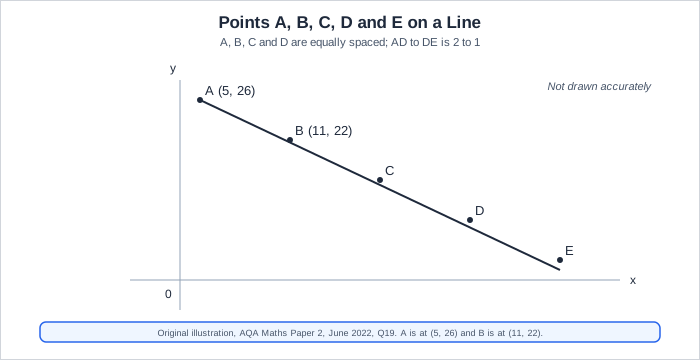
The full worked answer — June 2022
Since A, B, C and D are equally spaced, each step between consecutive points is the same vector, 6 across and 4 down, so from C at (17, 18) to D, the coordinates are (17 plus 6, 18 minus 4), which is (23, 14).
The vector from A to D covers three of these equal steps, so it is 3 times (6, negative 4), which is (18, negative 12). Since AD to DE equals 2 to 1, the vector DE is half the size of AD, which is (9, negative 6).
Adding this vector to D's coordinates gives E at (23 plus 9, 14 minus 6), which is (32, 8).
Could you have written this? Every fact in this answer is drilled in our quizzes — the writing is the easy part once the evidence is automatic.
Practise coordinate geometry questionsWhat the mark scheme rewarded
- 1 mark for identifying the correct step vector between equally spaced points, 1 mark (dependent) for correctly scaling the vector AD using the ratio 2 to 1 to find DE, and 1 mark for the final coordinates of E, (32, 8).
- Points described as equally spaced along a straight line share the same constant step vector between each consecutive pair
- A ratio between two segments on the same straight line, such as AD to DE, can be used to scale a known vector to find an unknown one, since both vectors point along the same direction
Traps examiners saw
- Using the wrong number of steps between A and D, forgetting that A to D covers three equal steps, not two, since there are four equally spaced points A, B, C, D
- Adding the full vector AD instead of the scaled-down vector DE when finding E's coordinates
Full-mark self-check 0 of 3
1×asked“A (1, 3) and B (2, 9) are points on a centimetre grid. ABCD is a parallelogram. AD and BC are horizontal and each has length 5 cm. The diagonals of ABCD cross at E. Work out the two possible pairs of coordinates of E. [4 marks]”
“A (1, 3) and B (2, 9) are points on a centimetre grid. ABCD is a parallelogram. AD and BC are horizontal and each has length 5 cm. The diagonals of ABCD cross at E. Work out the two possible pairs of coordinates of E. [4 marks]”
What it’s really asking
Recognise that D and C could each be 5 cm to the right or 5 cm to the left of A and B, giving two different valid parallelograms, then find the midpoint of a diagonal for each case.
What the sources actually showed — June 2023
A centimetre grid showing points A at (1, 3) and B at (2, 9). ABCD is a parallelogram with AD and BC horizontal, each 5 cm long, though the diagram does not show whether D and C are to the right or the left of A and B.
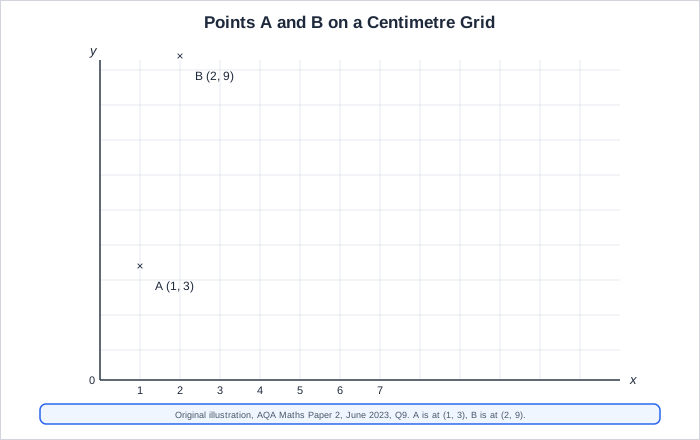
The full worked answer — June 2023
Since AD is horizontal and 5 cm long, D could be 5 to the right of A, giving D at (6, 3), or 5 to the left of A, giving D at (negative 4, 3); correspondingly, C would be at (7, 9) or (negative 3, 9). Both are genuinely valid parallelograms, since the diagram does not show which direction AD points.
The diagonals of a parallelogram bisect each other, so E is the midpoint of diagonal AC. For the first case, the midpoint of A (1, 3) and C (7, 9) is (1 plus 7 over 2, 3 plus 9 over 2), which is (4, 6).
For the second case, the midpoint of A (1, 3) and C (negative 3, 9) is (1 plus negative 3 over 2, 3 plus 9 over 2), which is (negative 1, 6). So the two possible pairs of coordinates for E are (4, 6) and (negative 1, 6).
Could you have written this? Every fact in this answer is drilled in our quizzes — the writing is the easy part once the evidence is automatic.
Practise coordinate geometry questionsWhat the mark scheme rewarded
- 1 mark for identifying one valid pair of coordinates for D or C, 1 mark (dependent) for identifying both pairs, 1 mark (dependent) for using the diagonals-bisect-each-other property to find the midpoint of one diagonal, and 1 mark for both correct final coordinates of E.
- In any parallelogram, the two diagonals bisect each other, meaning their point of intersection is the midpoint of both diagonals
- When a question only gives a length and a direction description, such as horizontal, without specifying left or right, more than one genuinely valid configuration can exist, and a question asking for two possible answers is testing whether this is recognised
Traps examiners saw
- Only finding one of the two valid parallelograms and stopping, missing the second required pair of coordinates
- Using the midpoint of BD instead of AC, or mixing up which pair of points forms a diagonal versus a side
Full-mark self-check 0 of 3
The method for every Q19 (Jun22) / Q9 (Jun23) — same every sittingMark bands, steps, timing
What this question type rewards
The topic changes by sitting — the mark scheme never does. Learn this once, then open your question above for that sitting’s sources and a full worked answer.
- Working out the vector or step between two known, or two derivable, points
- Applying a given ratio correctly to scale that vector to the required segment
- Adding or averaging coordinates correctly to reach the final unknown point
The steps
- Identify what is fixed (equally spaced points, a shared midpoint) and what is unknown
- Find the vector or step size linking the known points
- Apply the given ratio, or the midpoint relationship, to find the missing point
- Check whether more than one valid answer is possible, given how the shape could be drawn
Which point has coordinates (–3, 5)?
Coordinate geometry questions using ratios or midpoints come up in two of the four sittings we have. Practise checking whether a question genuinely has more than one valid answer.
Practise coordinate geometry questions“Two of the four sittings we have full papers for use the relationship between the gradients of two lines, either perpendicular or simply to be compared.”
Each version needs a gradient found from two coordinates, then used differently: to find the negative reciprocal for a perpendicular line and solve for an unknown coordinate (June 2022), or to directly compare two gradients found in different ways (June 2023).
1×asked“A straight line is perpendicular to the straight line through (2, 8) and (6, 15), and passes through (0, 9) and (x, 17). Work out the value of x. [4 marks]”
“A straight line is perpendicular to the straight line through (2, 8) and (6, 15), and passes through (0, 9) and (x, 17). Work out the value of x. [4 marks]”
What it’s really asking
Find the gradient of the first line, take its negative reciprocal to find the perpendicular gradient, then use this with the two points on the second line to solve for x.
The full worked answer — June 2022
The gradient of the line through (2, 8) and (6, 15) is the change in y divided by the change in x, which is 15 minus 8, over 6 minus 2, giving 7 over 4.
Since the second line is perpendicular to the first, its gradient is the negative reciprocal of 7 over 4, which is negative 4 over 7.
Using the gradient formula on the second line's two points, 17 minus 9, over x minus 0, equals negative 4 over 7. This gives 8 over x equals negative 4 over 7, so negative 4x equals 56, giving x equals negative 14.
Could you have written this? Every fact in this answer is drilled in our quizzes — the writing is the easy part once the evidence is automatic.
Practise gradient questionsWhat the mark scheme rewarded
- 1 mark for finding the gradient of the first line, 7 over 4, 1 mark for correctly finding the perpendicular gradient, negative 4 over 7, 1 mark (dependent) for a correct equation using the unknown coordinate, and 1 mark for the final value, x equals negative 14.
- Two lines are perpendicular exactly when the product of their gradients is negative 1, meaning one gradient is the negative reciprocal of the other
- The gradient formula, change in y over change in x, applies to any two points on a line, including a point with an unknown coordinate, allowing an equation to be set up and solved
Traps examiners saw
- Finding the reciprocal of the gradient without also making it negative, giving 4 over 7 instead of negative 4 over 7
- Substituting the coordinates into the gradient formula the wrong way round, mixing up which value is the change in y and which is the change in x
Full-mark self-check 0 of 3
1×asked“Line A has equation y equals ax minus 1 and passes through the point (7, 13). Line B has equation 5y minus 3x equals 4. Show that line A has a greater gradient than line B. [3 marks]”
“Line A has equation y equals ax minus 1 and passes through the point (7, 13). Line B has equation 5y minus 3x equals 4. Show that line A has a greater gradient than line B. [3 marks]”
What it’s really asking
Substitute the given point into line A's equation to find a and therefore its gradient, rearrange line B's equation into the form y equals mx plus c to find its gradient, then compare the two values.
The full worked answer — June 2023
Substituting the point (7, 13) into y equals ax minus 1 gives 13 equals 7a minus 1, so 7a equals 14, giving a equals 2. This means line A has gradient 2.
Rearranging line B's equation, 5y minus 3x equals 4, into the form y equals mx plus c gives 5y equals 3x plus 4, so y equals 3 over 5, times x, plus 4 over 5. This means line B has gradient 3 over 5.
Comparing the two gradients, 2 is greater than 3 over 5, since 3 over 5 is less than 1 and 2 is greater than 1, so line A does have a greater gradient than line B, as required.
Could you have written this? Every fact in this answer is drilled in our quizzes — the writing is the easy part once the evidence is automatic.
Practise gradient questionsWhat the mark scheme rewarded
- 1 mark for finding a equals 2, giving line A's gradient, 1 mark for correctly rearranging line B's equation to find its gradient, 3 over 5, and 1 mark for a clear comparison stating that 2 is greater than 3 over 5.
- In the equation y equals mx plus c, the gradient is always the coefficient of x, m, which is why an equation not already in this form must be rearranged first
- Substituting a known point into a line's equation is a reliable way to find an unknown constant in that equation, here revealing the gradient directly
Traps examiners saw
- Reading off 3 (the coefficient of x before rearranging) as line B's gradient directly from 5y minus 3x equals 4, without first dividing every term by 5
- Finding a equals 2 correctly but not stating that this represents line A's gradient, leaving the comparison incomplete
Full-mark self-check 0 of 3
The method for every Q24 (Jun22) / Q16 (Jun23) — same every sittingMark bands, steps, timing
What this question type rewards
The topic changes by sitting — the mark scheme never does. Learn this once, then open your question above for that sitting’s sources and a full worked answer.
- Finding a gradient correctly from two coordinates, using the change in y divided by the change in x
- Knowing that perpendicular lines have gradients that multiply to give negative 1, so one gradient is the negative reciprocal of the other
- Setting up and solving an equation correctly when an unknown coordinate is involved
The steps
- Find the gradient of any line given by two known coordinates
- If perpendicular lines are involved, find the negative reciprocal of that gradient
- Use the gradient formula again, now with an unknown coordinate, to set up an equation
- Solve the equation, or compare the two gradients directly, depending on what the question asks
Which of the following is true about two parallel straight lines?
Perpendicular and comparable gradient questions come up in two of the four sittings we have. Practise rearranging any line equation into y equals mx plus c before reading off its gradient.
Practise gradient questions“Three of the four sittings we have full papers for include this exact house-style question type, a tick-box asking how a changed assumption affects an earlier answer, and June 2023 uses it twice in the same paper.”
Each version changes a different kind of assumption: a scale on a grid (June 2018), the reliability of a sample (June 2022), or the number of sides of a polygon (June 2023), but every version rewards reasoning about the underlying relationship, not recalculating from scratch.
1×asked“A straight line is drawn on a centimetre grid. Fay assumes that the scale is 1 cm represents 1 unit. (a) Use her assumption to work out the gradient of the line. [1 mark] (b) In fact, the scale is 1 cm represents 2 units. Which statement is correct? Tick one box: the answer to part (a) is too big; the answer to part (a) stays the same; the answer to part (a) is too small. [1 mark]”
“A straight line is drawn on a centimetre grid. Fay assumes that the scale is 1 cm represents 1 unit. (a) Use her assumption to work out the gradient of the line. [1 mark] (b) In fact, the scale is 1 cm represents 2 units. Which statement is correct? Tick one box: the answer to part (a) is too big; the answer to part (a) stays the same; the answer to part (a) is too small. [1 mark]”
What it’s really asking
Recognise that gradient is a ratio of vertical change to horizontal change, and that scaling both axes by the same factor changes both parts of that ratio equally, leaving the gradient itself unaffected.
What the sources actually showed — June 2018
A straight line drawn on a plain centimetre grid, with no axis labels or scale given other than Fay's stated assumption.
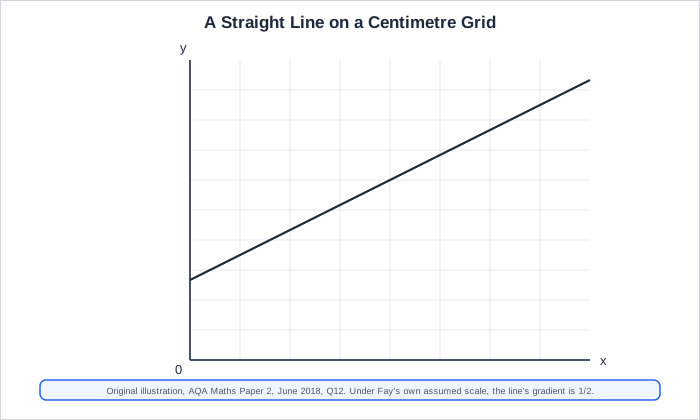
The full worked answer — June 2018
Using Fay's assumption, 1 cm represents 1 unit, the gradient of the line is 1 half.
The gradient stays the same, because the true scale, 1 cm represents 2 units, applies equally to both the vertical distance and the horizontal distance on the grid, so both parts of the gradient ratio are affected by the same factor and cancel out.
Could you have written this? Every fact in this answer is drilled in our quizzes — the writing is the easy part once the evidence is automatic.
Practise assumption-reasoning questionsWhat the mark scheme rewarded
- 1 mark for the correct gradient under Fay's assumption, 1 half, and 1 mark for correctly ticking that the answer stays the same, since scaling both axes by the same factor leaves a gradient ratio unchanged.
- Gradient is calculated as a ratio, change in y over change in x, so any factor that scales both the vertical and horizontal grid measurements equally will cancel out and leave the gradient unaffected
- This is different from a situation where only one axis is rescaled, which would genuinely change the calculated gradient
Traps examiners saw
- Assuming any change to the scale must change the gradient, without checking whether the change affects both axes equally
- Actually recalculating the gradient with the new scale from scratch, which is unnecessary and easy to get wrong, when the reasoning shortcut answers it directly
Full-mark self-check 0 of 3
1×asked“A survey was held in a football stadium. A sample of the crowd was asked about the importance of a family area, shown on a pie chart. (a) The total number of people in the crowd was 29 250. Estimate how many people in the crowd think that a family area is very important. Assume that the sample is representative of the crowd. [3 marks] (b) In fact, 50% of the sample were sitting in the family area, but only 10% of the crowd were sitting in the family area. What is this likely to mean about the actual number of people in the crowd who think that a family area is very important? Tick one box: it is larger than the answer to part (a); it is the same as the answer to part (a); it is lower than the answer to part (a). [1 mark]”
“A survey was held in a football stadium. A sample of the crowd was asked about the importance of a family area, shown on a pie chart. (a) The total number of people in the crowd was 29 250. Estimate how many people in the crowd think that a family area is very important. Assume that the sample is representative of the crowd. [3 marks] (b) In fact, 50% of the sample were sitting in the family area, but only 10% of the crowd were sitting in the family area. What is this likely to mean about the actual number of people in the crowd who think that a family area is very important? Tick one box: it is larger than the answer to part (a); it is the same as the answer to part (a); it is lower than the answer to part (a). [1 mark]”
What it’s really asking
Recognise that the sample over-represents people sitting in the family area, who are more likely to say a family area is very important, so the earlier estimate based on that sample is likely too high compared to the true crowd figure.
What the sources actually showed — June 2022
A pie chart showing the survey sample's answers about the importance of a family area, split into sectors for different levels of importance, with a sample total of 2250 people.
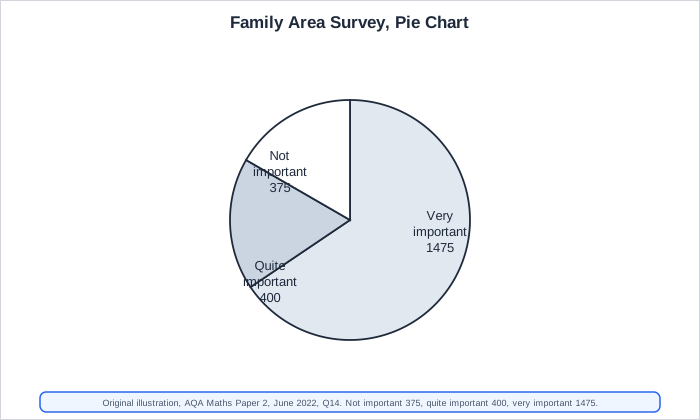
The full worked answer — June 2022
The very important sector represents 1475 out of the surveyed sample total of 375 plus 400 plus 1475, which is 2250. Multiplying this proportion by the crowd size of 29 250 gives 1475 divided by 2250, times 29 250, which is 19 175 people.
It is lower than the answer to part (a), because the sample used for the pie chart included far more people sitting in the family area, 50%, than the crowd as a whole, only 10%. Since people already sitting in the family area are more likely to say it is very important, the sample's answers are skewed towards very important more than the true crowd's opinions would be.
Could you have written this? Every fact in this answer is drilled in our quizzes — the writing is the easy part once the evidence is automatic.
Practise assumption-reasoning questionsWhat the mark scheme rewarded
- 1 mark for correctly ticking lower than the answer to part (a), reasoning that the sample over-represents people from the family area, biasing the earlier estimate upwards.
- A sample that over-represents a particular group relative to the whole population will bias any estimate towards that group's typical views or behaviour
- People already sitting in a family area are more likely to value it, so a sample containing proportionally more of them will overestimate how important the family area seems to the crowd as a whole
Traps examiners saw
- Assuming the estimate stays the same because the calculation method itself, using the pie chart's proportions, did not change
- Reasoning in the wrong direction, concluding the true figure must be higher because the sample seemed enthusiastic about the family area, rather than recognising this enthusiasm as a bias to correct for
Full-mark self-check 0 of 3
1×asked“Part of a regular polygon is shown. (a) Assume that the polygon is an octagon. Work out the size of an exterior angle. [2 marks] (b) In fact, the polygon has more sides than an octagon. What does this mean about the size of an exterior angle? Tick one box: it is more than the answer to part (a); it is the same as the answer to part (a); it is less than the answer to part (a); it could be any of the above. [1 mark]”
“Part of a regular polygon is shown. (a) Assume that the polygon is an octagon. Work out the size of an exterior angle. [2 marks] (b) In fact, the polygon has more sides than an octagon. What does this mean about the size of an exterior angle? Tick one box: it is more than the answer to part (a); it is the same as the answer to part (a); it is less than the answer to part (a); it could be any of the above. [1 mark]”
What it’s really asking
Recognise that the exterior angle formula, 360 divided by the number of sides, gets smaller as the number of sides gets bigger, so more sides than an octagon means a smaller exterior angle than the octagon's own.
What the sources actually showed — June 2023
Part of a regular polygon shown on the page, marked not drawn accurately, with not enough of the shape visible to count the sides directly.
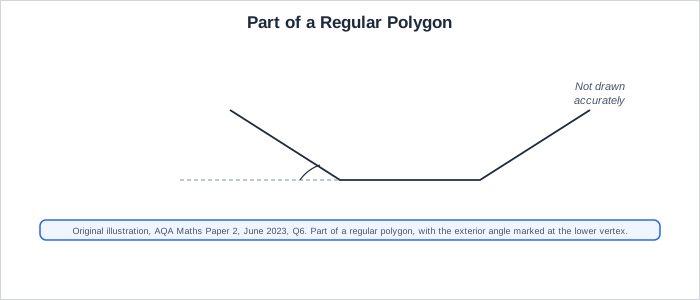
The full worked answer — June 2023
Assuming the polygon is a regular octagon, its exterior angle is 360 divided by 8, which is 45 degrees.
It is less than the answer to part (a), because the formula for an exterior angle, 360 divided by the number of sides, gives a smaller result as the number of sides increases, so a regular polygon with more sides than an octagon must have a smaller exterior angle than 45 degrees.
Could you have written this? Every fact in this answer is drilled in our quizzes — the writing is the easy part once the evidence is automatic.
Practise assumption-reasoning questionsWhat the mark scheme rewarded
- 2 marks for correctly finding the octagon's exterior angle, 45 degrees, using 360 divided by 8, and 1 mark for correctly ticking that it is less than the answer to part (a), reasoning that more sides means a smaller exterior angle.
- The exterior angles of a regular polygon always sum to 360 degrees, so each individual exterior angle is 360 divided by the number of sides
- As the number of sides in a regular polygon increases, each exterior angle must decrease, since the same total, 360 degrees, is being shared between more angles
Traps examiners saw
- Confusing exterior angle with interior angle, where the relationship with the number of sides works in the opposite direction
- Trying to guess a specific new number of sides and recalculate, rather than reasoning directly from how the formula behaves as the number of sides changes
Full-mark self-check 0 of 3
The method for every Q12 (Jun18) / Q14 (Jun22) / Q6 (Jun23) — same every sittingMark bands, steps, timing
What this question type rewards
The topic changes by sitting — the mark scheme never does. Learn this once, then open your question above for that sitting’s sources and a full worked answer.
- Understanding the mathematical relationship behind the earlier answer well enough to reason about it without recalculating
- Recognising when a change affects both parts of a calculation equally, cancelling out, versus when it only affects one part
- Selecting the tick-box option that matches the reasoned direction of change, not just a guess
The steps
- Identify exactly what changed between the original assumption and the actual situation
- Work out, using the underlying relationship, whether this change makes the original answer bigger, smaller, or leaves it unaffected
- Match this reasoning to the correct tick-box option
- Double check the reasoning against the specific numbers or context in the question, rather than a general rule that might not apply here
What is the sum of the interior angles of a hexagon?
This assume-then-actually reasoning question comes up in three of the four sittings we have, twice in June 2023 alone. Practise reasoning about the underlying relationship instead of recalculating from scratch.
Practise assumption-reasoning questions“Three of the four sittings we have full papers for test set notation or Venn diagrams, from a substantial calculation to a quick multiple choice check.”
Each version tests the same underlying skill at a different depth: working out an unknown region of a Venn diagram from a given probability then finding a further probability (June 2018), matching a shaded region to the correct set notation (June 2019), or matching a worded description to the correct set notation (June 2022).
1×asked“The Venn diagram shows some information about 150 students. The universal set is 150 students. C is students who study Chemistry, with 47 students studying only Chemistry. P is students who study Physics, with 35 students studying only Physics. The probability that a Physics student, chosen at random, also studies Chemistry is 5 twelfths. One of the 150 students is chosen at random. Work out the probability that the student does not study either Chemistry or Physics. [4 marks]”
“The Venn diagram shows some information about 150 students. The universal set is 150 students. C is students who study Chemistry, with 47 students studying only Chemistry. P is students who study Physics, with 35 students studying only Physics. The probability that a Physics student, chosen at random, also studies Chemistry is 5 twelfths. One of the 150 students is chosen at random. Work out the probability that the student does not study either Chemistry or Physics. [4 marks]”
What it’s really asking
Use the given probability to set up an equation for the number of students studying both subjects, then subtract every known region from 150 to find the number studying neither, and write this as a probability.
What the sources actually showed — June 2018
A Venn diagram with two overlapping circles, C for Chemistry and P for Physics, inside a rectangle labelled with the universal set of 150 students. The region for only Chemistry shows 47 students and the region for only Physics shows 35 students; the region where both circles overlap, and the region outside both circles, are left unlabelled as unknowns to be found.
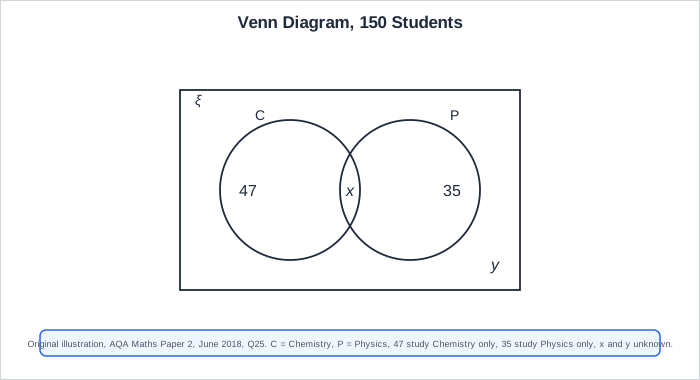
The full worked answer — June 2018
Let x be the number of students who study both Chemistry and Physics. The number who study Physics is x plus 35, and the probability that a Physics student also studies Chemistry is x divided by x plus 35, which is given as 5 twelfths. So 12x equals 5 times x plus 35, giving 12x equals 5x plus 175, so 7x equals 175, giving x equals 25.
The number of students who study neither Chemistry nor Physics is 150 minus the only-Chemistry region, 47, minus the only-Physics region, 35, minus the both region, 25, which is 150 minus 47 minus 35 minus 25, giving 43.
The probability that a randomly chosen student studies neither subject is 43 out of 150.
Could you have written this? Every fact in this answer is drilled in our quizzes — the writing is the easy part once the evidence is automatic.
Practise Venn diagram questionsWhat the mark scheme rewarded
- 1 mark for a correct equation using the given conditional probability, 1 mark (dependent) for the both region, 25, 1 mark (dependent) for a correct method to find the neither region using 150 and every other known region, and 1 mark for the final probability, 43 out of 150.
- The probability that a Physics student also studies Chemistry is the both region divided by the whole Physics region (both plus only-Physics), not the both region divided by the total of 150
- Every region of a two-circle Venn diagram, only Chemistry, only Physics, both, and neither, must add up to the total in the universal set, which is what allows the final unknown region to be found by subtraction
Traps examiners saw
- Dividing the both region by 150 instead of by the whole Physics region when checking the given conditional probability, setting up the wrong equation entirely
- Forgetting to subtract all three known regions, only-Chemistry, only-Physics and both, from 150, and only subtracting one or two of them
Full-mark self-check 0 of 3
1×asked“Which of these represents the shaded region on the Venn diagram? Circle your answer: A union B; the complement of (A intersection B); A intersection B; the complement of A union the complement of B. [1 mark]”
“Which of these represents the shaded region on the Venn diagram? Circle your answer: A union B; the complement of (A intersection B); A intersection B; the complement of A union the complement of B. [1 mark]”
What it’s really asking
Recognise which set notation symbol correctly describes the region that is shaded on the diagram; here, the shaded region is the overlap where both sets A and B occur together.
What the sources actually showed — June 2019
A Venn diagram with two overlapping circles, labelled A and B, inside a rectangle. Only the overlapping region where both circles meet is shaded.
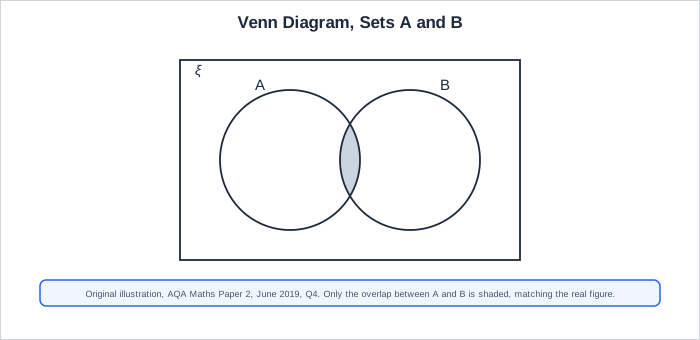
The full worked answer — June 2019
The shaded region is exactly where the two circles overlap, which is the region belonging to both A and B at the same time. This is represented by A intersection B, so this is the correct answer.
Could you have written this? Every fact in this answer is drilled in our quizzes — the writing is the easy part once the evidence is automatic.
Practise Venn diagram questionsWhat the mark scheme rewarded
- 1 mark for correctly selecting A intersection B, the notation for the region belonging to both sets.
- The intersection symbol represents the overlap between two sets, everything belonging to both at once, while the union symbol represents everything belonging to either set
- A complement symbol, shown with a dash or prime mark, represents everything outside the named set, the opposite of what is shaded here
Traps examiners saw
- Confusing intersection with union, selecting the option for everything in either circle instead of only the overlap
- Selecting an option involving a complement, which would represent an unshaded region rather than the overlap that is actually shaded
Full-mark self-check 0 of 2
1×asked“Circle the expression that means the probability of A and not B. [1 mark]”
“Circle the expression that means the probability of A and not B. [1 mark]”
What it’s really asking
Translate the everyday phrase A and not B directly into set notation, recognising that and means intersection and not B means the complement of B.
What the sources actually showed — June 2022
Four probability expressions to choose from, written using union, intersection and complement notation for events A and B.
The full worked answer — June 2022
A and not B means the outcome is in A but is not in B, so it belongs to A intersected with the complement of B, written P of A intersection B complement, which is the correct answer.
Could you have written this? Every fact in this answer is drilled in our quizzes — the writing is the easy part once the evidence is automatic.
Practise Venn diagram questionsWhat the mark scheme rewarded
- 1 mark for correctly selecting the expression for A intersection B complement, the notation for A and not B.
- The word and in probability translates directly to the intersection symbol, while the word not translates to the complement symbol applied to whichever set follows it
- The order in which the complement is applied matters: not B applies only to B, giving A intersection B complement, which is different from applying not to the whole expression
Traps examiners saw
- Selecting an option with the complement applied to A instead of B, confusing which set the word not actually refers to
- Selecting an option using union instead of intersection, mistaking and for or
Full-mark self-check 0 of 2
The method for every Q25 (Jun18) / Q4 (Jun19) / Q2 (Jun22) — same every sittingMark bands, steps, timing
What this question type rewards
The topic changes by sitting — the mark scheme never does. Learn this once, then open your question above for that sitting’s sources and a full worked answer.
- Understanding what each region of a Venn diagram represents, especially the difference between only one set, both sets, and neither set
- Translating between set notation symbols, union, intersection and complement, and their everyday meaning, or and, both, and not
- Using the total in the outer rectangle correctly to check that every region adds up
The steps
- Identify which region of the Venn diagram, or which set notation, the question is actually asking about
- Use any given probability or frequency to find an unknown region algebraically if needed
- Check all the regions of the diagram add up to the correct overall total
- Give the final answer in the exact form the question asks for
In a Venn diagram with two events A and B, which symbol represents the region where BOTH events occur at the same time?
Set notation and Venn diagram questions come up in three of the four sittings we have. Practise translating between everyday words and the correct notation symbols.
Practise Venn diagram questions“Three of the four sittings we have full papers for test recognising or continuing a special number sequence, with triangular numbers tested twice.”
Each version tests this at a different depth: matching five different sequences to their correct type name (June 2018), identifying a single triangular number among four options (June 2022), or continuing a list of triangular numbers to find the next one (June 2023).
1×asked“Match each sequence to its description. One has been done for you. The description options are: arithmetic progression, geometric progression, Fibonacci sequence, triangular numbers, cube numbers, square numbers. [4 marks]”
“Match each sequence to its description. One has been done for you. The description options are: arithmetic progression, geometric progression, Fibonacci sequence, triangular numbers, cube numbers, square numbers. [4 marks]”
What it’s really asking
Recognise the defining pattern behind each named sequence type and match each unlabelled sequence shown on the page to the correct description from the list.
What the sources actually showed — June 2018
Five unlabelled number sequences printed on the page, with connecting lines to be drawn to the correct description from a list of six type names; one matching pair is already completed as an example. This source is a matching diagram, not a data table, so the specific sequences themselves are not reproduced here.
The full worked answer — June 2018
An arithmetic progression has a constant difference between consecutive terms, for example adding the same number each time. A geometric progression has a constant ratio between consecutive terms, for example multiplying by the same number each time. A Fibonacci-type sequence has each term equal to the sum of the two terms before it.
Triangular numbers, 1, 3, 6, 10, 15 and so on, have a gap between consecutive terms that increases by 1 each time. Cube numbers are each term cubed, 1, 8, 27, 64 and so on, and square numbers are each term squared, 1, 4, 9, 16 and so on.
Could you have written this? Every fact in this answer is drilled in our quizzes — the writing is the easy part once the evidence is automatic.
Practise sequence questionsWhat the mark scheme rewarded
- Up to 4 marks scaled for the number of the five sequences correctly matched to their description, with the sixth description name left unused for the one sequence type that does not appear.
- Each named sequence type has one specific defining pattern; checking a given sequence's differences, ratios, or specific number pattern against each definition in turn is more reliable than matching from a general impression
- Fibonacci-type and triangular sequences can look superficially similar since both grow with increasing gaps, but only a Fibonacci-type sequence has each term equal to the sum of the two immediately before it
Traps examiners saw
- Confusing an arithmetic progression, constant difference, with a geometric progression, constant ratio, especially when the numbers in a sequence are all fairly close together
- Mistaking a triangular number sequence for a Fibonacci-type sequence, since both have gaps that grow, without checking whether each term is actually the sum of the two before it
Full-mark self-check 0 of 3
1×asked“Circle the triangular number. [1 mark]”
“Circle the triangular number. [1 mark]”
What it’s really asking
Recall or generate the sequence of triangular numbers, 1, 3, 6, 10, 15, 21 and so on, and match one of the four given options to a term in that sequence.
What the sources actually showed — June 2022
Four numbers to choose from: 9, 12, 15 and 18.
The full worked answer — June 2022
The triangular numbers are 1, 3, 6, 10, 15, 21 and so on, formed by adding 1 more each time than was added for the previous term. Among the four given options, 15 is the only triangular number, so 15 is the correct answer.
Could you have written this? Every fact in this answer is drilled in our quizzes — the writing is the easy part once the evidence is automatic.
Practise sequence questionsWhat the mark scheme rewarded
- 1 mark for correctly selecting 15.
- The triangular numbers can be generated by adding consecutive integers, 1, then plus 2, then plus 3, and so on, which is a reliable way to check whether any given number belongs to the sequence
- 9, 12 and 18 are not triangular numbers, though they can look plausible if only the earlier, smaller triangular numbers are remembered
Traps examiners saw
- Selecting 12, which is a multiple of 3 like several triangular numbers but is not itself one
- Only remembering the first few triangular numbers, 1, 3, 6, and stopping before reaching 15, then guessing incorrectly among the later options
Full-mark self-check 0 of 2
1×asked“Four consecutive triangular numbers are 6, 10, 15, 21. Write down the next triangular number. [1 mark]”
“Four consecutive triangular numbers are 6, 10, 15, 21. Write down the next triangular number. [1 mark]”
What it’s really asking
Find the pattern in how the gap between consecutive triangular numbers grows, then apply the next gap in that pattern to the last given term.
The full worked answer — June 2023
The gaps between the given terms are 10 minus 6, which is 4, then 15 minus 10, which is 5, then 21 minus 15, which is 6. Each gap is 1 more than the gap before it, so the next gap is 7.
Adding this gap to the last given term, 21 plus 7 gives 28, so the next triangular number is 28.
Could you have written this? Every fact in this answer is drilled in our quizzes — the writing is the easy part once the evidence is automatic.
Practise sequence questionsWhat the mark scheme rewarded
- 1 mark for correctly stating 28 as the next triangular number.
- In a triangular number sequence, the gap between consecutive terms always increases by exactly 1 each time, which is the fastest way to continue the sequence without needing the full formula
- Checking the pattern of gaps directly from the given terms is more reliable than trying to recall the triangular number sequence from memory alone
Traps examiners saw
- Assuming a constant gap, as in an arithmetic sequence, and simply adding 6 again instead of recognising the gap itself grows by 1 each time
- Miscounting the gap pattern, using a gap of 6 instead of 7 for the next term
Full-mark self-check 0 of 2
The method for every Q5 (Jun18) / Q3 (Jun22) / Q2 (Jun23) — same every sittingMark bands, steps, timing
What this question type rewards
The topic changes by sitting — the mark scheme never does. Learn this once, then open your question above for that sitting’s sources and a full worked answer.
- Knowing the defining pattern of each special sequence type: constant difference for arithmetic, constant multiplier for geometric, each term the sum of the two before for Fibonacci-type, and the specific patterns for triangular, square and cube numbers
- Checking a sequence against a definition systematically rather than guessing from a general impression
- For triangular numbers specifically, recognising that the difference between consecutive terms increases by 1 each time
The steps
- Recall the defining pattern of each sequence type being tested
- Check the given numbers against each definition in turn
- For triangular numbers, look at how the gap between consecutive terms itself changes
- Select or state the answer that correctly matches the pattern found
What is the common difference of the arithmetic sequence below? 4, 11, 18, 25, 32, ...
Special number sequence questions come up in three of the four sittings we have, and triangular numbers appear twice. Practise recognising the defining pattern of each type quickly.
Practise sequence questions“Two of the four sittings we have full papers for require reasoning backwards through a percentage change, rather than simply calculating one forwards.”
Each version reverses a percentage differently: finding an unknown percentage decrease that achieves the same effect as a given price increase (June 2022), or finding the original price before a known percentage increase was applied (June 2023).
1×asked“A company makes and sells boxes of washing powder currently priced at 5.60 pounds. The company wants to increase the amount of money it receives per kg of powder. To get the required increase it can increase the price to 5.88 pounds, or reduce the mass of powder in the box by x%. Work out the value of x to 2 decimal places. [4 marks]”
“A company makes and sells boxes of washing powder currently priced at 5.60 pounds. The company wants to increase the amount of money it receives per kg of powder. To get the required increase it can increase the price to 5.88 pounds, or reduce the mass of powder in the box by x%. Work out the value of x to 2 decimal places. [4 marks]”
What it’s really asking
Set the new rate per kg from raising the price equal to the new rate per kg from lowering the mass by x%, then solve for x, recognising that reducing the mass by x% means multiplying by (100 minus x) over 100.
The full worked answer — June 2022
Increasing the price from 5.60 to 5.88 pounds, while keeping the mass the same, increases the rate per kg by a multiplier of 5.88 divided by 5.60.
Reducing the mass by x%, while keeping the price at 5.60, means the new mass is (100 minus x) over 100 of the original mass, so the rate per kg is multiplied by 100 over (100 minus x). Setting this equal to the price-increase multiplier gives 100 over (100 minus x) equals 5.88 over 5.60.
Rearranging, (100 minus x) over 100 equals 5.60 over 5.88, so 100 minus x equals 100 times 5.60 over 5.88, which is approximately 95.24, giving x equals approximately 4.76.
Could you have written this? Every fact in this answer is drilled in our quizzes — the writing is the easy part once the evidence is automatic.
Practise reverse percentage questionsWhat the mark scheme rewarded
- 1 mark for a correct multiplier or fraction linking the price increase, 1 mark for a correct method setting the mass-reduction effect equal to the price-increase effect, 1 mark (dependent) for solving towards x, and 1 mark for the final value, x equals 4.76.
- A rate such as money per kg increases when the price goes up with the same mass, or when the mass goes down with the same price; both changes affect the rate the same way, which is why they can be set equal to each other
- Reducing a quantity by x% means multiplying it by (100 minus x) over 100, not simply subtracting x from the original value
Traps examiners saw
- Setting the equation up as a straightforward percentage decrease of 5.60 to 5.88, confusing the price increase itself with the required mass decrease
- Inverting the fraction incorrectly when rearranging, leading to a value of x greater than 100 or a negative value
Full-mark self-check 0 of 3
1×asked“The price of a toy increases by 12.5% to 19.53 pounds. Work out the original price of the toy. [2 marks]”
“The price of a toy increases by 12.5% to 19.53 pounds. Work out the original price of the toy. [2 marks]”
What it’s really asking
Recognise that 19.53 pounds is 112.5% of the original price, then divide by 1.125 rather than finding 12.5% of 19.53 and subtracting it.
The full worked answer — June 2023
A 12.5% increase means the new price, 19.53 pounds, represents 112.5% of the original price, so as a decimal multiplier, 19.53 equals the original price times 1.125.
Dividing both sides by 1.125, the original price is 19.53 divided by 1.125, which is 17.36 pounds.
Could you have written this? Every fact in this answer is drilled in our quizzes — the writing is the easy part once the evidence is automatic.
Practise reverse percentage questionsWhat the mark scheme rewarded
- 1 mark for correctly identifying the multiplier 1.125 (or an equivalent method), and 1 mark for the correct final answer, 17.36 pounds.
- When a value is given after a percentage increase has already been applied, finding the original value requires dividing by the decimal multiplier, since the increase was applied by multiplying, not by subtracting
- Subtracting 12.5% of the new value, 19.53, rather than dividing, is a common but incorrect shortcut, since 12.5% of the new value is not the same as 12.5% of the original value
Traps examiners saw
- Finding 12.5% of 19.53 and subtracting it from 19.53, which gives a different, incorrect answer, since the 12.5% increase was originally a percentage of the smaller, original price, not of 19.53
- Dividing 19.53 by 12.5 instead of by 1.125, confusing the percentage figure itself with the decimal multiplier
Full-mark self-check 0 of 3
The method for every Q20 (Jun22) / Q4 (Jun23) — same every sittingMark bands, steps, timing
What this question type rewards
The topic changes by sitting — the mark scheme never does. Learn this once, then open your question above for that sitting’s sources and a full worked answer.
- Recognising when a value given is the result of a percentage change, not the original value, so working backwards is needed
- Dividing by the decimal multiplier, not multiplying by it, to reverse a percentage increase or decrease
- Setting up a correct equation when the reverse percentage forms part of a larger comparison
The steps
- Identify whether the given value is before or after the percentage change
- Write the percentage change as a decimal multiplier
- If working backwards, divide by this multiplier rather than multiplying by it
- Check the answer makes sense: reversing an increase should give a smaller original value, and vice versa
A price after a 20% increase is £120. Which calculation finds the ORIGINAL price?
Reverse percentage questions come up in two of the four sittings we have. Practise recognising when a value given is after a percentage change, not before it.
Practise reverse percentage questions“Two of the four sittings we have full papers for include a show-that question built entirely from algebraic fraction manipulation.”
Each version needs a different core algebraic fraction skill: factorising a single fraction's numerator and denominator to cancel a common factor (June 2018), or combining two separate fractions over a common denominator (June 2023).
1×asked“Show that, for x not equal to negative 1, 8x squared minus 8, all over 4x plus 4, simplifies to the form ax plus b, where a and b are integers. [3 marks]”
“Show that, for x not equal to negative 1, 8x squared minus 8, all over 4x plus 4, simplifies to the form ax plus b, where a and b are integers. [3 marks]”
What it’s really asking
Factorise both the numerator, using the difference of two squares, and the denominator fully, then cancel the common factor they share to reach a linear expression.
The full worked answer — June 2018
The numerator, 8x squared minus 8, factorises as 8 times x squared minus 1, which further factorises as 8 times (x minus 1) times (x plus 1), using the difference of two squares.
The denominator, 4x plus 4, factorises as 4 times (x plus 1).
Cancelling the common factor of (x plus 1) from both the numerator and denominator, since x is not equal to negative 1, leaves 8 times (x minus 1), over 4, which simplifies to 2 times (x minus 1), which is 2x minus 2, so a equals 2 and b equals negative 2.
Could you have written this? Every fact in this answer is drilled in our quizzes — the writing is the easy part once the evidence is automatic.
Practise algebraic fraction questionsWhat the mark scheme rewarded
- 1 mark for a correct factorisation of the numerator or denominator, 1 mark (dependent) for a correct fraction with a common algebraic factor showing in both the numerator and denominator, and 1 mark for the final simplified form, 2x minus 2.
- A numerator in the form of a number times x squared minus a number is often a disguised difference of two squares, which factorises into two brackets that can reveal a common factor with the denominator
- Cancelling an algebraic factor from a fraction is only valid because the question specifically excludes the value of x that would make that factor zero, x is not equal to negative 1 here
Traps examiners saw
- Only partially factorising the numerator, stopping at 8 times (x squared minus 1) without going on to factorise x squared minus 1 itself into two brackets
- Cancelling incorrectly, for example cancelling an x term that is not actually a full common factor of both the numerator and denominator
Full-mark self-check 0 of 3
1×asked“Show that x minus 5, all over x minus 2, plus x plus 5, all over x plus 2, simplifies to ax squared minus b, all over x squared minus 4, where a and b are integers. [3 marks]”
“Show that x minus 5, all over x minus 2, plus x plus 5, all over x plus 2, simplifies to ax squared minus b, all over x squared minus 4, where a and b are integers. [3 marks]”
What it’s really asking
Find the common denominator by multiplying the two given denominators together, expand and combine the two numerators, then simplify fully to match the stated form.
The full worked answer — June 2023
The common denominator of x minus 2 and x plus 2 is their product, (x minus 2)(x plus 2), which is x squared minus 4. Writing both fractions over this common denominator gives (x minus 5)(x plus 2), all over x squared minus 4, plus (x plus 5)(x minus 2), all over x squared minus 4.
Expanding both brackets in the numerator: (x minus 5)(x plus 2) equals x squared minus 3x minus 10, and (x plus 5)(x minus 2) equals x squared plus 3x minus 10.
Adding these two numerators, x squared minus 3x minus 10, plus x squared plus 3x minus 10, gives 2x squared minus 20, since the 3x and negative 3x terms cancel. So the whole expression simplifies to 2x squared minus 20, over x squared minus 4, giving a equals 2 and b equals 20.
Could you have written this? Every fact in this answer is drilled in our quizzes — the writing is the easy part once the evidence is automatic.
Practise algebraic fraction questionsWhat the mark scheme rewarded
- 1 mark for correctly combining both fractions over the common denominator (x minus 2)(x plus 2), 1 mark (dependent) for correctly expanding both numerators, and 1 mark for the final simplified form, 2x squared minus 20 over x squared minus 4.
- Two algebraic fractions with different linear denominators are combined by multiplying the two denominators together to form a common denominator, exactly as with numerical fractions
- Expanding (x minus 5)(x plus 2) and (x plus 5)(x minus 2) separately before adding reduces the risk of a sign error compared with trying to combine them in a single step
Traps examiners saw
- Adding the two original numerators, x minus 5 and x plus 5, without first multiplying each by the other fraction's denominator, which only works if the denominators were already the same
- Making a sign error when expanding (x plus 5)(x minus 2), losing the negative 3x term or mishandling the constant term
Full-mark self-check 0 of 3
The method for every Q13 (Jun18) / Q25 (Jun23) — same every sittingMark bands, steps, timing
What this question type rewards
The topic changes by sitting — the mark scheme never does. Learn this once, then open your question above for that sitting’s sources and a full worked answer.
- Factorising fully before attempting to cancel any common factor
- Finding a correct common denominator when combining two or more algebraic fractions
- Reaching exactly the form stated in the question, not just an equivalent but differently arranged expression
The steps
- Factorise the numerator and denominator of any single fraction as far as possible
- Cancel any factor common to both the numerator and denominator
- For two or more fractions, find a common denominator and combine the numerators
- Expand and simplify the combined numerator fully to match the exact form given
Simplify 6x²/3x
Show-that questions built from algebraic fractions come up in two of the four sittings we have. Practise factorising fully before cancelling, and finding a genuine common denominator before combining.
Practise algebraic fraction questions“Two of the four sittings we have full papers for test recognising the equation of a circle centred at the origin as a quick multiple choice question.”
Each version tests the same fact, that a circle centred at the origin with radius r has equation x squared plus y squared equals r squared, either working forwards from a given point on the circle (June 2018) or simply recognising the correct general shape among distractors (June 2022).
1×asked“A circle, centre O, passes through (5, 0). What is the equation of the circle? Circle your answer. [1 mark]”
“A circle, centre O, passes through (5, 0). What is the equation of the circle? Circle your answer. [1 mark]”
What it’s really asking
Recognise that the point (5, 0) is a distance of 5 from the centre, so the radius is 5, and substitute this into the general equation of a circle centred at the origin.
What the sources actually showed — June 2018
Four equations to choose from: x squared plus y squared equals 25, x squared plus y squared equals 5, x squared plus y squared equals 10, and x squared plus y squared equals 100.
The full worked answer — June 2018
Since the circle is centred at the origin and passes through (5, 0), its radius is the distance from the origin to this point, which is 5. The equation of a circle centred at the origin is x squared plus y squared equals r squared, so with r equal to 5, the equation is x squared plus y squared equals 25.
Could you have written this? Every fact in this answer is drilled in our quizzes — the writing is the easy part once the evidence is automatic.
Practise circle equation questionsWhat the mark scheme rewarded
- 1 mark for correctly selecting x squared plus y squared equals 25.
- For a circle centred at the origin, the general equation is x squared plus y squared equals r squared, where r is the radius, so the constant on the right-hand side is always the radius squared, not the radius itself
- A point lying on such a circle gives the radius directly as its distance from the origin, which for a point on an axis, like (5, 0), is simply the value of the non-zero coordinate
Traps examiners saw
- Selecting the option with 5 on the right-hand side instead of 25, forgetting that the equation uses the radius squared, not the radius itself
- Selecting an option that does not have both x squared and y squared, which would not represent a circle at all
Full-mark self-check 0 of 3
1×asked“Which of these is the equation of a circle? Circle your answer. [1 mark]”
“Which of these is the equation of a circle? Circle your answer. [1 mark]”
What it’s really asking
Recognise which of the given equations is in the x squared plus y squared equals a constant form, since this is the only form among the options that represents a genuine circle.
What the sources actually showed — June 2022
Four equations to choose from: x squared minus y squared equals 6, x squared plus y squared equals 6, y equals x squared minus 6, and y equals x squared plus 6.
The full worked answer — June 2022
Only x squared plus y squared equals 6 is in the correct form for a circle centred at the origin, x squared plus y squared equals r squared. The other options either subtract y squared instead of adding it, which does not give a circle, or are in the y equals form of a parabola, not a circle.
Could you have written this? Every fact in this answer is drilled in our quizzes — the writing is the easy part once the evidence is automatic.
Practise circle equation questionsWhat the mark scheme rewarded
- 1 mark for correctly selecting x squared plus y squared equals 6.
- A circle centred at the origin always has the form x squared plus y squared equals a positive constant; changing the plus to a minus, or writing y as a function of x squared alone, produces a completely different type of curve
- y equals x squared plus a constant, or y equals x squared minus a constant, are both parabolas, not circles, even though they also involve x squared
Traps examiners saw
- Selecting x squared minus y squared equals 6, mistaking the minus sign for a valid variation on the circle equation
- Selecting one of the y equals x squared options, confusing the general shape of an equation involving x squared with the specific circle equation
Full-mark self-check 0 of 3
The method for every Q22 (Jun18) / Q21 (Jun22) — same every sittingMark bands, steps, timing
What this question type rewards
The topic changes by sitting — the mark scheme never does. Learn this once, then open your question above for that sitting’s sources and a full worked answer.
- Knowing that the equation of a circle centred at the origin is x squared plus y squared equals r squared, where r is the radius
- Correctly finding r squared, either from a known point on the circle or from the equation's own constant
- Distinguishing this from the equation of a parabola or other curve that looks superficially similar
The steps
- Recall the general equation of a circle centred at the origin, x squared plus y squared equals r squared
- If a point on the circle is given, use it to find r squared, the radius squared
- Match this to the correct option, checking the right-hand side is r squared exactly, not r
- Rule out any option that is not in the correct x squared plus y squared form
A triangle is drawn inside a circle with one side being the diameter. What is the size of the angle at the circumference opposite the diameter?
Recognising the equation of a circle comes up in two of the four sittings we have. Practise the general form, x squared plus y squared equals radius squared, until it is instant recall.
Practise circle equation questions“Two of the four sittings we have full papers for test finding a reciprocal directly, once for a number with a power and once for a simple fraction.”
Each version applies the same core fact, that a reciprocal is 1 divided by the original value, in a slightly different context: a number written with a power, where the reciprocal simply negates the power (June 2022), or a straightforward fraction, where the reciprocal swaps the numerator and denominator (June 2023).
1×asked“Circle the reciprocal of 8 to the power 5. [1 mark]”
“Circle the reciprocal of 8 to the power 5. [1 mark]”
What it’s really asking
Recognise that the reciprocal of a base raised to a power is the same base raised to the negative of that power.
What the sources actually showed — June 2022
Four expressions to choose from: 8 to the power negative 5, 5 to the power negative 8, negative 8 to the power 5, and 5 to the power 8.
The full worked answer — June 2022
The reciprocal of any value a to the power n is 1 over a to the power n, which by the negative index law is the same as a to the power negative n. So the reciprocal of 8 to the power 5 is 8 to the power negative 5.
Could you have written this? Every fact in this answer is drilled in our quizzes — the writing is the easy part once the evidence is automatic.
Practise reciprocal questionsWhat the mark scheme rewarded
- 1 mark for correctly selecting 8 to the power negative 5.
- The negative index law states that a to the power negative n equals 1 over a to the power n, which is exactly the definition of a reciprocal expressed with the same base
- Only the power is negated when finding the reciprocal of a power; the base itself, 8, stays exactly the same
Traps examiners saw
- Selecting 5 to the power negative 8, mistakenly swapping the base and the power instead of only negating the power
- Selecting negative 8 to the power 5, confusing a negative base with a negative power, which are entirely different operations
Full-mark self-check 0 of 2
1×asked“Write down the reciprocal of 4 sevenths. [1 mark]”
“Write down the reciprocal of 4 sevenths. [1 mark]”
What it’s really asking
Swap the numerator and denominator of the given fraction to find its reciprocal.
The full worked answer — June 2023
The reciprocal of a fraction is found by swapping its numerator and denominator. Swapping 4 sevenths gives 7 fourths, since 4 sevenths multiplied by 7 fourths equals 1, confirming they are genuine reciprocals of each other.
Could you have written this? Every fact in this answer is drilled in our quizzes — the writing is the easy part once the evidence is automatic.
Practise reciprocal questionsWhat the mark scheme rewarded
- 1 mark for correctly stating the reciprocal as 7 fourths (or an equivalent form, such as 1 and 3 quarters).
- The reciprocal of any fraction a over b is b over a, found by simply swapping the numerator and denominator
- Multiplying any value by its reciprocal always gives exactly 1, which is a quick way to check a reciprocal has been found correctly
Traps examiners saw
- Writing the reciprocal as a decimal or in an unexpected form that does not clearly show the swapped fraction, when a clean fraction answer is expected
- Confusing the reciprocal with the negative of the fraction, writing negative 4 sevenths instead of swapping the numerator and denominator
Full-mark self-check 0 of 2
The method for every Q22 (Jun22) / Q3 (Jun23) — same every sittingMark bands, steps, timing
What this question type rewards
The topic changes by sitting — the mark scheme never does. Learn this once, then open your question above for that sitting’s sources and a full worked answer.
- Knowing that the reciprocal of any value is 1 divided by that value
- For a number written as a base to a power, recognising that its reciprocal is the same base to the negative of that power
- For a fraction, recognising that its reciprocal simply swaps the numerator and denominator
The steps
- Identify the value whose reciprocal is being asked for
- If it is written as a power, negate the power to find the reciprocal
- If it is a fraction, swap the numerator and denominator
- Double check the reciprocal multiplied by the original value gives exactly 1
What is the value of 2⁻³?
Reciprocal questions come up in two of the four sittings we have. Practise both forms, negating a power and swapping a fraction, until they are instant.
Practise reciprocal questionsWhat is guaranteed to come up, and what genuinely varies
Across the four sittings we have full papers for, Paper 2's overall structure and total marks (80) never changed, and the same handful of skills recur every year, though the exact numbers and context are different every time.
Not seen as a standalone, cleanly repeating question on Paper 2 in the four sittings we have full papers for
Sketching a cubic curve and identifying its y-intercept, tested only in June 2019 · Proving algebraically that a recurring decimal converts to a given fraction, tested only in June 2018 on this paper · Using the discriminant to show a curve and a line have exactly one point of intersection, tested only in June 2018 · Rearranging a formula so that x appears in both the numerator and denominator on one side, tested only in June 2023 · Comparing two probability options built from different sets of cards and working out which gives the better chance of winning, tested only in June 2023 · Working out an unknown value using an iterative formula, tested only in June 2023 · Circle theorem reasoning involving a tangent, a chord and the alternate segment theorem, tested only in June 2023 · Working out a compound interest rate needed to reach a savings target, tested only in June 2023 · Working out a quadratic sequence's nth term from its first four terms, tested only in June 2023 · Using a histogram together with a grouped frequency table to estimate a difference between two data sets, tested only in June 2019 · Reading values from a real-life height-against-time graph and using them to calculate an average speed, tested only in June 2018 · Single, standalone multiple choice concept checks that did not repeat in the same shape across sittings, such as identifying a shaded circle part by name, a solid from its plan view, or completing a magic-square-style product grid
These topics genuinely appeared in at least one of the four sittings, but we could not find a single sub-question shape that repeated across sittings with a diagram or structure we could verify from the real paper, so there is no dedicated cluster on this page for them. Do not assume any of the specific facts below are safe to skip, only that we have not found clean repeat evidence, or a diagram we could confidently read, for a dedicated page section.
Before you revise
Does Paper 2 always have the same structure?
Yes, in all four sittings we have full papers for. Every sitting totalled 80 marks in 1 hour 30 minutes, and every paper covered a similarly broad spread of number, algebra, ratio, geometry, probability and statistics questions, mostly worth 1 to 5 marks each. Always check your own paper's front cover to confirm, since AQA can make real changes in any future series.
Is a calculator allowed on Paper 2?
Yes, in all four sittings we have full papers for. Paper 2 is explicitly the calculator paper. This does not mean working can be skipped, though: the real mark schemes below show that method marks are very often withheld from students who show no working, even on questions where a calculator gets the right number quickly.
Why is there no June 2020 or June 2021 paper on this page?
Because those sittings do not exist. GCSE exams were cancelled in both 2020 and 2021 due to the pandemic, so there are no real question papers or mark schemes to analyse from those years. Our four sittings, June 2018, June 2019, June 2022 and June 2023, are the most recent full sittings we could obtain both the real question paper and the real mark scheme for.
Was a formulae sheet always provided?
No. June 2022 and June 2023 both list a Formulae Sheet as an enclosed insert in the materials for this paper, but June 2018 and June 2019 do not mention one, meaning more formulae had to be memorised in those earlier years. Always check your own paper's materials list, since this has changed once already.
How is a calculator paper actually marked, compared to a non-calculator paper?
In exactly the same way. Nearly every question is still marked using method marks (M), which reward a correct approach even if the final answer is wrong, and accuracy marks (A), which reward the correct final value following a correct method. A calculator being allowed does not remove this requirement: several questions on these four papers specifically state that method marks are not awarded to students who show no working, even when their final answer is correct.
What is the single biggest way marks are lost on this paper?
According to the real mark schemes for these four sittings, marks are very often lost by choosing the wrong combination of upper and lower bounds in a bounds question, or by not showing any working on a question that specifically asks for it. On multi-stage word problems, marks are also commonly lost by using the wrong quantity partway through a calculation, for example applying a rate or a ratio to the total instead of to the correct part of it.
Practise the questions that are guaranteed to come up
Every skill on this page has practice questions waiting in the app, built the way AQA actually structures Paper 2.
Start revising free