Test yourself on Congruence with exam style questions, marked instantly.
Flashcards that come back just before you would forget them.
A revision plan that remembers what you know and shows what to do next.
See which topics you have nailed and which need another look.
Quiz yourself on CongruenceGet your flashcardsBuild my revision planTrack my progressWhy Does Congruence Matter?
What Does Congruent Mean?
- Congruent shapes are identical in both shape and size. One can be placed exactly on top of the other (flips and rotations allowed).
- All corresponding sides are equal in length.
- All corresponding angles are equal in size.
- The symbol for congruence is ≅ (sometimes written ≡).
- Congruent ≠ Similar: Similar shapes have the same shape but may differ in size (they are enlargements of each other). Congruent shapes are a special case where the scale factor is exactly 1.
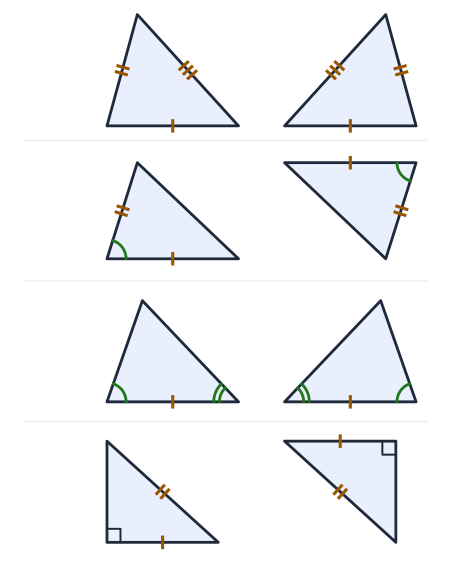
The Four Congruence Conditions for Triangles
You only need to check a minimum set of measurements to guarantee two triangles are congruent. There are exactly four valid conditions:
1. SSS: Side-Side-Side
If all three sides of one triangle equal the three sides of another (in corresponding pairs), the triangles are congruent.
Triangle ABC ≅ Triangle DEF if: AB = DE, BC = EF, AC = DF
Why it works: Fixing three side lengths determines the triangle completely: there is only one triangle (up to reflection) with those three side lengths.
2. SAS: Side-Angle-Side
If two sides and the included angle (the angle between those two sides) are equal, the triangles are congruent.
Triangle ABC ≅ Triangle DEF if: AB = DE, angle B = angle E, BC = EF
Critical detail: The angle MUST be included (between) the two sides. Knowing two sides and a non-included angle is NOT sufficient (see SSA below).
3. ASA: Angle-Side-Angle
If two angles and the included side (the side between those two angles) are equal, the triangles are congruent.
Triangle ABC ≅ Triangle DEF if: angle A = angle D, AB = DE, angle B = angle E
Note: AAS (Angle-Angle-Side where the side is NOT included) is also valid because if two angles are known, the third is determined (angles sum to 180°), so AAS effectively gives you ASA.
4. RHS: Right angle-Hypotenuse-Side
For right-angled triangles only: if the hypotenuse and one other side are equal, the triangles are congruent.
Triangle ABC ≅ Triangle DEF if: angle C = angle F = 90°, AB = DE (hypotenuse), AC = DF (or BC = EF)
Why it works: The third side is determined by Pythagoras' theorem once two sides are fixed in a right-angled triangle.
Invalid Conditions: Common Traps
- AAA (Angle-Angle-Angle) is NOT sufficient for congruence. Three equal angles gives similar triangles, but they could be any size.
- SSA (or ASS) is NOT a valid congruence condition. Two sides and a non-included angle can produce two different triangles (the ambiguous case).
- In SAS, the angle must be between the two sides: it is not enough for any angle to be equal.
- RHS only works when you know there is a right angle: you cannot assume it.
Writing a Formal Congruence Proof
In GCSE exams, a congruence proof requires you to state:
- Three pieces of evidence (matching the chosen condition), each justified with a geometric reason.
- The condition used (SSS, SAS, ASA, or RHS).
- The conclusion (therefore triangles are congruent).
Worked Example 1
ABCD is a parallelogram. Prove that triangle ABC is congruent to triangle CDA.
AB = CD (opposite sides of a parallelogram are equal)
BC = DA (opposite sides of a parallelogram are equal)
AC = CA (common side / shared diagonal)
Therefore triangle ABC ≅ triangle CDA (SSS)
Worked Example 2
Triangle ABC has M as the midpoint of AB. Angle AMC = angle BMC = 90°. Prove triangle ACM is congruent to triangle BCM.
AM = BM (M is the midpoint of AB)
Angle AMC = angle BMC = 90° (given)
CM = CM (common side)
Therefore triangle ACM ≅ triangle BCM (SAS)
Congruent vs Similar: Quick Comparison
| Property | Congruent | Similar |
|---|---|---|
| Same shape | Yes | Yes |
| Same size | Yes | Not necessarily |
| Angles equal | Yes | Yes |
| Sides equal | Yes (all) | Proportional (scale factor) |
| Scale factor | Always 1 | Any positive value |
Exam Tips
- Always state your geometric reason for each piece of evidence (e.g., "opposite sides of a parallelogram", "vertically opposite angles", "common side").
- Label vertices carefully: write the triangles in the order of corresponding vertices: triangle ABC ≅ triangle DEF means A↔D, B↔E, C↔F.
- When identifying a shared side, write both names: AC = CA (or AC is common) to make the correspondence clear.
- In AAS, remember to state that the third angle is determined from angle sum = 180°.
- If you have a right angle and the hypotenuse, try RHS before other conditions.
- A common 3-mark proof question will award: M1 for three correct pairs stated, A1 for reasons, A1 for correct condition and conclusion.
Quick Practice
- State which congruence condition (SSS, SAS, ASA, RHS) applies when: two triangles share a common side, and the two angles at either end of that side are equal in the respective triangles.
- Explain why AAA is not a valid congruence condition.
- Triangle PQR has PQ = 5 cm, QR = 7 cm, angle PQR = 48°. Triangle XYZ has XY = 5 cm, YZ = 7 cm, angle XYZ = 48°. Are the triangles congruent? Which condition applies?
- ABCD is a rectangle. Prove that triangle ABD is congruent to triangle CDB.
- In triangle ABC, AB = AC. D is the midpoint of BC. Prove triangle ABD is congruent to triangle ACD. (Hint: look for a common side.)
Make this stick
Signing in gives access to all PrepWise features.