Test yourself on Recurring Decimals with exam style questions, marked instantly.
Flashcards that come back just before you would forget them.
A revision plan that remembers what you know and shows what to do next.
See which topics you have nailed and which need another look.
Quiz yourself on Recurring DecimalsGet your flashcardsBuild my revision planTrack my progressDecimals That Never End
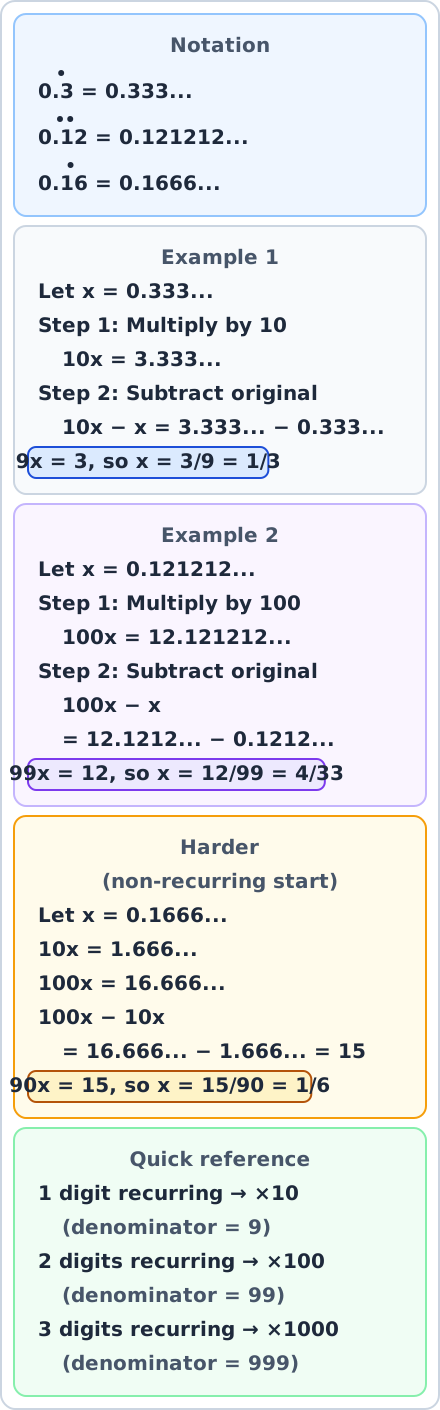
A dot over a digit means that digit repeats: one dot means one digit repeats, and dots over two digits mean those two digits repeat together. Multiply to line up the recurring parts, then subtract to remove the decimal part. This gives a simple equation to solve for x. In Example 2 two digits recur, so multiply by 10² = 100. When the decimal has a non-recurring start, subtract two multiplied equations.
Notation
| Decimal | Meaning | Fraction |
|---|---|---|
| 0.3̇ | 0.333333... | 1/3 |
| 0.1̇2̇ | 0.121212... (12 repeats) | 12/99 = 4/33 |
| 0.16̇ | 0.1666... (only 6 repeats) | 1/6 |
A dot over a single digit means that digit repeats. Dots over two digits means those two digits repeat together.
Converting Recurring Decimal → Fraction
Worked Example 1: Simple Recurring
Convert 0.7̇ to a fraction
Step 1 Let x = 0.777...
x = 0.777777...
Step 2 Multiply by 10
10x = 7.777777...
Step 3 Subtract x from 10x
10x − x = 7.777... − 0.777...
9x = 7
Step 4 Solve for x
x = 7/9
Worked Example 2: Two-Digit Recurring
Convert 0.2̇3̇ to a fraction
Step 1 Let x = 0.232323...
x = 0.232323...
Step 2 Multiply by 100 (two digits repeat)
100x = 23.232323...
Step 3 Subtract
100x − x = 23.2323... − 0.2323...
99x = 23
Step 4 Solve
x = 23/99
Make this stick
Signing in gives access to all PrepWise features.