Test yourself on Transformations with exam style questions, marked instantly.
Flashcards that come back just before you would forget them.
A revision plan that remembers what you know and shows what to do next.
See which topics you have nailed and which need another look.
Quiz yourself on TransformationsGet your flashcardsBuild my revision planTrack my progressMoving Shapes Around
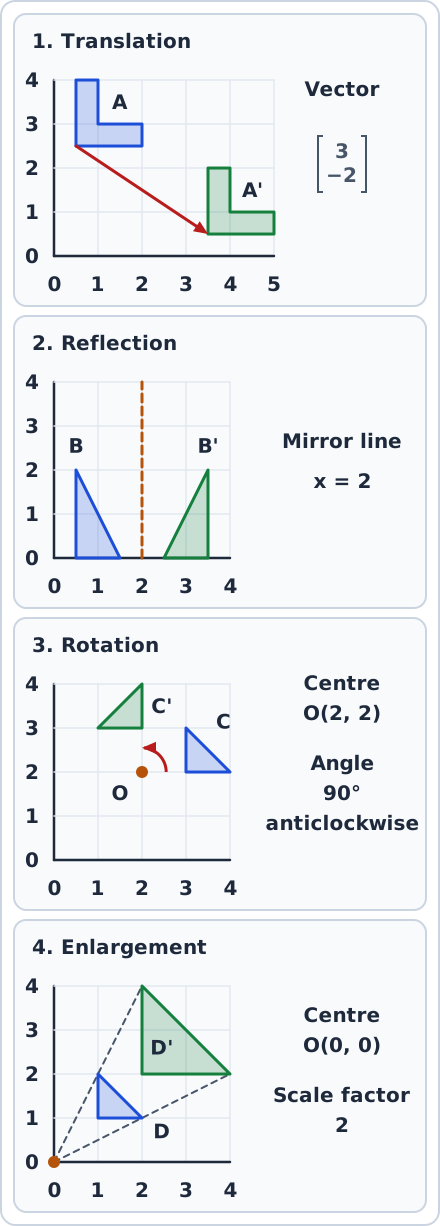
What to state for each transformation. Translation: the column vector, for example (4, −2). Reflection: the equation of the mirror line, for example y = x, and it can also be y = 2. Rotation: the centre, the angle and the direction, clockwise or anticlockwise. Enlargement: the centre of enlargement and the scale factor.
What to State for Each Transformation
| Transformation | What to State | What Changes |
|---|---|---|
| Translation | The vector (x, y) | Position only |
| Reflection | The mirror line (e.g., y = x, x = 2) | Position, orientation flips |
| Rotation | Centre, angle, direction (CW/ACW) | Position, orientation |
| Enlargement | Centre, scale factor | Position, SIZE (only one!) |
Method: Identifying Transformations
Worked Example: Translation
Point A is at (2, 3). After a translation, it moves to (5, 7). What is the translation vector?
Step 1 Find horizontal movement
x-coordinate: 2 → 5, moved 3 right
Step 2 Find vertical movement
y-coordinate: 3 → 7, moved 4 up
Step 3 Write as vector
Vector = (3, 4)
Common Mistakes
Make this stick
Signing in gives access to all PrepWise features.