Test yourself on Circumference & Area of Circles with exam style questions, marked instantly.
Flashcards that come back just before you would forget them.
A revision plan that remembers what you know and shows what to do next.
See which topics you have nailed and which need another look.
Quiz yourself on Circumference & Area of CirclesGet your flashcardsBuild my revision planTrack my progressThe Most Famous Number in Maths
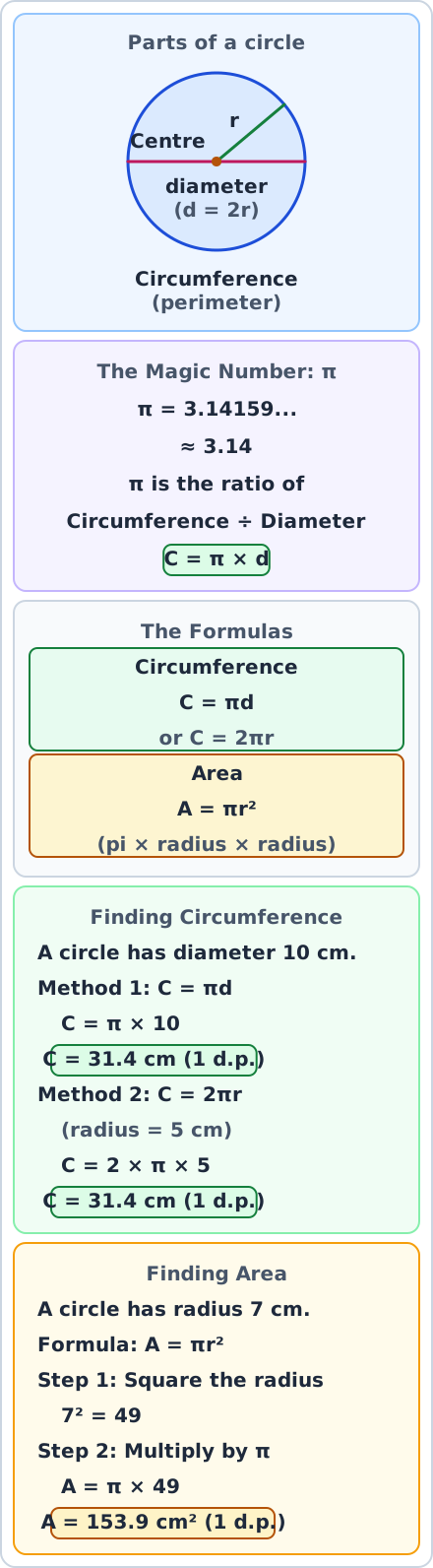
Use the π button on your calculator, not 3.14. π is the ratio of the circumference to the diameter for any circle, so C = π × d always. Both circumference formulas give the same answer. Circumference uses the diameter, or 2r. Area always uses the radius squared.
Key Vocabulary
| Term | Meaning | Symbol |
|---|---|---|
| Radius | Distance from centre to edge | r |
| Diameter | Distance across through centre | d = 2r |
| Circumference | Perimeter (distance around) | C |
| Pi (π) | ≈ 3.14159... or use π button | π |
The Two Essential Formulas
Circumference
C = πd
or C = 2πr
Area
A = πr²
pi × radius × radius
⚠️ Area uses radius SQUARED! This is the most common mistake.
Method: Finding Circumference
- Identify if you have radius or diameter
- Use the formula: C = πd (or C = 2πr if you have radius)
- Substitute and calculate
- Include units (same as input: cm, m, etc.)
Method: Finding Area
- Find the radius (if given diameter, halve it!)
- Square the radius (r × r)
- Multiply by π
- Include units² (cm², m², etc.)
Worked Example 1: Finding Circumference
A circle has diameter 14 cm. Find its circumference. Give your answer to 1 decimal place.
Step 1 Write the formula
C = πd
Step 2 Substitute the values
C = π × 14
Step 3 Calculate
C = 43.98... = 44.0 cm (1 dp)
Worked Example 2: Finding Area
A circle has radius 5 cm. Find its area. Give your answer to 1 decimal place.
Step 1 Write the formula
A = πr²
Step 2 Square the radius first
r² = 5² = 25
Step 3 Multiply by π
A = π × 25 = 78.539... = 78.5 cm² (1 dp)
Common Mistakes to Avoid
- Using diameter instead of radius for area: A = πr² needs RADIUS, not diameter!
- Forgetting to square: πr² means π × r × r, NOT π × r × 2
- Wrong units for area: Area must be in cm², m² etc. (squared units)
- Rounding too early: Keep π in your calculator until the final answer
Exam Tips
- If given diameter, HALVE IT to get radius before using A = πr²
- Leave answers in terms of π if asked (e.g., 25π cm²)
- Use the π button on your calculator, not 3.14
- Check your units - circumference uses cm, area uses cm²
Practice Questions
Q1 Find the circumference of a circle with diameter 10 cm (1 dp) [2 marks]
Q2 Find the area of a circle with radius 5 cm (1 dp) [2 marks]
Q3 Find the area of a circle with diameter 8 cm (1 dp) [3 marks]
Q4 A circular pond has radius 6 m. Find the distance around the pond (1 dp) [2 marks]
Q5 Calculate the circumference of a circle with diameter 12 cm. Give your answer to 1 decimal place. [2 marks]
Q6 Find the area of a circle with radius 6 cm. Give your answer to 1 decimal place. [2 marks]
Q7 A circular table has diameter 120 cm. Calculate its area in m². Give your answer to 2 decimal places. [3 marks]
Q8 A bicycle wheel has diameter 70 cm. How far does the bicycle travel in one complete revolution of the wheel? Give your answer to the nearest cm. [3 marks]
Q9 A circle has radius 9 cm. Find its circumference. Give your answer to 1 decimal place. [3 marks]
Q10 A circular lawn has diameter 8 m. Grass seed costs £2.50 per m². What is the total cost to seed the lawn? Give your answer to the nearest penny. [4 marks]
Q11 Find the area of a circle with radius 7 cm. Leave your answer in terms of π. [2 marks]
Q12 The circumference of a circle is 50 cm. Find its radius. Give your answer to 2 decimal places. [4 marks]
Q13 A circular garden has area 100 m². Calculate its diameter. Give your answer to 1 decimal place. [4 marks]
Q14 A semicircular window has diameter 80 cm. Find: (a) the perimeter, (b) the area. Give answers to 1 decimal place. [5 marks]
Q15 A circular ring (annulus) has outer radius 10 cm and inner radius 7 cm. Find the area of the ring. Give your answer to 1 decimal place. [5 marks]
Q16 A car wheel has diameter 55 cm. The car travels 3 km. How many complete revolutions does the wheel make? [6 marks]
Q17 The radius of a circle is increased by 20%. Find the percentage increase in: (a) circumference, (b) area. [6 marks]
Q18 A running track consists of two straight sections of 100 m joined by two semicircular ends with diameter 60 m. Find the total distance around the track. [6 marks]
Q19 A square has side length 10 cm. A circle is inscribed inside it (touching all four sides). Find the area of the shaded region between the square and circle. Give your answer to 2 decimal places. [7 marks]
Q20 The area of a circle is numerically equal to its circumference. Find the radius. [7 marks]
Q21 A circular pizza has diameter 30 cm. One slice is a sector with angle 60° at the centre. Find the area of the slice. Give your answer to 1 decimal place. [8 marks]
Q22 A piece of wire 100 cm long is bent into a circle. Find: (a) the radius, (b) the area enclosed. Give answers to 2 decimal places. [8 marks]
Q23 Four identical circles of radius 5 cm are placed so that each touches two others. The centres form a square. Find the area of the region inside the square but outside the circles. Give your answer to 1 decimal place. [9 marks]
Q24 Two circles have areas in the ratio 4:9. The smaller circle has radius 6 cm. Find: (a) the radius of the larger circle, (b) the ratio of their circumferences. [9 marks]
Q25 A circle has radius 8 cm. A chord is 6 cm from the centre. Find the area of the minor segment (region between chord and arc). Give your answer to 2 decimal places. [Use: area of segment = area of sector - area of triangle] [10 marks]
Q26 A sector of a circle has radius 12 cm and arc length 15 cm. Find: (a) the angle of the sector in degrees, (b) the area of the sector. Give answers to 1 decimal place. [10 marks]
Q27 Prove that if a circle of radius r is inscribed in a square, the ratio of the circle's area to the square's area is π:4. [11 marks]
Q28 A sphere has surface area 314 cm². Find: (a) its radius, (b) its volume. Use formulas: Surface area = 4πr², Volume = (4/3)πr³. Give answers to 1 decimal place. [12 marks]
Make this stick
Signing in gives access to all PrepWise features.