Test yourself on nth Term with exam style questions, marked instantly.
Flashcards that come back just before you would forget them.
A revision plan that remembers what you know and shows what to do next.
See which topics you have nailed and which need another look.
Quiz yourself on nth TermGet your flashcardsBuild my revision planTrack my progressThe Formula for Any Term
Visual Guide
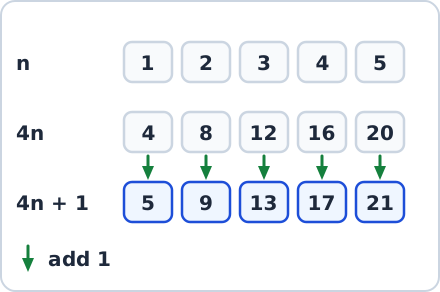
Each term is 4 times its position, plus 1.
Key Vocabulary
| Term | Meaning | Example |
|---|---|---|
| nth term | A formula for any term in the sequence | 3n - 1 |
| n | The position number (1st, 2nd, 3rd...) | For 5th term, n = 5 |
| Formula | Mathematical rule using n | an + b (where a is the difference) |
| Substitute | Replace n with a number | If n = 3, then 3n - 1 = 8 |
Method: Finding the nth Term
Subtract consecutive terms: 2nd − 1st = d
If d = 4, start with "4n"
Work out what to add or subtract to match the first term
If 4n gives 4, 8, 12... but sequence is 3, 7, 11... need to subtract 1
Test it works for n=1, n=2, n=3
Worked Example 1: Finding the nth Term
Find the nth term of the sequence: 5, 9, 13, 17, 21, ...
Step 1 Find the common difference
9 − 5 = 4
13 − 9 = 4
Common difference d = 4
Step 2 Start the formula
nth term starts with 4n
Step 3 Compare to the sequence
4n gives: 4, 8, 12, 16, 20...
Sequence is: 5, 9, 13, 17, 21...
Each term is 1 more than 4n
So add 1: 4n + 1
Step 4 Check it works
n=1: 4(1)+1 = 5 ✓
n=2: 4(2)+1 = 9 ✓
n=3: 4(3)+1 = 13 ✓
Answer: nth term = 4n + 1
Worked Example 2: Using the nth Term
The nth term of a sequence is 3n - 2
a) Find the 10th term
b) Is 100 a term in this sequence?
Part a Find the 10th term
Substitute n = 10:
3(10) − 2 = 30 − 2 = 28
Part b Is 100 in the sequence?
Set 3n − 2 = 100 and solve:
3n = 102
n = 34
Since n is a whole number, yes, 100 is the 34th term
Worked Example 3: Decreasing Sequence
Find the nth term of: 20, 17, 14, 11, 8, ...
Step 1 Find the common difference
17 − 20 = −3
Common difference d = −3
Step 2 Start the formula
nth term starts with −3n
Step 3 Compare and adjust
−3n gives: −3, −6, −9, −12...
Sequence is: 20, 17, 14, 11...
20 − (−3) = 23, so add 23
Answer: nth term = −3n + 23 (or 23 − 3n)
Common Mistakes to Avoid
Make this stick
Signing in gives access to all PrepWise features.