Test yourself on Inverse Functions with exam style questions, marked instantly.
Flashcards that come back just before you would forget them.
A revision plan that remembers what you know and shows what to do next.
See which topics you have nailed and which need another look.
Quiz yourself on Inverse FunctionsGet your flashcardsBuild my revision planTrack my progressFunctions as Machines
Think of a function as a machine: you put a number in, it does something, and a different number comes out. An INVERSE function is a machine that UNDOES what the first machine did. It takes the output and gives you back the original input! It's like having an "undo" button for mathematics.
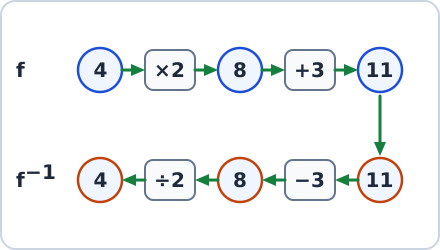
f(x) = 2x + 3. The inverse undoes it, step by step, in the opposite order.
Key Facts
| Concept | Meaning | Example |
|---|---|---|
| f(x) | A function of x | f(x) = 2x + 3 |
| f⁻¹(x) | Inverse function (undoes f) | f⁻¹(x) = (x − 3)/2 |
Key insight: f(f⁻¹(x)) = x and f⁻¹(f(x)) = x
Method: Finding an Inverse Function
1Write y = f(x)
2Swap x and y
3Rearrange to make y the subject
4Replace y with f⁻¹(x)
Worked Example 1: Finding an Inverse
f(x) = 3x − 5. Find f⁻¹(x).
Step 1 Write y = 3x − 5
y = 3x − 5
Step 2 Swap x and y
x = 3y − 5
Step 3 Rearrange for y
x + 5 = 3y
y = (x + 5)/3
Step 4 Write the answer
f⁻¹(x) = (x + 5)/3
Worked Example 2: Verifying an Inverse
f(x) = 4x + 1. Find f⁻¹(x) and verify it's correct.
Step 1 Find the inverse
y = 4x + 1
x = 4y + 1
x - 1 = 4y
y = (x - 1)/4
f⁻¹(x) = (x - 1)/4
Step 2 Verify with f(f⁻¹(x))
f(f⁻¹(x)) = f((x-1)/4)
= 4 × (x-1)/4 + 1
= (x-1) + 1 = x ✓
Step 3 Verify with f⁻¹(f(x))
f⁻¹(f(x)) = f⁻¹(4x + 1)
= ((4x + 1) - 1)/4
= 4x/4 = x ✓
Common Mistakes to Avoid
✗ Forgetting to swap x and y
✓ Always swap before rearranging
This is the crucial step that "undoes" the function
✗ Not verifying your answer
✓ Check that f(f⁻¹(x)) = x
Verification confirms you've done it correctly
✗ Confusing f⁻¹(x) with 1/f(x)
✓ f⁻¹ means inverse, not reciprocal
Inverse function ≠ reciprocal function
Make this stick
Signing in gives access to all PrepWise features.