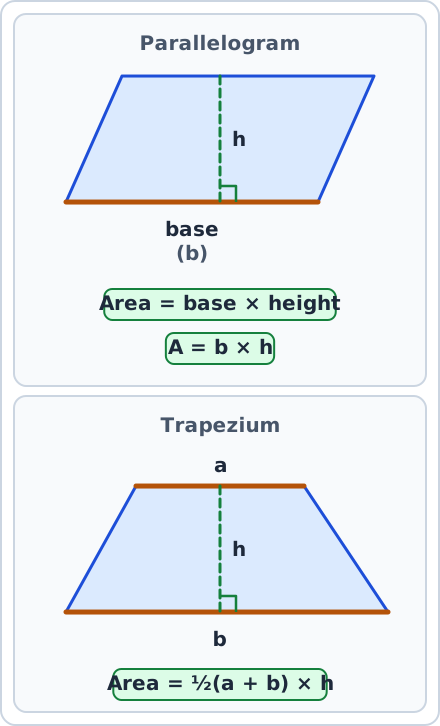
A parallelogram is like a "pushed over" rectangle - imagine pushing the top of a rectangle sideways. A trapezium has just ONE pair of parallel sides. Both are common in real life - roof sections, road signs, and sloped surfaces!
Visual: Parallelogram & Trapezium Areas
The height must be perpendicular to the base. It is measured at 90°, never along the sloping side.
The Key Formulas
Shape
Formula
Key Point
Parallelogram
Area = base × perpendicular height
Same as rectangle! (A = b × h)
Trapezium
Area = ½ × (a + b) × h
a and b are the parallel sides
Remember: Height is ALWAYS perpendicular (90°) - never the slanted side!
Memory Trick for Trapezium
1Add the parallel sides (a + b)
2Multiply by the height
3Halve it (divide by 2)
Why? A trapezium is like the average of two rectangles - one using side 'a' and one using side 'b'.
Worked Example 1: Parallelogram
Find the area of a parallelogram with base 9 cm and perpendicular height 4 cm.
Step 1 Write the formula
Area = base × height
Step 2 Substitute and calculate
Area = 9 × 4 = 36 cm²
Worked Example 2: Trapezium
Find the area of a trapezium with parallel sides 8 cm and 12 cm, and height 5 cm.
Step 1 Write the formula
Area = ½ × (a + b) × h
Step 2 Add the parallel sides
a + b = 8 + 12 = 20
Step 3 Apply the formula
Area = ½ × 20 × 5
Area = ½ × 100 = 50 cm²
Worked Example 3: Finding Missing Height
A parallelogram has area 56 cm² and base 8 cm. Find the height.
Step 1 Set up the equation
Area = base × height
56 = 8 × height
Step 2 Solve for height
height = 56 ÷ 8 = 7 cm
Common Mistakes
✗ Using the slanted side as height✓ Always use PERPENDICULAR height (at 90°)
✗ Forgetting to add parallel sides for trapezium✓ Trapezium: ½ × (a + b) × h - add FIRST, then multiply
✗ Forgetting the ½ in trapezium formula✓ Always halve after multiplying (a + b) × h
Practice Questions
Q1Find the area of a parallelogram: base 12 cm, height 4 cm[1 mark]
[1] 12 × 4 = 48 cm²
Q2Find the area of a trapezium: parallel sides 6 cm and 10 cm, height 5 cm[2 marks]
[1] ½ × (6 + 10) × 5 = ½ × 16 × 5
[1] = ½ × 80 = 40 cm²
Q3A parallelogram has area 54 cm² and base 9 cm. Find the height.[2 marks]
[1] 54 = 9 × h
[1] h = 54 ÷ 9 = 6 cm
Q4Find the area of a trapezium: parallel sides 7 cm and 14 cm, height 5 cm[2 marks]
[1] ½ × (7 + 14) × 5 = ½ × 21 × 5
[1] = ½ × 105 = 52.5 cm²
Q5A parallelogram has base 15 cm and height 6 cm. Find its area.[2 marks]
[1] Area = base × height = 15 × 6
[1] = 90 cm²
Examiner says: It's just like a rectangle - base × perpendicular height. Don't be tricked by the slanted side!
Q6Find the area of a trapezium with parallel sides 8 cm and 12 cm, and height 6 cm.[2 marks]
[1] Area = ½ × (8 + 12) × 6 = ½ × 20 × 6
[1] = ½ × 120 = 60 cm²
Examiner says: Remember to add the parallel sides FIRST, then multiply by height, then halve.
Q7A parallelogram has area 72 cm² and base 9 cm. Calculate the height.[3 marks]
[1] Area = base × height, so 72 = 9 × h
[1] h = 72 ÷ 9
[1] h = 8 cm
Examiner says: Working backwards - divide the area by the base to find the height.
Q8A farmer wants to fertilize a parallelogram-shaped field. The base is 120 m and the perpendicular height is 85 m. One bag of fertilizer covers 500 m². How many bags does he need?[3 marks]
[1] Area of field = 120 × 85 = 10,200 m²
[1] Number of bags = 10,200 ÷ 500 = 20.4
[1] Need 21 bags (must round UP)
Examiner says: Real-world contexts often require rounding UP to the next whole number.
Q9A trapezium has parallel sides of 4.5 cm and 9.5 cm, with height 6 cm. Find its area.[3 marks]
[1] Area = ½ × (4.5 + 9.5) × 6
[1] = ½ × 14 × 6 = ½ × 84
[1] = 42 cm²
Q10A trapezoidal garden has parallel sides 12 m and 18 m, and width 10 m. Turf costs £8 per m². What is the total cost to cover the garden?[4 marks]
[1] Area = ½ × (12 + 18) × 10
[1] = ½ × 30 × 10 = 150 m²
[1] Cost = 150 × £8
[1] = £1,200
Q11A trapezium has area 84 cm², parallel sides in the ratio 2:5, and height 6 cm. Find the lengths of the parallel sides.[4 marks]
[1] Let sides be 2x and 5x. Area = ½ × (2x + 5x) × 6 = 84
[1] ½ × 7x × 6 = 84, so 21x = 84
[1] x = 84 ÷ 21 = 4
[1] Parallel sides are 8 cm and 20 cm
Q12A shape consists of a rectangle 10 cm × 8 cm with a trapezium on top. The trapezium has parallel sides 10 cm (base) and 6 cm (top), with height 4 cm. Find the total area.[4 marks]
[1] Rectangle area = 10 × 8 = 80 cm²
[1] Trapezium area = ½ × (10 + 6) × 4 = ½ × 64 = 32 cm²
[1] Total = 80 + 32
[1] = 112 cm²
Q13A parallelogram has base 12 cm and height 7 cm. If the base is increased by 20% and the height decreased by 10%, find the percentage change in area.[5 marks]
[1] Original area = 12 × 7 = 84 cm²
[1] New base = 12 × 1.2 = 14.4 cm, new height = 7 × 0.9 = 6.3 cm
Examiner says: When both dimensions change, you must calculate the new area - you can't just add/subtract the percentage changes!
Q14A parallelogram has base (x + 4) cm and height (x - 2) cm. Its area is 40 cm². Form and solve an equation to find x.[5 marks]
[1] Area = base × height, so (x + 4)(x - 2) = 40
[1] x² - 2x + 4x - 8 = 40
[1] x² + 2x - 8 = 40, so x² + 2x - 48 = 0
[1] (x + 8)(x - 6) = 0, so x = -8 or x = 6
[1] Since dimensions must be positive, x = 6
Q15A trapezoidal roof section has parallel edges 3.2 m and 4.8 m, and width 2.5 m. One tin of waterproof coating covers 6000 cm². How many tins are needed?[5 marks]
[1] Area = ½ × (3.2 + 4.8) × 2.5 = ½ × 8 × 2.5 = 10 m²
[1] Convert: 10 m² = 10 × 10,000 = 100,000 cm²
[1] Coverage per tin = 6000 cm²
[1] Number needed = 100,000 ÷ 6000 = 16.67
[1] Need 17 tins
Examiner says: Watch out for mixed units! 1 m² = 10,000 cm² (not 100!).
Q16A trapezium has parallel sides a and 2a, and height h. The perimeter is 60 cm and the slanted sides are each 10 cm. Find the area.[6 marks]
[1] Perimeter = a + 2a + 10 + 10 = 60
[1] 3a + 20 = 60, so 3a = 40, a = 40/3 cm
[1] Using Pythagoras on one slanted side: h² + ((2a-a)/2)² = 10²
[1] Area = ½ × (40/3 + 80/3) × 7.45 = ½ × 40 × 7.45 = 149 cm²
Q17Two similar parallelograms have areas in the ratio 9:25. The smaller has base 6 cm. Find the base of the larger parallelogram.[6 marks]
[2] Area ratio = 9:25, so linear scale factor = √(9/25) = 3/5 or √(25/9) = 5/3
[2] Since we're going from smaller to larger, SF = 5/3
[1] Larger base = 6 × (5/3)
[1] = 10 cm
Examiner says: For similar shapes, area ratio = (length ratio)². Square root to find the length scale factor.
Q18A parallelogram has vertices at A(1,2), B(5,2), C(7,6) and D(3,6). Find its area.[6 marks]
[1] Base AB is horizontal from (1,2) to (5,2)
[1] Base length = 5 - 1 = 4 units
[2] Height is vertical distance between the parallel sides y = 2 and y = 6
[1] Height = 6 - 2 = 4 units
[1] Area = 4 × 4 = 16 square units
Examiner says: When sides are parallel to axes, finding perpendicular height is straightforward!
Q19Show algebraically that a trapezium with parallel sides a and b and height h has the same area as a rectangle with width (a+b)/2 and height h.[7 marks]
[2]Trapezium area = ½ × (a + b) × h
[2]Rectangle area = width × height = [(a+b)/2] × h
[2] Expanding: [(a+b)/2] × h = (a+b)h/2 = ½(a+b)h
[1] Both expressions equal ½(a+b)h, so areas are equal
Examiner says: This shows why the trapezium formula works - it's the average of the parallel sides, times the height!
Q20A parallelogram has adjacent sides of 10 cm and 8 cm. The angle between them is 65°. Find the area.[7 marks]
[2] To find perpendicular height: h = 8 × sin(65°)
[2] h = 8 × 0.9063 = 7.25 cm
[2] Area = base × perpendicular height = 10 × 7.25
[1] = 72.5 cm²
Examiner says: Alternative formula: Area = ab sin(θ) where a,b are adjacent sides and θ is the angle between them.
Q21A trapezium has parallel sides of lengths x cm and (x+6) cm. The height is (10-x) cm. Find the value of x that gives maximum area.[8 marks]
[1] Area A = ½ × [x + (x+6)] × (10-x)
[1] A = ½ × (2x + 6) × (10 - x)
[1] A = ½ × (20x - 2x² + 60 - 6x) = ½ × (-2x² + 14x + 60)
[1] A = -x² + 7x + 30
[2] A = (x + 3)(10 - x), so A = 0 at x = -3 and x = 10. The parabola opens downward, so the maximum is halfway between the roots: x = (-3 + 10) ÷ 2 = 3.5
Q22A prism has an isosceles trapezium cross-section with parallel sides 8 cm and 12 cm, and height 5 cm. The prism is 20 cm long. Find: (a) the cross-sectional area, (b) the volume, (c) the surface area.[9 marks]
[2] (a) Cross-sectional area = ½ × (8 + 12) × 5 = ½ × 100 = 50 cm²
Q23A bridge support beam has a trapezoidal cross-section (top 20 cm, bottom 35 cm, height 40 cm). If steel weighs 7.85 g/cm³ and the beam is 5 m long, find its mass in kg.[8 marks]
[2] Cross-sectional area = ½ × (20 + 35) × 40 = ½ × 55 × 40 = 1100 cm²
[1] Length = 5 m = 500 cm
[2] Volume = 1100 × 500 = 550,000 cm³
[1] Mass = volume × density = 550,000 × 7.85 g
[1] = 4,317,500 g
[1] = 4,317.5 kg (or 4.32 tonnes)
Q24An isosceles trapezium has parallel sides a and 3a, where a > 0. The height is also a. Show that the area is 2a² and find the value of a if the perimeter must be at least 40 cm and the area exactly 72 cm².[9 marks]
[2] Area = ½ × (a + 3a) × a = ½ × 4a × a = 2a² ✓
[1] Given area = 72, so 2a² = 72
[1] a² = 36, so a = 6 cm (positive)
[2] Slant sides: using Pythagoras, each slant² = a² + a² = 2a² = 72, so slant = 6√2 ≈ 8.49 cm
Q25A parallelogram has vertices at (t, t²), (t+2, t²), (t+3, (t+1)²), and (t+1, (t+1)²) where t is a parameter. Find the area in terms of t, and the value of t that gives maximum area for 0 ≤ t ≤ 5. (t is a number you can choose.)[10 marks]
[2] Base is horizontal from (t, t²) to (t+2, t²), length = 2
[2] Height is vertical distance between y = t² and y = (t+1)²
PrepWise is a trading name of A3M Quality Solutions Limited, registered in England and Wales, company number 14959172. Registered office: 202 Stroud Road, Gloucester, GL1 5LA. ICO registration ZC267069.
Cookies on PrepWise
Cookies. Essential ones keep you signed in. With your OK we'd also use a few to see which pages help people find us, never to follow you elsewhere. Cookie policy