Test yourself on Graph Transformations with exam style questions, marked instantly.
Flashcards that come back just before you would forget them.
A revision plan that remembers what you know and shows what to do next.
See which topics you have nailed and which need another look.
Quiz yourself on Graph TransformationsGet your flashcardsBuild my revision planTrack my progressMoving and Flipping Graphs
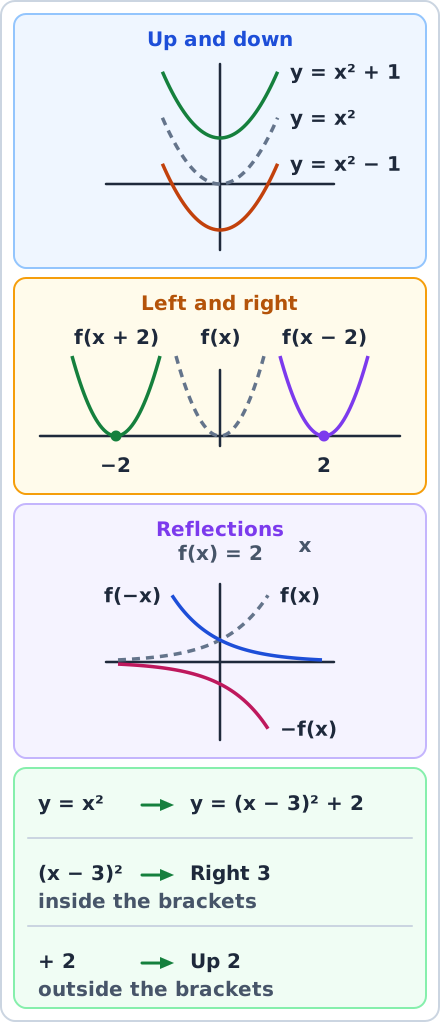
f(x) + a moves a graph up by a and f(x) − a moves it down by a. f(x + a) moves it left by a and f(x − a) moves it right by a. −f(x) reflects in the x axis and f(−x) reflects in the y axis. Golden rule: changes outside f(x) change the y values and behave as you expect, in the same direction. Changes inside f(x) change the x values and behave the opposite way to what you expect. In the worked example, (x − 3)² is inside the brackets, so the graph moves right, opposite to the minus sign, and + 2 is outside, so the graph moves up.
Transformation Rules (THE Table!)
| Transformation | Effect | Example from y = f(x) |
|---|---|---|
| f(x) + a | Translate UP by a | y = x² + 3 moves up 3 |
| f(x) − a | Translate DOWN by a | y = x² − 2 moves down 2 |
| f(x + a) | Translate LEFT by a | y = (x + 3)² moves left 3 |
| f(x − a) | Translate RIGHT by a | y = (x − 2)² moves right 2 |
| −f(x) | Reflect in x-axis | y = −x² flips upside down |
| f(−x) | Reflect in y-axis | y = 2^(-x) is y = 2^x flipped left-right |
Memory trick: Inside brackets = opposite direction (+ goes left, − goes right)!
Worked Examples
Example 1
The graph of y = x² is translated 3 units to the right. Write the equation of the transformed graph.
Solution
Translate right 3 means use (x − 3)
New equation: y = (x − 3)²
Example 2
A graph has equation y = f(x). The point (2, 5) lies on this graph. After the transformation y = f(x) + 2, what are the new coordinates of this point?
Step 1: Understand the transformation
y = f(x) + 2 means add 2 to all y-values
This is a translation 2 units up
Step 2: Apply to the x-coordinate
A vertical translation doesn't affect x-coordinates
x stays as 2
Step 3: Apply to the y-coordinate
Original y-value: 5
New y-value: 5 + 2 = 7
Step 4: State the new coordinates
The transformed point is (2, 7)
Example 3
The graph y = f(x) passes through the point (4, -3). Find the coordinates of this point after the combined transformations: first a reflection in the x-axis, then a translation 5 units left.
Step 1: Apply the first transformation (reflection in x-axis)
Reflection in x-axis: y = -f(x)
This changes the sign of y-coordinates
After reflection: (4, -3) becomes (4, 3)
Step 2: Apply the second transformation (translation left 5)
Translation left 5: y = f(x + 5)
This subtracts 5 from x-coordinates
x-coordinate: 4 - 5 = -1
y-coordinate stays: 3
Step 3: Write the equation of the final graph
Starting with y = f(x)
After reflection: y = -f(x)
After translation: y = -f(x + 5)
Step 4: State the final answer
The point (4, -3) transforms to (-1, 3)
The equation becomes y = -f(x + 5)
Make this stick
Signing in gives access to all PrepWise features.