Test yourself on Inverse Proportion with exam style questions, marked instantly.
Flashcards that come back just before you would forget them.
A revision plan that remembers what you know and shows what to do next.
See which topics you have nailed and which need another look.
Quiz yourself on Inverse ProportionGet your flashcardsBuild my revision planTrack my progressThe Opposite of Direct
If 4 workers can build a wall in 6 days, how long would 8 workers take? More workers = less time! When one thing increases and the other decreases in proportion, that's INVERSE proportion. The product of the two values always stays the same.
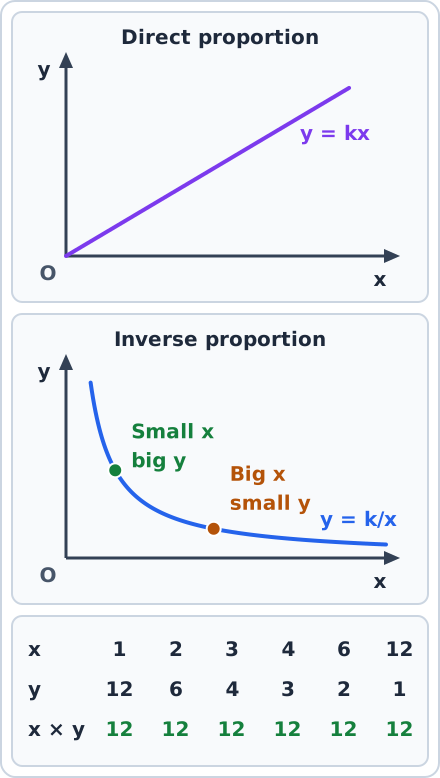
Key Features of Inverse Proportion
| Feature | What It Means |
|---|---|
| y ∝ 1/x | y is inversely proportional to x |
| y = k/x | The equation form (k is constant) |
| xy = k | The product is always constant |
| Graph | Curved (hyperbola), never touches axes |
Method: Solving Inverse Problems
1
Find k by multiplying the two given values: k = x × y
2
Use k to find the unknown: y = k ÷ x (or x = k ÷ y)
Worked Example
6 workers take 15 days to complete a job. How long would 10 workers take?
Step 1 Find k (workers × days)
k = 6 × 15 = 90
Step 2 Use k to find new time
days = k ÷ workers = 90 ÷ 10
Answer:
9 days
Common Mistakes
- WRONG: Using y = kx for inverse (that's direct!) (Should be y = k/x)
- WRONG: More workers take MORE time (Inverse means opposite!)
- RIGHT: Check logic - does your answer make sense?
Make this stick
Signing in gives access to all PrepWise features.