Test yourself on Basic Probability with exam style questions, marked instantly.
Flashcards that come back just before you would forget them.
A revision plan that remembers what you know and shows what to do next.
See which topics you have nailed and which need another look.
Quiz yourself on Basic ProbabilityGet your flashcardsBuild my revision planTrack my progressProbability in Daily Life
When you flip a coin, what are the chances it lands on heads? When you roll a die, what's the likelihood of getting a 6? These everyday situations involve probability - the mathematical way of measuring uncertainty and chance.
From weather forecasts to sports results, probability helps us make sense of uncertain events and make informed decisions.
Key Facts
- Probability = number of successful outcomes ÷ total number of possible outcomes
- Probability is always between 0 and 1 (or 0% and 100%)
- P = 0 means the event is impossible
- P = 1 means the event is certain
- P = 0.5 means the event is equally likely to happen or not happen
- All probabilities for all possible outcomes must add up to 1
Probability Scale
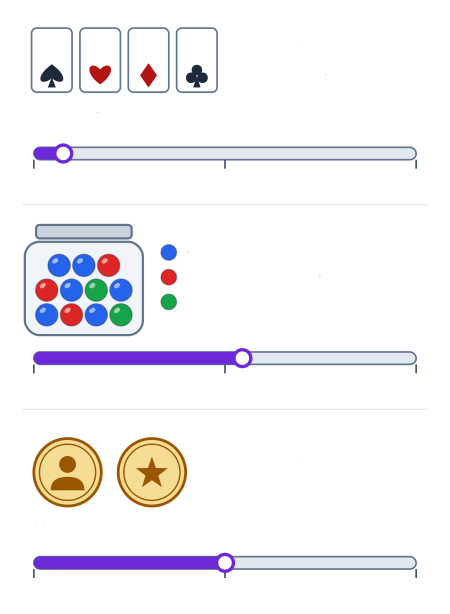
Understanding Probability
The Basic Formula
P(event) = Number of favourable outcomes / Total number of possible outcomes
Example 1: Coin Flip
A fair coin has 2 possible outcomes: heads or tails
- P(heads) = 1/2 = 0.5 = 50%
- P(tails) = 1/2 = 0.5 = 50%
Example 2: Rolling a Die
A standard die has 6 faces numbered 1, 2, 3, 4, 5, 6
- P(rolling a 3) = 1/6 ≈ 0.167 = 16.7%
- P(rolling an even number) = 3/6 = 1/2 = 0.5 = 50%
- P(rolling a number less than 7) = 6/6 = 1 = 100% (certain)
- P(rolling an 8) = 0/6 = 0 = 0% (impossible)
Example 3: Drawing Cards
A standard deck has 52 cards: 13 spades, 13 hearts, 13 diamonds, 13 clubs
- P(drawing a spade) = 13/52 = 1/4 = 0.25 = 25%
- P(drawing an ace) = 4/52 = 1/13 ≈ 0.077 = 7.7%
- P(drawing a red card) = 26/52 = 1/2 = 0.5 = 50%
Exam Tips
- Always simplify fractions - write 1/2 instead of 3/6
- Check your answer makes sense - probability cannot be negative or greater than 1
- Read the question carefully - "at least one" is different from "exactly one"
- Use clear notation - write P(A) for "probability of event A"
- Show your working - write the fraction before converting to decimal
- Be careful with units - some questions want decimals, others want percentages or fractions
Common Probability Scenarios
| Scenario | Total Outcomes | Example Event | Probability |
|---|---|---|---|
| Coin flip | 2 | Getting heads | 1/2 |
| Rolling a die | 6 | Rolling a 6 | 1/6 |
| Picking from 10 balls | 10 | Picking the red ball | 1/10 |
| Drawing from deck | 52 | Drawing an ace | 4/52 = 1/13 |
Make this stick
Signing in gives access to all PrepWise features.