Test yourself on Factorising with exam style questions, marked instantly.
Flashcards that come back just before you would forget them.
A revision plan that remembers what you know and shows what to do next.
See which topics you have nailed and which need another look.
Quiz yourself on FactorisingGet your flashcardsBuild my revision planTrack my progressFactorising = Reverse of Expanding
The Key Idea
Find the Highest Common Factor (HCF) of all terms
ab + ac = a(b + c)
Method: Factorising Step by Step
Worked Example 1: Numbers Only
Factorise: 6x + 15
Step 1 Find HCF of 6 and 15
6 = 2 × 3, 15 = 3 × 5
HCF = 3
Step 2 Divide each term by 3
6x ÷ 3 = 2x
15 ÷ 3 = 5
Final Write in factorised form
6x + 15 = 3(2x + 5)
Check: 3 × 2x + 3 × 5 = 6x + 15 ✓
Worked Example 2: With Common Variable
Factorise: 4x² + 10x
Step 1 Find HCF of numbers
HCF of 4 and 10 = 2
Step 2 Find common letters
x² has x×x, 10x has x
Common: x (lowest power)
Step 3 HCF = 2x
4x² ÷ 2x = 2x
10x ÷ 2x = 5
Final Write answer
4x² + 10x = 2x(2x + 5)
Worked Example 3: Three Terms
Factorise: 12x³ + 8x² - 4x
Step 1 Find HCF of 12, 8, 4
HCF = 4
Step 2 Find common letter (lowest power)
x³, x², x → common is x
HCF = 4x
Step 3 Divide each term
12x³ ÷ 4x = 3x²
8x² ÷ 4x = 2x
-4x ÷ 4x = -1
Final Write answer
12x³ + 8x² - 4x = 4x(3x² + 2x - 1)
Common Mistakes
Practice Questions
Q1 Factorise: 5x + 15 [1 mark]
Q2 Factorise: 3x² + 12x [2 marks]
Q3 Factorise: 6x² - 8x [2 marks]
Q4 Factorise: 10y³ + 5y² - 15y [2 marks]
Advanced: Factorising Quadratics
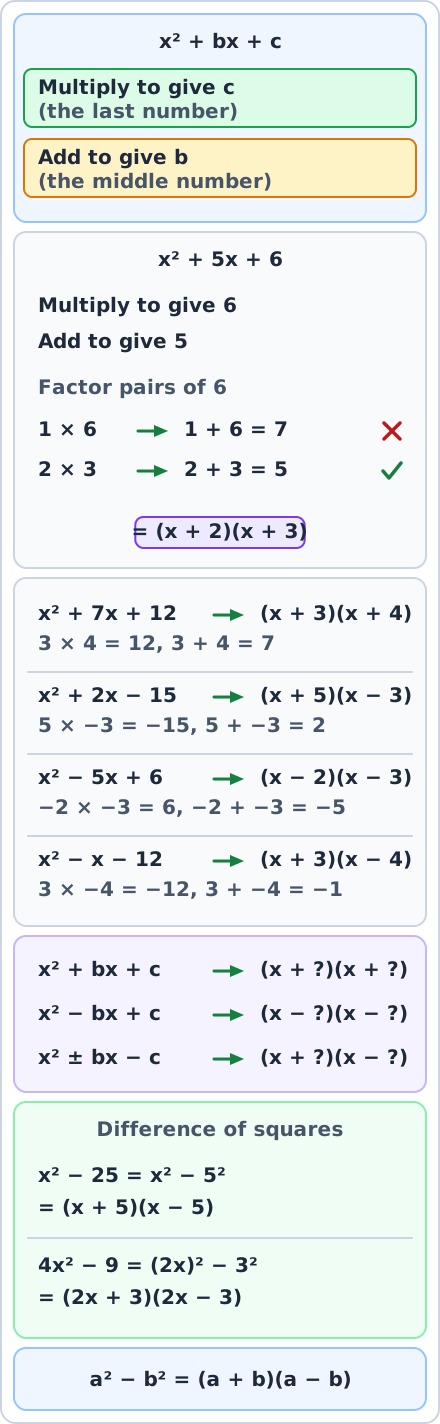
Watch the signs. If b and c are both positive, both numbers are positive. If c is negative, one number is positive and one is negative. If b is negative and c is positive, both numbers are negative. If b and c are both negative, one number is positive and one is negative, and the bigger number is the negative one. In x² ± bx − c, the bigger number takes the sign of b. For a difference of squares there is no middle term, so look for a² − b². In 4x² − 9, a is 2x and b is 3.
The "Two Numbers" Method
For x² + bx + c, find two numbers that:
MULTIPLY to give c
ADD to give b
Example: x² + 5x + 6
- Need: multiply to 6, add to 5
- Numbers: 2 and 3 (2×3=6, 2+3=5)
- Answer: (x + 2)(x + 3)
Worked Example: Quadratic - Both Positive
Factorise: x² + 7x + 12
Step 1 Set up the problem
Need: multiply to 12, add to 7
Step 2 List factor pairs of 12
1 × 12 (sum = 13) ✗
2 × 6 (sum = 8) ✗
3 × 4 (sum = 7) ✓
Final Write the brackets
x² + 7x + 12 = (x + 3)(x + 4)
Check: x² + 4x + 3x + 12 = x² + 7x + 12 ✓
Worked Example: Quadratic - Negative Constant
Factorise: x² + 2x - 15
Step 1 Set up the problem
Need: multiply to -15, add to +2
Negative product means ONE negative, ONE positive
Step 2 Find the right pair
-3 × 5 = -15, -3 + 5 = +2 ✓
Final Write the brackets
x² + 2x - 15 = (x - 3)(x + 5)
Sign Rules Cheat Sheet
| Expression | Signs in Brackets |
|---|---|
| x² + bx + c (both positive) | (x + __)(x + __) |
| x² - bx + c (middle neg, end pos) | (x - __)(x - __) |
| x² + bx - c (end negative) | (x + __)(x - __) bigger number positive |
| x² - bx - c (end negative) | (x + __)(x - __) bigger number negative |
Q5 Factorise: x² + 7x + 10 [2 marks]
Q6 Factorise: x² + x - 12 [2 marks]
Q7 Factorise: x² - 8x + 12 [2 marks]
Make this stick
Signing in gives access to all PrepWise features.