Advanced: Factorising Quadratics

Test yourself on Factorising with exam style questions, marked instantly.

Flashcards that come back just before you would forget them.

A revision plan that remembers what you know and shows what to do next.

See which topics you have nailed and which need another look.

Quiz yourself on FactorisingGet your flashcardsBuild my revision planTrack my progress

Advanced: Factorising Quadratics

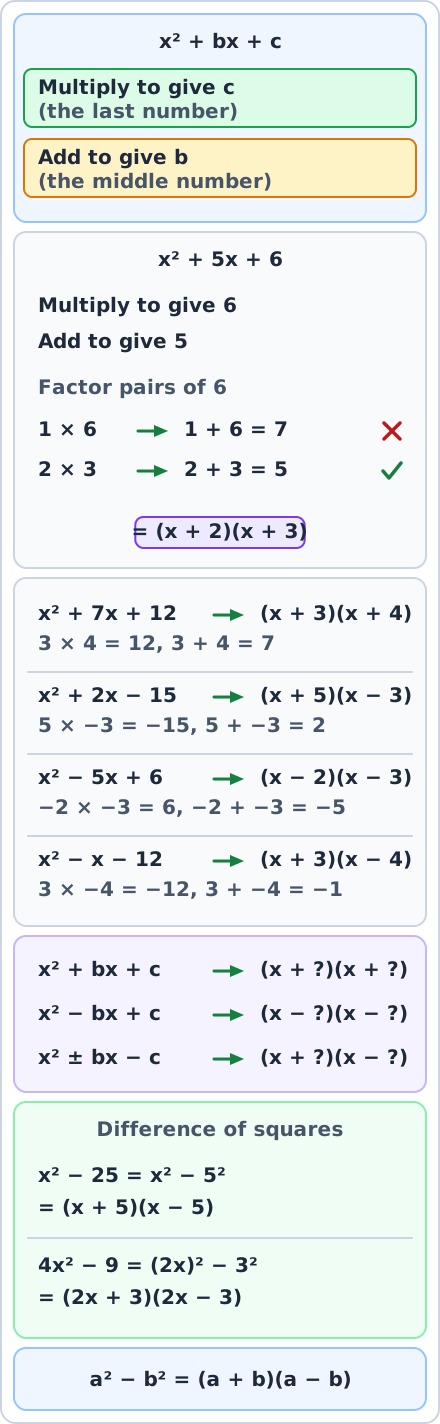
When you expand (x + 3)(x + 2), you get x² + 5x + 6. Factorising is the reverse - given x² + 5x + 6, find the two brackets! The trick is finding two numbers that multiply to give the last number AND add to give the middle number.
To factorise x² + bx + c, find two numbers that multiply to give c and add to give b. The example x² + 5x + 6: the factor pairs of 6 are 1 × 6, which adds to 7 and is wrong, and 2 × 3, which adds to 5 and is right, so the answer is (x + 2)(x + 3). Four sign cases: x² + 7x + 12 = (x + 3)(x + 4), x² + 2x − 15 = (x + 5)(x − 3), x² − 5x + 6 = (x − 2)(x − 3), x² − x − 12 = (x + 3)(x − 4). The signs in the brackets for each kind of expression, and the difference of squares: x² − 25 = (x + 5)(x − 5), 4x² − 9 = (2x + 3)(2x − 3) and a² − b² = (a + b)(a − b).

Watch the signs. If b and c are both positive, both numbers are positive. If c is negative, one number is positive and one is negative. If b is negative and c is positive, both numbers are negative. If b and c are both negative, one number is positive and one is negative, and the bigger number is the negative one. In x² ± bx − c, the bigger number takes the sign of b. For a difference of squares there is no middle term, so look for a² − b². In 4x² − 9, a is 2x and b is 3.

Make this stick

Signing in gives access to all PrepWise features.

PrepWise is a trading name of A3M Quality Solutions Limited, registered in England and Wales, company number 14959172. Registered office: 202 Stroud Road, Gloucester, GL1 5LA. ICO registration ZC267069.