Test yourself on Completing the Square with exam style questions, marked instantly.
Flashcards that come back just before you would forget them.
A revision plan that remembers what you know and shows what to do next.
See which topics you have nailed and which need another look.
Quiz yourself on Completing the SquareGet your flashcardsBuild my revision planTrack my progressA Perfect Form
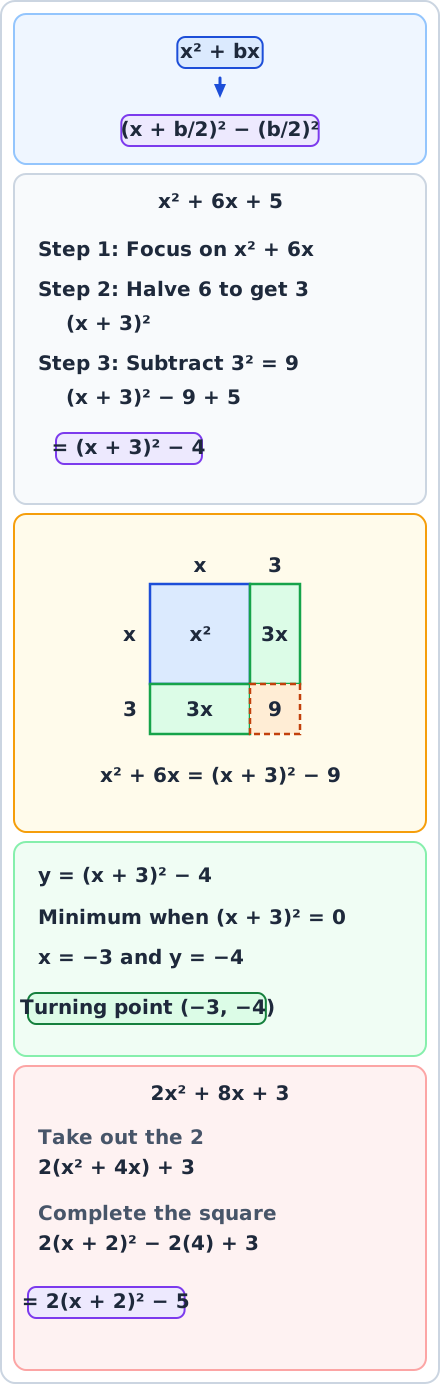
To complete the square, halve the x coefficient, square it and subtract it. Ignore the + 5 for now: work on x² + 6x first, then add the 5 back. The 9 completes the square, because we add 9 then subtract 9. The minimum of y = (x + 3)² − 4 is when (x + 3)² = 0, so x = −3 and y = −4. For 2x² + 8x + 3, take the 2 out of the x terms first.
Method: When a = 1
To write x² + bx + c in the form (x + p)² + q:
Key insight: (x + p)² + q has turning point at (−p, q)
Worked Example 1
Write x² + 8x + 5 in the form (x + p)² + q
Step 1 Find p
p = half of 8 = 4
Step 2 Write in form
(x + 4)² − 4² + 5
= (x + 4)² − 16 + 5
= (x + 4)² − 11
Worked Example 2: Negative b
Write x² − 6x + 2 in completed square form
Solution
p = half of −6 = −3
(x − 3)² − (−3)² + 2
= (x − 3)² − 9 + 2
= (x − 3)² − 7
Worked Example 3: Finding Turning Point
Find the turning point of y = x² + 4x − 3
Solution
Complete the square: (x + 2)² − 4 − 3 = (x + 2)² − 7
Turning point at x = −2, y = −7
Turning point: (−2, −7)
Make this stick
Signing in gives access to all PrepWise features.