Imagine you're following a recipe: "Add 2 cups flour plus 3 times 4 tablespoons sugar". Do you add 2 + 3 = 5, then multiply by 4 to get 20 tablespoons sugar? Or do you multiply 3 × 4 = 12 first, then add 2 cups flour plus 12 tablespoons sugar? Without BIDMAS, mathematical expressions would be as confusing as this recipe! BIDMAS gives us the universal order that mathematicians worldwide follow.
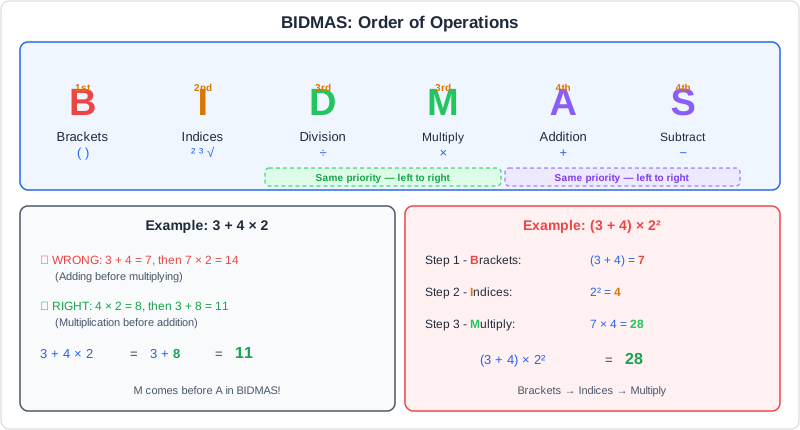
This introduction covers Why Order Matters within BIDMAS for GCSE Mathematics. Revise BIDMAS in Number for GCSE Mathematics with 14 exam-style questions and 22 flashcards. This topic appears regularly enough that it should still be part of a steady revision cycle. It is section 1 of 9 in this topic. Use this introduction to connect the idea to the wider topic before moving on to questions and flashcards.
Practice questions for BIDMAS
What does the letter 'I' stand for in BIDMAS?
Explain what BIDMAS tells us about calculations and why it is needed.
Quick recall flashcards
Calculate: 10 - 2²
**Step 1:** Indices first (BIDMAS)
2² = 4
**Step 2:** Then subtraction
10 - 4 = **6**
*(Not 10 - 2 = 8, then 8² = 64)*
Calculate: 2 + 3 × 4
**Step 1:** Multiplication first (BIDMAS)
3 × 4 = 12
**Step 2:** Then addition
2 + 12 = **14**
*(Not 2 + 3 = 5, then 5 × 4 = 20)*