Atomic StructureDiagram

Nuclear Decay Equations

Part of Radioactive DecayGCSE Physics

This diagram covers Nuclear Decay Equations within Radioactive Decay for GCSE Physics. Revise Radioactive Decay in Atomic Structure for GCSE Physics with 13 exam-style questions and 6 flashcards. This topic appears regularly enough that it should still be part of a steady revision cycle. It is section 5 of 14 in this topic. Focus on the labels, the relationships between parts, and the explanation that turns the diagram into an exam-ready answer.

Topic position

Section 5 of 14

Practice

13 questions

Recall

6 flashcards

📊 Nuclear Decay Equations

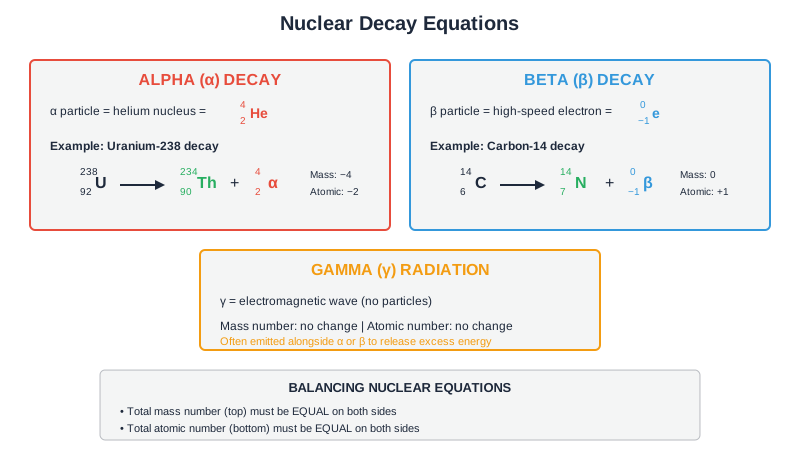
Nuclear decay equations showing alpha decay example with uranium-238 to thorium-234 plus alpha particle, beta decay example with carbon-14 to nitrogen-14 plus electron, and gamma radiation explanation, with balancing rules

Figure 2: Balancing nuclear equations — mass numbers and atomic numbers must balance on both sides.

BALANCING TIP: Add up mass numbers on both sides (must be equal). Add up atomic numbers on both sides (must be equal). The alpha particle is ⁴₂He, the beta particle is ⁰₋₁e.

Keep building this topic

Read this section alongside the surrounding pages in Radioactive Decay. That gives you the full topic sequence instead of a single isolated revision point.

Practice Questions for Radioactive Decay

An alpha particle consists of which particles?

  • A. 2 protons and 2 neutrons
  • B. 1 proton and 1 neutron
  • C. An electron and a positron
  • D. A proton and an electron
1 markfoundation

Explain why alpha radiation is described as highly ionising but weakly penetrating.

2 marksstandard

Quick Recall Flashcards

Beta particle is?
Fast electron from nucleus
Alpha particle is?
2p + 2n (helium nucleus)

Want to test your knowledge?

PrepWise has 13 exam-style questions and 6 flashcards for Radioactive Decay — with adaptive difficulty and instant feedback.

Join Alpha