Edexcel Physics Paper 1

499 questions with model answers · Physics Paper 1 · GCSE Physics revision

Forces & Their Effects

Common28
1.

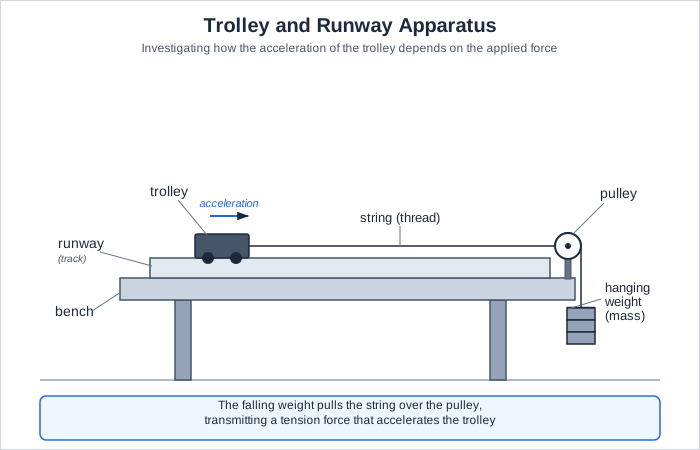
Describe a method to investigate how the resultant force on a trolley affects its acceleration. Your method should include: the equipment needed, how you would change the force, how you would measure acceleration, and one way to make your results more reliable.

6 marks · standardCommon

Equipment: a trolley on a flat runway, a pulley fixed at the end of the runway, a length of string connecting the trolley to hanging masses over the pulley, two light gates connected to a data logger, a metre rule, and a set of masses. Method: Set up one light gate near the start of the trolley's path and a second light gate further along; measure the distance between them with the metre rule. Transfer masses from the trolley to the hanger to provide a known force — this keeps the total system mass constant, which is the control variable. Allow the trolley to accelerate from rest through both light gates. The data logger records the velocity at each gate; calculate acceleration as change in velocity divided by the time between gates. Repeat the measurement for each force setting three times and calculate the mean acceleration to improve reliability. Plot a graph of acceleration (y-axis) against force (x-axis) — a straight line through the origin confirms F = ma.

  • Level 3 (5-6 marks): Method produces a valid outcome. Equipment named (trolley, runway/ramp, pulley, string, hanging masses, light gates or data logger, metre rule). Force changed by transferring masses from trolley to hanger (keeping total system mass constant). Acceleration measured from light gate timings and measured distance between gates. At least one valid reliability improvement stated (repeat and mean). Steps logically sequenced. (6m)
  • Level 2 (3-4 marks): Most key steps identified but one significant element missing or not fully explained — e.g. method for changing force described but compensating masses not mentioned, OR acceleration measurement described but equipment not fully named. (4m)
  • Level 1 (1-2 marks): Some relevant steps identified but method would not produce valid results — e.g. only names equipment without describing the procedure, or describes measuring force only without describing how acceleration is found. (2m)

This is Required Practical RPA7 (F = ma trolley investigation). The key insight is that masses must be transferred from the trolley to the hanger — not simply added to the hanger — so the total system mass stays constant. This makes force the only independent variable. Acceleration is calculated from light gate data: a = (v2 - v1) / t. Repeating and averaging reduces random errors. The resulting acceleration-force graph should be a straight line through the origin, confirming Newton's Second Law.

Test yourself on this in PrepWise
2.

A student wants to investigate how the extension of a spring varies with the force applied. Describe a method the student could use to carry out this investigation. Include the equipment needed, the measurements to take, and how to make the results more reliable. (6 marks - Level of Response)

6 marks · higherCommon

Equipment: hang a spring from a clamp stand, attach a pointer to the spring end, and use a metre rule fixed vertically alongside. Known masses are used as weights. Measure the natural length of the spring before adding any mass. The independent variable is the force applied (mass added), and the dependent variable is the extension of the spring. Add masses one at a time, recording the new length after each addition. Extension equals new length minus original length. Control variables include using the same spring throughout and keeping the temperature constant. To improve reliability, repeat each measurement at least twice and calculate a mean. Plot a graph of force (y-axis) against extension (x-axis). On the straight-line section the gradient equals the spring constant (k = F divided by extension).

  • Level 3 (5-6 marks): Describes a valid method with: equipment listed (spring, ruler/metre rule, masses/weights, clamp stand, pointer), measurements described (force in N, extension in m/cm), correct identification of IV and DV, control variable mentioned (same spring/temperature), describes repeating measurements and calculating a mean, and explains how to plot a force-extension graph. (6m)
  • Level 2 (3-4 marks): Describes most steps but may not fully identify variables or mention repeating, or may omit some key equipment. (4m)
  • Level 1 (1-2 marks): Some relevant steps but method is incomplete or lacks logical sequence; minimal reference to measurements or variables. (2m)

A complete method: hang the spring from a clamp stand, use a metre rule to measure its natural length. Add known masses (providing known forces) one at a time and measure the new length after each addition. Extension = new length - original length. Plot a force-extension graph; the gradient gives the spring constant. Repeat readings and calculate means to improve reliability. Keep the same spring and temperature as control variables.

Test yourself on this in PrepWise
3.

Explain the difference between a scalar quantity and a vector quantity. Give one example of each and explain why forces must be represented as vectors when calculating a resultant force.

4 marks · higherCommon

A scalar quantity has only magnitude (size) but no direction. A vector quantity has both magnitude and direction. An example of a scalar is speed (just a number and unit, e.g. 10 m/s). An example of a vector is velocity (magnitude and direction, e.g. 10 m/s north). Forces must be represented as vectors because forces have both magnitude and direction. When calculating a resultant force, the direction of each force matters - forces in the same direction add together while forces in opposite directions partially or fully cancel each other out. Ignoring direction would give the wrong resultant.

  • Scalar: has magnitude (size) only, no direction - with correct example (speed, distance, mass, temperature, energy) (1m)
  • Vector: has both magnitude and direction - with correct example (force, velocity, acceleration, displacement, momentum) (1m)
  • Forces are vectors because they have direction; direction must be considered when adding forces (1m)
  • Same direction forces add; opposite direction forces subtract / cancel - giving correct resultant only if direction considered (1m)

Scalars have magnitude only (e.g. speed, mass, temperature). Vectors have both magnitude and direction (e.g. force, velocity, acceleration). Forces must be treated as vectors because 10 N right + 10 N left = 0 N (they cancel), but 10 N right + 10 N right = 20 N right.

Test yourself on this in PrepWise
4.

A student plots a graph of acceleration (y-axis, m/s^2) against force (x-axis, N) for a trolley on a runway. The graph is a straight line through the origin with a gradient of 0.4 m/s^2 per N. What is the total mass of the trolley system? Show your working.

4 marks · higherCommon
  • State that gradient of acceleration-force graph = a/F = 1/m (from F = ma rearranged as a = F/m) (1m)
  • Correct relationship: mass = 1 / gradient (1m)
  • Correct substitution: mass = 1 / 0.4 (1m)
  • Correct answer: mass = 2.5 kg (1m)

Rearranging F = ma gives a = (1/m) x F. A graph of a against F is a straight line through the origin with gradient = 1/m. Therefore m = 1/gradient = 1/0.4 = 2.5 kg. This graph analysis skill tests whether students can connect the mathematical form of F = ma to the physical meaning of the gradient of an experimental graph.

Test yourself on this in PrepWise
5.

Explain the difference between elastic and inelastic deformation. Include what happens to the object in each case when the force is removed.

3 marks · standardCommon

Elastic deformation occurs when an object is deformed by a force but returns to its original shape and size when the force is removed. Inelastic deformation occurs when an object is deformed and does not return to its original shape when the force is removed - the change in shape is permanent.

  • Elastic deformation: object returns to its original shape when the force is removed (1m)
  • Inelastic deformation: object does not return to its original shape / the change is permanent (1m)
  • Clear comparison or reference to what happens when force is removed in both cases (1m)

The key difference is reversibility. Elastic deformation is reversible - the object returns to its original shape. Inelastic (plastic) deformation is permanent - the object stays deformed.

Test yourself on this in PrepWise
6.

A spring has a spring constant of 40 N/m. A force of 12 N is applied to the spring. Calculate the extension of the spring. Use the equation: force = spring constant x extension

3 marks · standardCommon
  • Correct rearrangement: extension = force / spring constant (1m)
  • Correct substitution: extension = 12 / 40 (1m)
  • Correct answer: 0.3 m (1m)

Using F = ke, rearrange to e = F/k. Substituting: e = 12 / 40 = 0.3 m. The spring extends by 0.3 m (or 30 cm).

Test yourself on this in PrepWise
7.

In an investigation of F = ma using a trolley on a runway, why must the total mass of the system (trolley plus all masses) be kept constant when changing the force?

3 marks · standardCommon

If masses are simply added to the hanger to increase the force, the total mass of the system also increases. By F = ma, acceleration depends on both force and mass, so two variables would change at once. To make it a fair test, total mass must be kept constant. This is done by transferring masses from the trolley to the hanger — the total system mass stays the same, so any change in acceleration is caused only by the change in force.

  • Acceleration depends on both force and mass (F = ma), so if mass also changes, you cannot tell which variable is responsible for the change in acceleration (1m)
  • Keeping total mass constant makes it a fair test / ensures only one variable (force) changes at a time (1m)
  • Method: transfer masses from the trolley to the hanger so total system mass is unchanged (1m)

F = ma shows that acceleration is affected by both force and mass. If you simply add masses to the hanger, you increase both the force and the total system mass simultaneously — making the test unfair. Transferring masses from the trolley to the hanger keeps total mass constant, so force is the only independent variable.

Test yourself on this in PrepWise
8.

Give three examples of forces and for each state whether it is a contact or non-contact force. Explain the difference between contact and non-contact forces.

3 marks · higherCommon

Friction is a contact force because it acts between surfaces that are touching. Gravity is a non-contact force because it acts between objects without them needing to touch, acting across a distance. Magnetic force is a non-contact force because it acts on magnetic materials at a distance without physical contact. Contact forces require objects to be physically touching; non-contact forces act at a distance through a field.

  • Any one contact force correctly named (e.g. friction, tension, normal contact force, air resistance) (1m)
  • Any one non-contact force correctly named (e.g. gravity / gravitational, magnetic, electrostatic) (1m)
  • Correct explanation: contact forces require objects to be touching; non-contact forces act at a distance (through a field) (1m)

Contact forces (friction, tension, normal contact force, air resistance) require physical contact between objects. Non-contact forces (gravity, magnetism, electrostatic) act through fields and do not require objects to touch.

Test yourself on this in PrepWise
9.

A spring with spring constant 250 N/m is compressed by 0.08 m. Calculate the elastic potential energy stored in the spring.

3 marks · higherCommon
  • Correct equation recalled: Ee = 0.5 x k x e^2 (1m)
  • Correct substitution: Ee = 0.5 x 250 x 0.08^2 (1m)
  • Correct answer: 0.8 J (1m)

Ee = 0.5 x k x e^2 = 0.5 x 250 x (0.08)^2 = 0.5 x 250 x 0.0064 = 0.8 J.

Test yourself on this in PrepWise
10.

A student stretches a spring and plots a force-extension graph. The graph is a straight line through the origin up to a certain point, after which it curves. Explain what the straight line region and the curved region tell us about the spring.

3 marks · higherCommon

The straight line region shows that the spring obeys Hooke's Law - the extension is directly proportional to the force applied. The gradient of this straight line equals the spring constant. The curved region shows that the spring has exceeded its limit of proportionality and Hooke's Law no longer applies. Beyond this point the spring may also undergo inelastic deformation and not return to its original shape.

  • Straight line through origin: extension is directly proportional to force / Hooke's Law is obeyed / spring constant is constant (1m)
  • Curved region: limit of proportionality has been exceeded / Hooke's Law no longer applies (1m)
  • Beyond the limit the relationship is no longer linear / extension increases more rapidly / spring may be permanently deformed (1m)

Straight line through origin = directly proportional relationship = Hooke's Law obeyed. Where it curves = limit of proportionality exceeded = Hooke's Law no longer applies. Beyond this the extension is greater for each unit of force increase.

Test yourself on this in PrepWise
11.

Using the velocity-time graph, explain how you would calculate the distance travelled by the object.

3 marks · higherCommon

The distance travelled is equal to the area under the velocity-time graph. The graph can be split into a triangle (under the sloped section) and a rectangle (under the horizontal section). Calculate the area of each shape separately using the correct formulas, then add the two areas together to find the total distance.

  • Distance is equal to the area under the velocity-time graph (1m)
  • Split the area into recognisable shapes (triangle and rectangle) (1m)
  • Calculate the area of each shape and add them together to find total distance (1m)

On a velocity-time graph, distance = area under the graph. Break it into sections (triangles and rectangles), compute each area, then sum all the areas.

Test yourself on this in PrepWise
12.

The velocity-time graph shows an object accelerating from 0 to 10 m/s in 5 s, then travelling at constant 10 m/s for another 10 s. Using the graph, calculate the total distance travelled.

3 marks · higherCommon

The total distance equals the area under the velocity-time graph. The area under the first section is a triangle: area = 0.5 x base x height = 0.5 x 5 x 10 = 25 m. The area under the second section is a rectangle: area = length x width = 10 x 10 = 100 m. Total distance = 25 + 100 = 125 m.

  • States that distance = area under the velocity-time graph (1m)
  • Correctly calculates area of triangle = 0.5 x 5 x 10 = 25 m AND area of rectangle = 10 x 10 = 100 m (1m)
  • Total distance = 125 m (correct addition of both areas) (1m)

Distance = area under v-t graph. Triangle: 0.5 x 5 s x 10 m/s = 25 m. Rectangle: 10 s x 10 m/s = 100 m. Total = 125 m.

Test yourself on this in PrepWise
13.

The distance-time graph shows two sections, A and B. Section A has a steeper gradient than section B. Using the graph, compare the speeds of the object in sections A and B.

3 marks · higherCommon

The speed in section A is greater than the speed in section B. The gradient of a distance-time graph represents speed, so a steeper gradient means a higher speed. In section A the gradient (and therefore speed) is greater than in section B. Both speeds are constant because both lines are straight.

  • The speed in section A is greater than in section B (section A is faster) (1m)
  • This is because section A has a steeper gradient, and gradient = speed on a distance-time graph (1m)
  • Both sections show constant speed because both lines are straight (1m)

Gradient = speed on a d-t graph. Steeper gradient = higher speed. Both sections are straight lines, so both represent constant (but different) speeds.

Test yourself on this in PrepWise
14.

Explain what is meant by the resultant force on an object.

2 marks · standardCommon

The resultant force is the single force that has the same effect as all the individual forces acting on an object combined. It is found by adding all the forces together, taking into account their directions. When forces act in the same direction they add together; when they act in opposite directions they subtract.

  • The resultant force is the single/overall/net force that represents the combined effect of all forces acting on the object (1m)
  • Found by adding forces taking direction into account - same direction forces add, opposite direction forces subtract (1m)

The resultant force is the net single force equivalent to all forces acting on an object. For forces along a line: add forces in the same direction and subtract forces in opposite directions.

Test yourself on this in PrepWise
15.

A car experiences a driving force of 3000 N forwards and a friction force of 800 N backwards. Calculate the resultant force on the car. Use the equation: resultant force = driving force - friction force

2 marks · standardCommon
  • Correct substitution: resultant = 3000 - 800 (1m)
  • Correct answer: 2200 N forwards (1m)

Resultant force = driving force - friction = 3000 - 800 = 2200 N. The resultant is forwards because the driving force is larger.

Test yourself on this in PrepWise
16.

Look at the velocity-time graph. Describe what happens to the velocity of the object during the first section of the graph.

2 marks · standardCommon

During the first section the velocity increases. The straight line shows the velocity increases at a constant rate, meaning the object has a constant acceleration.

  • The velocity increases / the object accelerates during the first section (1m)
  • The rate of increase is constant / the acceleration is constant (shown by the straight line) (1m)

A straight line with a positive gradient on a velocity-time graph means velocity is increasing at a constant rate — this is uniform (constant) acceleration.

Test yourself on this in PrepWise
17.

Using the velocity-time graph, describe how you would calculate the acceleration of the object during the first 5 seconds.

2 marks · standardCommon

To find the acceleration, calculate the gradient of the straight section of the velocity-time graph. The gradient is found by dividing the change in velocity by the time taken: acceleration = change in velocity divided by time.

  • State that the gradient of the velocity-time graph gives the acceleration (1m)
  • Gradient = change in velocity divided by time (accept: correct reading from graph with correct division) (1m)

Acceleration = gradient of a velocity-time graph = change in velocity / time. Read off the velocity at 0 s and at 5 s, subtract, then divide by 5.

Test yourself on this in PrepWise
18.

Using the distance-time graph, describe the motion of the object during the first section of the graph.

2 marks · standardCommon

During the first section the distance increases with time. The straight line shows the object is moving at constant speed (the distance increases by the same amount each second).

  • The distance is increasing / the object is moving forward (1m)
  • The object is moving at constant speed (accept: the rate of increase is constant / the line is straight so speed is constant) (1m)

A straight line with a positive gradient on a distance-time graph means the object moves with constant speed. A steeper straight line means a faster constant speed.

Test yourself on this in PrepWise
19.

Using the distance-time graph, explain how you would calculate the speed of the object from the gradient of the graph.

2 marks · standardCommon

Speed is calculated from the gradient of the distance-time graph. The gradient equals the change in distance divided by the change in time: speed = change in distance / change in time.

  • The gradient of the distance-time graph gives the speed (1m)
  • Gradient = change in distance divided by change in time (accept correct formula or reference to rise over run) (1m)

Speed = gradient of a distance-time graph = change in distance / change in time. Choose two clearly separated points on the straight line and read off their coordinates.

Test yourself on this in PrepWise
20.

What is a force?

  • A. A push or pull that can change the motion or shape of an object
  • B. The speed at which an object moves
  • C. The mass of an object in kilograms
  • D. The distance an object travels in one second
1 mark · foundationCommon

A force is a push or pull that acts on an object. Forces can change the speed, direction or shape of an object. They are measured in newtons (N) and are vector quantities.

Test yourself on this in PrepWise
21.

A book rests on a table. The weight of the book is 5 N downwards and the normal contact force is 5 N upwards. What is the resultant force on the book?

  • A. 10 N upwards
  • B. 5 N downwards
  • C. 0 N
  • D. 5 N upwards
1 mark · foundationCommon

When forces are equal in size but opposite in direction, they are balanced. The resultant force is found by adding the forces, taking direction into account: 5 N down + 5 N up = 0 N. A resultant force of zero means the book does not accelerate.

Test yourself on this in PrepWise
22.

Look at the velocity-time graph. What does a horizontal line on a velocity-time graph represent?

  • A. Acceleration
  • B. Constant velocity
  • C. Deceleration
  • D. Stationary
1 mark · foundationCommon

A horizontal line on a velocity-time graph means velocity is not changing with time, so the object is travelling at constant (steady) velocity.

Test yourself on this in PrepWise
23.

Look at the flat section of the velocity-time graph. What does this section tell you about the motion of the object?

1 mark · foundationCommon

The flat horizontal section shows the object is travelling at constant velocity (constant speed in a constant direction).

  • The object is moving at constant velocity / constant speed (the velocity is not changing) (1m)

A horizontal line on a velocity-time graph means velocity is not changing with time. The object is at constant velocity — no acceleration, no deceleration.

Test yourself on this in PrepWise
24.

Look at the velocity-time graph. What does the gradient of a velocity-time graph represent?

  • A. Distance travelled
  • B. Speed
  • C. Acceleration
  • D. Displacement
1 mark · foundationCommon

The gradient (slope) of a velocity-time graph equals acceleration. A steeper gradient means greater acceleration. A horizontal line (zero gradient) means zero acceleration — constant velocity.

Test yourself on this in PrepWise
25.

Look at the distance-time graph. What does a horizontal line on a distance-time graph represent?

  • A. Constant speed
  • B. Acceleration
  • C. Stationary (not moving)
  • D. Deceleration
1 mark · foundationCommon

A horizontal line on a distance-time graph means distance is not changing with time — the object is stationary. The distance stays the same, so the object is not moving.

Test yourself on this in PrepWise
26.

Which of the following is a non-contact force?

  • A. Friction
  • B. Tension
  • C. Normal contact force
  • D. Gravity
1 mark · standardCommon

Gravity is a non-contact force because it acts on objects without them needing to touch. Friction, tension, and normal contact force all require physical contact between objects.

Test yourself on this in PrepWise
27.

A spring is stretched and returns to its original length when the force is removed. What type of deformation is this?

  • A. Inelastic deformation
  • B. Plastic deformation
  • C. Elastic deformation
  • D. Permanent deformation
1 mark · standardCommon

Elastic deformation occurs when an object returns to its original shape and size after the deforming force is removed. Inelastic (plastic) deformation is permanent - the object does not return to its original shape.

Test yourself on this in PrepWise
28.

Look at the distance-time graph. What does a steeper gradient on a distance-time graph indicate?

  • A. A slower speed
  • B. Deceleration
  • C. A higher (faster) speed
  • D. The object is stationary
1 mark · standardCommon

A steeper gradient on a distance-time graph means the distance changes more quickly with time — the object is moving faster. Gradient = speed, so a steeper line = greater speed.

Test yourself on this in PrepWise

Newton's Laws of Motion

Common24
1.

A skydiver jumps from a plane. Describe and explain the motion of the skydiver from the moment they jump until they reach terminal velocity. Your answer should include reference to the forces acting, how the forces change, and what happens to the velocity and acceleration at each stage. (6 marks - Level of Response)

6 marks · higherCommon

When the skydiver first jumps, weight is greater than air resistance. There is a resultant force downwards so the skydiver accelerates downwards (Newton's Second Law: F = ma). As speed increases, air resistance increases because drag depends on speed. The resultant force decreases because the difference between weight and air resistance gets smaller. Since resultant force decreases, the acceleration also decreases (Newton's Second Law). The skydiver continues to speed up but with decreasing acceleration. Eventually air resistance becomes equal to weight. The resultant force is now zero, so acceleration is zero. The skydiver moves at a constant velocity — this is terminal velocity (Newton's First Law).

  • Level 3 (5-6 marks): Logically sequenced account covering: (1) Initially weight > air resistance so resultant force is downward and skydiver accelerates. (2) As speed increases, air resistance increases. (3) The resultant force decreases as air resistance approaches weight. (4) Acceleration decreases as resultant force decreases. (5) At terminal velocity, weight = air resistance, forces balanced, resultant = 0, acceleration = 0, constant velocity. Uses Newton's Laws throughout. (6m)
  • Level 2 (3-4 marks): Identifies most stages but may not fully explain the changing resultant force or may not clearly link force changes to acceleration changes. (4m)
  • Level 1 (1-2 marks): Some relevant statements about forces or motion but not logically sequenced or linked. (2m)

Stage 1: Weight > air resistance. Resultant force downwards. Skydiver accelerates downwards (Newton's 2nd Law). Stage 2: As speed increases, air resistance increases. Resultant force decreases. Acceleration decreases. Stage 3: Terminal velocity reached when air resistance = weight. Resultant force = 0. Acceleration = 0. Constant velocity (Newton's 1st Law).

Test yourself on this in PrepWise
2.

A rocket of mass 2000 kg accelerates upwards at 15 m/s^2. The gravitational field strength is 9.8 N/kg. Calculate the thrust force produced by the rocket engines. (Hint: the resultant force = thrust - weight)

4 marks · higherCommon
  • Correct calculation of weight: W = mg = 2000 x 9.8 = 19600 N (1m)
  • Correct calculation of resultant force: F = ma = 2000 x 15 = 30000 N (1m)
  • Correct rearrangement: thrust = resultant + weight = 30000 + 19600 (1m)
  • Correct answer: 49600 N (1m)

Weight = mg = 2000 x 9.8 = 19600 N. Resultant force = ma = 2000 x 15 = 30000 N. Since resultant = thrust - weight: thrust = 30000 + 19600 = 49600 N.

Test yourself on this in PrepWise
3.

Explain the factors that affect the stopping distance of a car. Include both thinking distance and braking distance in your answer.

4 marks · higherCommon

Stopping distance is the sum of thinking distance and braking distance. Thinking distance is the distance the car travels while the driver reacts and applies the brakes. It increases if the driver's reaction time is longer - caused by tiredness, alcohol, drugs, or distractions. Braking distance is the distance the car travels after the brakes are applied until it stops. It increases with greater speed, reduced friction (wet/icy roads, worn tyres), greater mass of the car, and reduced braking force.

  • Stopping distance = thinking distance + braking distance (or both terms correctly defined) (1m)
  • Factors affecting thinking distance: reaction time increased by tiredness / alcohol / drugs / distractions (any one valid factor) (1m)
  • Factors affecting braking distance: increased speed / reduced friction (wet/icy roads, worn tyres) (any one valid factor) (1m)
  • Correct explanation of why the factor increases stopping distance (e.g. less friction means less deceleration so car takes longer to stop) (1m)

Stopping distance = thinking distance + braking distance. Thinking distance increases with longer reaction time (tiredness, alcohol, drugs, distractions). Braking distance increases with higher speed, reduced friction (ice, wet roads, worn tyres), and higher vehicle mass.

Test yourself on this in PrepWise
4.

A satellite orbits Earth at a radius of 7000 km from Earth's centre with an orbital period of 100 minutes. Calculate the centripetal force on the satellite if its mass is 500 kg. Use: speed = 2 x pi x radius / period, and F = mv^2 / r

4 marks · higherCommon
  • Convert radius to metres: r = 7000 x 10^3 = 7 x 10^6 m; convert period to seconds: T = 100 x 60 = 6000 s (1m)
  • Calculate speed: v = 2 x pi x 7 x 10^6 / 6000 = 7330 m/s (accept 7330 to 7340 m/s) (1m)
  • Substitute into F = mv^2 / r: F = 500 x 7330^2 / 7 x 10^6 (1m)
  • Correct answer: F ≈ 3838 N (accept 3800–3850 N depending on π approximation) (1m)

Convert: r = 7 × 10^6 m, T = 6000 s. Calculate speed: v = 2π × 7 × 10^6 / 6000 = 7330 m/s. Calculate force: F = mv²/r = 500 × 7330² / 7,000,000 = 500 × 53,728,900 / 7,000,000 ≈ 3838 N. The centripetal force is directed toward Earth's centre. Accept answers in the range 3800–3850 N depending on how π is approximated.

Test yourself on this in PrepWise
5.

A car of mass 1500 kg is travelling at 20 m/s and comes to rest in 4 seconds when the brakes are applied. Calculate the braking force. Show your working clearly.

4 marks · challengeCommon
  • Correct calculation of deceleration: a = (v - u) / t = (0 - 20) / 4 = -5 m/s^2 (or 5 m/s^2 deceleration) (1m)
  • Correct application of F = ma: F = 1500 x 5 (1m)
  • Correct answer: 7500 N (1m)
  • Correct direction stated (braking force acts backwards/in opposite direction to motion) (1m)

a = (0 - 20) / 4 = -5 m/s^2 (deceleration of 5 m/s^2). F = ma = 1500 x 5 = 7500 N (acting backwards to oppose motion).

Test yourself on this in PrepWise
6.

An object decelerates uniformly from 20 m/s to rest over a displacement of 50 m. Calculate (a) the deceleration, and (b) the time taken to stop. Use: v^2 = u^2 + 2as and v = u + at

4 marks · challengeCommon
  • Part a: Correct substitution into v^2 = u^2 + 2as: 0 = 400 + 2a x 50, giving 100a = -400 (1m)
  • Part a: Correct deceleration: a = -4 m/s^2 (magnitude 4 m/s^2) (1m)
  • Part b: Correct substitution into v = u + at: 0 = 20 + (-4)t, giving 4t = 20 (1m)
  • Part b: Correct time: t = 5 s (accept answer to part b only if part a method is correct) (1m)

Part a: Using v² = u² + 2as: 0 = 20² + 2a × 50, so 0 = 400 + 100a, giving a = -4 m/s² (deceleration = 4 m/s²). Part b: Using v = u + at: 0 = 20 + (-4)t, so 4t = 20, giving t = 5 s. Take care with signs: deceleration means acceleration is negative when taking the initial direction as positive.

Test yourself on this in PrepWise
7.

A resultant force of 600 N acts on a car of mass 1200 kg. Calculate the acceleration of the car. Use the equation: resultant force = mass x acceleration

3 marks · standardCommon
  • Correct rearrangement: a = F / m (1m)
  • Correct substitution: a = 600 / 1200 (1m)
  • Correct answer: 0.5 m/s^2 (1m)

Rearranging F = ma: a = F / m = 600 / 1200 = 0.5 m/s^2.

Test yourself on this in PrepWise
8.

A bicycle and rider have a combined mass of 80 kg. The cyclist accelerates at 2.5 m/s^2. Calculate the resultant force on the cyclist. Use the equation: resultant force = mass x acceleration

3 marks · standardCommon
  • Correct substitution: F = 80 x 2.5 (1m)
  • Correct calculation: F = 200 (1m)
  • Correct answer with unit: 200 N (1m)

F = ma = 80 x 2.5 = 200 N.

Test yourself on this in PrepWise
9.

A car starts from rest and accelerates at 2.5 m/s^2 for 8 seconds. Calculate the distance travelled. Use the equation: s = ut + 1/2 x a x t^2

3 marks · standardCommon
  • Correct identification: u = 0 m/s, a = 2.5 m/s^2, t = 8 s and correct substitution into s = ut + 1/2 at^2 (1m)
  • Correct working: s = 0 + 1/2 x 2.5 x 64 = 1.25 x 64 (1m)
  • Correct answer: s = 80 m (1m)

u = 0 (starts from rest). s = ut + ½at^2 = 0 + ½ x 2.5 x 8^2 = ½ x 2.5 x 64 = 1.25 x 64 = 80 m.

Test yourself on this in PrepWise
10.

Explain Newton's Third Law using a person standing on the ground as an example. Why do action-reaction force pairs not cancel each other out?

3 marks · higherCommon

Newton's Third Law states that when object A exerts a force on object B, object B exerts an equal and opposite force on object A. For a person standing on the ground: the person exerts a downward force (their weight) on the ground; the ground exerts an equal force upward on the person (the normal contact force). These forces do not cancel out because they act on different objects - the weight acts on the ground and the normal contact force acts on the person.

  • Newton's Third Law: for every action there is an equal and opposite reaction / forces come in equal and opposite pairs that act on different objects (1m)
  • Correct example: person pushes down on ground (weight/gravity), ground pushes up on person (normal contact force) - forces equal in size (1m)
  • They do not cancel because they act on different objects (not the same object) (1m)

Action-reaction pairs are equal and opposite but act on DIFFERENT objects, so they cannot cancel. Cancellation requires forces to act on the SAME object. The person's weight acts on the Earth; the Earth's normal contact force acts on the person.

Test yourself on this in PrepWise
11.

A skydiver jumps from a plane. Explain why the skydiver reaches a terminal velocity and state the forces acting at terminal velocity.

3 marks · higherCommon

When the skydiver first jumps, their weight (downward force) is greater than air resistance (drag), so there is a resultant force downward and they accelerate. As their speed increases, the air resistance increases. Eventually the air resistance equals the weight - the forces are balanced and there is no resultant force. The skydiver then falls at a constant velocity called terminal velocity.

  • Initially weight greater than air resistance/drag so there is a resultant force downwards and the skydiver accelerates (1m)
  • As speed increases, air resistance/drag increases (1m)
  • At terminal velocity, air resistance/drag equals weight - forces are balanced/resultant is zero - constant velocity (1m)

Terminal velocity occurs when weight = air resistance (balanced forces, no resultant). Before this, weight > drag so acceleration occurs. As speed increases, drag increases until balance is achieved.

Test yourself on this in PrepWise
12.

A car of mass 1200 kg travels around a roundabout at a speed of 15 m/s. The radius of the roundabout is 50 m. Calculate the centripetal force acting on the car. Use the equation: F = mv^2 / r

3 marks · higherCommon
  • Correct substitution: F = 1200 x 15^2 / 50 = 1200 x 225 / 50 (1m)
  • Correct intermediate step: F = 270000 / 50 (1m)
  • Correct answer: F = 5400 N (1m)

F = mv^2 / r = 1200 x 15^2 / 50 = 1200 x 225 / 50 = 270000 / 50 = 5400 N. This inward (centripetal) force is provided by friction between the car tyres and the road surface.

Test yourself on this in PrepWise
13.

Explain how a banked road allows a car to travel around a bend at higher speed without relying on friction from the tyres.

3 marks · higherCommon

A banked road is tilted inwards at an angle. The normal contact force from the road on the car acts perpendicular to the road surface. On a banked road this normal force is tilted, so it has a horizontal component that points towards the centre of the curve. This horizontal component provides the centripetal force needed for circular motion. Because the banking supplies centripetal force, the car can corner at higher speed without needing friction to provide it.

  • The road is banked/tilted so the normal contact force acts at an angle (not straight upward) (1m)
  • The normal force has a horizontal component directed towards the centre of the bend (1m)
  • This horizontal component provides the centripetal force, reducing the need for friction and allowing higher speeds (1m)

On a flat road, friction provides the centripetal force for cornering. On a banked road, the tilted normal force has a horizontal inward component that provides some or all of the centripetal force instead. This reduces (or eliminates) the need for friction, allowing higher cornering speeds.

Test yourself on this in PrepWise
14.

A ball is thrown vertically upward at 15 m/s. Using g = 9.8 m/s^2, calculate the maximum height reached before the ball stops. Use the equation: v^2 = u^2 + 2as

3 marks · higherCommon
  • Correct identification: v = 0 m/s, u = 15 m/s, a = -9.8 m/s^2 and rearrangement: s = (v^2 - u^2) / 2a (1m)
  • Correct substitution: s = (0 - 225) / (2 x -9.8) = -225 / -19.6 (1m)
  • Correct answer: s = 11.5 m (accept 11.4 to 11.5 m) (1m)

Taking upward as positive: initial velocity u = +15 m/s, acceleration a = -10 m/s² (gravity acts downward), final velocity v = 0 m/s (at maximum height). Using v² = u² + 2as: 0 = 15² + 2 × (-10) × s, so 0 = 225 - 20s, giving s = 225/20 = 11.25 m ≈ 11.3 m. Common mistake: forgetting that g acts downward (negative) when upward is positive.

Test yourself on this in PrepWise
15.

A spaceship is travelling through deep space far from any planets. The engines are switched off. Explain what will happen to the motion of the spaceship and why.

2 marks · standardCommon

The spaceship will continue to move at constant velocity - it will not slow down or change direction. This is because in deep space there is no resultant force acting on it (no friction, no air resistance, no gravity from nearby planets). According to Newton's First Law, an object with no resultant force acting on it continues at constant velocity.

  • The spaceship continues at constant velocity / same speed and direction / does not slow down (1m)
  • No resultant force acts on it (no friction / no air resistance in space) so Newton's First Law applies (1m)

In deep space there is no air resistance or friction, so no resultant force acts on the spaceship. By Newton's First Law, it continues at constant velocity indefinitely.

Test yourself on this in PrepWise
16.

A car travels around a bend at a constant speed. Explain why a tighter bend (smaller radius) requires a larger centripetal force.

2 marks · standardCommon

Centripetal force is given by F = mv^2 / r. If the radius r is smaller and the speed stays the same, the centripetal force must increase because force and radius are inversely proportional. A tighter bend requires a larger inward force to keep the car on the circular path.

  • Centripetal force and radius are inversely proportional (from F = mv^2 / r) — as radius decreases, force increases (1m)
  • A larger inward/centripetal force is needed to maintain circular motion on a tighter bend (1m)

The equation F = mv^2/r shows that centripetal force and radius are inversely proportional. At constant speed and mass, halving the radius doubles the centripetal force. A tighter bend means the direction of travel must change more sharply, requiring a greater inward force.

Test yourself on this in PrepWise
17.

Explain the difference between distance and displacement, and between speed and velocity.

2 marks · standardCommon

Distance is a scalar quantity — it has only magnitude (size) and no direction. Displacement is a vector — it has both magnitude and direction, describing how far an object has moved in a specific direction from its starting point. Speed is a scalar — it is the rate of change of distance. Velocity is a vector — it is the rate of change of displacement and includes direction.

  • Displacement has direction, distance does not / displacement is a vector, distance is a scalar (1m)
  • Velocity has direction, speed does not / velocity is a vector, speed is a scalar (1m)

Scalar quantities have magnitude only; vector quantities have magnitude AND direction. Distance and speed are scalars. Displacement and velocity are vectors — they specify both how much and in which direction.

Test yourself on this in PrepWise
18.

According to Newton's First Law, what happens to an object when there is no resultant force acting on it?

  • A. It accelerates in the direction of motion
  • B. It remains at rest or continues moving at constant velocity
  • C. It decelerates and eventually stops
  • D. It changes direction
1 mark · foundationCommon

Newton's First Law states that an object at rest stays at rest, and an object in motion stays in motion at constant velocity, unless acted upon by a resultant (unbalanced) force. This is the principle of inertia.

Test yourself on this in PrepWise
19.

Which equation correctly represents Newton's Second Law?

  • A. Force = mass / acceleration
  • B. Force = mass x acceleration
  • C. Force = mass + acceleration
  • D. Force = acceleration / mass
1 mark · foundationCommon

Newton's Second Law states that the resultant force on an object equals its mass multiplied by its acceleration: F = ma. Force is measured in newtons (N), mass in kilograms (kg), and acceleration in m/s^2.

Test yourself on this in PrepWise
20.

A swimmer pushes backwards on the water with a force of 200 N. According to Newton's Third Law, what is the reaction force?

  • A. The water pushes the swimmer forwards with 200 N
  • B. The water pushes the swimmer backwards with 200 N
  • C. The water pushes the swimmer forwards with 100 N
  • D. There is no reaction force because the swimmer is moving
1 mark · standardCommon

Newton's Third Law states that for every action there is an equal and opposite reaction. The swimmer pushes the water backwards (action), so the water pushes the swimmer forwards with an equal force of 200 N (reaction). The forces are equal in size, opposite in direction, and act on different objects.

Test yourself on this in PrepWise
21.

Which of the following best describes inertia?

  • A. The force that makes objects slow down
  • B. The tendency of an object to resist changes in its motion
  • C. The tendency of an object to resist changes in its state of motion, which increases with mass
  • D. The energy stored in a moving object
1 mark · standardCommon

Inertia is the tendency of an object to resist changes in its state of motion (whether at rest or moving). Objects with greater mass have greater inertia and require a larger resultant force to produce the same acceleration (F = ma). Kinetic energy is the energy of a moving object - this is a different concept.

Test yourself on this in PrepWise
22.

An object is moving in a circle at constant speed. What is the direction of the centripetal force acting on the object?

  • A. Towards the centre of the circle
  • B. Away from the centre of the circle
  • C. Tangential to the circle in the direction of motion
  • D. Along the radius outward from the centre
1 mark · standardCommon

The centripetal force always points towards the centre of the circle. This inward force is what keeps the object moving in a circular path rather than flying off in a straight line. Without it, the object would travel in a straight line (Newton's First Law). The force is centripetal (centre-seeking), not centrifugal.

Test yourself on this in PrepWise
23.

A ball rolls from rest and you know its acceleration and the time it has been rolling. Which equation would you use to find how far it has travelled?

  • A. v = u + at
  • B. v^2 = u^2 + 2as
  • C. s = ut + 1/2 at^2
  • D. F = ma
1 mark · standardCommon

The equation s = ut + ½at² links displacement (s), initial velocity (u), acceleration (a) and time (t). It is one of the kinematic (SUVAT) equations. Option A links v, u, a, t but not displacement. Option B links v, u, a, s but not time. F = ma is Newton's Second Law, not a kinematic equation.

Test yourself on this in PrepWise
24.

A ball on a string is swung in a horizontal circle. The string suddenly breaks. Which direction does the ball travel immediately after the string breaks?

  • A. Towards the centre of the circle
  • B. Away from the centre along the radius
  • C. Straight downward due to gravity only
  • D. Tangentially — in a straight line in the direction it was moving at that instant
1 mark · higherCommon

When the string breaks, the centripetal force disappears. By Newton's First Law, the ball continues in a straight line at the velocity it had at the instant of breaking — which is tangential to the circle (at right angles to the radius). This is why mud flies off a spinning wheel tangentially, and why objects on a roundabout feel thrown outward.

Test yourself on this in PrepWise

Stopping Distances

Common15
1.

A road safety campaign states: 'Doubling your speed more than doubles your stopping distance.' Explain in detail why this statement is true, considering both thinking distance and braking distance.

6 marks · higherCommon

Stopping distance equals thinking distance plus braking distance. Thinking distance equals speed multiplied by reaction time. If speed doubles, thinking distance also doubles. Braking distance depends on how much kinetic energy must be removed by the brakes. Kinetic energy equals one-half times mass times velocity squared. If speed doubles, velocity squared quadruples (2 squared equals 4). This means kinetic energy quadruples. The brakes must do four times as much work to remove this kinetic energy. Using work done equals force times distance, if the braking force stays the same, the braking distance quadruples. So thinking distance doubles but braking distance quadruples. The total stopping distance more than doubles, confirming the statement.

  • Thinking distance = speed x reaction time. Doubling speed doubles thinking distance. (1m)
  • Braking distance depends on kinetic energy: Ek = 0.5mv^2 (1m)
  • Doubling speed quadruples kinetic energy (2^2 = 4) (1m)
  • Brakes must do 4 times more work to remove the kinetic energy (1m)
  • With the same braking force, braking distance quadruples (W = Fd) (1m)
  • Overall stopping distance more than doubles because the braking distance contribution quadruples, even though thinking distance only doubles (1m)

Thinking distance doubles when speed doubles. Braking distance quadruples because kinetic energy is proportional to v^2. Combined, the total stopping distance more than doubles.

Test yourself on this in PrepWise
2.

A car of mass 1200 kg is travelling at 25 m/s. The braking force is 6000 N. Calculate the braking distance. Use the equations: kinetic energy = 0.5 x mass x speed^2 and work done = force x distance.

4 marks · higherCommon
  • Correct kinetic energy calculation: Ek = 0.5 x 1200 x 25^2 = 375,000 J (1m)
  • Equation: work done = braking force x braking distance (1m)
  • Rearrangement: braking distance = kinetic energy / braking force (1m)
  • Correct answer: 375,000 / 6000 = 62.5 m (1m)

Ek = 0.5 x 1200 x 625 = 375,000 J. Work done by brakes = 375,000 J. Distance = 375,000 / 6000 = 62.5 m.

Test yourself on this in PrepWise
3.

During emergency braking, very large braking forces are applied. Explain how the braking force decelerates a car, and evaluate why very large braking forces could be dangerous.

4 marks · higherCommon

The braking force is produced by friction between the brake pads and the wheel disc. The braking force acts in the opposite direction to motion, producing a deceleration (Newton's second law: F = ma, so a = F/m). A very large braking force produces a very large deceleration. This is dangerous because the large deceleration can cause the wheels to lock (stop rotating) leading to loss of control and skidding. The driver and passengers may also experience large forces due to their inertia, which could cause injury.

  • Braking force opposes motion and causes deceleration (F = ma referenced) (1m)
  • Larger braking force produces larger deceleration (F = ma) (1m)
  • Very large deceleration can cause wheels to lock / skidding / loss of control (1m)
  • Large deceleration produces large forces on passengers due to inertia / risk of injury (1m)

Braking force decelerates the car via F=ma. Very large braking forces cause very large decelerations, which can lock wheels causing skidding. Passengers are also at risk from the large forces due to inertia.

Test yourself on this in PrepWise
4.

A driver's stopping distance depends on both thinking distance and braking distance. Evaluate how tiredness and icy road conditions each affect stopping distance, explaining the physics behind your answer. [4 marks]

4 marks · challengeCommon

Tiredness increases the driver's reaction time, which increases thinking distance. Thinking distance = speed × reaction time, so a longer reaction time at any given speed directly increases thinking distance. Tiredness does not affect braking distance (assuming road and vehicle conditions are unchanged). Icy road conditions reduce the friction force between the tyres and the road surface. A smaller friction force means a smaller deceleration force is available when braking, so the vehicle takes longer to decelerate to rest — braking distance increases. Ice does not affect the driver's reaction time, so thinking distance is unchanged. Together, a tired driver on an icy road would have both a longer thinking distance and a longer braking distance, making overall stopping distance much larger.

  • Tiredness increases reaction time, which increases thinking distance (thinking distance = speed × reaction time) (1m)
  • Tiredness does not affect braking distance (braking distance depends on friction/deceleration not reaction time) (1m)
  • Icy roads reduce friction between tyres and road surface, reducing the braking force available (1m)
  • Smaller braking force means smaller deceleration, so the car takes longer to stop / braking distance increases; ice does not affect reaction time / thinking distance (1m)

Stopping distance = thinking distance + braking distance. Thinking distance depends only on reaction time (thinking distance = speed × reaction time) — tiredness slows reaction time and so increases thinking distance. Braking distance depends on the deceleration available, which in turn depends on the friction force between tyres and road. Ice reduces this friction force, reducing deceleration and increasing braking distance. Icy conditions do not affect the driver's reaction time, so thinking distance is unaffected. Tiredness does not affect road friction, so it does not increase braking distance. The two factors therefore affect different components of stopping distance.

Test yourself on this in PrepWise
5.

Explain, using ideas about kinetic energy and work done, why braking distance increases much more than proportionally when vehicle speed increases. [4 marks]

4 marks · challengeCommon

Kinetic energy = ½mv². This means kinetic energy is proportional to the square of speed. If speed doubles, kinetic energy quadruples. When the brakes are applied, the braking force does work to remove all of the vehicle's kinetic energy. Work done = force × distance. If the braking force stays the same, a vehicle with four times the kinetic energy needs four times the braking distance to bring it to rest. Therefore, doubling the speed quadruples the braking distance, not doubles it — braking distance increases disproportionately with speed.

  • Kinetic energy = ½mv² — kinetic energy is proportional to speed squared / squaring speed multiplies KE by the square (1m)
  • Doubling speed quadruples kinetic energy (or appropriate numerical example showing non-proportional increase) (1m)
  • Work done by brakes = braking force × braking distance — must equal kinetic energy to bring vehicle to rest (1m)
  • With constant braking force, braking distance is proportional to kinetic energy / quadrupling KE requires quadrupling braking distance / braking distance increases with speed squared (1m)

The non-proportional relationship between speed and braking distance comes directly from two equations working together: KE = ½mv² (kinetic energy proportional to speed squared) and work done = force × distance. When a vehicle brakes, the braking force does work equal to the vehicle's kinetic energy. If braking force is fixed, braking distance must equal KE ÷ force. Since KE scales as speed², braking distance also scales as speed². Doubling speed → ×4 braking distance; tripling speed → ×9 braking distance. This is why high-speed crashes are so much more severe than low-speed ones.

Test yourself on this in PrepWise
6.

A driver has a reaction time of 0.7 s. A car is travelling at 20 m/s. Calculate the thinking distance. Use the equation: thinking distance = speed x reaction time.

3 marks · standardCommon
  • Correct substitution: thinking distance = 20 x 0.7 (1m)
  • Correct calculation shown (1m)
  • Correct answer: 14 m (1m)

Thinking distance = speed x reaction time = 20 x 0.7 = 14 m.

Test yourself on this in PrepWise
7.

Explain why a car travelling at higher speed has a greater braking distance than a car travelling at lower speed, assuming the same braking force.

3 marks · standardCommon

A car travelling at higher speed has more kinetic energy (Ek = 0.5mv^2, so Ek increases with speed squared). The brakes must transfer all this kinetic energy to thermal energy in the brake pads and tyres. Since the braking force is the same, more work must be done by the brakes, which requires a greater distance (work done = force x distance). Therefore the braking distance is greater.

  • Higher speed means greater kinetic energy (Ek is proportional to v^2) (1m)
  • Brakes must do more work to remove the greater kinetic energy (1m)
  • Since braking force is constant, greater distance is needed (work = force x distance) (1m)

Braking distance is greater at higher speeds because kinetic energy is proportional to v^2. Greater kinetic energy requires more work done by the brakes (W = Fd), and with the same braking force, a longer distance is needed.

Test yourself on this in PrepWise
8.

Explain why a car's braking distance is greater on a wet road than on a dry road at the same speed.

3 marks · standardCommon

On a wet road, there is less friction between the tyres and the road surface. The braking force is produced by friction between the tyres and the road. With less friction, the braking force is reduced. Since work done = force x distance, a smaller force acting over a greater distance is needed to remove the same amount of kinetic energy, so the braking distance increases.

  • Wet road reduces friction between tyres and road surface (1m)
  • Reduced friction means smaller braking force (1m)
  • Smaller force requires greater distance to do the same work / remove the same kinetic energy (1m)

Wet road reduces friction, which reduces the braking force. Less braking force means a greater distance is needed to do the same amount of work to remove the kinetic energy.

Test yourself on this in PrepWise
9.

A student uses the falling ruler test to measure their reaction time. Describe how this experiment would be carried out and how the reaction time is calculated from the results.

3 marks · higherCommon

One person holds a ruler vertically with the 0 cm mark at the bottom. The other person holds their fingers near the bottom of the ruler without touching it. Without warning, the first person releases the ruler and the second person catches it as quickly as possible. The distance the ruler falls is measured. This distance is used to calculate the reaction time using the equation: d = 0.5 x g x t^2, rearranged to t = sqrt(2d/g).

  • Ruler held vertically at zero end, subject's fingers positioned to catch without touching (1m)
  • Ruler released without warning; distance the ruler falls before being caught is measured (1m)
  • Reaction time calculated using d = 0.5 x g x t^2 rearranged as t = sqrt(2d/g) (1m)

In the falling ruler test, the distance fallen before catching is measured and t = sqrt(2d/g) gives the reaction time.

Test yourself on this in PrepWise
10.

A car travels at 30 mph. The driver's thinking distance is 9 m and the braking distance is 14 m. Calculate the total stopping distance. Use the equation: stopping distance = thinking distance + braking distance.

2 marks · foundationCommon
  • Correct substitution: stopping distance = 9 + 14 (1m)
  • Correct answer: 23 m (1m)

Stopping distance = thinking distance + braking distance = 9 + 14 = 23 m.

Test yourself on this in PrepWise
11.

Give two factors that can increase a driver's reaction time.

2 marks · foundationCommon

A driver's reaction time can be increased by tiredness (fatigue) and by the influence of alcohol or drugs.

  • Tiredness / fatigue / being distracted (1m)
  • Alcohol / drugs / medication (1m)

Factors that increase reaction time include tiredness/fatigue, alcohol, drugs, distractions (e.g. mobile phone), and some medications.

Test yourself on this in PrepWise
12.

What is the correct definition of stopping distance?

  • A. The distance the car travels while the brakes are applied only
  • B. The distance the car travels during the driver's reaction time only
  • C. Thinking distance plus braking distance
  • D. The speed of the car divided by the braking force
1 mark · foundationCommon

Stopping distance = thinking distance + braking distance. Thinking distance is the distance travelled during the driver's reaction time. Braking distance is the distance travelled from when the brakes are applied until the car stops.

Test yourself on this in PrepWise
13.

Which of the following would INCREASE a driver's thinking distance?

  • A. Driving on a wet road
  • B. Having worn tyres
  • C. Driving faster
  • D. Worn brake pads
1 mark · foundationCommon

Thinking distance = speed x reaction time. A higher speed means more distance is covered during the same reaction time, so thinking distance increases. Wet roads and worn tyres/brakes affect braking distance, not thinking distance.

Test yourself on this in PrepWise
14.

A car doubles its speed. What happens to its braking distance (assuming the same braking force)?

  • A. It stays the same
  • B. It doubles
  • C. It triples
  • D. It quadruples (becomes 4 times larger)
1 mark · standardCommon

Kinetic energy = 0.5mv^2. Doubling speed quadruples kinetic energy (2^2 = 4). Since braking force is constant, the brakes must do 4 times more work, requiring 4 times the distance. So braking distance quadruples.

Test yourself on this in PrepWise
15.

A driver is tired and has an increased reaction time. How does this affect their stopping distance at a given speed?

  • A. Thinking distance increases; braking distance stays the same
  • B. Braking distance increases; thinking distance stays the same
  • C. Both thinking distance and braking distance increase
  • D. Neither thinking distance nor braking distance is affected
1 mark · standardCommon

Reaction time affects thinking distance (distance = speed x reaction time). If reaction time increases, thinking distance increases. Braking distance depends on speed, braking force, and road/tyre conditions, not reaction time.

Test yourself on this in PrepWise

Momentum

Common13
1.

A 2 kg ball travelling at 3 m/s to the right collides with a 1 kg ball travelling at 2 m/s to the left. After the collision, the 2 kg ball travels at 0.33 m/s to the right. Calculate the velocity of the 1 kg ball after the collision. Determine whether this is an elastic or inelastic collision by comparing the total kinetic energy before and after. Show all your working clearly.

6 marks · higherCommon

Taking right as positive: momentum of 2 kg ball before = 2 x 3 = 6 kg m/s. Momentum of 1 kg ball before = 1 x (-2) = -2 kg m/s. Total momentum before = 6 + (-2) = 4 kg m/s. By conservation of momentum, total momentum after = 4 kg m/s. Momentum of 2 kg ball after = 2 x 0.33 = 0.66 kg m/s. Momentum of 1 kg ball after = 4 - 0.66 = 3.34 kg m/s. Velocity of 1 kg ball = 3.34 / 1 = 3.34 m/s to the right. KE before = 0.5 x 2 x 3 squared + 0.5 x 1 x 2 squared = 9 + 2 = 11 J. KE after = 0.5 x 2 x 0.33 squared + 0.5 x 1 x 3.34 squared = 0.11 + 5.58 = 5.69 J. Since KE after (5.69 J) is less than KE before (11 J), kinetic energy is not conserved. This is an inelastic collision.

  • Total momentum before = (2 x 3) + (1 x -2) = 6 - 2 = 4 kg m/s (to the right) (1m)
  • Momentum after: 2 x 0.33 = 0.66 kg m/s. Momentum of 1 kg ball = 4 - 0.66 = 3.34 kg m/s (1m)
  • Velocity of 1 kg ball = 3.34 / 1 = 3.34 m/s to the right (accept answers consistent with conservation) (1m)
  • KE before: 0.5 x 2 x 9 + 0.5 x 1 x 4 = 9 + 2 = 11 J (1m)
  • KE after: 0.5 x 2 x 0.33^2 + 0.5 x 1 x 3.34^2 = 0.11 + 5.58 = 5.69 J (approximately) (1m)
  • KE after < KE before, so kinetic energy is not conserved - this is an inelastic collision (1m)

Total p before = 4 kg m/s. After: 1 kg ball velocity ≈ 3.34 m/s right. KE before = 11 J, KE after ≈ 5.69 J. KE is not conserved, so this is an inelastic collision.

Test yourself on this in PrepWise
2.

A gun of mass 2.5 kg fires a bullet of mass 0.010 kg. The bullet leaves the barrel at 400 m/s. Before firing, both are stationary. Calculate the recoil velocity of the gun after firing.

4 marks · higherCommon
  • States total momentum before = 0 (both stationary) (1m)
  • Momentum of bullet after = 0.010 x 400 = 4 kg m/s (1m)
  • Gun momentum = -4 kg m/s (opposite direction to bullet) (1m)
  • Recoil velocity = 4 / 2.5 = 1.6 m/s (in opposite direction to bullet) (1m)

Total momentum before = 0. Bullet momentum = 0.010 x 400 = 4 kg m/s. Gun momentum = -4 kg m/s. Recoil velocity = 4 / 2.5 = 1.6 m/s in the opposite direction to the bullet.

Test yourself on this in PrepWise
3.

Two identical balls, each of mass 0.5 kg, collide. Ball A moves at 6 m/s and ball B is stationary. After the collision, ball A stops completely. Explain whether momentum is conserved and whether kinetic energy is conserved in this collision.

4 marks · higherCommon

Momentum before: ball A has p = 0.5 x 6 = 3 kg m/s; ball B has p = 0. Total = 3 kg m/s. After collision: ball A is stationary (p = 0), so ball B must have p = 3 kg m/s, giving velocity = 3/0.5 = 6 m/s. Total momentum after = 3 kg m/s. Momentum is conserved. Kinetic energy before: Ek = 0.5 x 0.5 x 36 = 9 J. After: Ek = 0.5 x 0.5 x 36 = 9 J. Kinetic energy is also conserved, so this is an elastic collision.

  • Momentum before = 3 kg m/s; after collision ball B must have momentum 3 kg m/s (1m)
  • Ball B velocity after = 6 m/s; total momentum after = 3 kg m/s, so momentum is conserved (1m)
  • Kinetic energy before = 0.5 x 0.5 x 36 = 9 J; kinetic energy after = 9 J (1m)
  • Kinetic energy is conserved; this is an elastic collision (1m)

Momentum: 3 kg m/s before and after (conserved). KE: 9 J before and after (conserved). This is an elastic collision.

Test yourself on this in PrepWise
4.

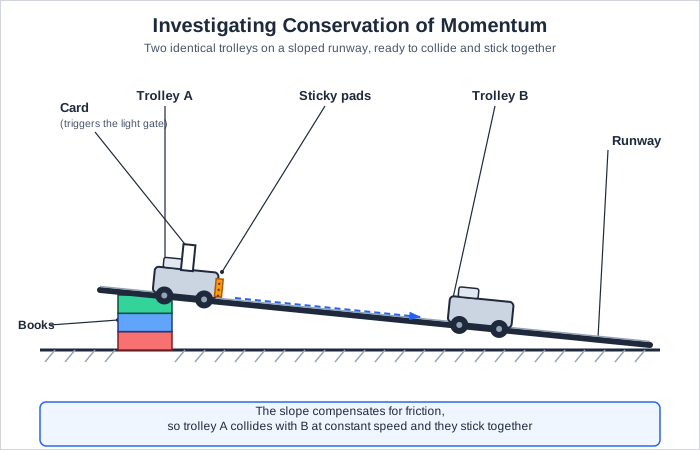
A 3 kg trolley moving at 4 m/s collides with a stationary 1 kg trolley and they stick together. Calculate their combined velocity after the collision. Use the principle of conservation of momentum: total momentum before = total momentum after.

3 marks · standardCommon
  • Correct total momentum before: 3 x 4 = 12 kg m/s (1m)
  • Correct equation after: (3 + 1) x v = 12 (1m)
  • Correct answer: v = 3 m/s (1m)

Total momentum before = 3 x 4 + 1 x 0 = 12 kg m/s. After: (3 + 1) x v = 12, so v = 12 / 4 = 3 m/s.

Test yourself on this in PrepWise
5.

A stationary firework rocket explodes and splits into two pieces that fly apart in opposite directions. Explain why this is consistent with conservation of momentum.

3 marks · standardCommon

Before the explosion, the total momentum of the stationary rocket is zero. After the explosion, the two pieces fly apart in opposite directions. Their momenta are equal in magnitude but opposite in direction, so they cancel out. The total momentum after the explosion is also zero. This equals the total momentum before, so momentum is conserved.

  • Total momentum before explosion is zero (rocket stationary) (1m)
  • After explosion, pieces move in opposite directions with equal and opposite momenta (1m)
  • Total momentum after = zero, which equals total momentum before, so momentum is conserved (1m)

Before: total momentum = 0. After: two pieces with equal and opposite momenta, total = 0. Momentum is conserved.

Test yourself on this in PrepWise
6.

Newton's second law can be written as: force = change in momentum / time taken. Explain how this equation relates to the more familiar form F = ma.

3 marks · higherCommon

Change in momentum = m x change in velocity = m x (v - u). Dividing by time: F = m(v - u)/t. Since (v - u)/t is the definition of acceleration (a = change in velocity / time), this gives F = ma. So Newton's second law written using momentum is equivalent to F = ma when mass is constant.

  • Change in momentum = mass x change in velocity (m x delta v or m(v-u)) (1m)
  • Dividing by time: F = m(v-u)/t (1m)
  • Identifies (v-u)/t as acceleration, giving F = ma (1m)

Change in momentum = m(v-u). F = m(v-u)/t = ma, since a = (v-u)/t.

Test yourself on this in PrepWise
7.

A car of mass 1500 kg is travelling at 20 m/s. Calculate the momentum of the car. Use the equation: momentum = mass x velocity.

2 marks · foundationCommon
  • Correct substitution: p = 1500 x 20 (1m)
  • Correct answer: 30,000 kg m/s (1m)

p = mv = 1500 x 20 = 30,000 kg m/s.

Test yourself on this in PrepWise
8.

Explain what is meant by saying momentum is a vector quantity.

2 marks · standardCommon

Momentum is a vector quantity because it has both magnitude and direction. The direction of the momentum is the same as the direction of the velocity. When calculating with momenta in opposite directions, one must be given a positive sign and one a negative sign.

  • Momentum has both magnitude and direction (1m)
  • Direction of momentum is the same as the direction of velocity / opposing momenta have opposite signs (1m)

Momentum is a vector - it has both magnitude (mass x speed) and direction (same as velocity). Objects moving in opposite directions have momenta with opposite signs.

Test yourself on this in PrepWise
9.

What is the equation for momentum?

  • A. momentum = mass / velocity
  • B. momentum = mass + velocity
  • C. momentum = mass x velocity
  • D. momentum = force x time
1 mark · foundationCommon

Momentum (p) = mass (m) x velocity (v). The unit of momentum is kg m/s. Note that option D describes impulse, not momentum.

Test yourself on this in PrepWise
10.

What is the unit of momentum?

  • A. kg m/s
  • B. Newtons (N)
  • C. Joules (J)
  • D. Watts (W)
1 mark · foundationCommon

The unit of momentum is kg m/s (kilogram metres per second). This comes from the equation p = mv, where m is in kg and v is in m/s.

Test yourself on this in PrepWise
11.

State the law of conservation of momentum.

1 mark · foundationCommon

In a closed system, the total momentum before an event equals the total momentum after the event.

  • Total momentum before = total momentum after (in a closed system / no external forces) (1m)

Conservation of momentum: total momentum before = total momentum after, provided the system is closed (no net external forces).

Test yourself on this in PrepWise
12.

Two ice skaters (A and B) stand still on a frictionless surface. Skater A pushes skater B. What can be said about their momenta after the push?

  • A. Both skaters have the same momentum in the same direction
  • B. Both skaters have zero momentum
  • C. The momenta are equal in magnitude but opposite in direction, so total momentum is zero
  • D. Skater A has greater momentum than skater B
1 mark · standardCommon

By conservation of momentum, the total momentum before (zero, as both were stationary) must equal the total momentum after. So the momenta of A and B must be equal and opposite, summing to zero.

Test yourself on this in PrepWise
13.

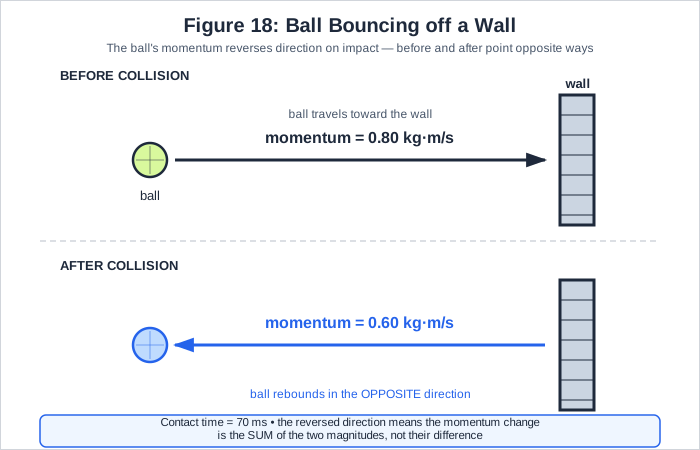
A 2 kg ball moving east at 5 m/s has a momentum of +10 kg m/s. It bounces off a wall and moves west at 5 m/s. What is its momentum after the bounce?

  • A. +10 kg m/s
  • B. 0 kg m/s
  • C. -10 kg m/s
  • D. The sign depends on the direction chosen as positive, but magnitude is 10 kg m/s
1 mark · standardCommon

Momentum is a vector. If east is positive, momentum before = +10 kg m/s, momentum after = -10 kg m/s (moving west). The change in momentum = -10 - (+10) = -20 kg m/s. The sign depends on which direction is defined as positive.

Test yourself on this in PrepWise

Impulse & Collisions

Common13
1.

In a car crash test, a 1500 kg car travelling at 15 m/s hits a barrier. The car comes to rest in 0.12 s without crumple zones and in 0.8 s with crumple zones. Calculate the average force on the car in both cases and evaluate the safety benefits of crumple zones, using your calculations and the concept of impulse to support your answer.

6 marks · 8-9Common

Change in momentum = mass x change in velocity = 1500 x 15 = 22,500 kg m/s. This is the same in both cases. Force equals change in momentum divided by time. Without crumple zones: F = 22,500 divided by 0.12 = 187,500 N. With crumple zones: F = 22,500 divided by 0.8 = 28,125 N. The crumple zone reduces the force by a factor of 6.7 (187,500 divided by 28,125). The impulse (change in momentum) is the same in both cases because the car starts and ends with the same velocities. The crumple zone increases the collision time, which reduces the force for the same impulse. By Newton's Second Law, the smaller force produces a smaller acceleration on the passengers, greatly reducing the risk of serious injury.

  • Change in momentum = 1500 x 15 = 22,500 kg m/s (in both cases) (1m)
  • Force without crumple zone = 22,500 / 0.12 = 187,500 N (1m)
  • Force with crumple zone = 22,500 / 0.8 = 28,125 N (1m)
  • Crumple zone reduces force by a factor of approximately 6.7 (187,500 / 28,125) (1m)
  • The impulse (change in momentum) is the same in both cases - the crumple zone does not reduce the change in momentum (1m)
  • The much smaller force with crumple zones greatly reduces the risk of serious injury to passengers (by Newton's 2nd law, smaller force = smaller acceleration = less bodily harm) (1m)

Both cases: delta p = 22,500 kg m/s. Without crumple: F = 22,500/0.12 = 187,500 N. With crumple: F = 22,500/0.8 = 28,125 N. Crumple zone reduces force by factor ~6.7. Impulse same in both cases. Much smaller force with crumple zones greatly reduces injury risk.

Test yourself on this in PrepWise
2.

A 1200 kg car is travelling at 30 m/s when it collides with a wall and comes to rest. The collision lasts 0.06 s. Calculate the average force exerted on the car during the collision.

4 marks · higherCommon
  • Change in momentum = 1200 x 30 = 36,000 kg m/s (1m)
  • Correct equation: F = delta p / t (1m)
  • Correct substitution: F = 36,000 / 0.06 (1m)
  • Correct answer: 600,000 N (1m)

Delta p = 1200 x 30 = 36,000 kg m/s. F = 36,000 / 0.06 = 600,000 N.

Test yourself on this in PrepWise
3.

A force-time graph shows a variable force acting on an object. Explain what the area under a force-time graph represents, and explain how the shape of the graph changes if the same impulse is delivered over a longer time.

4 marks · higherCommon

The area under a force-time graph represents the impulse delivered to the object. Impulse equals change in momentum, so the area also represents the change in momentum of the object. If the same impulse is delivered over a longer time, the area must remain the same, but the graph becomes wider (longer time axis) and shorter (lower peak force). The peak force is reduced because the same total impulse is spread over a greater time interval.

  • Area under force-time graph represents impulse (1m)
  • Impulse equals change in momentum (1m)
  • Same impulse over longer time: graph is wider (longer time) (1m)
  • Peak force is lower (so that the area under the graph remains the same) (1m)

Area under F-t graph = impulse = change in momentum. Same impulse over longer time: graph widens and peak force decreases, maintaining the same area.

Test yourself on this in PrepWise
4.

A 0.4 kg ball is kicked and its velocity changes from 0 m/s to 15 m/s. The kick lasts for 0.05 s. Calculate the average force applied to the ball. Use the equations: change in momentum = mass x change in velocity, and force = change in momentum / time.

3 marks · standardCommon
  • Change in momentum = 0.4 x 15 = 6 kg m/s (1m)
  • Correct equation: force = change in momentum / time (1m)
  • Correct answer: force = 6 / 0.05 = 120 N (1m)

Delta p = 0.4 x 15 = 6 kg m/s. F = 6 / 0.05 = 120 N.

Test yourself on this in PrepWise
5.

Explain how an airbag reduces the risk of injury to a driver in a collision.

3 marks · standardCommon

During a collision, a driver experiences a change in momentum (they decelerate from the car's speed to zero). An airbag increases the time taken for the driver to slow down. Since impulse = force x time = change in momentum, and the change in momentum is fixed, a longer time means the force acting on the driver is reduced. This smaller force means less injury to the driver.

  • The airbag increases the time over which the driver decelerates / increases collision time (1m)
  • Change in momentum is the same / impulse = F x t = change in momentum (constant) (1m)
  • Longer time means smaller force (F = delta p / t), reducing risk of injury (1m)

Airbag increases collision time. Impulse = F x t = change in momentum (fixed). Longer time = smaller force = less injury.

Test yourself on this in PrepWise
6.

Explain how crumple zones in cars improve safety during a collision.

3 marks · standardCommon

Crumple zones are designed to deform and collapse during a collision, increasing the time over which the car (and its occupants) decelerates. The change in momentum (impulse) of the car is fixed. Since impulse = force x time, a longer collision time means the force acting on the car and its occupants is smaller. This reduces the forces on passengers, reducing the risk of serious injury.

  • Crumple zone deforms during collision, increasing the time of the collision (1m)
  • Change in momentum / impulse is the same regardless of crumple zone (1m)
  • Longer time means smaller force (F = impulse / t), reducing injury to occupants (1m)

Crumple zones extend collision time. Same impulse over longer time = smaller force on passengers.

Test yourself on this in PrepWise
7.

Explain the difference between an elastic collision and an inelastic collision in terms of conservation laws.

3 marks · higherCommon

In both elastic and inelastic collisions, momentum is always conserved (total momentum before equals total momentum after). In an elastic collision, kinetic energy is also conserved - the total kinetic energy before equals the total kinetic energy after. In an inelastic collision, kinetic energy is not conserved; some kinetic energy is converted to thermal energy, sound, or deformation of materials.

  • Both collisions conserve momentum (1m)
  • Elastic collision: kinetic energy is also conserved (1m)
  • Inelastic collision: kinetic energy is not conserved (converted to thermal energy / sound / deformation) (1m)

Both conserve momentum. Elastic collisions also conserve kinetic energy. Inelastic collisions convert some kinetic energy to thermal energy, sound or deformation.

Test yourself on this in PrepWise
8.

A force of 500 N acts on a ball for 0.04 s. Calculate the impulse. Use the equation: impulse = force x time.

2 marks · foundationCommon
  • Correct substitution: impulse = 500 x 0.04 (1m)
  • Correct answer: 20 Ns (1m)

Impulse = F x t = 500 x 0.04 = 20 Ns.

Test yourself on this in PrepWise
9.

Which equation correctly defines impulse?

  • A. impulse = force / time
  • B. impulse = force x time
  • C. impulse = mass x acceleration
  • D. impulse = mass x velocity
1 mark · foundationCommon

Impulse = force x time (F x t). Impulse is equal to the change in momentum of an object. Option D is momentum (p = mv), which is related but not the definition of impulse.

Test yourself on this in PrepWise
10.

Impulse is equal to which of the following?

  • A. The change in momentum of an object
  • B. The total momentum of a system
  • C. The mass multiplied by the distance
  • D. The kinetic energy of an object
1 mark · foundationCommon

Impulse = F x t = change in momentum (delta p). This comes from Newton's second law: F = delta p / delta t, rearranged to F x delta t = delta p.

Test yourself on this in PrepWise
11.

State the unit of impulse.

1 mark · foundationCommon

The unit of impulse is the Newton-second (Ns).

  • Newton-second (Ns) or kg m/s (1m)

Impulse = F x t, so units = N x s = Ns. This is equivalent to kg m/s (the unit of momentum).

Test yourself on this in PrepWise
12.

A car airbag increases the time of a collision from 0.02 s to 0.2 s. The change in momentum of the passenger is the same in both cases. What effect does this have on the force experienced by the passenger?

  • A. The force is 10 times larger
  • B. The force stays the same
  • C. The force becomes zero
  • D. The force is 10 times smaller
1 mark · standardCommon

Impulse = F x t = change in momentum (constant). If t increases by a factor of 10 (from 0.02 to 0.2 s) and impulse is constant, the force must decrease by a factor of 10. F = impulse / t.

Test yourself on this in PrepWise
13.

A crumple zone at the front of a car is designed to deform during a collision. What is the main safety benefit of this design?

  • A. It increases the change in momentum of the car
  • B. It reduces the total kinetic energy of the car
  • C. It increases the duration of the collision, reducing the force on passengers
  • D. It prevents the car from stopping
1 mark · standardCommon

Crumple zones increase the time over which the collision occurs. Since impulse = F x t = change in momentum, and the change in momentum is fixed, a longer collision time means a smaller force. This reduces the force experienced by the passengers, reducing injury.

Test yourself on this in PrepWise

Moments & Levers

Common13
1.

A student investigates levers by balancing objects on a metre rule pivoted at its centre. They place a 4 N weight at the 20 cm mark and want to balance it with a 5 N weight. Describe how the student should use the principle of moments to find where to place the 5 N weight, calculate the correct position, and evaluate one source of error in this experiment and how it could be reduced.

6 marks · higherCommon

The principle of moments states that for a balanced system (in equilibrium), the sum of clockwise moments equals the sum of anticlockwise moments. The pivot is at the 50 cm mark. The 4 N weight is at the 20 cm mark, which is 30 cm from the pivot. The anticlockwise moment is 4 N times 30 cm equals 120 Ncm. For equilibrium, the clockwise moment from the 5 N weight must also equal 120 Ncm. So 5 N times d equals 120, giving d equals 24 cm from the pivot. The 5 N weight should be placed at the 74 cm mark. A source of error is that the metre rule may not be perfectly uniform in mass distribution, so the centre of mass may not be exactly at 50 cm. To reduce this error, check that the rule balances horizontally on the pivot before adding any weights, and repeat measurements to check consistency.

  • States principle of moments: clockwise moment = anticlockwise moment (1m)
  • Calculates anticlockwise moment: 4 N x 30 cm = 120 Ncm (or 4 x 0.30 = 1.2 Nm) (1m)
  • Sets up equation for 5 N weight: 5 x d = 120 (or 1.2) (1m)
  • Correct answer: d = 24 cm from pivot, so at 74 cm mark (or 26 cm mark on other side) (1m)
  • Identifies a valid source of error (e.g. metre rule may not be exactly uniform/calibrated; pivot friction; difficulty reading exact position) (1m)
  • Suggests a valid improvement (e.g. repeat and take mean; use a more precise ruler; ensure pivot is frictionless; check ruler is horizontal before starting) (1m)

Pivot is at 50 cm. The 4 N weight is at 20 cm, which is 30 cm from the pivot. Anticlockwise moment = 4 x 30 = 120 Ncm. For equilibrium: 5 x d = 120, so d = 24 cm from the pivot, placing the 5 N weight at the 74 cm mark.

Test yourself on this in PrepWise
2.

A uniform beam is balanced on a pivot. A 60 N weight is placed 2 m to the left of the pivot. A second weight is placed 3 m to the right of the pivot. The beam is in equilibrium. Calculate the size of the second weight. Use the principle of moments: total clockwise moment = total anticlockwise moment.

3 marks · standardCommon
  • Correct anticlockwise moment: 60 x 2 = 120 Nm (1m)
  • Correct equation: F x 3 = 120 (1m)
  • Correct answer: F = 40 N (1m)

Anticlockwise moment = 60 x 2 = 120 Nm. For equilibrium: F x 3 = 120. F = 120 / 3 = 40 N.

Test yourself on this in PrepWise
3.

Explain how a lever can be used to lift a heavy load with a smaller effort force.

3 marks · standardCommon

A lever has a pivot (fulcrum), a load and an effort force. The effort is applied at a greater distance from the pivot than the load. Because moment = force x distance, the larger distance means that a smaller effort force can produce the same moment as a larger load force, so the heavy load can be lifted.

  • Effort is applied at a greater distance from the pivot than the load (1m)
  • Moment = force x distance stated or implied (1m)
  • Larger distance allows smaller force to produce the same (or greater) moment (1m)

Levers allow a small effort to overcome a larger load by applying the effort at a greater distance from the pivot. Since M = F x d, the same moment can be produced with a smaller force if the distance is larger.

Test yourself on this in PrepWise
4.

A 45 N force is applied to a lever. The clockwise moment produced is 36 Nm. Calculate the perpendicular distance from the pivot at which the force is applied.

3 marks · higherCommon
  • Correct equation: moment = force x distance, so distance = moment / force (1m)
  • Correct substitution: distance = 36 / 45 (1m)
  • Correct answer: 0.8 m (1m)

Rearranging M = F x d gives d = M / F = 36 / 45 = 0.8 m.

Test yourself on this in PrepWise
5.

Explain why a wide-based object with a low centre of gravity is more stable than a tall object with a high centre of gravity.

3 marks · higherCommon

A wide-based object is more stable because when tilted, the vertical line through the centre of gravity still falls within the base. The restoring moment from the weight brings the object back upright. A tall object with a high centre of gravity will topple when tilted because the vertical line through the centre of gravity quickly passes outside the base, causing the moment due to weight to rotate the object further away from upright.

  • Wide base means vertical line through centre of gravity remains within the base when tilted (1m)
  • Weight of object creates a restoring moment when centre of gravity is within base (1m)
  • High centre of gravity means the line through it quickly falls outside the base, causing toppling moment (1m)

Stability depends on whether the weight of the object creates a restoring moment or a toppling moment. A low, wide-based object keeps the weight acting within the base through larger tilts, creating a restoring moment. A tall object's high centre of gravity quickly moves the weight line outside the base, creating a toppling moment.

Test yourself on this in PrepWise
6.

A student opens a door by pushing at the edge furthest from the hinges. Explain why pushing at the edge is more effective than pushing near the hinges, and explain what would happen to the effort needed if the student pushed at half the distance from the hinges.

3 marks · higherCommon

Pushing at the edge (greatest distance from the pivot/hinges) maximises the perpendicular distance from the pivot, so for a given force the moment is largest. This makes it easiest to rotate the door. If the student pushed at half the distance, the perpendicular distance would be halved, so the moment would be halved for the same force. To produce the same moment to open the door, the student would need to apply twice the force.

  • Larger distance from pivot (hinges) produces a larger moment for the same force (1m)
  • At half the distance, the moment would be halved for the same force (1m)
  • Twice the force would be needed to produce the same moment at half the distance (1m)

Moment = F x d. Greater distance from hinges = larger moment for same force. Halving distance halves the moment, so the force must double to produce the same moment.

Test yourself on this in PrepWise
7.

A force of 20 N is applied at a perpendicular distance of 0.5 m from a pivot. Calculate the moment of this force. Use the equation: moment = force x perpendicular distance from pivot.

2 marks · foundationCommon
  • Correct substitution: moment = 20 x 0.5 (1m)
  • Correct answer: 10 Nm (1m)

moment = F x d = 20 x 0.5 = 10 Nm

Test yourself on this in PrepWise
8.

State the principle of moments.

2 marks · standardCommon

For a system in equilibrium, the total clockwise moment about a pivot equals the total anticlockwise moment about the same pivot.

  • Clockwise moments equal anticlockwise moments (1m)
  • Reference to equilibrium or balanced system (1m)

The principle of moments states that for equilibrium, the total clockwise moment equals the total anticlockwise moment about any pivot.

Test yourself on this in PrepWise
9.

What is a moment?

  • A. The mass of an object multiplied by its speed
  • B. The turning effect of a force about a pivot
  • C. The pressure exerted by a force on a surface
  • D. The rate of change of velocity
1 mark · foundationCommon

A moment is the turning effect of a force about a pivot point. It is calculated as moment = force x perpendicular distance from the pivot.

Test yourself on this in PrepWise
10.

What is the equation for the moment of a force?

  • A. moment = force / distance
  • B. moment = force + distance
  • C. moment = mass x gravity
  • D. moment = force x perpendicular distance from pivot
1 mark · foundationCommon

The equation for moment is M = F x d, where F is the force in Newtons and d is the perpendicular distance from the pivot in metres. The unit of moment is Newton-metres (Nm).

Test yourself on this in PrepWise
11.

A seesaw is balanced (in equilibrium). Which statement is correct?

  • A. The total clockwise moment equals the total anticlockwise moment
  • B. All forces acting on the seesaw are zero
  • C. The seesaw has no weight
  • D. The clockwise moment is greater than the anticlockwise moment
1 mark · foundationCommon

For a system to be in equilibrium (balanced), the principle of moments states that the sum of all clockwise moments must equal the sum of all anticlockwise moments about any pivot point.

Test yourself on this in PrepWise
12.

State the unit of moment.

1 mark · foundationCommon

The unit of moment is the Newton-metre (Nm).

  • Newton-metre (Nm) stated as the unit (1m)

Moment = force (N) x distance (m), so the unit of moment is Newton-metres (Nm).

Test yourself on this in PrepWise
13.

A spanner is used to loosen a bolt. Using a longer spanner handle makes it easier to turn the bolt. Why?

  • A. The longer handle has less mass, so less force is needed
  • B. A longer distance from the pivot creates a larger moment for the same force
  • C. The longer handle increases the friction between spanner and bolt
  • D. The longer handle reduces the force needed to hold the bolt still
1 mark · standardCommon

Moment = force x distance. Using a longer handle increases the distance from the pivot (the bolt), so a larger moment is created for the same applied force. This makes it easier to rotate the bolt.

Test yourself on this in PrepWise

Work Done & Energy Transfer

Common13
1.

A ball is thrown upwards, rises, and then falls back to the ground. Describe and explain all the energy transfers that occur from the moment the ball is thrown until it hits the ground. Your answer should include reference to work done, the energy stores involved, and the conservation of energy. (6 marks - Level of Response)

6 marks · higherCommon

When the ball is thrown, work is done by the hand on the ball. Energy transfers from the chemical energy store of the thrower's muscles to the kinetic energy store of the ball. As the ball rises, kinetic energy decreases and gravitational potential energy increases. Air resistance acts on the ball throughout, transferring some energy from the kinetic energy store to the thermal energy store of the surroundings. At the top of the flight, almost all kinetic energy has been converted to gravitational potential energy. As the ball falls, gravitational potential energy decreases and kinetic energy increases. When the ball hits the ground, the kinetic energy is transferred to thermal energy (from the impact), sound energy, and elastic deformation energy of the ball and ground. Throughout all stages, the total energy remains constant — energy is conserved (it cannot be created or destroyed, only transferred between stores).

  • Level 3 (5-6 marks): Logically sequenced answer including: (1) Throw: work done by hand on ball transfers chemical energy to kinetic energy. (2) Rising: kinetic energy decreases, gravitational potential energy increases as ball gains height. Work done against gravity. (3) If air resistance present: some kinetic energy continuously transferred to thermal energy. (4) Falling: gravitational potential energy decreases, kinetic energy increases. (5) Landing: kinetic energy transferred to other stores (thermal, sound, elastic deformation). (6) Overall: total energy is conserved throughout - energy transferred between stores but total remains constant. Must reference conservation of energy and work done. (6m)
  • Level 2 (3-4 marks): Identifies most energy transfers correctly but may not fully explain work done or conservation, or may miss some stages. (4m)
  • Level 1 (1-2 marks): Some relevant energy stores identified but transfers not clearly explained or linked incorrectly. (2m)

Throw: chemical energy (hand/muscles) transferred to kinetic energy of ball via work done by the throwing force. Rising: kinetic energy decreases, gravitational potential energy increases. Air resistance transfers some energy to thermal store throughout. Falling: gravitational PE converts back to kinetic energy. Landing: kinetic energy transferred to thermal energy, sound energy, and elastic deformation of ball/ground. Throughout: total energy is conserved (conservation of energy: energy cannot be created or destroyed, only transferred between stores).

Test yourself on this in PrepWise
2.

An electric motor has a power of 2400 W. It operates for 5 minutes. Calculate the work done by the motor. Give your answer in joules.

4 marks · higherCommon
  • Correct time conversion: 5 minutes = 300 seconds (1m)
  • Correct equation: W = Pt or rearrangement of P = W/t (1m)
  • Correct substitution: W = 2400 x 300 (1m)
  • Correct answer: 720000 J (or 720 kJ) (1m)

Time = 5 x 60 = 300 s. W = Pt = 2400 x 300 = 720000 J (720 kJ).

Test yourself on this in PrepWise
3.

A car of mass 900 kg accelerates from 0 m/s to 20 m/s over a distance of 80 m. Assuming all work done by the engine is transferred to kinetic energy, calculate the average driving force. Use the equations: kinetic energy = 0.5 x mass x speed^2 and work done = force x distance

4 marks · challengeCommon
  • Correct calculation of kinetic energy: Ek = 0.5 x 900 x 20^2 = 180000 J (1m)
  • Statement that work done = kinetic energy gained = 180000 J (1m)
  • Rearrangement: F = W / s = 180000 / 80 (1m)
  • Correct answer: 2250 N (1m)

Ek = 0.5 x 900 x 400 = 180000 J. Work done = 180000 J. F = W/s = 180000 / 80 = 2250 N.

Test yourself on this in PrepWise
4.

A student drags a box along the floor with a horizontal force of 75 N over a distance of 8 m. Calculate the work done by the student. Use the equation: work done = force x distance

3 marks · standardCommon
  • Correct substitution: W = 75 x 8 (1m)
  • Correct calculation: W = 600 (1m)
  • Correct answer with unit: 600 J (1m)

W = Fs = 75 x 8 = 600 J.

Test yourself on this in PrepWise
5.

A crane lifts a steel beam of mass 500 kg to a height of 12 m. Gravitational field strength = 9.8 N/kg. Calculate the work done against gravity. Use the equations: weight = mass x gravitational field strength and work done = force x distance

3 marks · standardCommon
  • Correct weight: W = 500 x 9.8 = 4900 N (1m)
  • Correct substitution: work done = 4900 x 12 (1m)
  • Correct answer: 58800 J (or 58.8 kJ) (1m)

Weight = mg = 500 x 9.8 = 4900 N. Work done = F x d = 4900 x 12 = 58800 J.

Test yourself on this in PrepWise
6.

A motor does 4500 J of work moving a load through a distance of 15 m. Calculate the force the motor exerts on the load.

3 marks · higherCommon
  • Correct rearrangement: F = W / s = 4500 / 15 (1m)
  • Correct calculation: F = 300 (1m)
  • Correct answer with unit: 300 N (1m)

Rearranging W = Fs: F = W / s = 4500 / 15 = 300 N.

Test yourself on this in PrepWise
7.

A car applies its brakes and comes to a stop. Explain the energy transfers that occur during braking, including what happens to the kinetic energy of the car.

3 marks · higherCommon

When the brakes are applied, a friction force acts between the brake pads and the wheels. This friction force does work on the car. The kinetic energy of the car is transferred to thermal energy in the brakes and surroundings. The temperature of the brake pads and discs increases. The kinetic energy store of the car decreases to zero as the car stops.

  • Friction force / braking force does work on the car (1m)
  • Kinetic energy of the car is transferred / decreases as the car slows (1m)
  • Energy is transferred to the thermal energy store of the brakes/surroundings / brakes heat up (1m)

Friction (braking force) does work on the car. The kinetic energy store decreases as work is done against friction. Energy is transferred to the thermal energy store of the brakes and surroundings - the brakes heat up.

Test yourself on this in PrepWise
8.

A student lifts a 2 kg mass through a height of 0.5 m in 1 second. A second student lifts the same mass through the same height in 3 seconds. Compare the work done and the power of the two students.

3 marks · higherCommon

Both students do the same amount of work because work done equals force multiplied by distance, and both students apply the same force (weight of the mass) over the same distance (0.5 m). The work done is equal. However, the first student has a greater power because power is the rate of energy transfer (or work done per unit time). The first student transfers the same energy in less time, so their power is greater.

  • Both students do the same work done (because same force and same distance) (1m)
  • Power is defined as rate of energy transfer / work done per unit time (P = W/t) (1m)
  • First student has greater power because same work done in less time (1m)

Work done is the same (both do F x d = weight x 0.5 m). Power = W/t. Same work in less time = greater power for student 1.

Test yourself on this in PrepWise
9.

Explain what is meant by 'work done' in physics. Include the conditions required for work to be done.

2 marks · standardCommon

Work done is a measure of the energy transferred when a force moves an object. Work is done when a force causes a displacement in the direction of the force. The amount of work done equals the force multiplied by the distance moved in the direction of the force. Work done is measured in joules.

  • Work done is the energy transferred when a force causes movement / work done = force x distance (1m)
  • Work is done only when there is movement in the direction of the force / force must cause displacement (1m)

Work is done when a force causes a displacement in the direction of the force. W = Fs. Work done equals the energy transferred. No movement = no work done.

Test yourself on this in PrepWise
10.

Which equation correctly represents work done?

  • A. Work done = force / distance
  • B. Work done = force x distance
  • C. Work done = force + distance
  • D. Work done = distance / force
1 mark · foundationCommon

Work done is calculated using: work done (W) = force (F) x distance (s). The unit of work done is the joule (J). Work is done when a force causes an object to move in the direction of the force.

Test yourself on this in PrepWise
11.

When work is done by a force moving an object, what happens to the energy?

  • A. Energy is created in the object
  • B. Energy is destroyed by friction
  • C. Energy is transferred from one store to another
  • D. Energy stays stored in the force
1 mark · foundationCommon

Work done is a measure of energy transferred. When a force does work on an object, energy is transferred from one store to another (e.g. from chemical store in muscles to kinetic store of the object). Energy is always conserved - it cannot be created or destroyed, only transferred.

Test yourself on this in PrepWise
12.

A person pushes a box with a force of 50 N over a distance of 3 m. How much work is done?

  • A. 17 J
  • B. 53 J
  • C. 150 J
  • D. 500 J
1 mark · standardCommon

Work done = force x distance = 50 x 3 = 150 J. The unit is joules (J).

Test yourself on this in PrepWise
13.

A crane lifts a steel beam vertically. Which statement correctly describes the work done against gravity?

  • A. Work is done against gravity only when the beam is accelerating
  • B. No work is done because gravity acts downwards and movement is upwards
  • C. Work is done against gravity only if the crane moves at constant speed
  • D. Work is done against gravity whenever the beam moves upward, equal to the lifting force times the vertical distance
1 mark · standardCommon

Work done = force x distance in the direction of the force. When lifting, the crane must exert a force upward to raise the beam, and the work done is the crane's lifting force multiplied by the vertical distance moved. (Note: if lifting at constant speed, the crane force equals the weight, so both options B and C give the same answer in that case - but the force applied by the crane is the force doing the work.)

Test yourself on this in PrepWise

Terminal Velocity

Common13
1.

A skydiver jumps from a plane and later opens a parachute. Describe and explain the changes in speed, force, and acceleration from the moment of jumping to reaching the final lower terminal velocity. You may include a sketch of the speed-time graph in your answer. [6 marks]

6 marks · higherCommon
  • Level 3 (5-6 marks): Full description of all 4 phases: (1) Initial: weight > drag, accelerates downward. (2) As speed increases, drag increases, resultant force decreases, acceleration decreases. (3) First terminal velocity: drag = weight, constant speed. (4) Parachute opens: drag >> weight, decelerates. (5) New lower terminal velocity: drag = weight at lower speed. Logical, well-sequenced, correct physics throughout. (6m)
  • Level 2 (3-4 marks): Most phases described but some missing. Physics mostly correct but some gaps. (4m)
  • Level 1 (1-2 marks): Only basic description. Limited force/acceleration analysis. (2m)

Full skydive sequence: freefall acceleration -> decreasing acceleration -> first terminal velocity -> parachute opens (drag >> weight) -> deceleration -> new lower terminal velocity.

Test yourself on this in PrepWise
2.

Explain how a skydiver reaches terminal velocity after jumping from a plane. Include changes to forces and acceleration in your answer.

3 marks · standardCommon

When the skydiver first jumps, weight acts downward and is greater than drag, so there is a resultant downward force. The skydiver accelerates downward. As speed increases, drag force increases. The resultant force decreases, so acceleration decreases. Eventually drag equals weight and the resultant force is zero. The skydiver no longer accelerates and falls at a constant speed called terminal velocity.

  • Initially weight is greater than drag / resultant force is downward (1m)
  • As speed increases, drag increases, so resultant force decreases and acceleration decreases (1m)
  • When drag equals weight, resultant force is zero, acceleration is zero, constant terminal velocity reached (1m)

Key physics: drag increases with speed. Terminal velocity occurs when drag = weight (zero resultant force, zero acceleration).

Test yourself on this in PrepWise
3.

A speed-time graph for a falling object shows: (i) a curved section where the gradient decreases over time, (ii) a horizontal section. Explain what is happening during each section in terms of forces.

3 marks · higherCommon

During the curved section, weight is greater than drag. The resultant force is downward so the object accelerates. As speed increases, drag increases, so the resultant force decreases and the gradient of the graph decreases (acceleration decreases). During the horizontal section, drag equals weight so the resultant force is zero. Acceleration is zero and the object travels at constant speed - terminal velocity.

  • Curved section: object accelerating, weight greater than drag, decreasing resultant force causes decreasing acceleration (gradient decreasing) (1m)
  • Drag increases as speed increases, causing resultant force to reduce (further explanation of why gradient decreases) (1m)
  • Horizontal section: drag equals weight, resultant force zero, acceleration zero, constant terminal velocity (1m)

Speed-time graph: curved (decreasing gradient) = decreasing acceleration due to increasing drag. Horizontal = zero acceleration = terminal velocity (drag = weight).

Test yourself on this in PrepWise
4.

A 50 kg ball is falling at a speed where the drag force is 350 N. Calculate the resultant force on the ball and its acceleration at this moment. (g = 9.8 N/kg)

3 marks · higherCommon
  • Weight = 50 x 9.8 = 490 N downward (1m)
  • Resultant force = 490 - 350 = 140 N downward (1m)
  • Acceleration = F/m = 140/50 = 2.8 m/s^2 (downward) (1m)

W = 50 x 9.8 = 490 N. Resultant = 490 - 350 = 140 N down. a = F/m = 140/50 = 2.8 m/s^2 downward.

Test yourself on this in PrepWise
5.

Explain why a skydiver has a lower terminal velocity when they open their parachute compared to when they are in free fall without the parachute.

3 marks · higherCommon

Without the parachute, the skydiver reaches terminal velocity when drag equals weight at a relatively high speed due to their small cross-sectional area. Opening the parachute greatly increases the cross-sectional area, which greatly increases the drag force at any given speed. The drag now exceeds weight, causing deceleration. The skydiver slows down until drag again equals weight, but now at a much lower speed. This new terminal velocity is lower because the larger parachute generates sufficient drag to balance weight at a lower speed.

  • Parachute increases cross-sectional area (greatly increases drag force) (1m)
  • Drag exceeds weight so there is a net upward force causing deceleration / slowing down (1m)
  • New equilibrium (drag = weight) is reached at a lower speed (lower terminal velocity) (1m)

Parachute increases area -> increases drag. Drag > weight -> deceleration -> slower speed -> new equilibrium where drag = weight at lower terminal velocity.

Test yourself on this in PrepWise
6.

A parachutist has a mass of 80 kg. At terminal velocity, what is the drag force acting on the parachutist? (gravitational field strength g = 9.8 N/kg). Use the equation: weight = mass x gravitational field strength

2 marks · standardCommon
  • Weight = 80 x 9.8 = 784 N (1m)
  • At terminal velocity, drag = weight = 784 N (1m)

W = 80 x 9.8 = 784 N. At terminal velocity drag = weight, so drag = 784 N.

Test yourself on this in PrepWise
7.

Explain how a streamlined shape reduces the drag force on a moving vehicle.

2 marks · standardCommon

A streamlined shape is designed to allow air to flow smoothly over the surface without creating turbulence. This reduces the drag force on the vehicle, which means it can travel at a higher speed for the same engine force, or reach a higher terminal velocity.

  • Streamlining allows air to flow smoothly (reduces turbulence) (1m)
  • Less turbulence means a smaller drag force on the vehicle (1m)

Streamlined shapes reduce turbulence, which reduces drag. Less drag means the vehicle can travel faster (higher terminal velocity) for the same driving force.

Test yourself on this in PrepWise
8.

A 25 kg object is falling and experiencing a drag force of 180 N. Calculate the resultant force and state its direction. (g = 9.8 N/kg). Use the equations: weight = mass x g and resultant force = weight - drag

2 marks · standardCommon
  • Weight = 25 x 9.8 = 245 N (1m)
  • Resultant force = 245 - 180 = 65 N downward (1m)

W = 25 x 9.8 = 245 N. Resultant = 245 - 180 = 65 N downward. The object is still accelerating downward.

Test yourself on this in PrepWise
9.

An object reaches terminal velocity when falling through air. Which statement correctly describes the forces at terminal velocity?

  • A. Weight is greater than drag force
  • B. Drag force is greater than weight
  • C. Weight equals drag force
  • D. There are no forces acting on the object
1 mark · foundationCommon

At terminal velocity the downward weight force exactly equals the upward drag force. The resultant force is zero so there is no acceleration and the object falls at constant speed.

Test yourself on this in PrepWise
10.

How does drag force change as an object falls faster through air?

  • A. Drag decreases
  • B. Drag stays constant
  • C. Drag increases
  • D. Drag first increases then decreases
1 mark · foundationCommon

Drag force increases with speed. The faster an object moves through a fluid, the more air molecules it collides with per second, so the greater the resistive force.

Test yourself on this in PrepWise
11.

State what is meant by terminal velocity.

1 mark · foundationCommon

Terminal velocity is the maximum constant speed reached by a falling object when the drag force equals its weight, so the resultant force is zero and there is no further acceleration.

  • Maximum constant speed reached when drag equals weight (resultant force = 0 / no acceleration) (1m)

Terminal velocity: constant maximum falling speed when drag = weight (zero resultant force, zero acceleration).

Test yourself on this in PrepWise
12.

A skydiver opens their parachute. What happens to the drag force and their speed immediately after the parachute opens?

  • A. Drag increases; speed increases
  • B. Drag increases; speed decreases
  • C. Drag decreases; speed decreases
  • D. Drag stays the same; speed stays the same
1 mark · standardCommon

Opening the parachute greatly increases the surface area, which greatly increases drag. The drag now exceeds weight so there is a net upward force, decelerating the skydiver (speed decreases).

Test yourself on this in PrepWise
13.

Skydiver A has a mass of 60 kg and skydiver B has a mass of 90 kg. Both dive without parachutes in the same body position. Which skydiver has a higher terminal velocity?

  • A. Skydiver A, because they are lighter
  • B. Skydiver B, because their greater weight means a faster speed is needed to generate enough drag to balance it
  • C. Both reach the same terminal velocity
  • D. Skydiver A, because they experience less drag
1 mark · standardCommon

Terminal velocity is reached when drag equals weight. Skydiver B has more weight so needs a higher speed to generate enough drag to balance it, giving a higher terminal velocity.

Test yourself on this in PrepWise

Energy Stores & Systems

Common14
1.

A wind turbine generates electricity from wind. Describe and explain the energy stores and transfers involved as wind energy is converted to electrical energy, and discuss why the efficiency of a wind turbine cannot reach 100%. [6 marks]

6 marks · higherCommon

Wind has a kinetic energy store due to the moving air. As air hits the turbine blades, energy is transferred mechanically (by the force of the wind on the blades), causing the blades to rotate. The rotating blades drive a generator, which transfers energy electrically to the electrical energy store in the circuit. During these transfers, some energy is dissipated. Friction in the bearings and generator transfers energy to the thermal energy store of the surroundings by heating. Some energy is also transferred to the surroundings by sound. Because energy is always dissipated in real systems, the useful electrical output energy is always less than the total kinetic input energy. Therefore, efficiency = useful electrical output / total kinetic input, which is always less than 1 (or 100%).

  • Kinetic energy store of moving air / wind (1m)
  • Energy transferred mechanically (by force) from wind to turbine blades (1m)
  • Energy transferred electrically from generator to the circuit (electrical energy store) (1m)
  • Some energy is dissipated to the thermal energy store of the surroundings (by heating from friction) or as sound (1m)
  • Efficiency = useful output / total input (less than 100% because energy is dissipated) (1m)
  • Energy is always dissipated in real systems (law of conservation of energy means total energy is conserved but some is wasted) (1m)

Level 3 (5-6): Identifies kinetic store of wind, mechanical transfer to blades, electrical transfer from generator, dissipation to thermal/sound stores, states efficiency equation, and explains why 100% is impossible. Level 2 (3-4): Identifies most stores and at least two transfer pathways, mentions dissipation. Level 1 (1-2): Identifies kinetic energy of wind or mentions electrical output, with limited development.

Test yourself on this in PrepWise
2.

A roller coaster car of mass 800 kg starts from rest at the top of a slope of height 45 m. It reaches the bottom of the slope travelling at 27 m/s. The gravitational field strength is 9.8 N/kg. Calculate the gravitational potential energy at the top of the slope. Calculate the kinetic energy at the bottom of the slope. Use your answers to calculate the efficiency of the energy transfer.

4 marks · higherCommon
  • Correct GPE: Ep = mgh = 800 x 9.8 x 45 = 352,800 J (1m)
  • Correct Ek: Ek = 0.5 x 800 x 27^2 = 0.5 x 800 x 729 = 291,600 J (1m)
  • Correct substitution into efficiency = 291600 / 352800 (1m)
  • Correct answer: 0.826... (accept 0.83 or 83%) (1m)

Step 1: GPE = mgh = 800 x 9.8 x 45 = 352,800 J. Step 2: Ek = 0.5 x 800 x 27^2 = 0.5 x 800 x 729 = 291,600 J. Step 3: efficiency = Ek / GPE = 291,600 / 352,800 = 0.826 (83%). Some energy is dissipated to the thermal energy store of the surroundings due to friction and air resistance.

Test yourself on this in PrepWise
3.

A pump has an efficiency of 0.65. It transfers energy from its electrical energy store at a rate of 800 W. Calculate the useful power output of the pump. The pump is used for 5 minutes. Calculate the total electrical energy input and the useful energy output during this time. How much energy is wasted as thermal energy?

4 marks · challengeCommon
  • Useful power output = efficiency x input power = 0.65 x 800 = 520 W (1m)
  • Convert time: 5 minutes = 300 s. Total electrical energy input = 800 x 300 = 240,000 J (1m)
  • Useful energy output = 0.65 x 240,000 = 156,000 J (1m)
  • Wasted energy = 240,000 - 156,000 = 84,000 J (1m)

Step 1: Useful power = 0.65 x 800 = 520 W. Step 2: Time = 5 x 60 = 300 s. Total input energy = 800 x 300 = 240,000 J. Step 3: Useful output energy = 0.65 x 240,000 = 156,000 J. Step 4: Wasted energy = 240,000 - 156,000 = 84,000 J. The question asks for wasted thermal energy, which is 84,000 J, but the primary calculated answer is the useful output 156,000 J as the multi-step result.

Test yourself on this in PrepWise
4.

A car engine converts chemical energy into kinetic energy. Explain why the car engine is not 100% efficient, using the idea of energy dissipation.

3 marks · standardCommon

The car engine transfers some energy to the thermal energy store of the surroundings. This energy is dissipated and spreads out into the surroundings, making it less useful. Because some energy is wasted as thermal energy rather than being transferred to the kinetic energy store, the engine cannot be 100% efficient.

  • Some energy is transferred to the thermal energy store of the surroundings (wasted as heat) (1m)
  • This energy is dissipated (spreads out into the surroundings) (1m)
  • Because not all energy is usefully transferred to the kinetic store, efficiency is less than 100% (or: efficiency = useful output / total input, which is less than 1 when energy is wasted) (1m)

No engine is 100% efficient because energy is always dissipated to the surroundings, mainly as thermal energy (heat) and sound. Efficiency = useful output energy / total input energy. If 40 kJ out of 100 kJ is usefully transferred, efficiency = 0.40 or 40%.

Test yourself on this in PrepWise
5.

A motor transfers 500 J of energy from its electrical energy store. 350 J is usefully transferred to the kinetic energy store. Calculate the efficiency of the motor. Use the equation: efficiency = useful output energy transfer / total input energy transfer

3 marks · standardCommon
  • Correct substitution: efficiency = 350 / 500 (1m)
  • Correct calculation performed (1m)
  • Correct answer: 0.7 (or 70%) (1m)

efficiency = useful output energy / total input energy = 350 / 500 = 0.7 (or 70%). Efficiency has no units. A value of 0.7 means 70% of the input energy is usefully transferred.

Test yourself on this in PrepWise
6.

A tennis ball has a mass of 0.06 kg and is travelling at 20 m/s. Calculate the kinetic energy stored in the ball. Use the equation: kinetic energy = 0.5 x mass x speed squared

3 marks · standardCommon
  • Correct substitution: Ek = 0.5 x 0.06 x 20^2 (1m)
  • Correct intermediate step: 0.5 x 0.06 x 400 (1m)
  • Correct answer: 12 J (1m)

Ek = 0.5 x m x v^2 = 0.5 x 0.06 x (20)^2 = 0.5 x 0.06 x 400 = 12 J. Common mistake: forgetting to square the speed, which would give 0.5 x 0.06 x 20 = 0.6 J (wrong).

Test yourself on this in PrepWise
7.

An electric kettle is used to heat water. Describe the energy transfers that occur, naming the pathways by which energy is transferred.

3 marks · higherCommon

Electrical energy is transferred electrically to the thermal energy store of the heating element. Energy is then transferred by heating from the element to the thermal energy store of the water. Some energy is also transferred by heating to the thermal energy store of the surroundings.

  • Energy is transferred electrically (from the mains/power supply to the heating element) (1m)
  • Energy is then transferred by heating from the element to the water (increasing the thermal energy store of the water) (1m)
  • Some energy is dissipated/wasted, transferred by heating to the thermal energy store of the surroundings (1m)

The four pathways for energy transfer are: mechanically (by a force), electrically (by a current), by heating (from hot to cold), and by radiation (electromagnetic waves or sound). The kettle uses electrical transfer then heating transfer.

Test yourself on this in PrepWise
8.

A hairdryer has a power of 1200 W. It is used for 3 minutes. Calculate the total energy transferred by the hairdryer in this time. Give your answer in joules.

3 marks · higherCommon
  • Convert time to seconds: 3 minutes = 180 s (or substitute correctly in correct units) (1m)
  • Correct substitution: E = P x t = 1200 x 180 (1m)
  • Correct answer: 216,000 J (1m)

E = P x t. First convert time: 3 minutes = 3 x 60 = 180 s. Then E = 1200 x 180 = 216,000 J (or 216 kJ). A very common mistake is to forget to convert minutes to seconds.

Test yourself on this in PrepWise
9.

Explain what is meant by a 'closed system' in terms of energy.

2 marks · standardCommon

A closed system is one where no energy is transferred to or from the surroundings. The total energy within a closed system remains constant because energy is conserved.

  • A closed system does not transfer energy to or from the surroundings (no energy enters or leaves) (1m)
  • The total energy within a closed system remains constant (energy is conserved) (1m)

A closed system has no energy transfer to or from the surroundings. As a result, the total energy is conserved — it stays the same. Real systems are rarely perfectly closed, but the concept is used to apply the law of conservation of energy.

Test yourself on this in PrepWise
10.

Which energy store is associated with an object that is moving?

  • A. Gravitational potential
  • B. Elastic potential
  • C. Kinetic
  • D. Chemical
1 mark · foundationCommon

Kinetic energy is the energy stored by an object because of its motion. Any moving object has a kinetic energy store. Gravitational potential is stored due to height, elastic potential due to deformation, and chemical energy is stored in bonds.

Test yourself on this in PrepWise
11.

A hot cup of coffee is left on a table. Which energy store decreases as the coffee cools down?

  • A. Thermal
  • B. Kinetic
  • C. Chemical
  • D. Nuclear
1 mark · foundationCommon

The thermal energy store of an object depends on its temperature and mass. As the coffee cools, energy is transferred to the surroundings, so the thermal energy store of the coffee decreases.

Test yourself on this in PrepWise
12.

The law of conservation of energy states that energy can be:

  • A. Created but not destroyed
  • B. Destroyed but not created
  • C. Created or destroyed depending on the process
  • D. Transferred or stored, but never created or destroyed
1 mark · foundationCommon

Energy can never be created or destroyed. It can only be transferred from one store to another or dissipated to the surroundings. The total energy in a closed system always remains constant.

Test yourself on this in PrepWise
13.

A cyclist rides up a hill and then comes to a stop at the top. Which energy transfer best describes what happened when the cyclist braked to stop?

  • A. Kinetic energy store to thermal energy store by heating
  • B. Kinetic energy store to thermal energy store by friction (mechanically)
  • C. Chemical energy store to thermal energy store by heating
  • D. Gravitational potential to kinetic energy store by radiation
1 mark · foundationCommon

When the cyclist brakes, friction between the brake pads and wheels transfers energy mechanically (by force). This reduces the kinetic energy store and increases the thermal energy store of the brakes and surroundings. The transfer pathway is mechanical (by friction/force), not by heating directly.

Test yourself on this in PrepWise
14.

A light bulb transfers 100 J of energy from the electrical energy store. 10 J is transferred as useful light. What happens to the remaining 90 J?

  • A. It is destroyed inside the light bulb
  • B. It is stored permanently in the bulb
  • C. It is dissipated to the thermal energy store of the surroundings
  • D. It is converted back into electrical energy
1 mark · standardCommon

Energy cannot be destroyed. The 90 J of 'wasted' energy is dissipated (spread out) to the thermal energy store of the surroundings, mainly as heat. This is why we say the energy is dissipated rather than destroyed.

Test yourself on this in PrepWise

Kinetic Energy

Common15
1.

A road safety organisation is comparing two vehicles: - Vehicle A: mass 1000 kg, travelling at 30 m/s - Vehicle B: mass 3000 kg, travelling at 20 m/s Both vehicles brake to a stop with the same braking force of 15,000 N. Using kinetic energy and work done, calculate the braking distance for each vehicle. Then evaluate which vehicle presents a greater danger in terms of stopping distance.

6 marks · higherCommon

Vehicle A KE: Ek = 0.5 x 1000 x 30² = 0.5 x 1000 x 900 = 450,000 J. Vehicle B KE: Ek = 0.5 x 3000 x 20² = 0.5 x 3000 x 400 = 600,000 J. Braking distance uses work = F x d, so d = KE / F. Vehicle A: d = 450,000 / 15,000 = 30 m. Vehicle B: d = 600,000 / 15,000 = 40 m. Vehicle B is more dangerous as it has a greater kinetic energy despite the lower speed and requires a 40 m stopping distance compared to 30 m for Vehicle A. The greater mass of Vehicle B is the dominant factor.

  • Level 3 (5-6 marks): Correct kinetic energy calculated for both vehicles (450,000 J and 600,000 J). Work done = F x d used to find braking distances (30 m and 40 m). Clear comparison made with valid conclusion about Vehicle B having greater danger due to longer stopping distance and greater mass. (6m)
  • Level 2 (3-4 marks): Kinetic energy found for at least one vehicle. Braking distance method shown for at least one vehicle. Some comparison attempted. (4m)
  • Level 1 (1-2 marks): Some relevant physics recalled (Ek = 0.5mv², or work = Fd). Partial calculation shown. (2m)

Vehicle A: Ek = 450,000 J, braking distance = 450,000 / 15,000 = 30 m. Vehicle B: Ek = 600,000 J, braking distance = 600,000 / 15,000 = 40 m. Vehicle B is more dangerous despite lower speed because its much greater mass (3x) gives it more kinetic energy, requiring a 40 m stopping distance.

Test yourself on this in PrepWise
2.

A football of mass 0.45 kg is kicked and accelerates from rest to 30 m/s. Calculate the kinetic energy gained by the football. Then calculate the minimum work done by the player's foot to achieve this. Assume all work done is transferred to kinetic energy. Give both answers in J.

4 marks · higherCommon
  • Correct equation used: Ek = 0.5 x m x v² (1m)
  • Correct substitution: Ek = 0.5 x 0.45 x 30² (1m)
  • Correct kinetic energy: 202.5 J (1m)
  • States minimum work done = 202.5 J (work-energy theorem: work = change in KE, starting from rest) (1m)

Ek = 0.5 x 0.45 x 30² = 0.5 x 0.45 x 900 = 202.5 J. Since the ball starts from rest, all kinetic energy comes from work done by the foot. Minimum work done = 202.5 J (assuming 100% efficiency).

Test yourself on this in PrepWise
3.

A car has a mass of 1200 kg and is travelling at 25 m/s on a motorway. Calculate the kinetic energy of the car. Use the equation: kinetic energy = 0.5 x mass x speed²

3 marks · standardCommon
  • Correct substitution: Ek = 0.5 x 1200 x 25² (1m)
  • Correct calculation step: 0.5 x 1200 x 625 (1m)
  • Correct answer: 375,000 J (allow 375 kJ or 3.75 x 10⁵ J) (1m)

Ek = 0.5 x m x v² = 0.5 x 1200 x 25² = 0.5 x 1200 x 625 = 375,000 J

Test yourself on this in PrepWise
4.

A cyclist has a mass of 70 kg. The cyclist has 2450 J of kinetic energy. Calculate the speed of the cyclist. Use the equation: kinetic energy = 0.5 x mass x speed² You will need to rearrange the equation.

3 marks · standardCommon
  • Correct rearrangement: speed² = 2 x Ek / mass (= 2 x 2450 / 70) (1m)
  • Correct intermediate value: speed² = 70 (1m)
  • Correct answer: speed = 8.37 m/s (allow 8.3-8.4) (1m)

Rearrange Ek = 0.5mv² to get v² = 2Ek/m = (2 x 2450) / 70 = 4900 / 70 = 70. Then v = √70 = 8.37 m/s

Test yourself on this in PrepWise
5.

A lorry has a kinetic energy of 1,200,000 J when travelling at 20 m/s. Calculate the mass of the lorry.

3 marks · higherCommon
  • Correct rearrangement: m = 2Ek / v² (= 2 x 1200000 / 20²) (1m)
  • Correct denominator: v² = 400 (1m)
  • Correct answer: mass = 6000 kg (1m)

Rearrange Ek = 0.5mv² → m = 2Ek / v² = (2 x 1,200,000) / 20² = 2,400,000 / 400 = 6000 kg

Test yourself on this in PrepWise
6.

A car travelling at high speed takes a much longer distance to stop than the same car travelling at low speed. Use the kinetic energy equation to explain why braking distance increases so significantly when speed increases.

3 marks · higherCommon

The kinetic energy of the car is proportional to speed squared. When speed doubles, kinetic energy quadruples. During braking, friction between the brakes and the road converts kinetic energy into thermal energy. If the braking force is the same, a greater kinetic energy requires a greater distance to dissipate it, so braking distance increases by the square of the speed increase.

  • Kinetic energy is proportional to speed squared (when speed doubles, KE quadruples) (1m)
  • Braking converts kinetic energy into thermal energy (via friction between brakes/road) (1m)
  • Greater kinetic energy requires greater braking distance (for the same braking force) to dissipate it (1m)

Ek = 0.5mv² means kinetic energy scales with speed squared. If braking force F is constant, the work done by braking = F x d, which must equal the kinetic energy. So d = Ek/F. If Ek quadruples, d quadruples — this explains why higher speed roads require much greater stopping distances.

Test yourself on this in PrepWise
7.

A train of mass 80,000 kg slows from 50 m/s to 20 m/s as it approaches a station. Calculate the decrease in kinetic energy of the train. Give your answer in standard form.

3 marks · higherCommon
  • Initial KE: 0.5 x 80000 x 50² = 100,000,000 J (= 1 x 10⁸ J) (1m)
  • Final KE: 0.5 x 80000 x 20² = 16,000,000 J (= 1.6 x 10⁷ J) (1m)
  • Decrease in KE: 100,000,000 - 16,000,000 = 84,000,000 J = 8.4 x 10⁷ J (1m)

Initial KE = 0.5 x 80000 x 50² = 0.5 x 80000 x 2500 = 100,000,000 J. Final KE = 0.5 x 80000 x 20² = 0.5 x 80000 x 400 = 16,000,000 J. Decrease = 100,000,000 - 16,000,000 = 84,000,000 J = 8.4 x 10⁷ J.

Test yourself on this in PrepWise
8.

A ball has a mass of 0.5 kg and is moving at 4 m/s. Calculate the kinetic energy of the ball. Use the equation: kinetic energy = 0.5 x mass x speed²

2 marks · foundationCommon
  • Correct substitution: Ek = 0.5 x 0.5 x 4² (= 0.5 x 0.5 x 16) (1m)
  • Correct answer: 4 J (1m)

Ek = 0.5 x m x v² = 0.5 x 0.5 x 4² = 0.5 x 0.5 x 16 = 4 J

Test yourself on this in PrepWise
9.

A car travels at 20 m/s. The driver then doubles their speed to 40 m/s. Explain what happens to the kinetic energy of the car and by what factor it changes.

2 marks · standardCommon

The kinetic energy of the car increases by a factor of 4 (quadruples). This is because kinetic energy is proportional to speed squared. When speed doubles, the kinetic energy increases by 2 squared, which equals 4.

  • Kinetic energy increases by a factor of 4 (quadruples / increases 4 times) (1m)
  • Because kinetic energy is proportional to speed squared (so doubling speed squares the factor: 2² = 4) (1m)

In the equation Ek = 0.5mv², kinetic energy is proportional to v². Doubling speed from 20 to 40 m/s means v² increases from 400 to 1600 — a factor of 4. So kinetic energy quadruples.

Test yourself on this in PrepWise
10.

State what is meant by the kinetic energy store of an object and give two factors that determine how much energy is in this store.

2 marks · standardCommon

The kinetic energy store of an object contains the energy an object has because it is moving. The amount of kinetic energy depends on the mass of the object and the speed of the object.

  • Kinetic energy store contains energy due to motion / because the object is moving (1m)
  • Two factors: mass AND speed (both required for this mark) (1m)

The kinetic energy store contains energy because the object is moving. The equation Ek = 0.5mv² shows that both mass (m) and speed (v) determine how much kinetic energy is stored.

Test yourself on this in PrepWise
11.

Which of the following objects has kinetic energy stored in its kinetic energy store?

  • A. A book sitting on a shelf
  • B. A stretched elastic band
  • C. A car moving along a road
  • D. A battery connected to nothing
1 mark · foundationCommon

Kinetic energy is the energy an object has because it is moving. The car moving along a road has kinetic energy. The book on the shelf has gravitational potential energy, the elastic band has elastic potential energy, and the battery has chemical energy.

Test yourself on this in PrepWise
12.

Which equation correctly calculates kinetic energy?

  • A. Ek = mv
  • B. Ek = 0.5 x m x v²
  • C. Ek = m x v²
  • D. Ek = 0.5 x m x v
1 mark · foundationCommon

The kinetic energy equation is Ek = 0.5 x mass x speed squared (Ek = ½mv²). The 0.5 factor and the squaring of speed are both essential — forgetting either gives the wrong answer.

Test yourself on this in PrepWise
13.

A cyclist doubles their speed while their mass stays the same. What happens to their kinetic energy?

  • A. It doubles
  • B. It stays the same
  • C. It quadruples
  • D. It quadruples (increases by a factor of 4)
1 mark · foundationCommon

Kinetic energy is proportional to speed squared (Ek = ½mv²). If speed doubles (2v), then Ek = ½m(2v)² = ½m x 4v² = 4 x (½mv²). So kinetic energy quadruples. This is why doubling speed dramatically increases braking distance.

Test yourself on this in PrepWise
14.

A vehicle travelling at 20 m/s has a kinetic energy of 160,000 J. The driver brakes to a stop. Which energy transfer correctly describes what happens to the kinetic energy during braking?

  • A. Kinetic energy store to gravitational potential energy store
  • B. Kinetic energy store to thermal energy store of the brakes and road
  • C. Kinetic energy store is destroyed by the brakes
  • D. Kinetic energy store to chemical energy store of the fuel
1 mark · standardCommon

When brakes are applied, friction between the brake pads and discs converts kinetic energy into thermal energy (heat). The kinetic energy store decreases and the thermal energy stores of the brakes, road, and surroundings increase. Energy is never destroyed — only transferred.

Test yourself on this in PrepWise
15.

Car A has a mass of 1000 kg and travels at 20 m/s. Car B has a mass of 2000 kg and travels at 10 m/s. Which statement about their kinetic energies is correct?

  • A. Car A has more kinetic energy than Car B
  • B. Car B has more kinetic energy than Car A
  • C. Car A and Car B have equal kinetic energy
  • D. It is impossible to compare without knowing the braking force
1 mark · standardCommon

Car A: Ek = 0.5 x 1000 x 20² = 0.5 x 1000 x 400 = 200,000 J. Car B: Ek = 0.5 x 2000 x 10² = 0.5 x 2000 x 100 = 100,000 J. Car A has twice the kinetic energy of Car B. Speed is squared in the equation, so Car A's higher speed has more effect than Car B's greater mass.

Test yourself on this in PrepWise

Gravitational Potential Energy

Common15
1.

A skier of mass 70 kg starts from rest at the top of a 50 m slope. At the bottom of the slope the skier is moving at 25 m/s. Calculate the energy transferred to thermal stores due to friction during the descent. (g = 10 N/kg)

5 marks · challengeCommon
  • Calculate initial GPE: Ep = mgh = 70 × 10 × 50 = 35000 J (1m)
  • Calculate final KE: Ek = ½mv² = ½ × 70 × 25² = ½ × 70 × 625 = 21875 J (2m)
  • Apply conservation of energy: thermal energy = GPE − KE (1m)
  • Correct answer: 35000 − 21875 = 13125 J (accept 13600 J if g = 9.8 used for GPE) (1m)

Initial GPE = mgh = 70 × 10 × 50 = 35000 J. Final KE = ½mv² = ½ × 70 × 625 = 21875 J. Energy not transferred to KE is transferred to thermal stores by friction: 35000 − 21875 = 13125 J. Note: if g = 9.8 is used, GPE = 70 × 9.8 × 50 = 34300 J, giving thermal = 34300 − 21875 = 12425 J.

Test yourself on this in PrepWise
2.

A roller coaster cart starts at rest at the top of a hill 20 m high. It rolls to the bottom. Explain the energy transfers that take place as the cart moves from the top to the bottom of the hill. Assume no friction or air resistance.

4 marks · higherCommon

At the top of the hill, the cart has maximum gravitational potential energy and zero kinetic energy. As the cart moves down the hill, its height decreases so its gravitational potential energy decreases. At the same time the cart speeds up, so its kinetic energy increases. Energy is transferred from the gravitational potential store to the kinetic store. Because there is no friction or air resistance, energy is conserved — the decrease in gravitational potential energy equals the increase in kinetic energy. At the bottom the cart has maximum kinetic energy and zero gravitational potential energy.

  • At the top, the cart has (maximum) GPE and zero / minimum KE (1m)
  • As the cart descends, GPE decreases (as height decreases) and KE increases (as speed increases) (1m)
  • Energy is transferred from the gravitational potential store to the kinetic store (1m)
  • Energy is conserved — the decrease in GPE equals the increase in KE (because no friction/air resistance) (1m)

At the top of the hill the cart is stationary, so it has maximum gravitational potential energy and zero kinetic energy. As it rolls down, height decreases so GPE decreases; speed increases so KE increases. With no friction or air resistance, the law of conservation of energy means the decrease in GPE exactly equals the increase in KE — energy is transferred from the gravitational potential store to the kinetic store. A common error is stating that energy is lost or destroyed; in this ideal scenario none is.

Test yourself on this in PrepWise
3.

A 2 kg ball is dropped from a height of 5 m. Using conservation of energy and ignoring air resistance, calculate the speed of the ball just before it hits the ground. (g = 10 N/kg)

4 marks · higherCommon
  • Calculate GPE at top: Ep = mgh = 2 × 10 × 5 = 100 J (1m)
  • State that GPE transferred to KE: Ek = 100 J (energy conserved) (1m)
  • Rearrange Ek = ½mv² to give v = √(2Ek/m) (1m)
  • Correct answer: v = √(2 × 100 / 2) = √100 = 10 m/s (1m)

Step 1 — calculate GPE: Ep = mgh = 2 × 10 × 5 = 100 J. Step 2 — by conservation of energy (no air resistance), all GPE converts to KE: Ek = 100 J. Step 3 — rearrange Ek = ½mv²: v² = 2Ek/m = 2 × 100 / 2 = 100. Step 4 — v = √100 = 10 m/s.

Test yourself on this in PrepWise
4.

A student says: 'A feather dropped from 10 m will have the same speed as a steel ball dropped from the same height, because they both have the same GPE per kilogram.' Evaluate this statement.

4 marks · challengeCommon

The student is partially correct. In a vacuum (no air resistance), objects of any mass dropped from the same height would indeed reach the same speed, since GPE per kilogram = gh for all masses and by conservation of energy all GPE converts to KE. However, in practice the feather experiences significant air resistance relative to its weight, which transfers energy to thermal stores. This means less energy reaches the kinetic store, so the feather reaches a much lower speed than the steel ball. The steel ball's greater weight relative to air resistance means it loses very little energy to air resistance and reaches close to the speed predicted by conservation of GPE to KE.

  • Correct agreement: in a vacuum or if air resistance is ignored, the statement is correct — GPE per kg is the same and speed would be equal (1m)
  • Identifies air resistance as a key factor that invalidates the statement in practice (1m)
  • Explains that air resistance transfers energy to thermal stores, reducing KE of the feather (1m)
  • Conclusion: the feather travels slower than the steel ball in air because proportionally more energy is lost to air resistance (1m)

The student is partially correct. In a vacuum, all objects at the same height have the same GPE per kilogram (= gh), so conservation of energy predicts the same final speed regardless of mass — the statement holds. However, in air the feather experiences a much greater air resistance force relative to its weight compared to the steel ball. This transfers energy to thermal stores, reducing the kinetic energy the feather gains. So in practice the feather reaches a much lower speed. The key concept is that air resistance breaks the ideal energy conservation between GPE and KE stores.

Test yourself on this in PrepWise
5.

A 500 g ball is at the top of a ramp 2.5 m high. Calculate its gravitational potential energy at the top of the ramp. (g = 10 N/kg)

3 marks · standardCommon
  • Convert mass: 500 g = 0.5 kg (1m)
  • Correct substitution: Ep = 0.5 × 10 × 2.5 (1m)
  • Correct answer: 12.5 J (1m)

First convert 500 g to kg: 500 ÷ 1000 = 0.5 kg. Then Ep = mgh = 0.5 × 10 × 2.5 = 12.5 J. Always check units — mass must be in kg before substituting.

Test yourself on this in PrepWise
6.

Explain how gravitational potential energy is related to an object's mass and height. Refer to the equation Ep = mgh in your answer.

3 marks · standardCommon

Gravitational potential energy (Ep) is directly proportional to both mass and height. If mass doubles, Ep doubles. If height doubles, Ep doubles. This is shown by the equation Ep = mgh, where g is the gravitational field strength (9.8 N/kg on Earth). Increasing either mass or height increases the GPE stored in the gravitational store.

  • Ep is proportional to mass — doubling mass doubles GPE (or equivalent) (1m)
  • Ep is proportional to height — doubling height doubles GPE (or equivalent) (1m)
  • Reference to equation Ep = mgh or correct description linking both variables to energy (1m)

Gravitational potential energy (Ep = mgh) is directly proportional to both mass and height. This means if you double the mass, the GPE doubles; if you double the height, the GPE doubles. A common misconception is that only height matters — in fact both mass and height affect GPE equally. Gravitational field strength (g = 9.8 N/kg on Earth) is a constant that links the two variables to energy.

Test yourself on this in PrepWise
7.

Calculate the gravitational potential energy of a 4 kg object held 3 m above the ground. Use Ep = mgh and g = 10 N/kg. Give your answer in joules.

2 marks · foundationCommon
  • Correct substitution: Ep = 4 × 10 × 3 (1m)
  • Correct answer: 120 J (1m)

Ep = mgh = 4 × 10 × 3 = 120 J. Always substitute values in the correct order: mass (kg) × g (N/kg) × height (m).

Test yourself on this in PrepWise
8.

A 10 kg bag of sand is lifted onto a shelf 1.5 m high. Calculate the gravitational potential energy gained. Use Ep = mgh and g = 9.8 N/kg. Give your answer to 1 decimal place.

2 marks · foundationCommon
  • Correct substitution: Ep = 10 × 9.8 × 1.5 (1m)
  • Correct answer: 147 J (1m)

Ep = mgh = 10 × 9.8 × 1.5 = 147 J. Note: g = 9.8 N/kg gives a different answer than g = 10 N/kg (which would give 150 J). Use the value stated in the question.

Test yourself on this in PrepWise
9.

A 60 kg person climbs stairs to a height of 4 m. Calculate the gravitational potential energy they gain. Give your answer in joules. (g = 10 N/kg)

2 marks · standardCommon
  • Correct substitution: Ep = 60 × 10 × 4 (1m)
  • Correct answer: 2400 J (1m)

Ep = mgh = 60 × 10 × 4 = 2400 J. The person gains 2400 J of gravitational potential energy as they climb.

Test yourself on this in PrepWise
10.

An object of mass 8 kg is at a height of 6 m. Calculate its gravitational potential energy. (g = 9.8 N/kg). Show all working.

2 marks · higherCommon
  • Correct substitution: Ep = 8 × 9.8 × 6 (1m)
  • Correct answer: 470.4 J (1m)

Ep = mgh = 8 × 9.8 × 6 = 470.4 J. Using g = 9.8 N/kg (rather than 10) is expected in higher-tier questions. 8 × 9.8 = 78.4, then 78.4 × 6 = 470.4 J.

Test yourself on this in PrepWise
11.

What is the value of gravitational field strength (g) on Earth?

  • A. 9.8 N/kg
  • B. 9.8 m/s
  • C. 10 kg/N
  • D. 6.7 N/kg
1 mark · foundationCommon

The gravitational field strength on Earth is 9.8 N/kg (sometimes approximated as 10 N/kg in calculations). It has units of N/kg, not m/s or kg/N.

Test yourself on this in PrepWise
12.

Which of the following correctly shows the equation for gravitational potential energy?

  • A. Ep = ½mv²
  • B. Ep = mgh
  • C. Ep = mv
  • D. Ep = Fv
1 mark · foundationCommon

The gravitational potential energy equation is Ep = mgh, where m is mass (kg), g is gravitational field strength (N/kg), and h is height (m). Ep = ½mv² is kinetic energy.

Test yourself on this in PrepWise
13.

A ball is thrown upward and slows down as it rises. Which statement best describes the energy transfer taking place?

  • A. Chemical energy is transferred to kinetic energy
  • B. Gravitational potential energy is transferred to kinetic energy
  • C. Kinetic energy is transferred to gravitational potential energy
  • D. Thermal energy is transferred to kinetic energy
1 mark · standardCommon

As the ball rises, it slows down — kinetic energy decreases. At the same time, height increases — gravitational potential energy increases. Energy is transferred from the kinetic store to the gravitational potential store.

Test yourself on this in PrepWise
14.

An object has a mass of 2 kg and is held 5 m above the ground. Which change would cause the greatest increase in its gravitational potential energy?

  • A. Double the mass to 4 kg
  • B. Triple the height to 15 m
  • C. Double the mass and keep the height the same
  • D. Halve the mass and double the height
1 mark · standardCommon

Using Ep = mgh: Original = 2 × 10 × 5 = 100 J. Option A: 4 × 10 × 5 = 200 J (doubles). Option B: 2 × 10 × 15 = 300 J (triples). Option C: same as A = 200 J. Option D: 1 × 10 × 10 = 100 J (same). Tripling the height gives the greatest increase.

Test yourself on this in PrepWise
15.

A 3 kg book falls from a shelf. Which row correctly shows the energy changes as it falls? (Ignore air resistance.)

  • A. GPE increases, KE decreases, total energy stays the same
  • B. GPE decreases, KE increases, total energy stays the same
  • C. GPE decreases, KE decreases, total energy decreases
  • D. GPE decreases, KE increases, total energy stays the same
1 mark · higherCommon

As the book falls, height decreases so GPE decreases. Speed increases so KE increases. With no air resistance, energy is conserved — the decrease in GPE exactly equals the increase in KE. Total mechanical energy stays constant.

Test yourself on this in PrepWise

Specific Heat Capacity

Common15
1.

Describe a method to determine the specific heat capacity of a metal block using an electrical immersion heater. Include: - the equipment you would use - the measurements you would take - how you would calculate the specific heat capacity - how you would improve the accuracy of your results [6 marks] (Level of Response)

6 marks · challengeCommon

Equipment: Metal block with two holes (one for the immersion heater, one for the thermometer), an immersion heater, a thermometer (or temperature sensor), a joulemeter (or ammeter and voltmeter), a stopwatch, an electronic balance, and insulating material to wrap the block. Method: Measure and record the mass of the metal block using the balance. Insert the immersion heater into one hole and the thermometer into the other hole. Wrap the block in insulating material. Record the initial temperature of the block. Switch on the immersion heater and start the stopwatch. Record the joulemeter reading at the start and at the end of the heating period (or record current and voltage and time). After a set time (e.g. 5 minutes), switch off the heater and record the maximum temperature reached. Calculation: Calculate the temperature change: delta-theta = final temperature - initial temperature. Read the energy supplied from the joulemeter: E = final joulemeter reading - initial reading (or calculate E = V x I x t). Rearrange E = mc(delta-theta) to give c = E / (m x delta-theta). Substitute the values to calculate c in J/kg degrees C. Improvement: Wrap the block in insulation to reduce heat loss to the surroundings. Repeat the experiment and calculate a mean value of c. Wait for the temperature to stop rising (thermal equilibrium) before recording the final temperature.

  • Level 3 (5-6 marks): A detailed and logically sequenced method that would lead to a valid outcome. Must include: named equipment (immersion heater, thermometer, joulemeter or ammeter + voltmeter, metal block with holes for heater and thermometer, balance/scales); measurements taken (mass of block, initial temperature, final temperature, energy from joulemeter OR current + voltage + time); correct calculation using E = mcΔθ rearranged to c = E/(mΔθ); AND at least one valid improvement (insulation, repeating and averaging, waiting for thermal equilibrium, using a more precise thermometer). (6m)
  • Level 2 (3-4 marks): A method that would mostly lead to a valid outcome but steps may not be fully sequenced or one key element is missing. Most equipment named, most measurements identified, method for calculation present but may contain minor errors. (4m)
  • Level 1 (1-2 marks): Some relevant physics included but the method would not lead to a valid outcome. For example: mentions heater and thermometer but does not describe what to measure or how to calculate SHC. (2m)

RPA2 is one of the most commonly tested required practicals. Key points examiners award marks for: (1) correct named equipment including joulemeter; (2) measuring mass, initial and final temperature, and energy; (3) using c = E/(m delta-theta); (4) insulation as improvement. The most common error is forgetting to mention insulation or failing to state how energy is measured.

Test yourself on this in PrepWise
2.

A student heats a 1.5 kg block of an unknown metal using an immersion heater rated at 60 W for 5 minutes. The temperature of the block rises from 18 °C to 54 °C. Calculate the specific heat capacity of the metal. Give your answer to 3 significant figures.

4 marks · higherCommon
  • Correct energy: E = 60 × 300 = 18,000 J (converting 5 minutes to 300 s) (1m)
  • Correct temperature change: Δθ = 54 - 18 = 36 °C (1m)
  • Correct rearrangement: c = E / (m × Δθ) = 18000 / (1.5 × 36) (1m)
  • Correct answer: 333 J/kg°C (3 s.f.) Accept answers in range 830-835 J/kg°C (1m)

Step 1: Convert time: 5 min = 5 × 60 = 300 s. Step 2: E = P × t = 60 × 300 = 18,000 J. Step 3: Δθ = 54 - 18 = 36 °C. Step 4: c = E / (m × Δθ) = 18,000 / (1.5 × 36) = 18,000 / 54 = 333 J/kg°C. Note: The accepted answer of ~833 J/kg°C could correspond to a different metal; check the calculation chain carefully.

Test yourself on this in PrepWise
3.

A student supplies 63,000 J of energy to a block of iron. The temperature of the iron rises from 20 °C to 50 °C. The specific heat capacity of iron is 450 J/kg°C. Calculate the mass of the iron block. Use the equation: change in thermal energy = mass × specific heat capacity × temperature change

3 marks · standardCommon
  • Correct temperature change: Δθ = 50 - 20 = 30 °C (1m)
  • Correct rearrangement: m = E / (c × Δθ) = 63000 / (450 × 30) (1m)
  • Correct answer: 4.67 kg (accept 4.7 kg or 14/3 kg) (1m)

Δθ = 50 - 20 = 30 °C. Rearranging E = mcΔθ: m = E / (c × Δθ) = 63,000 / (450 × 30) = 63,000 / 13,500 = 4.67 kg

Test yourself on this in PrepWise
4.

An immersion heater of power 50 W heats a 0.5 kg copper block for 200 seconds. The specific heat capacity of copper is 400 J/kg°C. Calculate the temperature rise of the copper block. Assume all energy from the heater is transferred to the block. You may use the equations: energy = power × time and change in thermal energy = mass × specific heat capacity × temperature change

3 marks · standardCommon
  • Correct energy calculation: E = P × t = 50 × 200 = 10,000 J (1m)
  • Correct rearrangement: Δθ = E / (m × c) = 10000 / (0.5 × 400) (1m)
  • Correct answer: 50 °C (1m)

Step 1: E = P × t = 50 × 200 = 10,000 J. Step 2: Rearrange E = mcΔθ → Δθ = E / (mc) = 10,000 / (0.5 × 400) = 10,000 / 200 = 50 °C

Test yourself on this in PrepWise
5.

Water has a specific heat capacity of 4200 J/kg°C, much higher than most other common substances. Explain why this makes water useful in central heating systems.

3 marks · standardCommon

Water has a high specific heat capacity, meaning it can store a large amount of thermal energy for each degree of temperature rise. This means water can absorb a large amount of energy when heated in the boiler without its temperature increasing greatly. It then transfers this stored thermal energy to the radiators around the building as it cools, releasing a large amount of energy to heat the rooms efficiently.

  • Water can store a large amount of thermal energy (per kg per °C) / has high SHC (1m)
  • Water absorbs lots of energy from the boiler / heats up without large temperature rise (1m)
  • Water transfers/releases large amounts of energy to the radiators/rooms as it cools (1m)

Water's high SHC (4200 J/kg°C) means it can absorb and store a large amount of thermal energy per kg for every degree of temperature rise. This makes it an efficient heat carrier: the boiler heats the water (storing lots of energy), which then flows to radiators and releases that energy to warm the rooms.

Test yourself on this in PrepWise
6.

A student measures the specific heat capacity of an aluminium block using an immersion heater. Their calculated value is 1050 J/kg°C. The accepted value is 900 J/kg°C. Explain why the student's value is higher than the accepted value and suggest one improvement to make the result more accurate.

3 marks · higherCommon

The student's value is higher than the accepted value because energy is lost to the surroundings rather than all being transferred to the aluminium block. The joulemeter records all the energy supplied to the heater, but some of this energy heats the air and the surroundings instead of the block. This means E in the equation is too large, making the calculated SHC too high. The student could improve accuracy by wrapping the block in insulating material to reduce heat loss to the surroundings.

  • Energy is lost to the surroundings (not all energy goes into the block / heat loss to air/surroundings) (1m)
  • The recorded energy E is too large / greater than energy absorbed by block, making calculated c too high (accept: the joulemeter records more energy than the block receives) (1m)
  • Improvement: wrap/surround the block with insulation / use a polystyrene jacket to reduce heat loss (accept: repeat and take average / wait for thermal equilibrium before reading temperature) (1m)

The accepted value of SHC for aluminium is 900 J/kg°C. The student got 1050 J/kg°C because c = E/(mΔθ). If E is over-recorded (energy lost to surroundings), then c is calculated as too large. Solution: insulate the block to minimise heat loss so more energy goes into raising the block's temperature.

Test yourself on this in PrepWise
7.

A class is investigating how the material of a block affects its specific heat capacity. They heat blocks of different materials using the same immersion heater for the same amount of time and record the temperature change. State the independent variable, dependent variable, and one control variable in this investigation.

3 marks · higherCommon

The independent variable is the type of material (the metal block used). The dependent variable is the temperature change of the block. A control variable is the mass of each block (it must be kept the same for each material tested). The time of heating and the power of the heater are also kept the same.

  • Independent variable: type/material of the block (not just 'material') (1m)
  • Dependent variable: temperature change / temperature rise of the block (1m)
  • Control variable: mass of the block (accept: time of heating, power of heater, starting/initial temperature) (1m)

In this investigation: IV = the material/type of block (what you deliberately change); DV = the temperature change (what you measure); CV = mass of block, time of heating, power of heater (what you keep the same to make it fair).

Test yourself on this in PrepWise
8.

A solar panel transfers 540,000 J of energy to a 150 kg water tank. The temperature of the water increases from 15 °C to 22 °C. The specific heat capacity of water is 4200 J/kg°C. A student claims the solar panel transferred enough energy to raise the water temperature by 7 °C. Calculate the energy that would be needed to raise 150 kg of water by 7 °C and determine whether the student's claim is correct.

3 marks · higherCommon
  • Correct substitution: E = 150 × 4200 × 7 (1m)
  • Correct answer: 4,410,000 J (or 4410 kJ / 4.41 MJ) (1m)
  • Correct conclusion: The student's claim is NOT correct / 540,000 J is much less than 4,410,000 J required (accept: incorrect, not enough energy) (1m)

E = mcΔθ = 150 × 4200 × 7 = 4,410,000 J. The student's claim is NOT correct. The solar panel only transferred 540,000 J, which is far less than the 4,410,000 J needed to raise the water temperature by 7 °C.

Test yourself on this in PrepWise
9.

A 2 kg block of aluminium is heated and its temperature rises by 10 °C. The specific heat capacity of aluminium is 900 J/kg°C. Calculate the energy transferred to the aluminium block. Use the equation: change in thermal energy = mass × specific heat capacity × temperature change

2 marks · foundationCommon
  • Correct substitution: E = 2 × 900 × 10 (1m)
  • Correct answer: 18,000 J (18 kJ) (1m)

E = mcΔθ = 2 × 900 × 10 = 18,000 J

Test yourself on this in PrepWise
10.

Define specific heat capacity and give its unit.

2 marks · foundationCommon

Specific heat capacity is the amount of energy required to raise the temperature of 1 kg of a substance by 1 °C. The unit of specific heat capacity is J/kg°C (joules per kilogram per degree Celsius).

  • Energy required to raise temperature of 1 kg by 1 °C (accept: energy needed to increase temperature of 1 kilogram by 1 degree) (1m)
  • Unit: J/kg°C (accept J/kg/°C, J kg^-1 °C^-1, joules per kilogram per degree Celsius) (1m)

Specific heat capacity (symbol c) is defined as the energy required to raise the temperature of 1 kg of a substance by 1 °C. Its unit is J/kg°C. Water has a very high SHC of 4200 J/kg°C.

Test yourself on this in PrepWise
11.

What does the specific heat capacity of a substance measure?

  • A. The energy needed to change 1 kg of a substance from solid to liquid
  • B. The energy needed to raise the temperature of 1 kg of a substance by 1 °C
  • C. The maximum temperature a substance can reach before it boils
  • D. The rate at which a substance loses heat to its surroundings
1 mark · foundationCommon

Specific heat capacity is defined as the energy required to raise the temperature of 1 kg of a substance by 1 °C (or 1 K). Option A describes latent heat of fusion; C and D are unrelated definitions.

Test yourself on this in PrepWise
12.

The specific heat capacity of water is 4200 J/kg°C. What does this mean?

  • A. Water boils at 4200 °C
  • B. 1 kg of water releases 4200 J when it freezes
  • C. 4200 J of energy is needed to raise the temperature of 1 kg of water by 1 °C
  • D. Water can store up to 4200 J of energy before it evaporates
1 mark · foundationCommon

A specific heat capacity of 4200 J/kg°C means 4200 joules of energy must be transferred to raise the temperature of exactly 1 kilogram of water by exactly 1 °C. This is one of the highest SHC values of any common substance, making water excellent at storing thermal energy.

Test yourself on this in PrepWise
13.

Two blocks of the same mass are supplied with the same amount of energy. Block A has a higher specific heat capacity than Block B. Which statement is correct?

  • A. Block A reaches a higher temperature than Block B
  • B. Block A and Block B reach the same temperature
  • C. Block A reaches a lower temperature than Block B
  • D. Block B absorbs more energy than Block A
1 mark · foundationCommon

A higher specific heat capacity means more energy is required per kg per °C. With the same mass and the same energy input, the block with the higher SHC undergoes a smaller temperature change. Using E = mcΔθ, rearranging: Δθ = E/mc. A larger c gives a smaller Δθ.

Test yourself on this in PrepWise
14.

In the required practical to measure the specific heat capacity of a metal block, a student uses an immersion heater and a joulemeter. What is the purpose of the joulemeter in this experiment?

  • A. To measure the temperature of the metal block
  • B. To measure the mass of the metal block
  • C. To measure the resistance of the immersion heater
  • D. To measure the total electrical energy supplied to the heater
1 mark · standardCommon

A joulemeter (energy meter) measures the total electrical energy transferred to the immersion heater in joules. This value is used as E in the equation E = mcΔθ. Without knowing E accurately, the SHC cannot be calculated. The temperature is measured by the thermometer, not the joulemeter.

Test yourself on this in PrepWise
15.

A student measures the specific heat capacity of a copper block and gets a value higher than the accepted value. Which of the following best explains this result?

  • A. The student used too little insulation, so some energy was lost to the surroundings
  • B. The student used too much insulation, so the block got too hot
  • C. The student measured the temperature change incorrectly as too small
  • D. The joulemeter recorded less energy than was actually transferred
1 mark · standardCommon

If energy is lost to the surroundings (poor insulation), then less energy actually reaches the block than the joulemeter records. Rearranging E = mcΔθ gives c = E/(mΔθ). If E is over-estimated (because some energy escaped), the calculated SHC will be too high. Wrapping the block in insulation reduces this heat loss.

Test yourself on this in PrepWise

Heat Transfer

Common14
1.

A vacuum flask (thermos) is designed to keep drinks hot for several hours. The flask has a double-walled glass container with a vacuum between the walls. The glass is coated with a silver reflective layer. The flask has a plastic stopper at the top. Evaluate how the design features of a vacuum flask reduce thermal energy transfer by conduction, convection, and radiation.

6 marks · challengeCommon

Conduction: The vacuum between the glass walls prevents conduction because conduction requires particles to vibrate and pass energy to neighbouring particles. With no particles in the vacuum there can be no conduction. The plastic stopper at the top is a poor conductor of thermal energy, reducing conduction through the stopper. Convection: The vacuum also prevents convection because convection requires a fluid to circulate. There are no particles in the vacuum so no convection currents can form between the walls. Radiation: The silver reflective coating on the glass walls reflects infrared radiation back towards the drink rather than allowing it to be absorbed or emitted through the walls. Shiny silver surfaces are poor emitters and poor absorbers of infrared radiation, so the rate of energy transfer by radiation is greatly reduced. Together these three features minimise all three methods of thermal energy transfer, keeping the drink hot for several hours.

  • Level 3 (5-6 marks): Detailed description of all three methods of transfer AND explanation of how each design feature reduces that specific transfer method. Logical structure. (6m)
  • Level 2 (3-4 marks): Covers at least two of the three methods with correct explanations of how features reduce them. Some logical structure. (4m)
  • Level 1 (1-2 marks): Mentions at least one method correctly with some relevant link to a design feature. (2m)
  • Indicative content (conduction): The vacuum between the walls prevents conduction because conduction requires particles. The plastic stopper is a poor conductor, reducing conduction through the top. Glass is also a poor conductor. (1m)
  • Indicative content (convection): The vacuum between the walls also prevents convection because convection requires a fluid (particles). There is no fluid between the walls to circulate. (1m)
  • Indicative content (radiation): The silver reflective coating on the glass reflects infrared radiation back into the drink rather than absorbing or emitting it. Silver/shiny surfaces are poor emitters and poor absorbers of infrared radiation. (1m)

A vacuum flask uses three design features to minimise all three types of heat transfer: (1) The vacuum between the glass walls eliminates conduction and convection (both need particles/fluid). (2) The silver reflective coating reflects infrared radiation back, minimising radiation losses. (3) The plastic stopper is a poor conductor, reducing conduction at the top. Together these features keep drinks hot for hours.

Test yourself on this in PrepWise
2.

Explain why metals are much better thermal conductors than non-metals.

4 marks · higherCommon

In metals, there are free electrons that are not bound to any particular atom and can move freely through the metal structure. These free electrons can carry thermal energy rapidly from the hot end to the cool end. Additionally, metal particles vibrate and pass energy to neighbouring particles. Non-metals do not have free electrons, so energy transfer is much slower, relying only on particle vibrations.

  • Metals have free electrons that can move freely through the structure (1m)
  • Free electrons carry thermal energy rapidly from the hot end to the cool end (1m)
  • Non-metals rely only on particle vibration to transfer energy (1m)
  • Particle vibration is slower / free electrons make metals much better conductors than non-metals (1m)

Metals are better conductors for two reasons: (1) particle vibrations pass energy along, and (2) free electrons carry energy rapidly through the metal structure. Non-metals lack free electrons so they rely only on slow particle vibrations.

Test yourself on this in PrepWise
3.

Explain how a convection current forms when the base of a fluid is heated.

3 marks · standardCommon

The fluid at the base is heated and expands, becoming less dense. The less dense fluid rises. Cooler, denser fluid sinks to replace it at the base. This creates a convection current that circulates thermal energy through the fluid.

  • Heated fluid expands / becomes less dense (1m)
  • Less dense fluid rises; cooler denser fluid sinks to replace it (1m)
  • This creates a convection current / circulation of fluid that transfers thermal energy (1m)

Convection currents form because heating a fluid causes it to expand and become less dense. Less dense fluid rises, displacing cooler, denser fluid which sinks. This circulation (convection current) transfers thermal energy throughout the fluid.

Test yourself on this in PrepWise
4.

Explain why thermal energy from the Sun can reach the Earth, even though space is a vacuum.

3 marks · standardCommon

The Sun emits infrared radiation, which is a type of electromagnetic radiation. Electromagnetic radiation does not need a medium or particles to travel through. It can travel through the vacuum of space and is absorbed by the Earth's surface.

  • The Sun emits infrared radiation / electromagnetic radiation (1m)
  • Radiation does not need a medium / can travel through a vacuum / does not need particles (1m)
  • The radiation is absorbed by the Earth's surface (1m)

The Sun's energy reaches Earth by radiation (infrared/electromagnetic radiation). Unlike conduction or convection, radiation does not require a medium and can travel through the vacuum of space. The Earth's surface absorbs this radiation.

Test yourself on this in PrepWise
5.

A radiator transfers 36,000 J of thermal energy to a room in 5 minutes. Calculate the power of the radiator. Use the equation: power = energy transferred / time

3 marks · standardCommon
  • Convert time to seconds: 5 x 60 = 300 s (1m)
  • Correct substitution: P = 36000 / 300 (1m)
  • Correct answer: 120 W (1m)

First convert time: 5 minutes = 5 x 60 = 300 s. Then: P = E/t = 36,000 / 300 = 120 W. The unit of power is watts (W).

Test yourself on this in PrepWise
6.

A house has loft insulation made of fibreglass wool. Explain how loft insulation reduces unwanted thermal energy transfer from the house to the outside.

3 marks · higherCommon

The fibreglass wool traps pockets of air within it. Air is a poor conductor of thermal energy, so conduction through the trapped air is very slow. The trapped air also cannot circulate, preventing convection. This reduces the rate of thermal energy transfer from the warm house to the colder outside.

  • Insulation traps (pockets of) air / air is trapped within the material (1m)
  • Trapped air is a poor conductor (of thermal energy) / reduces conduction (1m)
  • Trapped air cannot circulate / cannot form convection currents / reduces convection / rate of thermal energy transfer is reduced (1m)

Loft insulation works by trapping pockets of air. Air is a poor thermal conductor (low thermal conductivity), so conduction is greatly reduced. The trapped, still air also cannot circulate, so convection currents cannot form. Both effects reduce the rate of energy transfer.

Test yourself on this in PrepWise
7.

A student investigates infrared radiation by placing two identical thermometers next to identical cans — one matt black and one shiny white — both filled with hot water at the same starting temperature. After 30 minutes, the matt black can has cooled more. Explain why this result was expected.

3 marks · higherCommon

Dark, matt surfaces are better emitters of infrared radiation than light, shiny surfaces. The matt black can emits infrared radiation at a greater rate than the shiny white can. More thermal energy is radiated per second from the black can, so it loses energy faster and cools more quickly.

  • Dark, matt surfaces are better emitters of infrared radiation than light, shiny surfaces (1m)
  • The matt black can emits infrared radiation at a greater rate than the shiny white can (1m)
  • More thermal energy is lost per second from the black can, so it cools more quickly (1m)

Dark matt surfaces are better emitters of infrared radiation. The matt black can radiates more energy per second than the shiny white can. Because it loses more energy per second, it cools faster. This is consistent with the experimental result.

Test yourself on this in PrepWise
8.

Explain how thermal energy is transferred through a solid metal rod by conduction.

2 marks · foundationCommon

Particles at the hot end gain energy and vibrate more. They pass this energy to neighbouring particles by vibration. This process continues along the rod so thermal energy transfers from the hot end to the cooler end.

  • Particles (at hot end) vibrate more / gain (more) energy / vibrate with greater amplitude (1m)
  • Energy is passed to neighbouring particles by vibration / collisions, transferring energy along the rod from hot to cool end (1m)

In conduction, particles at the hot end gain thermal energy and vibrate more vigorously. They collide with and transfer energy to neighbouring particles. In metals, free electrons also carry energy through the structure, making metals better conductors.

Test yourself on this in PrepWise
9.

Copper has a thermal conductivity of 400 W/m°C. Wood has a thermal conductivity of 0.1 W/m°C. How many times greater is the thermal conductivity of copper compared to wood? Use the equation: ratio = thermal conductivity of copper / thermal conductivity of wood

2 marks · standardCommon
  • Correct substitution: ratio = 400 / 0.1 (1m)
  • Correct answer: 4000 (times greater) (1m)

Ratio = 400 / 0.1 = 4000. Copper conducts thermal energy 4000 times faster than wood under the same conditions, which explains why metals feel much colder to the touch.

Test yourself on this in PrepWise
10.

Which method of thermal energy transfer occurs mainly in solids?

  • A. Convection
  • B. Conduction
  • C. Radiation
  • D. Evaporation
1 mark · foundationCommon

Conduction is the main method of thermal energy transfer in solids. Particles vibrate and pass energy to neighbouring particles. Convection requires fluid flow, which cannot happen in solids.

Test yourself on this in PrepWise
11.

Which method of thermal energy transfer does NOT require a medium (can travel through a vacuum)?

  • A. Conduction
  • B. Convection
  • C. Radiation
  • D. Both conduction and convection
1 mark · foundationCommon

Radiation (infrared radiation) can travel through a vacuum because it is a form of electromagnetic radiation and does not need particles to transfer energy. Conduction and convection both require matter.

Test yourself on this in PrepWise
12.

A student heats water at the bottom of a beaker. Which statement correctly describes what happens next?

  • A. The hot water sinks because it is denser
  • B. The hot water rises because it is less dense
  • C. The hot water stays at the bottom and heats the cooler water by conduction only
  • D. The hot water cools immediately without moving
1 mark · foundationCommon

When water at the bottom is heated, it expands and becomes less dense. Less dense fluid rises. Cooler, denser water sinks to replace it, creating a convection current.

Test yourself on this in PrepWise
13.

Two identical mugs contain the same hot drink. One mug is matt black, the other is shiny silver. Which mug will cool down faster, and why?

  • A. The shiny silver mug, because shiny surfaces absorb more radiation
  • B. The shiny silver mug, because silver surfaces emit more infrared radiation
  • C. The matt black mug, because dark matt surfaces are better emitters of infrared radiation
  • D. Both mugs cool at the same rate, because the liquid inside is identical
1 mark · standardCommon

Dark, matt surfaces are better emitters (and absorbers) of infrared radiation than shiny, light-coloured surfaces. The matt black mug radiates more energy per second so it cools faster.

Test yourself on this in PrepWise
14.

A metal spoon feels colder than a wooden spoon at the same room temperature. What is the best scientific explanation for this observation?

  • A. Metal is a colder material than wood
  • B. Metal conducts thermal energy away from your hand faster than wood does
  • C. Metal absorbs more radiation from the room than wood
  • D. Wood radiates more infrared radiation than metal
1 mark · standardCommon

Metal feels cold because it is a much better thermal conductor than wood. Metal rapidly conducts thermal energy away from your hand into the spoon. The sensation of 'cold' is actually the rapid loss of energy from your skin.

Test yourself on this in PrepWise

Black Body Radiation

Common16
1.

Scientists have proposed several methods to reduce the effects of climate change. One proposal is to inject reflective aerosol particles into the upper atmosphere to reflect more sunlight back into space. Using your knowledge of black body radiation and the Earth's radiation balance, evaluate this proposed method. In your answer, explain: - How the Earth's current temperature balance works - How injecting aerosols might affect the radiation balance - Any potential problems with this approach [6 marks]

6 marks · challengeCommon

The Earth's temperature is currently in approximate balance: the solar radiation absorbed by the Earth equals the infrared radiation emitted by the Earth into space. This is the radiation balance. If more greenhouse gases absorb more of the outgoing infrared radiation, less energy escapes and the Earth's temperature rises to a new, higher equilibrium. Injecting reflective aerosols into the upper atmosphere would increase the Earth's albedo — more solar radiation would be reflected back into space before being absorbed. This would reduce the amount of radiation absorbed by the Earth. According to the radiation balance, if less radiation is absorbed, the Earth would need to emit less radiation to stay in equilibrium — meaning the Earth would cool to a lower equilibrium temperature. This could counteract global warming. However, there are significant problems. Aerosols do not address the cause — CO2 levels would continue rising. If the aerosol injection were stopped, rapid termination shock warming would occur. Aerosols might affect rainfall patterns unevenly. The effects on ecosystems from reduced sunlight are unknown.

  • Level 3 (5-6 marks): The student gives a logically structured account covering: the Earth's radiation balance (absorbed solar = emitted infrared), how aerosols would reflect more solar radiation reducing absorption, the effect on equilibrium (less absorbed means Earth cools to a new equilibrium), and at least one well-explained limitation (e.g. uneven cooling, unknown side effects, termination shock if stopped suddenly, does not address CO2 concentration). (6m)
  • Level 2 (3-4 marks): The student covers most points but the account is not fully sequenced or one major aspect is missing/unclear. (4m)
  • Level 1 (1-2 marks): The student identifies some relevant ideas such as the greenhouse effect or radiation balance but does not develop them into a coherent evaluation. (2m)
  • Level 0 (0 marks): No relevant science. (1m)

This is a Level of Response question testing ability to apply the radiation balance concept to a novel real-world scenario. A top-band answer must cover: (1) current radiation balance clearly, (2) mechanism by which aerosols reduce absorbed radiation, (3) how this shifts equilibrium to a lower temperature, and (4) at least one well-explained limitation showing critical evaluation.

Test yourself on this in PrepWise
2.

Describe and explain how an increase in greenhouse gas concentrations in the atmosphere causes global average temperatures to rise. In your answer, include: - The mechanism by which greenhouse gases cause warming - Evidence that human activity has increased greenhouse gas concentrations - An evaluation of one method that could be used to reduce greenhouse gas emissions, including one advantage and one disadvantage [6 marks]

6 marks · challengeCommon

Greenhouse gases such as carbon dioxide, methane and water vapour absorb infrared radiation emitted by the Earth's surface. The gases then re-radiate this energy in all directions, including back towards the surface. This means less infrared radiation escapes into space, so more energy is retained in the Earth system. The Earth's temperature rises until a new equilibrium is reached where the rate of energy absorbed from the Sun equals the rate of energy emitted. Human activities have increased greenhouse gas concentrations. Burning fossil fuels (coal, oil, gas) releases carbon dioxide that was stored for millions of years. Deforestation reduces the number of trees absorbing CO2 through photosynthesis. Data shows that atmospheric CO2 concentration and global average temperature have both risen since industrialisation began in the 1800s, with a strong correlation between the two. One method to reduce emissions is to replace fossil fuels with renewable energy sources such as wind or solar power. An advantage is that these produce no greenhouse gas emissions during operation. A disadvantage is that they are intermittent — wind and solar only generate electricity when the wind blows or the sun shines — so backup energy storage or generation is needed, which increases cost and complexity.

  • Level 3 (5-6 marks): Logically structured account covering all three bullet points. Mechanism includes absorption AND re-radiation AND less escaping to space AND temperature rise to new equilibrium. Human evidence includes at least two named sources (fossil fuels, deforestation) and reference to data (correlation of CO2/temperature). Evaluation of one method includes a specific named method with both a correctly explained advantage AND disadvantage. (6m)
  • Level 2 (3-4 marks): Two of the three bullet points covered well, or all three covered superficially. Mechanism described but may miss equilibrium point. Human evidence gives one source. One advantage or disadvantage given but not both, or method not named. (4m)
  • Level 1 (1-2 marks): One bullet point partially addressed. Mechanism vague (e.g. 'greenhouse gases trap heat'). Human evidence vague (e.g. 'pollution'). Method mentioned without explanation. (2m)
  • Level 0 (0 marks): No relevant physics. (1m)

This is a Level of Response question combining three skills: explaining a physical mechanism (greenhouse effect), evaluating human evidence (emissions data and sources), and making a balanced evaluation of a solution. To reach Level 3 all three bullet points must be addressed with depth — a vague mention of 'greenhouse gases trap heat' and 'we burn fossil fuels' only reaches Level 1.

Test yourself on this in PrepWise
3.

Explain why an increase in greenhouse gases in the atmosphere causes the Earth's average temperature to increase.

4 marks · higherCommon

Greenhouse gases in the atmosphere absorb infrared radiation emitted by the Earth's surface. The gases then emit this infrared radiation in all directions, including back towards the Earth's surface. This means less infrared radiation escapes into space. The Earth must increase its temperature to emit enough radiation to maintain the balance with incoming radiation from the Sun. Therefore the average temperature of the Earth increases.

  • Greenhouse gases absorb infrared radiation emitted by the Earth's surface (1m)
  • The gases re-emit / re-radiate the infrared radiation back towards the Earth's surface / in all directions (1m)
  • Less infrared radiation escapes into space / more energy trapped in atmosphere (1m)
  • Earth's temperature increases until radiation emitted again equals radiation absorbed / new equilibrium reached (1m)

Greenhouse gases (CO2, CH4, water vapour) absorb infrared radiation emitted by the Earth. They re-emit it in all directions including back to Earth — this reduces the amount of energy lost to space. With more greenhouse gases, even less infrared escapes. To maintain the radiation balance (absorbed = emitted), the Earth must get warmer so it emits more radiation. This is the enhanced greenhouse effect.

Test yourself on this in PrepWise
4.

Two proposals to reduce carbon dioxide emissions have been suggested: Proposal A — Offshore wind turbines: generate electricity from wind with no CO₂ emissions during operation. Proposal B — Carbon capture at power stations: remove CO₂ from exhaust gases and store it underground. Evaluate both proposals in terms of their effectiveness in reducing atmospheric CO₂ concentrations. Consider advantages and disadvantages of each.

4 marks · challengeCommon

A carbon tax creates a financial incentive to reduce CO2 emissions — it makes burning fossil fuels more expensive, encouraging businesses and individuals to switch to lower-carbon alternatives. A limitation is that it may make energy more expensive for poorer households and businesses, and may not reduce emissions fast enough without other policies. Afforestation removes CO2 from the atmosphere directly through photosynthesis, which addresses existing atmospheric CO2 as well as reducing new emissions. A limitation is that it requires very large areas of land, which may compete with agriculture or natural habitats. Trees also take many years to grow and mature before absorbing significant amounts of CO2. Neither method alone is likely to be sufficient — a combination of reducing emissions and removing existing CO2 is needed.

  • Wind turbines: advantage — no CO₂ during operation / renewable energy source (1) (1m)
  • Wind turbines: limitation — intermittent (does not generate when no wind) / requires energy storage or backup (1) (1m)
  • Carbon capture: advantage — removes CO₂ directly from existing power stations / does not require replacing all energy infrastructure (1) (1m)
  • Carbon capture: limitation — energy intensive process / storage may leak / does not address all CO₂ sources (1) (1m)

This question requires evaluating two policy approaches to reducing greenhouse gas concentrations. Carbon tax works by changing the economics of fossil fuel use — raising costs incentivises alternatives. Afforestation works through biology — photosynthesis removes CO2 from the atmosphere. A complete evaluation identifies the mechanism AND a limitation for each, showing understanding of both the science and the real-world constraints.

Test yourself on this in PrepWise
5.

Explain how the radiation emitted by an object changes as its temperature increases.

3 marks · standardCommon

As the temperature of an object increases, the total amount of radiation emitted increases. The object emits more radiation per second at every wavelength. The peak wavelength of the emitted radiation also decreases, shifting towards shorter wavelengths. This means hotter objects emit radiation with a higher peak frequency.

  • The total amount of radiation emitted increases (more energy emitted per second) (1m)
  • The peak wavelength decreases / shifts to shorter wavelengths (1m)
  • Hotter objects emit radiation with a higher peak frequency / peak moves towards shorter wavelengths including visible/UV (1m)

Hotter objects emit more radiation overall (greater intensity at every wavelength). The peak wavelength shortens — a red-hot object is cooler than a white-hot object. Very hot stars emit most radiation in the ultraviolet while cool stars emit mainly in the infrared. This is the basis of colour-temperature in astronomy.

Test yourself on this in PrepWise
6.

Explain how the temperature of the Earth remains approximately constant over time, in terms of radiation absorbed and emitted.

3 marks · higherCommon

The Earth absorbs radiation from the Sun. The Earth also emits infrared radiation into space. When the temperature is constant, the amount of radiation absorbed equals the amount of radiation emitted. This is called a radiation balance or thermal equilibrium. If more radiation is absorbed than emitted, the Earth's temperature increases until a new equilibrium is reached.

  • The Earth absorbs radiation from the Sun (1m)
  • The Earth emits infrared radiation into space (1m)
  • Temperature is constant when radiation absorbed equals radiation emitted / radiation balance / equilibrium (1m)

The Earth receives energy from the Sun (mainly visible light and UV). It re-radiates this as infrared radiation. When the rate of energy absorbed from the Sun equals the rate of energy emitted by the Earth, the temperature stays constant — this is thermal equilibrium. If this balance is disrupted (e.g. by greenhouse gases trapping more radiation) the temperature changes.

Test yourself on this in PrepWise
7.

The Earth's average temperature has been rising. Using ideas about radiation balance, explain what must be happening to cause this temperature increase.

3 marks · higherCommon

If the Earth's temperature is rising, the amount of radiation absorbed by the Earth must be greater than the amount of radiation emitted by the Earth. This means the radiation balance has been disrupted. More radiation is being absorbed than emitted, so energy is accumulating in the Earth system, causing the temperature to increase. This imbalance could be caused by increased greenhouse gases reducing the infrared radiation that escapes to space.

  • The radiation absorbed by the Earth is greater than the radiation emitted by the Earth / radiation balance disrupted (1m)
  • More energy is absorbed than emitted / energy accumulates in the system (1m)
  • This could be caused by greenhouse gases / less infrared radiation escaping to space (1m)

A rising temperature means absorbed energy exceeds emitted energy — the radiation balance is broken. Energy builds up in the Earth system. The most likely cause is enhanced greenhouse effect: increased greenhouse gas concentrations absorb more of the Earth's infrared radiation and re-emit some back, reducing the amount escaping to space.

Test yourself on this in PrepWise
8.

State two properties of a perfect black body.

2 marks · foundationCommon

A perfect black body absorbs all radiation incident on it, reflecting none. It is also a perfect emitter of radiation, emitting the maximum amount of radiation possible at every wavelength for its temperature.

  • Absorbs all incident radiation / reflects no radiation / transmits no radiation (1m)
  • Perfect emitter / emits maximum radiation at every wavelength for its temperature (1m)

A perfect black body has two defining properties: (1) it absorbs all radiation that hits it — no reflection or transmission occurs, and (2) it is a perfect emitter, meaning it radiates the maximum possible energy at every wavelength for its temperature. Real objects are not perfect black bodies but some approximate one closely.

Test yourself on this in PrepWise
9.

The graph below shows radiation intensity against wavelength for three objects at different temperatures: Object P, Object Q, and Object R. Object P has its peak intensity at a wavelength of 10 micrometres. Object Q has its peak intensity at a wavelength of 3 micrometres. Object R has its peak intensity at a wavelength of 0.5 micrometres. Which object has the highest temperature? Give a reason for your answer.

2 marks · standardCommon
  • Object R (1 mark) (1m)
  • Because it has the shortest peak wavelength / a shorter peak wavelength indicates a higher temperature (1 mark) (1m)

Object R has its peak wavelength at 0.5 micrometres, which is the shortest of the three. As temperature increases, the peak wavelength of the emitted radiation decreases (shifts to shorter wavelengths). Therefore Object R, with the shortest peak wavelength, has the highest temperature. Object P (peak at 10 micrometres) is the coolest.

Test yourself on this in PrepWise
10.

A student claims: "The Earth's temperature stays the same because it receives exactly the right amount of energy from the Sun." Explain why the student is wrong, and describe what actually keeps the Earth's temperature roughly stable.

2 marks · standardCommon

The student is wrong because the Earth also emits infrared radiation back into space. The temperature is stable because the rate of energy absorbed from the Sun equals the rate of energy radiated back into space. This balance is called radiation equilibrium. Greenhouse gases in the atmosphere absorb some of the outgoing infrared radiation and re-emit it, reducing the rate at which energy escapes — this raises the equilibrium temperature.

  • The Earth also emits/radiates infrared radiation back into space (1m)
  • Temperature is stable when rate of energy absorbed = rate of energy emitted (radiation equilibrium) (1m)

Adding more greenhouse gases means more of the Earth's outgoing infrared radiation is absorbed by the atmosphere and re-emitted back towards the surface. Less escapes to space. The Earth is now absorbing more energy than it emits, so its temperature rises. As temperature rises, the Earth emits more infrared (Stefan-Boltzmann law direction — not required at GCSE) until a new equilibrium is reached at a higher temperature.

Test yourself on this in PrepWise
11.

A scientist records that a distant star has its peak emission wavelength at 290 nm (nanometres) in the ultraviolet range. Our Sun has its peak emission wavelength at 500 nm in the visible range. Using this information only, state which object has the higher surface temperature and which emits more total radiation per unit area.

2 marks · higherCommon
  • The star has the higher temperature because it has a shorter peak wavelength (1m)
  • The star also emits more total radiation per unit area because it is at a higher temperature (1m)

The star peaks at 290 nm, which is shorter than the Sun's 500 nm. A shorter peak wavelength indicates a higher temperature, so the star is hotter than the Sun. A hotter object also emits more total radiation per unit area at every wavelength, so the star emits more total radiation per unit area than the Sun.

Test yourself on this in PrepWise
12.

Explain why a perfect black body is both the best absorber and the best emitter of radiation.

2 marks · higherCommon

A perfect black body absorbs all radiation incident on it — no radiation is reflected or transmitted. Because it absorbs the maximum possible radiation at every wavelength, it also emits the maximum possible radiation at every wavelength for its temperature. Objects that are good absorbers are also good emitters — this is a fundamental property of thermal radiation.

  • A black body absorbs all incident radiation / reflects none / is a perfect absorber (1m)
  • Good absorbers are also good emitters / it emits the maximum possible radiation at its temperature (1m)

A perfect black body absorbs all radiation — none is reflected. Kirchhoff's law (at GCSE level: good absorbers are good emitters) means that an object that absorbs maximally at every wavelength also emits maximally at every wavelength. This is why a perfect black body is the ideal emitter as well as the ideal absorber.

Test yourself on this in PrepWise
13.

What is a perfect black body?

  • A. An object that reflects all radiation that hits it
  • B. An object that only emits visible light
  • C. An object that absorbs all radiation that hits it and reflects none
  • D. An object that is black in colour and absorbs only visible light
1 mark · foundationCommon

A perfect black body absorbs all radiation incident on it — it reflects no radiation and transmits none. It is also a perfect emitter, radiating the maximum amount of energy possible at every wavelength for its temperature. The colour of an object has nothing to do with whether it is a black body in the physics sense.

Test yourself on this in PrepWise
14.

Which statement about objects and infrared radiation is correct?

  • A. All objects above absolute zero emit infrared radiation
  • B. Only very hot objects such as the Sun emit radiation
  • C. Cold objects absorb radiation but do not emit any
  • D. Objects only emit radiation when they are heated by another source
1 mark · foundationCommon

All objects at any temperature above absolute zero (0 K) emit electromagnetic radiation — including infrared. The amount of radiation emitted increases as temperature increases, but even a cold object like an ice cube emits some radiation. The misconception that only hot objects emit radiation is very common.

Test yourself on this in PrepWise
15.

A star has a surface temperature of 12 000 K. Compared to our Sun (surface temperature 6000 K), the peak wavelength of radiation emitted by this star is:

  • A. The same wavelength as the Sun
  • B. At a longer wavelength than the Sun
  • C. At a shorter wavelength than the Sun
  • D. At exactly half the wavelength of the Sun
1 mark · standardCommon

As an object gets hotter, the peak wavelength of the radiation it emits shifts to shorter wavelengths. The star at 12 000 K is twice as hot as the Sun (6000 K), so its peak wavelength is at a shorter wavelength — the star would emit more in the ultraviolet range. Option D is tempting but the relationship between temperature and peak wavelength (Wien's law) is not required at GCSE — students just need to know the direction of shift.

Test yourself on this in PrepWise
16.

The Earth absorbs radiation from the Sun and emits infrared radiation. What is the role of the atmosphere in the Earth's temperature balance?

  • A. The atmosphere reflects all radiation from the Sun back into space
  • B. The atmosphere has no effect on the amount of radiation the Earth emits
  • C. The atmosphere absorbs some of the infrared radiation emitted by the Earth, keeping it warmer
  • D. The atmosphere absorbs some infrared radiation emitted by the Earth and re-radiates it, warming the surface
1 mark · standardCommon

Greenhouse gases in the atmosphere absorb some of the infrared radiation emitted by the Earth's surface and re-radiate it in all directions, including back towards the surface. This keeps the Earth warmer than it would be without an atmosphere — this is the natural greenhouse effect. Option C is partially correct but misses the re-radiation step, which is the key mechanism.

Test yourself on this in PrepWise

Power

Common14
1.

A crane lifts a steel beam of mass 800 kg to a height of 15 m in 30 s. Calculate the power of the crane motor. Gravitational field strength g = 10 N/kg. Give your answer in watts (W).

4 marks · higherCommon
  • Calculate work done (= GPE gained): W = mgh = 800 x 10 x 15 (1m)
  • Correct value: W = 120,000 J (1m)
  • Correct substitution: P = W/t = 120,000 / 30 (1m)
  • Correct answer: P = 4000 W (1m)

Step 1: Work done = GPE gained = mgh = 800 x 10 x 15 = 120,000 J. Step 2: P = W/t = 120,000 / 30 = 4000 W. This is a multi-step calculation combining gravitational PE and power equations.

Test yourself on this in PrepWise
2.

A car engine has a power input of 80 kW and an efficiency of 35%. The car travels for 5 minutes. Calculate the useful energy output of the engine over this time period. Give your answer in megajoules (MJ). 1 kW = 1000 W, 1 MJ = 1,000,000 J

4 marks · challengeCommon
  • Convert power: 80 kW = 80,000 W; convert time: 5 min = 300 s (1m)
  • Calculate total energy input: E = P x t = 80,000 x 300 = 24,000,000 J (1m)
  • Apply efficiency: useful energy = 0.35 x 24,000,000 = 8,400,000 J (1m)
  • Convert to MJ: 8,400,000 / 1,000,000 = 8.4 MJ (1m)

Step 1: 80 kW = 80,000 W; 5 min = 300 s. Step 2: Total input energy = 80,000 x 300 = 24,000,000 J. Step 3: Useful output = 0.35 x 24,000,000 = 8,400,000 J = 8.4 MJ. A challenge question requiring unit conversion + E=Pt + efficiency.

Test yourself on this in PrepWise
3.

A sports car of mass 1200 kg accelerates from rest to 30 m/s in 6 s. Assuming all engine power goes into kinetic energy, calculate the average power output of the engine during this acceleration. Give your answer in kilowatts (kW).

4 marks · challengeCommon
  • Calculate kinetic energy gained: Ek = 0.5 x m x v^2 = 0.5 x 1200 x 30^2 (1m)
  • Ek = 0.5 x 1200 x 900 = 540,000 J (1m)
  • Calculate power: P = E/t = 540,000 / 6 = 90,000 W (1m)
  • Convert to kW: 90,000 / 1000 = 90 kW (1m)

Step 1: Ek = 0.5 x 1200 x 30^2 = 0.5 x 1200 x 900 = 540,000 J. Step 2: P = E/t = 540,000 / 6 = 90,000 W = 90 kW. This combines kinetic energy and power equations — a classic challenge question on AQA papers.

Test yourself on this in PrepWise
4.

A kettle has a power rating of 2000 W. It is switched on for 3 minutes. Calculate the energy transferred by the kettle. Use the equation: energy transferred = power x time Give your answer in joules (J).

3 marks · standardCommon
  • Convert time to seconds: 3 x 60 = 180 s (1m)
  • Correct substitution: E = 2000 x 180 (1m)
  • Correct answer: E = 360,000 J (or 360 kJ) (1m)

First convert: 3 minutes = 3 x 60 = 180 s. Then E = P x t = 2000 x 180 = 360,000 J. Note: students often forget to convert minutes to seconds — always check units.

Test yourself on this in PrepWise
5.

A microwave oven transfers 54,000 J of energy. It has a power rating of 900 W. Calculate how long the microwave was switched on. Use the equation: power = energy transferred / time Give your answer in seconds (s).

3 marks · standardCommon
  • Correct rearrangement: t = E / P (1m)
  • Correct substitution: t = 54000 / 900 (1m)
  • Correct answer: t = 60 s (1m)

Rearrange P = E/t to get t = E/P. Substitute: t = 54,000 / 900 = 60 s. The microwave was on for 60 seconds (1 minute).

Test yourself on this in PrepWise
6.

A tumble dryer has a power rating of 3.5 kW. It is used for 40 minutes. Calculate the energy transferred by the dryer. Give your answer in megajoules (MJ). 1 kW = 1000 W, 1 MJ = 1,000,000 J

3 marks · higherCommon
  • Convert power: 3.5 kW = 3500 W (1m)
  • Convert time: 40 min = 40 x 60 = 2400 s, then calculate E = P x t = 3500 x 2400 = 8,400,000 J (1m)
  • Convert to MJ: 8,400,000 / 1,000,000 = 8.4 MJ (1m)

Convert: 3.5 kW = 3500 W; 40 min = 2400 s. Then E = Pt = 3500 x 2400 = 8,400,000 J = 8.4 MJ. A chain of unit conversions is needed — a common higher-tier skill.

Test yourself on this in PrepWise
7.

A student says: 'A 3 kW electric shower uses more energy than a 100 W light bulb because it has a higher power rating.' Evaluate this statement.

3 marks · higherCommon

The student's statement is only partly correct. Power is the rate of energy transfer, so a higher power rating means energy is transferred more quickly per second. However, the total energy transferred also depends on time. If the shower is used for a short time and the bulb is left on for many hours, the bulb could transfer more total energy. You cannot compare total energy without knowing how long each appliance is used.

  • Power is rate of energy transfer — higher power means more energy transferred per second (not necessarily more total energy) (1m)
  • Total energy transferred depends on both power AND time: E = P x t (1m)
  • Therefore the statement is not fully correct — without knowing the time, you cannot compare total energy (1m)

Power is energy per second. Higher wattage = more energy per second. But E = Pt means total energy depends on time as well. A 100 W bulb left on for 10 hours uses 3.6 MJ; a 3 kW shower used for 5 minutes uses 0.9 MJ — less total energy despite higher power.

Test yourself on this in PrepWise
8.

A gym machine has a power output of 250 W. A person uses it for 15 minutes. Calculate the energy transferred by the machine. Give your answer in kilojoules (kJ). 1 kJ = 1000 J

3 marks · higherCommon
  • Convert time to seconds: 15 x 60 = 900 s (1m)
  • Correct substitution: E = P x t = 250 x 900 = 225,000 J (1m)
  • Convert to kJ: 225,000 / 1000 = 225 kJ (1m)

Convert: 15 min = 900 s. Then E = Pt = 250 x 900 = 225,000 J = 225 kJ. Always convert minutes to seconds, and check the required unit of the answer.

Test yourself on this in PrepWise
9.

A lamp transfers 900 J of energy in 60 s. Calculate the power of the lamp. Use the equation: power = energy transferred / time Give your answer in watts (W).

2 marks · foundationCommon
  • Correct substitution: P = 900 / 60 (1m)
  • Correct answer: P = 15 W (1m)

P = E/t = 900 / 60 = 15 W. The lamp transfers 15 joules of energy every second.

Test yourself on this in PrepWise
10.

State what is meant by the term 'power' in physics and state its unit.

2 marks · standardCommon

Power is the rate of energy transfer (or the rate of doing work). The unit of power is the watt (W), which is equivalent to one joule per second (J/s).

  • Power is the rate of energy transfer (or rate of doing work) (1m)
  • Unit is the watt (W), equal to one joule per second (1m)

Power = rate of energy transfer. 1 W = 1 J/s. A 60 W bulb transfers 60 J every second.

Test yourself on this in PrepWise
11.

Which of the following is the correct definition of power?

  • A. The total amount of energy stored in a system
  • B. The rate at which energy is transferred
  • C. The force applied multiplied by the distance moved
  • D. The amount of work that can be done in one hour
1 mark · foundationCommon

Power is defined as the rate of energy transfer, i.e. how quickly energy is transferred from one store to another (or how quickly work is done). It is measured in watts (W), where 1 watt = 1 joule per second.

Test yourself on this in PrepWise
12.

One watt is equivalent to which of the following?

  • A. One joule per second
  • B. One joule per minute
  • C. One newton per second
  • D. One kilogram per second
1 mark · foundationCommon

One watt (W) is defined as one joule per second (J/s). This means a device with a power of 1 W transfers 1 J of energy every second. A more powerful device transfers more energy per second.

Test yourself on this in PrepWise
13.

A washing machine has a power rating of 2.5 kW. What is this in watts?

  • A. 0.0025 W
  • B. 25 W
  • C. 2500 W
  • D. 25 000 W
1 mark · standardCommon

To convert kilowatts to watts, multiply by 1000. So 2.5 kW = 2.5 x 1000 = 2500 W. The prefix 'kilo' always means 1000.

Test yourself on this in PrepWise
14.

A device transfers 600 J of energy in 2 minutes. What is its power output?

  • A. 300 W
  • B. 1200 W
  • C. 0.3 W
  • D. 5 W
1 mark · standardCommon

First convert 2 minutes to seconds: 2 x 60 = 120 s. Then use P = E/t = 600 / 120 = 5 W. Always convert minutes to seconds before calculating power.

Test yourself on this in PrepWise

Efficiency

Common19
1.

A government is deciding whether to build a new coal power station or invest in a combination of wind turbines and solar panels. Evaluate the advantages and disadvantages of each option. Include consideration of environmental impact, reliability, and long-term sustainability. [6 marks]

6 marks · challengeCommon

Coal power stations are reliable because they can generate electricity at any time, regardless of weather conditions, and can adjust output to match demand. However, burning coal releases carbon dioxide, a greenhouse gas that contributes to global warming and climate change. Coal is also a non-renewable, finite resource that will eventually run out, and mining coal damages the environment. Wind turbines and solar panels produce very little carbon dioxide during operation, making them much better for the environment. They are also renewable resources that will not run out. However, they are intermittent — wind turbines only generate when wind is blowing and solar panels only generate during daylight. A combination reduces but does not eliminate this problem, and backup storage or additional power sources may be needed. Overall, coal offers better reliability in the short term but has significant environmental disadvantages and will eventually run out. Renewables are better long-term for sustainability and the environment, but intermittency means they may not reliably meet all electricity demand without energy storage.

  • (5-6m)
  • (3-4m)
  • (1-2m)
  • (0m)

This is a Level of Response question. Top-level answers (5-6 marks) will discuss environmental impact (CO2, global warming from coal; low emissions from renewables), reliability (coal is on-demand; wind/solar are intermittent), and long-term sustainability (coal is finite; renewables will not run out), reaching a clear reasoned conclusion about the trade-off. Students should use correct physics terminology throughout.

Test yourself on this in PrepWise
2.

A wind turbine generates 1.8 MW of useful electrical power. It has an efficiency of 0.45. Calculate the total power input to the turbine from the wind. Give your answer in MW.

4 marks · higherCommon
  • Correct rearrangement: total input = useful output / efficiency (1m)
  • Correct substitution: total input = 1.8 / 0.45 (1m)
  • Correct answer: 4 MW (1m)
  • Correct unit: MW (or W if 4,000,000 W given) (1m)

Rearranging: total input = useful output / efficiency = 1.8 MW / 0.45 = 4 MW. The wind supplies 4 MW total; 1.8 MW (45%) is converted to electricity and 2.2 MW is wasted (mainly as sound and turbulent air movement).

Test yourself on this in PrepWise
3.

Compare the use of fossil fuels and renewable energy resources for generating electricity. In your answer, include environmental impact and reliability.

4 marks · higherCommon

Fossil fuels are reliable and can generate electricity on demand at any time, but burning them produces carbon dioxide which contributes to global warming and climate change. Renewable resources such as wind and solar have low carbon dioxide emissions during operation, but they are intermittent and cannot always generate electricity when demand is high. Renewable resources will not run out, whereas fossil fuels are finite and will eventually be depleted.

  • Fossil fuels are reliable / can generate electricity on demand at any time (1m)
  • Fossil fuels produce carbon dioxide / contribute to global warming / climate change (1m)
  • Renewable resources produce less / no carbon dioxide during operation / lower environmental impact (1m)
  • Renewable resources are intermittent / unreliable / cannot always meet demand; OR renewables will not run out whereas fossil fuels are finite (1m)

Fossil fuels: reliable, on-demand generation but produce CO2 (greenhouse gas, global warming), are finite. Renewables: very low or zero CO2 in operation, will not run out, but intermittent (solar needs sun, wind needs wind, tidal follows tidal cycles) -- not always available when needed. The trade-off is reliability vs environmental impact.

Test yourself on this in PrepWise
4.

A motor has a total input power of 500 W and does 350 J of useful work per second. Use the equation: efficiency = useful power output / total power input. (a) Calculate the efficiency of the motor. (b) Calculate the power wasted per second.

3 marks · standardCommon
  • Correct substitution: efficiency = 350 / 500 (1m)
  • Correct efficiency: 0.7 (or 70%) (1m)
  • Wasted power = 500 - 350 = 150 W (1m)

efficiency = 350 / 500 = 0.7 (70%). Wasted power = 500 - 350 = 150 W per second. The 150 J/s is dissipated to the thermal energy store of the surroundings.

Test yourself on this in PrepWise
5.

An electric heater has an efficiency of 0.85 and a total input energy of 2400 J. Use the equation: useful output energy = efficiency x total input energy transfer. Calculate the useful output energy transferred by the heater.

3 marks · standardCommon
  • Correct rearrangement or identification: useful output = efficiency x total input (1m)
  • Correct substitution: useful output = 0.85 x 2400 (1m)
  • Correct answer: 2040 J (1m)

Rearranging: useful output = efficiency x total input = 0.85 x 2400 = 2040 J. The remaining 360 J (2400 - 2040) is wasted as thermal energy transferred to the surroundings.

Test yourself on this in PrepWise
6.

Explain the difference between a renewable and a non-renewable energy resource. Give one example of each.

3 marks · standardCommon

A renewable energy resource is naturally replenished and will not run out, for example solar or wind. A non-renewable energy resource is finite and will eventually be used up, for example coal or natural gas (fossil fuels).

  • Renewable: naturally replenished / will not run out (1m)
  • Non-renewable: finite / will eventually run out / cannot be replaced on a human timescale (1m)
  • Correct example of each (e.g. wind/solar for renewable; coal/oil/gas for non-renewable) (1m)

Renewable resources (wind, solar, tidal, hydroelectric, geothermal, bio-fuel, wave) are replenished naturally and will not run out. Non-renewable resources (fossil fuels: coal, oil, natural gas; nuclear/uranium) are finite -- once used they cannot be replaced on a human timescale.

Test yourself on this in PrepWise
7.

A gas boiler has a power input of 24 kW. It transfers 19.2 kW usefully to heat a building. Calculate the efficiency of the boiler as a percentage.

3 marks · higherCommon
  • Correct substitution: efficiency = 19.2 / 24 (1m)
  • Correct decimal efficiency: 0.8 (1m)
  • Correct percentage: 80% (1m)

efficiency = 19.2 / 24 = 0.8. As a percentage: 0.8 x 100 = 80%. The boiler wastes 4.8 kW (24 - 19.2), likely through hot flue gases escaping to the surroundings.

Test yourself on this in PrepWise
8.

Some countries rely heavily on wind turbines for electricity generation. Explain why wind turbines alone may not be reliable enough to meet a country's electricity demand at all times.

3 marks · higherCommon

Wind turbines only generate electricity when wind is blowing. When there is no wind or insufficient wind speed, they produce little or no electricity. Electricity demand continues 24 hours a day regardless, so there may be times when supply does not meet demand. This makes wind turbines unreliable as the sole source of electricity.

  • Wind is intermittent / only generates when wind is blowing / dependent on wind speed (1m)
  • Electricity demand is continuous / 24 hours / does not stop at night (1m)
  • Supply may not match demand at all times / wind is unpredictable / unreliable sole source (1m)

Wind turbines are intermittent -- they only generate when wind is blowing at sufficient speed. Electricity demand is continuous (day and night). When supply is less than demand, there will be power shortages. Backup sources (fossil fuels, nuclear, battery storage) are needed to fill the gap.

Test yourself on this in PrepWise
9.

The Sankey diagram shows that a large proportion of energy is wasted. Suggest three ways in which the device could be made more efficient, and explain how each reduces energy wastage.

3 marks · higherCommon

First, lubrication of moving parts reduces friction, which reduces the amount of energy wasted as heat due to rubbing surfaces. Second, adding thermal insulation reduces energy lost to the surroundings as heat, keeping more energy inside the device. Third, using more efficient components (such as LED lights instead of filament bulbs) converts a greater proportion of input energy into useful output rather than waste heat.

  • Lubrication: reduces friction between moving parts, so less energy is wasted as heat (accept: streamlining to reduce air resistance) (1m)
  • Insulation: reduces heat loss to the surroundings / prevents thermal energy escaping from the device (1m)
  • Efficient components / technology upgrade: converts a greater proportion of input energy into useful output (e.g. LED instead of filament bulb, regenerative braking, better motors) (1m)

To improve efficiency: (1) lubricate to reduce friction heat, (2) insulate to reduce thermal losses to environment, (3) upgrade components (LEDs, efficient motors) to reduce waste. Each reduces the wasted energy arrow on the Sankey diagram.

Test yourself on this in PrepWise
10.

A lamp transfers 800 J of energy from the electrical store. Of this, 600 J is usefully transferred to light. Calculate the efficiency of the lamp. Use the equation: efficiency = useful output energy transfer / total input energy transfer

2 marks · foundationCommon
  • Correct substitution: efficiency = 600 / 800 (1m)
  • Correct answer: 0.75 (or 75%) (1m)

efficiency = useful output / total input = 600 / 800 = 0.75. To express as a percentage: 0.75 x 100 = 75%. Efficiency has no unit as it is a ratio of two energies.

Test yourself on this in PrepWise
11.

Explain one method that can be used to reduce unwanted energy transfers in a machine and state how it reduces waste.

2 marks · standardCommon

Lubrication reduces friction between moving parts, so less energy is transferred to the thermal energy store of the surroundings.

  • Correct method named (e.g. lubrication, thermal insulation, streamlining) (1m)
  • Correct mechanism: how the method reduces the unwanted energy transfer (e.g. lubrication reduces friction so less wasted as thermal energy) (1m)

Three main methods: (1) Lubrication -- oil between surfaces reduces friction, so less energy is wasted as thermal energy. (2) Thermal insulation -- traps heat in so less energy is lost to surroundings by conduction/convection. (3) Streamlining -- reduces air resistance so less energy is wasted overcoming drag.

Test yourself on this in PrepWise
12.

The Sankey diagram shows a device with 100 J input energy and 35 J of useful output energy. Using the diagram, calculate the efficiency of the device.

2 marks · standardCommon

Efficiency = useful output energy / total input energy x 100%. Efficiency = 35 J / 100 J x 100% = 35%.

  • Correctly uses efficiency = useful output energy / total input energy (or correctly identifies values from Sankey diagram: 35 J useful, 100 J input) (1m)
  • Correct answer: efficiency = 35% (or 0.35 as a decimal) (1m)

Efficiency = (useful output energy / total input energy) x 100% = (35 / 100) x 100% = 35%. The wasted energy (65 J) goes to the environment as heat.

Test yourself on this in PrepWise
13.

Using the Sankey diagram, explain what the wasted energy output represents in terms of energy transfer.

2 marks · standardCommon

The wasted energy output shown in the Sankey diagram represents energy that is transferred to the surroundings as thermal (heat) energy. This energy is dissipated into the environment and cannot easily be recovered or used to do useful work.

  • Wasted energy is transferred to the surroundings as heat / thermal energy (1m)
  • This energy is dissipated into the environment / cannot be used to do useful work / is not useful (1m)

Wasted energy = energy transferred to surroundings as heat (thermal energy). It is dissipated and cannot be recovered. The first law of thermodynamics means total energy is conserved, but it becomes less useful (more spread out).

Test yourself on this in PrepWise
14.

Which equation correctly defines efficiency?

  • A. efficiency = total input energy / useful output energy
  • B. efficiency = useful output energy transfer / total input energy transfer
  • C. efficiency = wasted energy / total input energy
  • D. efficiency = total input energy / wasted energy
1 mark · foundationCommon

Efficiency = useful output energy transfer / total input energy transfer. It measures what fraction of the energy put in is actually used for the intended purpose. This value is always between 0 and 1 (or 0% and 100%).

Test yourself on this in PrepWise
15.

Which of the following is a renewable energy resource?

  • A. Coal
  • B. Natural gas
  • C. Nuclear (uranium)
  • D. Wind
1 mark · foundationCommon

Wind is a renewable energy resource because it is naturally replenished and will not run out. Coal, natural gas, and nuclear (uranium) are non-renewable because they exist in finite amounts and cannot be replaced on a human timescale.

Test yourself on this in PrepWise
16.

A car engine wastes energy through friction between moving parts. Which method would most effectively reduce this unwanted energy transfer?

  • A. Lubricating the moving parts with oil
  • B. Increasing the engine temperature
  • C. Using a smaller fuel tank
  • D. Reducing the number of cylinders
1 mark · foundationCommon

Lubrication reduces friction between moving parts, so less energy is wasted as heat. Oil forms a thin film between surfaces, allowing them to slide more easily. This directly reduces the unwanted thermal energy transfer caused by friction.

Test yourself on this in PrepWise
17.

Look at the Sankey diagram. What does the width of the arrows represent?

  • A. The direction of energy flow
  • B. The amount of energy (in joules)
  • C. The speed of the device
  • D. The efficiency as a percentage
1 mark · foundationCommon

In a Sankey diagram, the width of each arrow is proportional to the amount of energy it represents. A wider arrow means more energy. The wide input arrow represents total input energy; narrower arrows represent smaller amounts of useful or wasted energy.

Test yourself on this in PrepWise
18.

A student says: 'Nuclear power is a renewable energy resource because it does not produce carbon dioxide.' Which statement correctly evaluates this claim?

  • A. The student is correct -- nuclear produces no CO2 so it is renewable
  • B. The student is correct -- nuclear fuel lasts forever
  • C. The student is wrong -- nuclear is non-renewable because uranium is a finite resource
  • D. The student is wrong -- nuclear does produce carbon dioxide
1 mark · standardCommon

Nuclear power is non-renewable because uranium (the fuel) exists in limited quantities and cannot be replaced on a human timescale. Renewable refers to whether the energy source is naturally replenished, not whether it produces CO2. Nuclear has very low CO2 emissions in operation but is still non-renewable.

Test yourself on this in PrepWise
19.

A country wants to generate electricity 24 hours a day regardless of the weather. Which energy resource is most suitable?

  • A. Solar panels
  • B. Nuclear power station
  • C. Wind turbines
  • D. Tidal barrages
1 mark · standardCommon

Nuclear power stations can generate electricity continuously, 24 hours a day, regardless of weather conditions. Solar panels only work in daylight, wind turbines only when wind is blowing, and tidal barrages only generate when tides are flowing. Nuclear is therefore more reliable for meeting constant electricity demand.

Test yourself on this in PrepWise

Wave Properties

Common21
1.

A student investigates the properties of waves using a slinky spring on the floor. Describe how the student could demonstrate both a transverse wave and a longitudinal wave using the spring. Include how they could observe the effect of changing frequency and amplitude on each wave type.

6 marks · higherCommon

To demonstrate a transverse wave: hold one end of the slinky fixed and move the other end side to side (perpendicular to the length of the spring). This creates peaks and troughs that travel along the spring. To demonstrate a longitudinal wave: push and pull the end of the spring backwards and forwards (parallel to the spring). This creates compressions (coils pushed together) and rarefactions (coils spread apart) that travel along the spring. To change frequency: oscillate the end faster or slower - faster oscillation creates more waves and a shorter wavelength. To change amplitude: move the end through a larger or smaller distance - larger displacement produces a greater amplitude wave. The amplitude does not affect the wave speed or wavelength.

  • Transverse wave: move one end of the spring side to side (perpendicular to the spring's length) (1m)
  • Longitudinal wave: push and pull one end of the spring backwards and forwards (parallel to spring's length), creating compressions and rarefactions (1m)
  • Frequency: increase the speed of oscillation to increase frequency; this decreases the wavelength (for same wave speed) (1m)
  • Amplitude: oscillate the end through a larger distance to increase amplitude (1m)
  • Observing wavelength: measure the distance between compressions (longitudinal) or between crests (transverse) (1m)
  • Changing frequency increases the number of waves visible along the spring; changing amplitude does not affect the number of waves (1m)

This is an RPA-style question. Students should demonstrate understanding of both wave types and the independent effects of changing frequency and amplitude.

Test yourself on this in PrepWise
2.

A sound wave has a frequency of 440 Hz and a wavelength of 0.77 m. Calculate the wave speed. Use the equation: wave speed = frequency x wavelength

3 marks · standardCommon
  • Correct substitution: v = 440 x 0.77 (1m)
  • Correct calculation (1m)
  • Correct answer: 338.8 m/s (accept 339 or 340) (1m)

Using v = f x lambda: v = 440 x 0.77 = 338.8 m/s. This is close to the speed of sound in air (~340 m/s).

Test yourself on this in PrepWise
3.

A wave has a period of 0.025 s. Calculate its frequency. Use the equation: frequency = 1 / period

3 marks · standardCommon
  • Correct substitution: f = 1 / 0.025 (1m)
  • Correct calculation (1m)
  • Correct answer: 40 Hz (1m)

f = 1/T = 1/0.025 = 40 Hz. Frequency and period are reciprocals of each other.

Test yourself on this in PrepWise
4.

A radio wave travels at 3 x 10^8 m/s and has a frequency of 100 MHz (1 x 10^8 Hz). Calculate the wavelength of this radio wave.

3 marks · higherCommon
  • Correct rearrangement: lambda = v / f (1m)
  • Correct substitution: lambda = 3 x 10^8 / 1 x 10^8 (1m)
  • Correct answer: 3 m (1m)

Rearranging v = f x lambda gives lambda = v/f = (3 x 10^8) / (1 x 10^8) = 3 m.

Test yourself on this in PrepWise
5.

Explain how a sound wave is produced by a loudspeaker and travels through air.

3 marks · higherCommon

The loudspeaker cone vibrates back and forth. When the cone moves forward it compresses the air in front of it, creating a region of higher pressure called a compression. When it moves back it creates a region of lower pressure called a rarefaction. These compressions and rarefactions travel through the air as a longitudinal wave.

  • The loudspeaker cone vibrates back and forth (1m)
  • Vibrations create compressions (higher pressure) and rarefactions (lower pressure) in the air (1m)
  • Sound travels as a longitudinal wave with particles oscillating parallel to the direction of travel (1m)

Sound is produced by vibration. The cone pushes and pulls air, creating alternating high-pressure compressions and low-pressure rarefactions. These travel as a longitudinal wave.

Test yourself on this in PrepWise
6.

A student uses a ripple tank to investigate water waves. Describe how the student could measure the frequency and wavelength of the waves, and use these measurements to calculate wave speed. (RPA8)

3 marks · higherCommon

To measure frequency: count the number of wave crests that pass a fixed point in one second, or use a stroboscope to freeze the wave pattern. To measure wavelength: measure the distance between two adjacent crests or troughs on the water surface. Then calculate wave speed using the equation v = f x lambda.

  • Measure frequency by counting crests passing a fixed point per second (1m)
  • Measure wavelength by measuring the distance between two adjacent crests (or troughs) (1m)
  • Use v = f x lambda to calculate wave speed (1m)

In RPA8, frequency is measured by counting peaks per second, wavelength by measuring between consecutive crests, and wave speed is calculated from v = f x lambda.

Test yourself on this in PrepWise
7.

A seismic wave has a speed of 8000 m/s and a period of 0.5 s. Calculate the wavelength of this seismic wave.

3 marks · higherCommon
  • Correctly calculate frequency: f = 1/T = 1/0.5 = 2 Hz OR correctly state lambda = v x T (1m)
  • Correct substitution: lambda = 8000 / 2 or lambda = 8000 x 0.5 (1m)
  • Correct answer: 4000 m (4 km) (1m)

Step 1: f = 1/T = 1/0.5 = 2 Hz. Step 2: lambda = v/f = 8000/2 = 4000 m. Alternatively, lambda = v x T = 8000 x 0.5 = 4000 m.

Test yourself on this in PrepWise
8.

A student claims that increasing the frequency of a wave increases its speed. Explain whether this statement is correct.

3 marks · higherCommon

The student is incorrect. The speed of a wave in a given medium is constant and does not depend on frequency. If frequency increases, the wavelength decreases proportionally so that wave speed stays the same. This is shown by the wave equation v = f x lambda - if v is constant and f increases, lambda must decrease.

  • The student is incorrect - wave speed does not increase with frequency (1m)
  • Wave speed is constant in a given medium (depends on the medium, not frequency) (1m)
  • If frequency increases, wavelength decreases proportionally (v = f x lambda, v constant) (1m)

Wave speed is determined by the medium, not the frequency. The wave equation v = f x lambda means that if speed is constant and frequency increases, wavelength must decrease.

Test yourself on this in PrepWise
9.

The wave shown in the diagram has a frequency of 5 Hz. Using the diagram to identify the wavelength, explain how you would calculate the wave speed.

3 marks · higherCommon

First, read the wavelength from the diagram by measuring from one crest to the next crest. Then use the wave speed equation: wave speed = frequency x wavelength (v = f x lambda). Multiply the frequency of 5 Hz by the wavelength read from the diagram to calculate the wave speed in metres per second.

  • Identify wavelength from the diagram as the distance between two adjacent crests (or equivalent points) (1m)
  • State the wave equation: wave speed = frequency x wavelength (v = f x lambda) (1m)
  • Substitute frequency = 5 Hz and the wavelength from the diagram into the equation to calculate wave speed in m/s (1m)

Wave speed v = f x lambda. First read lambda from the diagram (crest to crest), then multiply by the given frequency of 5 Hz to get the speed in m/s.

Test yourself on this in PrepWise
10.

Using the wave diagram, identify what is meant by the wavelength and the amplitude of the wave.

2 marks · foundationCommon

The wavelength is the distance from one crest to the next crest (or one trough to the next trough) — one complete wave cycle. The amplitude is the maximum displacement of the wave from the equilibrium (rest) position, measured from the midline to the top of a crest.

  • Wavelength: the distance from one crest to the next equivalent crest (or trough to trough / any two equivalent adjacent points) — one complete wave (1m)
  • Amplitude: the maximum displacement from the equilibrium/rest position to the crest or trough (1m)

Wavelength (symbol lambda) is measured horizontally between two equivalent adjacent points (e.g. crest to crest). Amplitude is measured vertically from the equilibrium line to the peak (or trough). These are two of the four key wave properties.

Test yourself on this in PrepWise
11.

Explain the difference between a transverse wave and a longitudinal wave.

2 marks · standardCommon

In a transverse wave, the particles oscillate perpendicular to the direction of wave travel. In a longitudinal wave, the particles oscillate parallel to the direction of wave travel, creating compressions and rarefactions.

  • In a transverse wave, particles oscillate perpendicular to the direction of wave travel (1m)
  • In a longitudinal wave, particles oscillate parallel to the direction of wave travel (1m)

The key difference is the direction of oscillation relative to wave travel. Transverse = perpendicular; Longitudinal = parallel (with compressions and rarefactions).

Test yourself on this in PrepWise
12.

Explain how the amplitude of a wave is related to the energy it carries.

2 marks · standardCommon

A wave with a greater amplitude carries more energy. The amplitude is the maximum displacement of particles from their equilibrium position, and larger displacement requires more energy.

  • Greater amplitude means more energy carried by the wave (1m)
  • Amplitude is the maximum displacement from equilibrium / larger displacement requires more energy (1m)

Greater amplitude = more energy. This is because amplitude represents how far particles are displaced, and displacing them further requires more energy input.

Test yourself on this in PrepWise
13.

Using the transverse wave diagram, describe the difference between amplitude and wavelength.

2 marks · standardCommon

Amplitude is the maximum displacement of a particle from the rest (equilibrium) position — it is measured vertically from the midline to the crest or trough. Wavelength is the horizontal distance from one point on the wave to the equivalent point on the next wave, such as from one crest to the next crest.

  • Amplitude is the maximum displacement from the rest/equilibrium position (vertical measurement, from midline to crest or trough) (1m)
  • Wavelength is the distance from one point to the equivalent point on the next wave / from crest to crest / one complete wave cycle (horizontal measurement) (1m)

Amplitude is a vertical measurement (from equilibrium to peak) telling you how much energy the wave carries. Wavelength is a horizontal measurement (from crest to crest) telling you the length of one complete wave cycle.

Test yourself on this in PrepWise
14.

Using the wave diagram, explain the difference between the crest and the trough of a transverse wave.

2 marks · standardCommon

A crest is the highest point of a wave — the point of maximum positive displacement above the equilibrium position. A trough is the lowest point of a wave — the point of maximum negative displacement below the equilibrium position.

  • Crest is the highest point / maximum positive displacement above the equilibrium position (1m)
  • Trough is the lowest point / maximum negative displacement below the equilibrium position (1m)

Crest = maximum positive displacement (above equilibrium). Trough = maximum negative displacement (below equilibrium). Both are at the same distance from the equilibrium — that distance is the amplitude.

Test yourself on this in PrepWise
15.

What do waves transfer from one place to another?

  • A. Matter only
  • B. Energy only
  • C. Both energy and matter
  • D. Energy without transferring matter
1 mark · foundationCommon

Waves transfer energy from one place to another without transferring matter. The medium through which the wave travels is not permanently displaced.

Test yourself on this in PrepWise
16.

In a transverse wave, in which direction do the particles oscillate relative to the direction of wave travel?

  • A. Parallel to the direction of wave travel
  • B. Perpendicular to the direction of wave travel
  • C. In the same direction as wave travel
  • D. In a circular path
1 mark · foundationCommon

In a transverse wave, particles oscillate perpendicular (at right angles) to the direction of wave travel. Examples include light waves, water waves, and all electromagnetic waves.

Test yourself on this in PrepWise
17.

The amplitude of a wave is best described as:

  • A. The maximum displacement from the equilibrium position
  • B. The distance between two successive crests
  • C. The number of waves passing a point per second
  • D. The speed at which the wave travels
1 mark · foundationCommon

Amplitude is the maximum displacement of a particle from its equilibrium (rest) position. A larger amplitude means the wave carries more energy.

Test yourself on this in PrepWise
18.

Explain why sound cannot travel through a vacuum.

1 mark · foundationCommon

Sound cannot travel through a vacuum because sound is a mechanical wave that needs a medium (such as air, water, or a solid) to travel through. In a vacuum there are no particles to vibrate and transfer the energy.

  • Sound needs a medium (particles) to travel through / vacuum has no particles to vibrate (1m)

Sound is a mechanical wave requiring particles to transfer energy through compressions and rarefactions. A vacuum has no particles, so sound cannot travel through it.

Test yourself on this in PrepWise
19.

Look at the transverse wave diagram. What is the name given to the maximum height of the wave from the rest position?

  • A. Wavelength
  • B. Frequency
  • C. Amplitude
  • D. Period
1 mark · foundationCommon

Amplitude is the maximum displacement of a particle from its rest (equilibrium) position. It is measured from the midline to the crest (or trough), not from crest to trough.

Test yourself on this in PrepWise
20.

Look at the transverse wave diagram. Which measurement correctly represents the amplitude of the wave?

  • A. The horizontal distance from one crest to the next crest
  • B. The vertical distance from the equilibrium line to the top of a crest
  • C. The vertical distance from the top of a crest to the bottom of a trough
  • D. The horizontal distance from the start of the wave to the end
1 mark · foundationCommon

Amplitude is the maximum displacement of a wave particle from the equilibrium (rest) position. This is measured vertically from the equilibrium line to the peak of a crest (or to the bottom of a trough). It is NOT the full crest-to-trough distance (that would be double the amplitude).

Test yourself on this in PrepWise
21.

A wave has a frequency of 50 Hz. What is its period?

  • A. 50 s
  • B. 0.002 s
  • C. 0.02 s
  • D. 500 s
1 mark · standardCommon

Period T = 1/f = 1/50 = 0.02 s. Frequency and period are reciprocals of each other.

Test yourself on this in PrepWise

Reflection & Refraction

Common15
1.

A student is investigating the refraction of light through a glass block (RPA9). Describe a complete experimental method that would allow the student to determine the refractive index of the glass. Include the equipment used, the measurements taken, and how the results would be used to calculate the refractive index.

6 marks · higherCommon

Equipment needed: ray box with single slit, rectangular glass block, plain white paper, pencil, protractor, ruler. Method: (1) Place the glass block on the paper and draw its outline carefully. (2) Shine a ray from the ray box at the glass block at a chosen angle. Mark two points on the incident ray and two on the emergent ray. (3) Remove the block and join the incident ray points to the boundary. Draw the normal (perpendicular line) at the point of entry. (4) Join the emergent ray back to the block using the outline. The refracted ray inside the block can be constructed by connecting the entry and exit points. (5) Use a protractor to measure the angle of incidence (between the incident ray and the normal) and the angle of refraction (between the refracted ray and the normal). (6) Repeat for 5 or more different angles of incidence. (7) Calculate the refractive index using n = sin(i)/sin(r) for each set of readings. Calculate the mean value.

  • Equipment: ray box (single slit), rectangular glass block, plain paper, pencil, protractor, ruler (1m)
  • Place the glass block on paper and draw around its outline. Remove the block. (1m)
  • Direct a ray of light at the glass block and mark the incident ray and the emergent ray on the paper (1m)
  • Draw the normal at the point where the ray enters the glass block (perpendicular to the surface) (1m)
  • Measure the angle of incidence and angle of refraction from the normal using a protractor. Repeat for several different angles of incidence. (1m)
  • Calculate refractive index using n = sin(angle of incidence) / sin(angle of refraction). Calculate a mean value from multiple measurements for reliability. (1m)

This full 6-mark Level of Response question requires a complete, logical experimental method including equipment, procedure, measurements, and data analysis to find the refractive index.

Test yourself on this in PrepWise
2.

A student investigates the refraction of light using a rectangular glass block (RPA9). Describe how the student should carry out the experiment and explain what measurements they should take.

4 marks · higherCommon

The student places the glass block on paper and draws its outline. A ray of light from a ray box is directed at the glass block. The student marks the positions of the incident ray and the emergent ray. They draw the normal at the point where the ray enters the glass. They measure the angle of incidence and the angle of refraction from the normal using a protractor. By repeating this for different angles of incidence, they can investigate how the angle of refraction changes. The refractive index can be calculated from the results.

  • Place glass block on paper, trace outline (1m)
  • Direct a ray of light at the block and mark the incident and emergent rays (1m)
  • Draw the normal at the point of entry and measure angles from the normal using a protractor (1m)
  • Repeat for different angles of incidence to see how the angle of refraction changes (1m)

RPA9 method: trace block outline, direct ray at block, mark incident and emergent rays, draw normal, measure angles of incidence and refraction using protractor, repeat for different angles.

Test yourself on this in PrepWise
3.

Explain why a ray of light bends when it passes from air into water.

3 marks · standardCommon

Light travels more slowly in water than in air because water is a denser medium. When the light ray enters the water at an angle, one side of the wavefront enters the water first and slows down before the other side. This causes the ray to bend towards the normal. The change in speed causes the change in direction called refraction.

  • Light slows down when entering water (from air) because water is denser (1m)
  • The change in speed causes the ray to change direction (1m)
  • The ray bends towards the normal when entering a denser medium (1m)

Refraction is caused by the change in speed of light at the boundary. Denser medium = slower speed = bends towards normal.

Test yourself on this in PrepWise
4.

A student measures the angle of incidence as 30 degrees and the angle of refraction as 19 degrees when light enters a glass block from air. Calculate the refractive index of the glass. Use the equation: n = sin(angle of incidence) / sin(angle of refraction). (sin 30 = 0.50, sin 19 = 0.33)

3 marks · standardCommon
  • Correct substitution: n = sin 30 / sin 19 = 0.50 / 0.33 (1m)
  • Correct calculation (1m)
  • Correct answer: n = 1.52 (no units, refractive index is dimensionless) (1m)

n = sin(30) / sin(19) = 0.50 / 0.33 = 1.52. This is close to the actual refractive index of glass (~1.5). Refractive index has no units.

Test yourself on this in PrepWise
5.

Explain how optical fibres use total internal reflection to transmit light signals over long distances.

3 marks · higherCommon

Optical fibres are made of glass or plastic. Light travels along the fibre and hits the boundary between the glass and the surrounding material at an angle greater than the critical angle. This causes total internal reflection, where all the light is reflected back into the glass and none escapes. The light bounces along the fibre from one end to the other, allowing signals to be transmitted over long distances with very little energy loss.

  • Light hits the glass-air boundary at an angle greater than the critical angle (1m)
  • Total internal reflection occurs - all light is reflected back into the glass/fibre (1m)
  • Light bounces along the fibre and signals are transmitted with little energy loss over long distances (1m)

TIR in optical fibres: light hits boundary at angle > critical angle, reflects completely, bounces along fibre, transmitting signals with minimal loss.

Test yourself on this in PrepWise
6.

A glass block has a refractive index of 1.5. The speed of light in air is 3.0 x 10^8 m/s. Calculate the speed of light in the glass block. Use the equation: refractive index = speed of light in vacuum / speed of light in medium

3 marks · higherCommon
  • Correct rearrangement: v = c/n (1m)
  • Correct substitution: v = 3.0 x 10^8 / 1.5 (1m)
  • Correct answer: 2.0 x 10^8 m/s (1m)

v = c/n = (3.0 x 10^8) / 1.5 = 2.0 x 10^8 m/s. Light travels more slowly in glass than in air, which is why it bends towards the normal when entering glass.

Test yourself on this in PrepWise
7.

Diamond has a higher refractive index than glass. Explain why this means that diamonds appear to sparkle more than glass.

3 marks · higherCommon

A higher refractive index means the critical angle for total internal reflection is smaller. In diamond, the critical angle is about 24 degrees, much smaller than for glass (about 42 degrees). This means that light entering a diamond is more likely to undergo total internal reflection inside it. When a diamond is cut with many flat faces at precise angles, light bounces around inside many times through total internal reflection before emerging, creating the sparkling appearance.

  • Higher refractive index means smaller critical angle for total internal reflection (1m)
  • Light is more likely to undergo total internal reflection inside the diamond (1m)
  • Light bounces around inside the many cut faces before emerging, creating the sparkling appearance (1m)

Higher refractive index = smaller critical angle = more TIR inside the diamond = light bounces around many faces before emerging = sparkling effect.

Test yourself on this in PrepWise
8.

State the law of reflection.

2 marks · foundationCommon

The angle of incidence equals the angle of reflection. Both angles are measured from the normal to the surface at the point of incidence.

  • The angle of incidence equals the angle of reflection (1m)
  • Both angles are measured from the normal (to the surface) (1m)

The law of reflection: angle of incidence = angle of reflection. Both angles measured from the normal (perpendicular to surface).

Test yourself on this in PrepWise
9.

A ray of light hits a plane mirror. The angle between the incident ray and the mirror surface is 35 degrees. What is the angle of reflection (measured from the normal)?

2 marks · standardCommon
  • Correct calculation: angle of incidence = 90 - 35 = 55 degrees (1m)
  • Angle of reflection = 55 degrees (by law of reflection) (1m)

Angles in reflection are measured from the NORMAL (perpendicular to the surface). If the ray makes 35 degrees with the surface, it makes 90 - 35 = 55 degrees with the normal. By the law of reflection, angle of reflection = 55 degrees.

Test yourself on this in PrepWise
10.

Describe the properties of an image formed by a plane mirror.

2 marks · standardCommon

The image formed by a plane mirror is virtual (cannot be projected on a screen), upright, and the same size as the object. The image appears to be the same distance behind the mirror as the object is in front of it.

  • Image is virtual and appears behind the mirror / same distance behind as object is in front (1m)
  • Image is the same size as the object and upright (1m)

Plane mirror image properties: virtual (behind mirror), same distance behind as object is in front, same size, upright, laterally inverted.

Test yourself on this in PrepWise
11.

Explain the difference between specular reflection and diffuse reflection.

2 marks · standardCommon

Specular reflection occurs from a smooth surface such as a mirror. The incident rays are parallel, and all the reflected rays are also parallel, producing a clear image. Diffuse reflection occurs from a rough surface. The surface has many tiny irregularities at different angles, so parallel incident rays are reflected in many different directions and no clear image is formed.

  • Specular reflection: smooth surface, reflected rays are parallel / regular / produce a clear image (1m)
  • Diffuse reflection: rough surface, reflected rays scatter in many directions / no clear image / surface at different angles (1m)

Specular = smooth surface, parallel reflected rays, clear image. Diffuse = rough surface, scattered reflected rays, no clear image.

Test yourself on this in PrepWise
12.

According to the law of reflection, the angle of incidence is:

  • A. Always 90 degrees
  • B. Greater than the angle of reflection
  • C. Equal to the angle of reflection
  • D. Measured from the reflecting surface
1 mark · foundationCommon

The law of reflection states that the angle of incidence equals the angle of reflection. Both angles are measured from the normal (a line perpendicular to the surface at the point of incidence).

Test yourself on this in PrepWise
13.

When light passes from air into a glass block, what happens to the ray at the boundary?

  • A. It speeds up and bends away from the normal
  • B. It slows down and bends towards the normal
  • C. It slows down and bends away from the normal
  • D. Its speed and direction remain unchanged
1 mark · foundationCommon

When light enters a denser medium (like glass from air), it slows down and bends towards the normal. The angle of refraction is smaller than the angle of incidence.

Test yourself on this in PrepWise
14.

A rough surface produces diffuse reflection. Which statement correctly explains why?

  • A. The law of reflection does not apply to rough surfaces
  • B. Rough surfaces absorb all the light that hits them
  • C. Rough surfaces slow down the light more than smooth surfaces
  • D. Each part of the surface is at a slightly different angle, reflecting light in many directions
1 mark · foundationCommon

Diffuse reflection occurs because a rough surface has many tiny facets at different angles. Each facet obeys the law of reflection, but since they point in different directions, light is reflected in many different directions overall. This is why rough surfaces appear matt.

Test yourself on this in PrepWise
15.

Total internal reflection occurs when:

  • A. Light travels from a denser medium into a less dense medium and the angle of incidence exceeds the critical angle
  • B. Light travels from a less dense medium into a denser medium
  • C. The angle of incidence is less than the critical angle
  • D. Light hits a mirror at 90 degrees
1 mark · standardCommon

Total internal reflection occurs when light is travelling in a denser medium (e.g. glass) and hits the boundary with a less dense medium (e.g. air) at an angle greater than the critical angle. The light is completely reflected back into the denser medium.

Test yourself on this in PrepWise

Sound Waves

Common13
1.

Describe how ultrasound scanning is used to produce an image of an internal organ. Your answer should include: what ultrasound is, the equipment used, what happens when the waves enter the body, and how the image is formed. (6 marks)

6 marks · higherCommon

Ultrasound is sound with a frequency above 20,000 Hz, which is above the range of human hearing. A transducer (probe) is placed on the surface of the skin and emits pulses of ultrasound into the body. At each boundary between tissues of different densities, some of the ultrasound is reflected back as an echo. The time taken for each echo to return to the transducer is measured. The depth of each boundary is calculated using the equation distance = wave speed x time, and this value is divided by two because the wave travels to the boundary and back. By repeating this process across the organ, the computer builds up a two-dimensional cross-sectional image which is displayed on a monitor.

  • Ultrasound is sound with frequency above 20,000 Hz / above human hearing range (1m)
  • A transducer (probe) is placed on the skin to emit pulses of ultrasound into the body (1m)
  • Pulses are reflected (echoes) at boundaries between different types of tissue (1m)
  • The time for each echo to return to the transducer is measured (1m)
  • Depth of boundary calculated using distance = wave speed x time, divided by 2 (wave travels to boundary and back) (1m)
  • Multiple echoes build up a 2D cross-sectional image displayed on a computer/monitor (1m)

Full Level 3 answer: Ultrasound (f > 20 kHz) is emitted from a transducer placed on the skin. Pulses travel into the body. At each tissue boundary, some sound is reflected (echo). The time for each echo to return is recorded. Using distance = v x t and dividing by 2 (pulse goes to boundary and back), the depth of each boundary is calculated. Repeating across the body builds a 2D cross-sectional image displayed on a monitor.

Test yourself on this in PrepWise
2.

A sound wave has a frequency of 400 Hz and a wavelength of 0.85 m. Calculate the speed of the sound wave. Use the equation: wave speed = frequency x wavelength

3 marks · standardCommon
  • Correct substitution: v = 400 x 0.85 (1m)
  • Correct calculation performed (1m)
  • Correct answer: 340 m/s (1m)

v = f x lambda = 400 x 0.85 = 340 m/s. This is approximately the speed of sound in air at room temperature.

Test yourself on this in PrepWise
3.

An ultrasound scanner produces waves with a frequency of 2,000,000 Hz. The speed of ultrasound in soft tissue is 1500 m/s. Calculate the wavelength of the ultrasound waves in soft tissue. Use the equation: wave speed = frequency x wavelength

3 marks · standardCommon
  • Correct rearrangement: wavelength = wave speed / frequency (1m)
  • Correct substitution: wavelength = 1500 / 2,000,000 (1m)
  • Correct answer: 0.00075 m (or 7.5 x 10^-4 m or 0.75 mm) (1m)

wavelength = v / f = 1500 / 2,000,000 = 0.00075 m = 7.5 x 10^-4 m. Short wavelengths are needed in medical imaging to detect small features.

Test yourself on this in PrepWise
4.

Explain how ultrasound is used in medical imaging. Include what ultrasound is and how an image is formed.

3 marks · higherCommon

Ultrasound is sound with a frequency above the human hearing range (above 20,000 Hz). In medical imaging, pulses of ultrasound are transmitted into the body. When the ultrasound reaches a boundary between different tissues, some of the wave is reflected back. The time taken for each reflected pulse to return is measured. Since the speed of ultrasound in tissue is known, the distance to each boundary can be calculated. A computer uses these distances and reflected signal strengths to build up an image of the internal structures.

  • Ultrasound is sound with a frequency above 20,000 Hz (above human audible range) (1m)
  • Ultrasound pulses are reflected at boundaries between different tissues; the time for each reflection (echo) to return is measured (1m)
  • The distance to each boundary is calculated using the speed of ultrasound in tissue; a computer builds up an image from the data (1m)

Ultrasound (f > 20 kHz) is used medically because it can penetrate the body and reflects at tissue boundaries. Timing the echoes and using distance = speed x time allows the depth of each boundary to be found. Multiple reflections are combined into an image.

Test yourself on this in PrepWise
5.

A ship uses sonar to detect the seabed. An ultrasound pulse is emitted and the echo returns after 0.06 s. The speed of sound in seawater is 1500 m/s. Calculate the depth of the seabed. (Remember: the pulse travels to the seabed AND back.)

3 marks · higherCommon
  • Identifies that total distance = speed x time = 1500 x 0.06 = 90 m (1m)
  • Divides by 2 to get one-way distance: 90 / 2 = 45 m (1m)
  • Correct answer: 45 m (1m)

Total distance = 1500 x 0.06 = 90 m. But this is the distance there and back, so depth = 90 / 2 = 45 m. The factor of 2 is a very common exam trap.

Test yourself on this in PrepWise
6.

Sound travels faster in steel than in air. Suggest two reasons why, and explain why sound cannot travel through a vacuum.

3 marks · higherCommon

Sound travels faster in steel than in air because the particles in steel are much closer together (higher density solid) and are more strongly bonded, so they can transfer vibrations to neighbouring particles more quickly. Sound cannot travel through a vacuum because there are no particles to vibrate and transfer the energy from particle to particle.

  • Particles are closer together in steel (denser medium) so vibrations are transmitted more quickly (1m)
  • Particles in steel are more strongly bonded so the restoring forces are greater, allowing faster transfer (1m)
  • A vacuum has no particles, so there is nothing to vibrate and energy cannot be transferred (1m)

Speed of sound depends on medium: (1) particle spacing - closer particles in solids allow faster transfer, (2) bond strength - stiffer bonds restore position faster. Vacuum = no particles = no medium = no sound transmission.

Test yourself on this in PrepWise
7.

Describe two uses of infrasound and explain what infrasound is.

3 marks · higherCommon

Infrasound is sound with a frequency below 20 Hz, which is below the lower limit of human hearing. Some animals such as elephants and whales use infrasound for long-distance communication because low-frequency sounds travel further with less energy loss. Infrasound is also used to detect natural events such as earthquakes and volcanic eruptions, as these events generate infrasound waves that travel great distances.

  • Infrasound has a frequency below 20 Hz (below human hearing range) (1m)
  • Used by animals (e.g. elephants/whales) for long-distance communication (1m)
  • Used to detect earthquakes, volcanic eruptions or other natural events (1m)

Infrasound: f < 20 Hz. Uses: (1) animal communication - elephants, whales, tigers use infrasound to communicate over km; (2) geophysical monitoring - infrasound detectors can warn of approaching tsunamis, earthquakes, and volcanic eruptions.

Test yourself on this in PrepWise
8.

Describe how a sound wave is produced and how energy is transferred by a longitudinal wave.

2 marks · standardCommon

A sound wave is produced when an object vibrates. The vibrations cause particles in the surrounding medium to oscillate parallel to the direction of wave travel, creating compressions and rarefactions. Energy is transferred from particle to particle through the medium without the particles themselves moving overall.

  • Object/source vibrates, causing particles to oscillate parallel to direction of travel (compressions and rarefactions) (1m)
  • Energy is transferred through the medium particle to particle; particles do not travel with the wave (1m)

Sound waves are longitudinal: particles vibrate parallel to the wave's direction of travel. This creates alternating compressions (high pressure, particles close together) and rarefactions (low pressure, particles spread out). Energy passes from particle to particle; the particles themselves do not travel with the wave.

Test yourself on this in PrepWise
9.

Explain how amplitude and frequency of a sound wave relate to the loudness and pitch of the sound heard.

2 marks · standardCommon

The amplitude of a sound wave determines its loudness: a larger amplitude means more energy is transferred, so the sound is louder. The frequency of a sound wave determines the pitch: a higher frequency means the particles vibrate more times per second, which the ear detects as a higher pitched sound.

  • Amplitude determines loudness: larger amplitude = louder sound (more energy transferred) (1m)
  • Frequency determines pitch: higher frequency = higher pitched sound (more vibrations per second) (1m)

Amplitude and loudness: larger amplitude = more energy = louder sound. Frequency and pitch: higher frequency = more vibrations per second = higher pitch. These are independent properties -- you can have a loud high-pitched sound or a quiet low-pitched sound.

Test yourself on this in PrepWise
10.

What type of wave is sound?

  • A. Transverse wave
  • B. Longitudinal wave
  • C. Electromagnetic wave
  • D. Stationary wave
1 mark · foundationCommon

Sound is a longitudinal wave. The particles vibrate parallel to the direction of wave travel, creating compressions (regions of high pressure) and rarefactions (regions of low pressure).

Test yourself on this in PrepWise
11.

Sound cannot travel through which of the following?

  • A. Water
  • B. Steel
  • C. A vacuum
  • D. Air
1 mark · foundationCommon

Sound is a mechanical wave and requires a medium (particles) to travel through. A vacuum contains no particles, so sound cannot travel through it. This is why space is silent.

Test yourself on this in PrepWise
12.

What is the approximate range of frequencies that humans can hear?

  • A. 200 Hz to 200,000 Hz
  • B. 0.02 Hz to 20 Hz
  • C. 20,000 Hz to 200,000 Hz
  • D. 20 Hz to 20,000 Hz
1 mark · foundationCommon

The normal human hearing range is approximately 20 Hz to 20,000 Hz (20 kHz). Frequencies below 20 Hz are called infrasound; frequencies above 20,000 Hz are called ultrasound. Both are inaudible to humans.

Test yourself on this in PrepWise
13.

A sound wave has a higher frequency. What effect does this have on the sound heard?

  • A. The sound becomes louder
  • B. The sound becomes quieter
  • C. The pitch of the sound increases
  • D. The speed of the sound increases
1 mark · standardCommon

Frequency determines the pitch of a sound. A higher frequency means more vibrations per second, which the ear perceives as a higher pitched sound. Amplitude determines loudness, not frequency. The speed of sound depends on the medium, not frequency.

Test yourself on this in PrepWise

Lenses & Images

Common13
1.

A student is designing a camera that uses a single converging lens. Describe how the student can use a ray diagram to predict the properties of the image formed. In your answer, include: the rules for drawing the rays, how image properties (size, orientation, type) are determined, and how changing the object distance changes the image. (6 marks)

6 marks · higherCommon
  • Level 3 (5-6 marks): Detailed coherent account. Includes all three ray construction rules (parallel ray through far F; ray through centre straight; ray through near F parallel). States how the intersection point gives the image. Correctly describes how image type, orientation, and size change with object distance (beyond 2F: real, inverted, diminished; at 2F: same size; F to 2F: real, inverted, magnified; inside F: virtual, upright, enlarged). Mentions that image distance also changes. (6m)
  • Level 2 (3-4 marks): Describes at least two correct ray rules and some correct image properties for different object distances, but the account is incomplete or has minor inaccuracies. (4m)
  • Level 1 (1-2 marks): Knows some basic facts (e.g. parallel ray through focal point) and one or two image properties but account is limited. (2m)

Ray construction: (1) ray // axis -> through far F; (2) ray through centre -> straight; (3) ray through near F -> // axis. Image at intersection. Object distances: beyond 2F: real, inverted, diminished; at 2F: real, inverted, same size; between F and 2F: real, inverted, magnified; inside F: virtual, upright, enlarged (magnifying glass).

Test yourself on this in PrepWise
2.

Explain the difference between a real image and a virtual image. State one situation where each type is formed by a converging lens.

3 marks · standardCommon

A real image is formed when light rays actually converge at a point after passing through the lens. A real image can be projected onto a screen. A converging lens produces a real image when the object is beyond the focal point. A virtual image is formed when light rays appear to diverge from a point but do not actually pass through it. A virtual image cannot be projected onto a screen. A converging lens produces a virtual image when the object is between the lens and the focal point (as in a magnifying glass).

  • Real image: rays actually converge at a point; can be projected onto a screen (1m)
  • Virtual image: rays appear to diverge from a point but do not actually pass through it; cannot be projected (1m)
  • Correct situation for each: real image when object is beyond focal point; virtual image when object is between lens and focal point (1m)

Real image: rays actually pass through the image point; can be caught on a screen; formed when object is beyond the focal point of a converging lens. Virtual image: rays only appear to come from the image point; cannot be projected; formed when object is inside the focal length of a converging lens (magnifying glass effect).

Test yourself on this in PrepWise
3.

Explain how a convex lens forms a real, inverted image of an object placed beyond its focal point. Include the ray diagram construction rules in your answer.

3 marks · higherCommon

To draw a ray diagram for a converging lens with the object beyond the focal point: a ray parallel to the principal axis refracts through the lens and passes through the far focal point; a ray passing through the optical centre of the lens continues in a straight line without changing direction; a ray passing through the near focal point refracts through the lens and emerges parallel to the principal axis. Where these refracted rays cross on the far side of the lens, the real image is formed. Because the rays cross below the axis, the image is inverted. Because the image is on the far side of the lens from the object, it is real and can be projected.

  • Ray parallel to principal axis refracts and passes through the far focal point (1m)
  • Ray through optical centre passes straight through (undeviated) (1m)
  • Rays cross on the far side forming a real, inverted image (real because rays actually converge; inverted because they cross the axis) (1m)

Three standard rays: (1) parallel to axis -> through far focal point; (2) through optical centre -> straight; (3) through near focal point -> parallel to axis. Image where any two cross on far side = real + inverted. Object beyond F gives real, inverted image (size depends on how far beyond F).

Test yourself on this in PrepWise
4.

A student uses a converging lens as a magnifying glass. Describe the properties of the image formed and explain why the object must be placed inside the focal length of the lens.

3 marks · higherCommon

When the object is placed inside the focal length of a converging lens, the image formed is virtual, upright, and enlarged. The image is virtual because the diverging refracted rays do not actually converge - they only appear to come from a point further away when traced back. The image is on the same side as the object. The object must be inside the focal length because if it is placed beyond the focal point, the rays converge on the far side producing a real inverted image, which cannot be used as a simple magnifier that you look through.

  • Image is virtual, upright, and enlarged (all three properties) (1m)
  • The image is virtual because the refracted rays diverge (do not actually converge); it appears on the same side as the object (1m)
  • Object must be inside focal length because beyond the focal point, rays converge producing a real, inverted image that cannot be used as a magnifier (1m)

Magnifying glass: object inside F -> rays refract but still diverge. The eye traces them back to find a virtual, upright, enlarged image on the same side as the object. Beyond F: rays converge on far side -> real, inverted image (not useful as magnifier).

Test yourself on this in PrepWise
5.

Explain the difference between a converging lens and a diverging lens. Include what each type does to parallel rays of light.

2 marks · standardCommon

A converging (convex) lens refracts parallel rays of light so that they come together at a point called the focal point. A diverging (concave) lens refracts parallel rays of light so that they spread apart as if coming from a single point on the same side as the incoming light. The focal point of a diverging lens is virtual.

  • Converging (convex) lens refracts parallel rays to meet at a real focal point (on the opposite side) (1m)
  • Diverging (concave) lens refracts parallel rays so they spread apart and appear to come from a virtual focal point (on the same side as incoming light) (1m)

Converging (convex) lens: parallel rays converge at the real focal point on the far side. Diverging (concave) lens: parallel rays spread out and appear to originate from a virtual focal point on the near side. This is why concave lenses always produce virtual images.

Test yourself on this in PrepWise
6.

A magnifying glass produces an image of a stamp that is 6 times the size of the actual stamp. The stamp is 2.5 cm tall. Calculate the height of the image. Use the equation: magnification = image height / object height

2 marks · standardCommon
  • Correct rearrangement: image height = magnification x object height (1m)
  • Correct answer: image height = 6 x 2.5 = 15 cm (1m)

Image height = magnification x object height = 6 x 2.5 = 15 cm. The magnification of 6 means the image is 6 times taller than the object.

Test yourself on this in PrepWise
7.

A microscope produces an image of a cell. The cell is 0.05 mm in diameter. The image on the eyepiece is 15 mm in diameter. Calculate the magnification of the microscope. Use the equation: magnification = image height / object height

2 marks · standardCommon
  • Correct substitution: magnification = 15 / 0.05 (1m)
  • Correct answer: 300 (no units, it is a ratio) (1m)

Magnification = image height / object height = 15 mm / 0.05 mm = 300. Both values are in mm so no unit conversion needed. Magnification has no units.

Test yourself on this in PrepWise
8.

A camera lens produces an image of a building 300 m tall. The image on the sensor is 6 mm tall. Calculate the magnification of the camera lens. Give your answer to 2 significant figures. (Note: both measurements must be in the same units.)

2 marks · higherCommon
  • Converts units so both are the same: 300 m = 300,000 mm (or 6 mm = 0.006 m) (1m)
  • Correct answer: magnification = 6 / 300,000 = 0.000020 (or 2.0 x 10^-5) (1m)

Convert 300 m to mm: 300 x 1000 = 300,000 mm. Magnification = 6 / 300,000 = 0.000020 = 2.0 x 10^-5. This very small magnification makes sense -- a huge building produces a tiny image on a camera sensor.

Test yourself on this in PrepWise
9.

A person with long-sightedness (hyperopia) can only focus on distant objects clearly. Explain which type of corrective lens is needed and why.

2 marks · higherCommon

A person with long-sightedness needs a converging (convex) lens. Long-sightedness occurs because the eye forms the image of near objects behind the retina rather than on it. A converging lens refracts the light rays together before they enter the eye, so the eye can then focus them correctly onto the retina. The converging lens effectively moves the near point of the eye to a closer distance.

  • A converging (convex) lens is needed for long-sightedness (1m)
  • The converging lens refracts light rays together before entering the eye so the image falls on the retina (rather than behind it) (1m)

Long-sight: image forms behind retina. Fix: converging lens refracts rays together before entering eye, shifting focus point forward onto the retina. Short-sight (myopia): image forms in front of retina; fix with diverging (concave) lens.

Test yourself on this in PrepWise
10.

What does a convex (converging) lens do to parallel rays of light?

  • A. It brings the rays together at the focal point
  • B. It spreads the rays apart
  • C. It reflects the rays back
  • D. It blocks the rays
1 mark · foundationCommon

A convex (converging) lens refracts parallel rays of light so that they converge at a single point called the focal point. The distance from the centre of the lens to this point is the focal length.

Test yourself on this in PrepWise
11.

Which of the following correctly describes a virtual image formed by a lens?

  • A. It can be projected onto a screen
  • B. It is always smaller than the object
  • C. It cannot be projected onto a screen and appears to be behind the lens
  • D. It is always inverted
1 mark · foundationCommon

A virtual image cannot be projected onto a screen because the light rays do not actually converge - they only appear to diverge from that point. A virtual image appears to be on the same side as the object (behind the lens for a converging lens when the object is within the focal length).

Test yourself on this in PrepWise
12.

A concave (diverging) lens always produces which type of image?

  • A. A real, inverted, magnified image
  • B. A real, upright, diminished image
  • C. A virtual, inverted, magnified image
  • D. A virtual, upright, diminished image
1 mark · foundationCommon

A concave (diverging) lens always produces a virtual, upright, diminished image regardless of where the object is placed. The image appears on the same side as the object and is always smaller.

Test yourself on this in PrepWise
13.

An object is 4 cm tall and the image formed by a lens is 12 cm tall. What is the magnification?

  • A. 0.33
  • B. 3
  • C. 8
  • D. 48
1 mark · standardCommon

Magnification = image height / object height = 12 / 4 = 3. A magnification greater than 1 means the image is larger than the object. Magnification has no units as it is a ratio.

Test yourself on this in PrepWise

Seismic Waves

Common13
1.

Describe and explain how scientists used seismic wave data to build up a model of the Earth's interior structure. In your answer, include: the properties of P-waves and S-waves, what the shadow zones tell us, how refraction provides further evidence, and what the overall model of the Earth's structure looks like. (6 marks)

6 marks · higherCommon

P-waves are longitudinal waves that can travel through both solids and liquids. S-waves are transverse waves that can only travel through solids. When seismologists detected no S-waves on the far side of the Earth from an earthquake, they concluded that the outer core must be liquid, because S-waves cannot pass through it. P-waves can travel through the outer core but are refracted (bent) at the boundary because their speed changes as they enter material of different density. This refraction creates a P-wave shadow zone where P-waves are not detected. However, P-waves are detected beyond the shadow zone, showing they have been refracted through the inner core. The fact that P-waves can travel through the inner core indicates it is solid. This evidence led to the model of Earth as a solid crust and mantle, a liquid outer core, and a solid inner core.

  • P-waves are longitudinal and travel through solids and liquids; S-waves are transverse and travel only through solids (1m)
  • S-waves do not reach the far side of the Earth — they are blocked by the outer core, which must be liquid (1m)
  • P-waves are refracted (change direction) at the core boundary because their speed changes (1m)
  • P-wave shadow zone (region where P-waves are not detected) also provides evidence of a distinct core (1m)
  • P-waves are detected on the far side despite the shadow zone, showing they refract through the inner core — the inner core must be solid (1m)
  • Overall model: solid crust, solid mantle, liquid outer core, solid inner core (1m)

Full model answer: P-waves = longitudinal, travel through all materials. S-waves = transverse, only through solids. S-wave shadow zone (no S-waves on far side) = liquid outer core. P-wave shadow zone + refraction at core boundary = core has different properties from mantle. P-waves refracted through core but still detected on far side = solid inner core. Earth model: crust (solid), mantle (solid, convects slowly), outer core (liquid iron/nickel), inner core (solid iron/nickel under extreme pressure).

Test yourself on this in PrepWise
2.

A P-wave has a frequency of 2.5 Hz and travels through the Earth's mantle at 8000 m/s. Calculate the wavelength of this P-wave. Use the equation: wave speed = frequency x wavelength

3 marks · standardCommon
  • Correct rearrangement: wavelength = wave speed / frequency (1m)
  • Correct substitution: wavelength = 8000 / 2.5 (1m)
  • Correct answer: 3200 m (or 3.2 km) (1m)

wavelength = v / f = 8000 / 2.5 = 3200 m. Seismic waves have very long wavelengths because they travel at high speeds but at low frequencies.

Test yourself on this in PrepWise
3.

An S-wave has a wavelength of 400 m and travels through rock at 4000 m/s. Calculate the frequency of this S-wave. Use the equation: wave speed = frequency x wavelength

3 marks · standardCommon
  • Correct rearrangement: frequency = wave speed / wavelength (1m)
  • Correct substitution: frequency = 4000 / 400 (1m)
  • Correct answer: 10 Hz (1m)

frequency = v / wavelength = 4000 / 400 = 10 Hz. Seismic waves typically have very low frequencies (below 20 Hz) which is why they are inaudible to humans.

Test yourself on this in PrepWise
4.

Explain how the analysis of seismic waves detected around the world after an earthquake provides evidence for the structure of the Earth's interior.

3 marks · higherCommon

After an earthquake, seismometers around the world detect seismic waves. S-waves, which are transverse, are not detected on the side of the Earth opposite the earthquake because they cannot travel through the liquid outer core. This creates an S-wave shadow zone and provides evidence that the outer core is liquid. P-waves, which are longitudinal, are refracted (bent) as they pass through the core because their speed changes with rock density. This refraction creates a P-wave shadow zone at certain angles, confirming that the outer core has a different composition from the mantle. The detection of P-waves (but not S-waves) on the opposite side of the Earth provides evidence that the inner core is solid.

  • S-waves cannot travel through the liquid outer core; S-wave shadow zone provides evidence the outer core is liquid (1m)
  • P-waves are refracted (change direction) as they pass through the Earth because wave speed changes with density/material; this creates a P-wave shadow zone (1m)
  • The detection of P-waves (refracted through core) but absence of S-waves on far side provides evidence for a solid inner core and liquid outer core structure (1m)

S-wave shadow zone -> outer core is liquid (S-waves = transverse, cannot go through liquid). P-wave refraction + shadow zone -> core has different density/properties from mantle. P-waves still arriving on far side (just refracted) -> inner core is solid (P-waves can pass through).

Test yourself on this in PrepWise
5.

Seismic waves travel in curved paths through the Earth rather than straight lines. Explain why this happens.

3 marks · higherCommon

Seismic waves travel in curved paths through the Earth because the speed of the waves increases with depth as density and pressure increase. Since the wave speed gradually increases with depth, the waves are continuously refracted (bent) at each rock layer boundary. This continuous refraction causes the waves to follow a curved path, bending away from the vertical as they travel deeper, and then curving back upwards towards the surface on the far side.

  • Wave speed increases with depth because density and pressure increase with depth (1m)
  • Waves are continuously refracted (bent) at each layer boundary as speed changes (1m)
  • The continuous refraction bends the waves gradually, creating a curved (not straight) path through the Earth (1m)

Speed increases with depth (greater pressure/density). Refraction at each layer bends the wave slightly. Thousands of layers = smooth curved path. Waves curve away from vertical while going deeper, then curve back to surface on far side.

Test yourself on this in PrepWise
6.

A seismometer detects a P-wave 1800 seconds after an earthquake occurs. The P-wave travels at an average speed of 7200 m/s through the Earth. Calculate the distance from the earthquake epicentre to the seismometer.

3 marks · higherCommon
  • Uses correct equation: distance = speed x time (1m)
  • Correct substitution: distance = 7200 x 1800 (1m)
  • Correct answer: 12,960,000 m (or 12,960 km) (1m)

distance = speed x time = 7200 x 1800 = 12,960,000 m = 12,960 km. This is slightly larger than the Earth's radius (~6,371 km), which makes sense for a wave that has travelled a curved path through the mantle.

Test yourself on this in PrepWise
7.

Scientists use seismometers at multiple locations to determine the epicentre of an earthquake. Explain how data from three seismometers can be used to pinpoint the location of an earthquake.

3 marks · higherCommon

Each seismometer records the time at which P-waves and S-waves arrive. Since P-waves travel faster than S-waves, the time difference between the arrival of P-waves and S-waves at a seismometer can be used to calculate the distance from that seismometer to the earthquake. Each seismometer gives a different distance, which is drawn as a circle around that seismometer. Data from three seismometers gives three circles. The epicentre of the earthquake is at the single point where all three circles intersect.

  • Time difference between P-wave and S-wave arrival at each seismometer gives the distance from seismometer to earthquake (P-waves travel faster) (1m)
  • The distance from each seismometer is used to draw a circle centred on that seismometer (1m)
  • Three circles from three seismometers intersect at a single point which is the epicentre (1m)

P-waves faster than S-waves -> arrival time gap = distance indicator. Each seismometer: time gap -> distance -> circle on map. Three circles from three stations intersect at one point = epicentre. Two circles give two possible points; three circles give one unique point.

Test yourself on this in PrepWise
8.

State two differences between P-waves and S-waves in terms of how the particles move and what materials they can travel through.

2 marks · standardCommon

P-waves are longitudinal waves: particles vibrate parallel to the direction of wave travel. S-waves are transverse waves: particles vibrate perpendicular to the direction of wave travel. P-waves can travel through solids and liquids. S-waves can only travel through solids and cannot pass through liquids.

  • P-waves are longitudinal (particles vibrate parallel); S-waves are transverse (particles vibrate perpendicular to wave direction) (1m)
  • P-waves travel through solids and liquids; S-waves can only travel through solids (1m)

P-wave = longitudinal (particles parallel to travel); S-wave = transverse (particles perpendicular to travel). P-waves travel through solids AND liquids; S-waves only through solids (transverse waves cannot propagate through liquids).

Test yourself on this in PrepWise
9.

Explain why P-waves are always detected before S-waves at a seismometer after an earthquake.

2 marks · standardCommon

P-waves (primary waves) travel faster than S-waves (secondary waves) through the same material. Because they travel faster, P-waves cover the distance from the earthquake to the seismometer in less time and arrive first. S-waves are slower and therefore arrive at the seismometer later. The greater the distance from the earthquake, the larger the time gap between the P-wave and S-wave arrivals.

  • P-waves travel faster than S-waves (in the same material) (1m)
  • Faster waves cover the same distance in less time, so P-waves arrive first (1m)

P-waves travel faster through rock than S-waves. Same distance, faster speed = less time to arrive. The primary (P) and secondary (S) naming reflects the order of arrival at seismometers.

Test yourself on this in PrepWise
10.

What type of wave is a P-wave (primary seismic wave)?

  • A. Longitudinal wave
  • B. Transverse wave
  • C. Electromagnetic wave
  • D. Surface wave only
1 mark · foundationCommon

P-waves (primary waves) are longitudinal waves. Particles vibrate parallel to the direction of wave travel, forming compressions and rarefactions. P-waves can travel through solids, liquids, and gases.

Test yourself on this in PrepWise
11.

Why do S-waves not reach the far side of the Earth after an earthquake?

  • A. S-waves are absorbed by the mantle
  • B. S-waves cannot travel through the liquid outer core
  • C. S-waves travel too slowly to reach the far side
  • D. S-waves are reflected by the inner core
1 mark · foundationCommon

S-waves are transverse waves and cannot travel through liquids. The Earth's outer core is liquid, so S-waves are blocked there and cannot continue to the other side of the Earth. This is how scientists deduced that the outer core is liquid.

Test yourself on this in PrepWise
12.

The 'shadow zone' of an earthquake is the area where no seismic waves are detected. Which waves create a shadow zone and what does this reveal about Earth's structure?

  • A. Only P-waves; shows the mantle is solid
  • B. Both P and S-waves equally; shows the crust is thin
  • C. Only S-waves; shows the outer core is liquid
  • D. Both P and S-waves in different zones; shows the outer core is liquid and refracts P-waves
1 mark · foundationCommon

Both P and S-waves create shadow zones but in different ways. S-waves cannot pass through the liquid outer core at all, creating a large S-wave shadow zone. P-waves are refracted (bent) as they pass through the liquid outer core, creating a P-wave shadow zone at specific angles. Together these provide evidence for the structure of Earth's interior.

Test yourself on this in PrepWise
13.

As a seismic wave travels from a less dense rock layer into a denser rock layer, what happens to its speed and direction?

  • A. Speed decreases and the wave bends away from the normal
  • B. Speed increases and the wave bends towards the normal
  • C. Speed increases and the wave bends away from the normal
  • D. Speed decreases and the wave bends towards the normal
1 mark · standardCommon

When a seismic wave enters a denser rock layer, it speeds up (denser rock is stiffer, transmitting vibrations faster). When a wave speeds up as it crosses a boundary at an angle, it bends away from the normal. This is refraction of seismic waves.

Test yourself on this in PrepWise

Electromagnetic Spectrum

Common17
1.

Evaluate the benefits and risks of using X-rays in medicine. In your answer, refer to the properties of X-rays and explain why precautions are taken when using them.

6 marks · higherCommon

X-rays have short wavelengths and high frequencies, giving them high energy. They are ionising radiation. Benefits: X-rays can penetrate soft tissue but are absorbed by bone and dense materials, so they produce images of bones and internal structures. CT scans use multiple X-ray images to build 3D images of organs. Risks: because they are ionising, X-rays can damage DNA in cells, potentially causing mutations and cancer. Precautions: patients wear lead aprons to protect parts of the body not being imaged, because lead absorbs X-rays effectively. Medical staff leave the room or stand behind lead screens. The dose is kept as low as possible, and the number of X-rays a patient receives is limited.

  • X-rays have short wavelength and high frequency/energy, making them highly penetrating (1m)
  • Benefit: X-rays can pass through soft tissue but are absorbed by dense material like bone, allowing bones and internal structures to be imaged (1m)
  • Benefit: used in CT scans for detailed 3D imaging of internal organs (1m)
  • Risk: X-rays are ionising radiation and can damage DNA in cells, potentially causing mutations and cancer (1m)
  • Precaution: lead shielding / lead aprons used to absorb X-rays and protect tissue not being imaged (1m)
  • Precaution: exposure time minimised / doses kept as low as reasonably possible (ALARP principle) / medical staff leave the room (1m)

This Level of Response question requires balanced discussion of benefits (imaging, CT scans) and risks (ionising, DNA damage, cancer) with specific precautions (lead shielding, minimal exposure).

Test yourself on this in PrepWise
2.

Explain how infrared radiation is used in a thermal imaging camera to produce an image, and explain why hotter objects appear brighter on the image.

4 marks · higherCommon

All objects above absolute zero emit infrared radiation. Hotter objects emit more infrared radiation and at shorter wavelengths. A thermal imaging camera detects the infrared radiation emitted by objects. The camera converts the detected infrared radiation into a visible image. Brighter areas on the image represent regions that are emitting more infrared radiation, which means they are at a higher temperature.

  • All objects above absolute zero emit infrared radiation (1m)
  • The camera detects infrared radiation emitted by objects (1m)
  • Hotter objects emit more infrared radiation (higher intensity) (1m)
  • Brighter areas on the image correspond to higher temperature / more infrared emitted (1m)

Thermal imaging works because all objects emit infrared. Hotter = more IR emitted = brighter in image. Camera detects IR and converts to visible image.

Test yourself on this in PrepWise
3.

A student claims: 'Microwaves are more dangerous than gamma rays because microwave ovens can cook food, but a gamma source in the lab just sits there doing nothing visible.' Evaluate this claim. [4 marks]

4 marks · challengeCommon

The student's claim is incorrect. Gamma rays are far more dangerous than microwaves because they are ionising radiation — they have enough photon energy to remove electrons from atoms and cause mutations in DNA, leading to cancer. Microwaves are non-ionising; they heat water molecules by causing them to vibrate but cannot ionise atoms or damage DNA directly. The reason a microwave oven heats food more visibly is because it is designed to concentrate microwave energy on food at high power. A sealed gamma source in a lab emits ionising radiation continuously but cannot be felt or seen — this absence of visible effect does not mean it is safe. Ionising radiation is dangerous precisely because it causes invisible cumulative DNA damage.

  • Gamma rays are ionising radiation — they have enough energy to remove electrons from atoms / ionise atoms (1m)
  • Ionising radiation can damage/mutate DNA, leading to cancer / cell death (1m)
  • Microwaves are non-ionising — they only cause heating by making molecules (water) vibrate; cannot ionise atoms or damage DNA directly (1m)
  • The visible effect of a microwave oven is due to high concentrated power, not intrinsic danger of microwaves / gamma sources emit invisible ionising radiation continuously (absence of visible effect does not mean it is safe) (1m)

The key distinction in the electromagnetic spectrum is between ionising and non-ionising radiation. Gamma rays (and X-rays, UV) are ionising: they carry enough energy per photon to remove electrons from atoms, which can break chemical bonds in DNA and cause mutations or cancer. Microwaves, infrared, and radio waves are non-ionising — they deposit energy as heat (molecular vibrations) but cannot ionise atoms. A microwave oven looks dangerous because it is a high-powered device concentrating energy, but the radiation type is far less intrinsically hazardous than gamma, which invisibly damages DNA at much lower power levels.

Test yourself on this in PrepWise
4.

Ultraviolet (UV) radiation from the Sun can be harmful to humans. Explain why UV radiation is harmful, and describe how the atmosphere and sunscreen both protect humans from this radiation. [4 marks]

4 marks · challengeCommon

UV radiation is ionising. It has enough energy to ionise atoms in skin cells, causing mutations in DNA. These mutations can lead to skin cancer. The ozone layer in the atmosphere absorbs most of the UV radiation from the Sun, preventing it from reaching Earth's surface. Sunscreen absorbs or reflects UV radiation before it reaches the skin, reducing the intensity of UV that penetrates to the deeper skin cells where DNA damage can occur.

  • UV radiation is ionising — it has enough energy to ionise atoms / damage/mutate DNA in skin cells (1m)
  • DNA mutations caused by UV can lead to skin cancer (1m)
  • The ozone layer in the atmosphere absorbs UV radiation from the Sun, preventing most of it reaching Earth's surface (1m)
  • Sunscreen absorbs or reflects UV radiation, reducing the amount that reaches skin cells (1m)

UV radiation is ionising — its photons carry enough energy to remove electrons from atoms in biological tissue, breaking chemical bonds in DNA. Accumulated DNA mutations are a major cause of skin cancer. Two protection mechanisms exist: (1) the stratospheric ozone layer absorbs most incoming UV before it reaches the surface, which is why ozone depletion increases cancer risk; (2) sunscreen contains compounds that absorb UV photons and re-emit the energy harmlessly as heat, preventing UV from penetrating to the basal layer of the skin where DNA damage is most harmful.

Test yourself on this in PrepWise
5.

Explain the potential dangers of ultraviolet radiation to humans.

3 marks · standardCommon

Ultraviolet radiation is ionising radiation. It can damage DNA in skin cells, which can lead to mutations and skin cancer. High doses can also cause sunburn and damage to the eyes. The ozone layer in the atmosphere absorbs most of the ultraviolet radiation from the Sun, protecting life on Earth.

  • UV is ionising radiation / can damage DNA (1m)
  • Can cause skin cancer / mutations in cells (1m)
  • Also causes sunburn and/or eye damage / ozone layer provides protection (1m)

UV radiation is dangerous because it is ionising - it can damage DNA, cause mutations, lead to skin cancer, and cause sunburn and eye damage.

Test yourself on this in PrepWise
6.

A radio wave has a frequency of 600 kHz (6 x 10^5 Hz). The speed of electromagnetic waves is 3 x 10^8 m/s. Calculate the wavelength of this radio wave. Use the equation: wave speed = frequency x wavelength

3 marks · standardCommon
  • Correct rearrangement: lambda = v/f (1m)
  • Correct substitution: lambda = 3 x 10^8 / 6 x 10^5 (1m)
  • Correct answer: 500 m (1m)

lambda = v/f = (3 x 10^8) / (6 x 10^5) = 500 m. Radio waves have long wavelengths - this is typical for AM radio.

Test yourself on this in PrepWise
7.

Visible light has a wavelength of 500 nm (5 x 10^-7 m). The speed of light is 3 x 10^8 m/s. Calculate the frequency of this light wave. Use the equation: wave speed = frequency x wavelength

3 marks · standardCommon
  • Correct rearrangement: f = v/lambda (1m)
  • Correct substitution: f = 3 x 10^8 / 5 x 10^-7 (1m)
  • Correct answer: 6 x 10^14 Hz (1m)

f = v/lambda = (3 x 10^8) / (5 x 10^-7) = 6 x 10^14 Hz. This is in the visible light frequency range.

Test yourself on this in PrepWise
8.

An X-ray has a wavelength of 1 x 10^-10 m. The speed of electromagnetic waves is 3 x 10^8 m/s. Calculate the frequency of this X-ray.

3 marks · higherCommon
  • Correct rearrangement: f = v/lambda (1m)
  • Correct substitution: f = 3 x 10^8 / 1 x 10^-10 (1m)
  • Correct answer: 3 x 10^18 Hz (1m)

f = v/lambda = (3 x 10^8) / (1 x 10^-10) = 3 x 10^(8-(-10)) = 3 x 10^18 Hz. X-rays have very high frequencies.

Test yourself on this in PrepWise
9.

Explain why gamma rays are used in both the treatment of cancer and in sterilising medical equipment.

3 marks · higherCommon

Gamma rays are ionising radiation with very high energy. They can kill cancer cells by ionising the DNA within them, preventing cell division. For sterilisation, gamma rays kill bacteria and viruses on medical equipment by ionising and destroying their DNA, without leaving any harmful residue.

  • Gamma rays are ionising / have high energy (1m)
  • Kill cancer cells by ionising/damaging DNA, preventing cell division (1m)
  • Kill bacteria/viruses on equipment by destroying their DNA (sterilisation without chemical residue) (1m)

Gamma rays work in both applications because they are ionising - they damage and destroy DNA. In cancer treatment this kills tumour cells; in sterilisation this kills pathogens.

Test yourself on this in PrepWise
10.

Explain why gamma rays are more dangerous to living tissue than radio waves, even though both are electromagnetic waves.

3 marks · higherCommon

Gamma rays have a much shorter wavelength and much higher frequency than radio waves. Higher frequency means higher energy. Because gamma rays have very high energy they are ionising radiation - they can knock electrons off atoms and damage DNA in cells, which can cause cancer. Radio waves have very low frequency and energy and are non-ionising, so they do not damage cells in the same way.

  • Gamma rays have shorter wavelength / higher frequency than radio waves (1m)
  • Higher frequency means higher energy; gamma rays are ionising radiation (1m)
  • Gamma rays can damage DNA / cause mutations / cause cancer; radio waves are non-ionising and do not damage DNA (1m)

Higher frequency = higher energy. Gamma is ionising (damages DNA, causes cancer). Radio waves are non-ionising and do not damage cells the same way.

Test yourself on this in PrepWise
11.

State the seven types of electromagnetic radiation in order of increasing frequency.

2 marks · foundationCommon

In order of increasing frequency: radio waves, microwaves, infrared, visible light, ultraviolet, X-rays, gamma rays.

  • Radio waves and microwaves at the low-frequency end, gamma rays at the high-frequency end (correct relative ordering) (1m)
  • All seven types named in the correct sequence: radio, microwave, infrared, visible, ultraviolet, X-ray, gamma (1m)

Mnemonic: 'Raging Martians Invaded Venus Using X-ray Guns'. Radio, Microwave, Infrared, Visible, Ultraviolet, X-ray, Gamma.

Test yourself on this in PrepWise
12.

State two different uses of microwaves.

2 marks · standardCommon

Microwaves are used in satellite communication and mobile phone networks. They are also used in microwave ovens to cook food because water molecules in food absorb microwave radiation and heat up.

  • Communication: satellite communication / mobile phones / wireless networks (1 mark) (1m)
  • Cooking: microwave ovens / heating food (1 mark) (1m)

Microwaves have two main uses: (1) communication (satellites, mobile phones, Wi-Fi) and (2) cooking food (microwave ovens heat water molecules in food).

Test yourself on this in PrepWise
13.

State two uses of radio waves.

2 marks · standardCommon

Radio waves are used for broadcasting television and radio programmes. They are also used for communication in mobile phones, emergency services, and long-distance communication with satellites and spacecraft.

  • Broadcast radio and/or television programmes (1 mark) (1m)
  • Mobile phone communication / emergency services / satellite communication (1 mark - any one) (1m)

Radio waves are used in broadcasting (radio, TV) and communication (mobile phones, emergency services, satellites).

Test yourself on this in PrepWise
14.

What is the speed of all electromagnetic waves in a vacuum?

  • A. 3 x 10^8 m/s
  • B. 3 x 10^6 m/s
  • C. 3 x 10^10 m/s
  • D. 340 m/s
1 mark · foundationCommon

All electromagnetic waves travel at the speed of light in a vacuum: 3 x 10^8 m/s. This is one of the fundamental constants of physics.

Test yourself on this in PrepWise
15.

Which type of electromagnetic wave has the highest frequency?

  • A. Radio waves
  • B. Visible light
  • C. Ultraviolet
  • D. Gamma rays
1 mark · foundationCommon

Gamma rays have the highest frequency (and shortest wavelength) in the electromagnetic spectrum. The order from lowest to highest frequency is: radio, microwave, infrared, visible, ultraviolet, X-ray, gamma.

Test yourself on this in PrepWise
16.

What type of wave are all electromagnetic waves?

  • A. Longitudinal waves
  • B. Transverse waves
  • C. Mechanical waves
  • D. Sound waves
1 mark · foundationCommon

All electromagnetic waves are transverse waves. The electric and magnetic fields oscillate perpendicular to the direction of wave travel. Unlike sound, they do not need a medium to travel.

Test yourself on this in PrepWise
17.

Which type of electromagnetic radiation is emitted by all objects with a temperature above absolute zero?

  • A. Gamma radiation
  • B. Ultraviolet radiation
  • C. Infrared radiation
  • D. X-rays
1 mark · standardCommon

All objects above absolute zero emit infrared radiation. Hotter objects emit more infrared radiation and at shorter wavelengths. This is the basis of thermal imaging.

Test yourself on this in PrepWise

Atomic Structure

15
1.

Describe how scientific models of the atom have changed over time, from the plum pudding model to the nuclear model with electron energy levels. Explain the experimental evidence that led to each change. [6 marks]

6 marks · higher

The plum pudding model, proposed by Thomson, described the atom as a ball of positive charge with electrons embedded throughout like fruit in a pudding. Rutherford tested this by firing alpha particles at a thin sheet of gold foil. He expected small deflections but found that most alpha particles passed straight through, some were deflected by large angles, and a very small number bounced almost straight back. This could only be explained if the positive charge was concentrated in a tiny, dense nucleus at the centre of the atom, with the rest of the atom being mostly empty space. This led to the nuclear model. Later, Bohr proposed that electrons orbit the nucleus in fixed energy levels (shells). Evidence for this came from emission spectra: when elements are heated they emit only specific frequencies of light, producing discrete spectral lines. This showed that electrons can only exist at fixed energy levels and emit a specific frequency of light when they fall from a higher to a lower energy level.

  • Plum pudding model: positive charge spread throughout the atom with electrons embedded like fruit in a pudding (1m)
  • Rutherford's alpha scattering experiment: alpha particles fired at gold foil; most passed through, some were deflected, a very small number bounced back (1m)
  • Conclusions from scattering: atom is mostly empty space; positive charge concentrated in a tiny dense nucleus (1m)
  • This led to the nuclear model: small positive nucleus at the centre, electrons orbiting at a distance (1m)
  • Bohr model / evidence from emission spectra: electrons occupy fixed energy levels / shells; electrons emit or absorb specific frequencies of light when changing levels (1m)
  • Observation of discrete spectral lines (not a continuous spectrum) provided evidence for fixed energy levels (1m)

Thomson proposed plum pudding (1897). Rutherford's alpha scattering (1911) disproved it and established the nuclear model. Bohr (1913) added electron shells/energy levels, supported by emission spectra showing discrete frequencies of emitted light.

Test yourself on this in PrepWise
2.

Explain how the Rutherford alpha-scattering experiment changed the model of the atom. Include what results were observed and what conclusions were drawn.

3 marks · higher

Most alpha particles passed straight through the gold foil, showing the atom is mostly empty space. A small number of alpha particles were deflected at large angles, showing the nucleus is small and positively charged. A very small number bounced straight back, showing the nucleus is very dense and concentrated.

  • Most alpha particles passed straight through, showing the atom is mostly empty space (1m)
  • Some alpha particles were deflected at large angles because the nucleus is small and positively charged (alpha particles repelled by positive charge) (1m)
  • A very small number of alpha particles bounced back, showing the nucleus is very dense / concentrated / contains most of the atom's mass (1m)

The plum-pudding model predicted all alpha particles would pass through with minor deflections. Instead: most passed through (atom is mostly empty space), some deflected (small positive nucleus), very few bounced back (nucleus is very dense). This led to the nuclear model.

Test yourself on this in PrepWise
3.

Explain how the emission of electromagnetic radiation from an atom provides evidence for electrons occupying discrete energy levels.

3 marks · higher

Electrons in an atom can only exist in fixed energy levels (shells). When an electron absorbs energy it moves to a higher energy level. When it falls back to a lower energy level it emits electromagnetic radiation of a specific frequency. Because only specific frequencies are emitted, this shows electrons can only have certain fixed energy values (discrete energy levels).

  • Electrons can only exist at fixed/discrete energy levels (shells) (1m)
  • When an electron falls from a higher to a lower energy level, electromagnetic radiation is emitted (1m)
  • The specific/fixed frequencies of emitted radiation show that only certain energy values are allowed (1m)

This connects the atomic line spectra to electron energy levels. Each element has a unique set of spectral lines because its electrons can only occupy specific energy levels. Jumps between levels produce photons of specific frequency.

Test yourself on this in PrepWise
4.

Compare the plum pudding model of the atom with the nuclear model. Explain what experimental evidence led scientists to replace the plum pudding model.

3 marks · higher

In the plum pudding model, the atom was a positive sphere with electrons embedded throughout. In the nuclear model, the atom has a tiny, dense, positively charged nucleus at the centre with electrons in shells around it and mostly empty space. The Rutherford alpha-scattering experiment provided the evidence: most alpha particles passed straight through (empty space), some were deflected (positive nucleus), and a very small number bounced back (dense concentrated nucleus). This disproved the plum pudding model.

  • Plum pudding: positive charge spread throughout with electrons embedded; Nuclear model: small dense positive nucleus at centre with electrons in shells / orbits around it (1m)
  • Rutherford alpha-scattering experiment: most alpha particles passed straight through (atom mostly empty space); some deflected (positive nucleus); very few bounced back (dense nucleus) (1m)
  • This evidence disproved the plum pudding model / led to adoption of the nuclear model (1m)

The plum pudding model (Thomson) predicted minor deflections of alpha particles. Rutherford's experiment showed large deflections and backward scattering, which could only be explained by a tiny, dense, positive nucleus. This led to the nuclear model.

Test yourself on this in PrepWise
5.

A neutral atom of lithium-7 has an atomic number of 3. Describe the structure of this atom, including the number and location of each type of subatomic particle. [3 marks]

3 marks · higher

Lithium-7 has an atomic number of 3, meaning it has 3 protons in the nucleus. The mass number is 7, so the number of neutrons = 7 - 3 = 4 neutrons, also in the nucleus. Because the atom is neutral, the number of electrons equals the number of protons: 3 electrons. The electrons orbit the nucleus in shells (energy levels). Protons have a positive charge, electrons have a negative charge, and neutrons have no charge.

  • 3 protons and 4 neutrons in the nucleus (mass number 7 - atomic number 3 = 4 neutrons) (1m)
  • 3 electrons orbiting the nucleus / in shells / energy levels outside the nucleus (1m)
  • Protons positive, electrons negative, neutrons neutral / atom is neutral because proton number equals electron number (1m)

For any atom: proton number (atomic number) = number of protons = number of electrons (in a neutral atom). Neutron number = mass number - atomic number. Lithium-7: atomic number 3 → 3 protons, 3 electrons. Neutrons = 7 - 3 = 4. Protons (+1 charge) and neutrons (0 charge) sit in the dense nucleus; electrons (-1 charge) orbit in shells. The equal number of protons and electrons gives the atom a net charge of zero.

Test yourself on this in PrepWise
6.

Carbon-12 and carbon-14 are isotopes of carbon. Explain what is meant by isotopes and describe how the structure of carbon-12 and carbon-14 atoms differs. [3 marks]

3 marks · higher

Isotopes are atoms of the same element that have the same number of protons (same atomic number) but different numbers of neutrons (different mass numbers). Carbon-12 has 6 protons and 6 neutrons (mass number = 12). Carbon-14 has 6 protons and 8 neutrons (mass number = 14). Both have 6 protons, so both are carbon — but carbon-14 has two extra neutrons compared to carbon-12.

  • Isotopes are atoms of the same element with the same number of protons (same atomic number) but different numbers of neutrons / different mass numbers (1m)
  • Carbon-12: 6 protons and 6 neutrons; Carbon-14: 6 protons and 8 neutrons (1m)
  • The difference is the number of neutrons (carbon-14 has 2 more neutrons) / same proton number but different neutron number (1m)

Isotopes are defined as atoms of the same element with the same atomic number (proton number) but different mass numbers (different neutron numbers). Since the atomic number of carbon is 6, both carbon-12 and carbon-14 have 6 protons. Carbon-12 neutrons = 12 - 6 = 6; carbon-14 neutrons = 14 - 6 = 8. The two isotopes are chemically identical (same proton number → same electron configuration → same chemistry) but differ in nuclear composition and mass.

Test yourself on this in PrepWise
7.

Describe the structure of an atom. Include the location and charge of the three main subatomic particles.

2 marks · standard

The nucleus is at the centre of the atom and contains protons and neutrons. Protons have a positive charge and neutrons have no charge (neutral). Electrons orbit the nucleus in shells and have a negative charge.

  • Nucleus at the centre containing protons (positive) and neutrons (neutral/no charge) (1m)
  • Electrons in shells/orbits around the nucleus with negative charge (1m)

Atoms have a tiny, dense nucleus at the centre containing protons (+1 charge) and neutrons (0 charge). Electrons (-1 charge) orbit in shells. Most of the atom is empty space.

Test yourself on this in PrepWise
8.

Explain what is meant by the term 'isotopes'. Use the example of carbon-12 and carbon-14 in your answer.

2 marks · standard

Isotopes are atoms of the same element with the same number of protons but different numbers of neutrons. Carbon-12 has 6 neutrons and carbon-14 has 8 neutrons, but both have 6 protons (atomic number 6).

  • Same element (same number of protons / same atomic number) but different numbers of neutrons (1m)
  • Correct reference to carbon-12 and carbon-14 having different neutron numbers (6 vs 8) OR different mass numbers (12 vs 14) (1m)

Isotopes have the same proton number (so they are the same element) but different neutron numbers. Carbon-12 (6p + 6n) and carbon-14 (6p + 8n) are both carbon atoms but with different mass numbers.

Test yourself on this in PrepWise
9.

An atom of uranium has a mass number of 238 and an atomic number of 92. Use the equation: number of neutrons = mass number - atomic number. Calculate the number of neutrons in this uranium atom.

2 marks · standard
  • Correct substitution: 238 - 92 (1m)
  • Correct answer: 146 neutrons (1m)

Neutrons = mass number - atomic number = 238 - 92 = 146

Test yourself on this in PrepWise
10.

An atom of chlorine has an atomic number of 17. How many electrons does a neutral chlorine atom have? Give a reason for your answer.

2 marks · standard
  • 17 electrons (1m)
  • Because in a neutral atom the number of electrons equals the number of protons / atomic number (1m)

In a neutral atom, the number of electrons equals the number of protons (atomic number). Chlorine has atomic number 17, so it has 17 protons and 17 electrons. This balances the positive and negative charges.

Test yourself on this in PrepWise
11.

What does the atomic number of an element tell you?

  • A. The number of neutrons in the nucleus
  • B. The total number of particles in the nucleus
  • C. The number of protons in the nucleus
  • D. The mass of one atom in grams
1 mark · foundation

The atomic number is the number of protons in the nucleus. It uniquely identifies the element. For example, all carbon atoms have an atomic number of 6 (6 protons).

Test yourself on this in PrepWise
12.

An atom has a mass number of 23 and an atomic number of 11. How many neutrons does it have?

  • A. 11
  • B. 12
  • C. 23
  • D. 34
1 mark · foundation

Number of neutrons = mass number - atomic number = 23 - 11 = 12. The mass number is the total number of protons and neutrons in the nucleus.

Test yourself on this in PrepWise
13.

Isotopes of the same element have the same number of protons but different numbers of which particle?

  • A. Protons
  • B. Electrons
  • C. Neutrons
  • D. Positrons
1 mark · foundation

Isotopes are atoms of the same element with the same number of protons but different numbers of neutrons. For example, carbon-12 and carbon-14 both have 6 protons but carbon-12 has 6 neutrons and carbon-14 has 8 neutrons.

Test yourself on this in PrepWise
14.

State where most of the mass of an atom is found.

1 mark · foundation

Most of the mass of an atom is found in the nucleus.

  • The nucleus / centre of the atom (1m)

Protons and neutrons are found in the nucleus and together make up almost all the mass of the atom. Electrons have negligible mass (about 1/1840 of a proton).

Test yourself on this in PrepWise
15.

The Bohr model of the atom was later modified when scientists discovered that electrons could be found at certain distances from the nucleus. Which statement best describes the modern understanding?

  • A. Electrons are embedded throughout the atom like a plum pudding
  • B. Electrons orbit the nucleus at fixed distances in shells or energy levels
  • C. Electrons are found in the nucleus along with protons and neutrons
  • D. Electrons are stationary and do not move around the nucleus
1 mark · standard

In the nuclear model, electrons occupy shells (energy levels) at fixed distances from the nucleus. When electrons absorb energy they move to a higher shell; when they release energy they fall back and emit electromagnetic radiation.

Test yourself on this in PrepWise

Radioactive Decay

15
1.

Compare the properties of alpha, beta and gamma radiation. For each type describe: (i) what it consists of, (ii) its ionising power, and (iii) what material stops it. Use this to explain why different types of radiation are used for different purposes. [6 marks]

6 marks · higher

Alpha radiation consists of 2 protons and 2 neutrons (a helium-4 nucleus). It is highly ionising and is stopped by a sheet of paper or a few centimetres of air. Beta radiation is a fast-moving electron emitted from the nucleus. It has moderate ionising power and is stopped by a few millimetres of aluminium. Gamma radiation is electromagnetic radiation. It has the lowest ionising power and requires several centimetres of lead or thick concrete to significantly reduce it. Alpha radiation is used in smoke detectors because it ionises the air between charged plates, allowing a current to flow; smoke particles absorb the radiation and the alarm triggers. Beta radiation is used in thickness control because it passes through thin materials but is absorbed by the calibration material (aluminium). Gamma radiation is used in medical tracers and sterilisation because it is highly penetrating and can be detected outside the body or pass through sealed packaging.

  • Alpha: consists of 2 protons and 2 neutrons (a helium-4 nucleus); highly ionising; stopped by a sheet of paper or a few cm of air (1m)
  • Beta: a fast-moving electron emitted from the nucleus; moderately ionising; stopped by a few mm of aluminium (1m)
  • Gamma: electromagnetic radiation (a wave); weakly ionising; significantly reduced by several cm of lead or thick concrete (1m)
  • Alpha used in smoke detectors — ionises air between plates, triggering alarm; highly ionising but short range makes it safe outside the detector (1m)
  • Beta used for thickness monitoring (e.g. paper or aluminium sheets) — amount passing through is measured; calibrated against aluminium absorption (1m)
  • Gamma used for medical tracers/imaging, sterilisation of equipment, and killing cancer cells — highly penetrating so detectable outside the body / can pass through packaging (1m)

Alpha (2p+2n): highest ionising, stopped by paper. Beta (electron): moderate ionising, stopped by Al. Gamma (EM wave): lowest ionising, requires thick lead. Uses match properties: alpha for smoke detectors (air ionisation), beta for thickness control (calibrated by Al), gamma for body imaging (highly penetrating).

Test yourself on this in PrepWise
2.

Radium-226 (atomic number 88) undergoes alpha decay. Calculate the mass number and atomic number of the daughter nucleus. Use the equation: mass number of daughter = mass number of parent - 4, and atomic number of daughter = atomic number of parent - 2.

3 marks · standard
  • Mass number of daughter: 226 - 4 = 222 (1m)
  • Atomic number of daughter: 88 - 2 = 86 (1m)
  • Correct identification that the daughter nucleus is radon-222 (Rn, atomic number 86) (1m)

Alpha decay removes 2 protons and 2 neutrons. Ra-226 (88): mass number 226 - 4 = 222, atomic number 88 - 2 = 86. The daughter is Radon-222.

Test yourself on this in PrepWise
3.

Carbon-14 (atomic number 6, mass number 14) undergoes beta-minus decay to form nitrogen. Explain what changes occur in the nucleus during beta decay and state the atomic number and mass number of the nitrogen atom produced.

3 marks · higher

In beta-minus decay, a neutron in the nucleus converts into a proton and emits a high-speed electron (beta particle) and an antineutrino. The atomic number increases by 1 (from 6 to 7) and the mass number remains the same (14). The nitrogen atom formed has atomic number 7 and mass number 14.

  • A neutron converts (turns into) a proton / a neutron is converted to a proton and an electron is emitted (1m)
  • Atomic number increases by 1: from 6 to 7 (1m)
  • Mass number remains the same: 14 / nitrogen-14 has mass number 14 and atomic number 7 (1m)

Beta-minus decay: n → p + e⁻ (+ antineutrino). Atomic number +1 (gains a proton), mass number unchanged (proton replaces neutron, so total nucleons constant). C-14 → N-14.

Test yourself on this in PrepWise
4.

Iodine-131 has atomic number 53 and mass number 131. It undergoes beta-minus decay. Calculate the atomic number and mass number of the daughter nucleus. In beta-minus decay: atomic number of daughter = atomic number of parent + 1, mass number of daughter = mass number of parent.

3 marks · higher
  • Atomic number increases by 1: 53 + 1 = 54 (1m)
  • Mass number unchanged: 131 (1m)
  • Daughter nucleus is xenon-131 (atomic number 54, mass number 131) (1m)

Beta-minus decay: n → p + e⁻. Atomic number +1 (53 + 1 = 54), mass number unchanged (131). Iodine-131 → Xenon-131.

Test yourself on this in PrepWise
5.

Explain the difference between irradiation and contamination as sources of radiation exposure, and state why contamination can be more dangerous.

3 marks · higher

Irradiation is when a person is exposed to radiation from an external source, but the radioactive material does not enter the body. Contamination is when radioactive material gets onto or into the body, becoming an internal or direct contact source of radiation. Contamination can be more dangerous because the source is in direct contact with living tissue and cannot be removed, giving a continuous dose of radiation.

  • Irradiation: exposure to radiation from an external source; the radioactive material is NOT in/on the body (1m)
  • Contamination: radioactive material gets on or inside the body (internal OR external contact) (1m)
  • Contamination is more dangerous because the source is in direct contact with tissue / gives a continuous dose / cannot be removed by moving away (1m)

Irradiation: you are exposed to radiation but not contaminated - you can move away and stop the exposure. Contamination: radioactive material is in/on your body - it stays with you and continuously irradiates nearby cells.

Test yourself on this in PrepWise
6.

A hospital uses two different radioactive sources. Source A is a gamma-emitting isotope used as a medical tracer, injected into a patient's bloodstream. Source B is an alpha-emitting source kept in a sealed container used to calibrate radiation detectors. Explain which source poses a greater risk of contamination and which poses a greater risk from irradiation. [3 marks]

3 marks · higher

Source A (gamma tracer) poses the greater risk from irradiation because gamma radiation is highly penetrating and can pass through the body and the detector operator's body. Source B (alpha) poses the greater contamination risk because if the sealed container were damaged, alpha particles — though short range — would be very harmful if the material were inhaled or ingested, since alpha is highly ionising inside the body. Source B poses little irradiation risk because alpha cannot penetrate skin.

  • Source A poses greater irradiation risk because gamma radiation is highly penetrating / can pass through the body / reaches tissues throughout the body (1m)
  • Source B poses greater contamination risk because if alpha material is inhaled or ingested it is highly ionising inside the body / causes serious tissue damage internally (1m)
  • Source B poses little external irradiation risk because alpha radiation is stopped by skin / cannot penetrate the body from outside (1m)

Irradiation = external exposure. Gamma's high penetrating power means it irradiates people near Source A. Contamination = radioactive material entering the body. If Source B (alpha) were inhaled or ingested, alpha's high ionising power causes severe internal damage. However alpha is stopped by skin, so Source B poses minimal external irradiation hazard.

Test yourself on this in PrepWise
7.

Scientists studying the decay chain of uranium-238 (atomic number 92, mass number 238) find that it first undergoes alpha decay to produce thorium, which then undergoes beta-minus decay. (a) State the atomic number and mass number of the thorium nucleus produced after the first (alpha) decay. [1 mark] (b) State the atomic number and mass number of the nucleus produced after the subsequent beta-minus decay of the thorium. [2 marks]

3 marks · higher

(a) After alpha decay: mass number = 238 − 4 = 234; atomic number = 92 − 2 = 90. Thorium-234 has atomic number 90. (b) After beta-minus decay of thorium-234: a neutron becomes a proton, so atomic number increases by 1 (90 → 91) and mass number is unchanged (234). The product has atomic number 91 and mass number 234.

  • (a) Mass number = 234 AND atomic number = 90 (1m)
  • (b) Atomic number = 91 (increases by 1 from 90) (1m)
  • (b) Mass number = 234 (unchanged in beta decay) (1m)

Alpha decay: −4 from mass, −2 from atomic. U-238 (92) → Th-234 (90). Beta-minus decay: atomic +1, mass unchanged. Th-234 (90) → Pa-234 (91). The product is protactinium-234, atomic number 91, mass number 234.

Test yourself on this in PrepWise
8.

Explain why alpha radiation is described as highly ionising but weakly penetrating.

2 marks · standard

Alpha particles are highly ionising because they have a large positive charge (+2) and relatively large mass, so they interact strongly with atoms and knock electrons off them. They are weakly penetrating because they lose energy rapidly through these interactions, and are stopped by just a few centimetres of air or a sheet of paper.

  • Highly ionising because alpha has a large charge (+2) or large mass, causing many interactions with atoms / knocking off electrons (1m)
  • Weakly penetrating because it loses energy rapidly and is stopped by a few cm of air or paper (1m)

Alpha particles are large (2p + 2n) with +2 charge. This causes strong electrical interactions with nearby atoms. While this makes them excellent ionisers, the energy lost in each interaction means they are quickly absorbed.

Test yourself on this in PrepWise
9.

Uranium-238 (atomic number 92) undergoes alpha decay. Write a word equation to show what happens to the mass number and atomic number of the nucleus after alpha decay.

2 marks · standard

When uranium-238 undergoes alpha decay, the mass number decreases by 4 (from 238 to 234) and the atomic number decreases by 2 (from 92 to 90). The new element formed is thorium-234.

  • Mass number decreases by 4 (238 to 234) because an alpha particle (mass number 4) is emitted (1m)
  • Atomic number decreases by 2 (92 to 90) because an alpha particle contains 2 protons (1m)

Alpha decay: mass number - 4, atomic number - 2. U-238 (92) → Th-234 (90) + alpha particle (He-4). Both mass number and atomic number must be conserved in the equation.

Test yourself on this in PrepWise
10.

Explain why gamma emission does not change the atomic number or mass number of a nucleus.

2 marks · standard

Gamma radiation is electromagnetic radiation emitted from the nucleus. It has no mass and no electric charge, so emitting it does not change the number of protons or neutrons in the nucleus. Therefore the atomic number and mass number remain the same.

  • Gamma radiation has no mass and no charge / is electromagnetic radiation (1m)
  • Therefore no protons or neutrons are removed from the nucleus, so atomic number and mass number do not change (1m)

Gamma rays carry energy away from an excited nucleus but contain no particles. Since no protons or neutrons leave the nucleus, there is no change in atomic number or mass number.

Test yourself on this in PrepWise
11.

Complete the nuclear equation for the alpha decay of thorium-232 (mass number 232, atomic number 90): Th → Ra + alpha particle What is the mass number of the radium nucleus produced?

2 marks · standard
  • Mass number of Ra = 232 - 4 = 228 (1m)
  • Atomic number of Ra = 90 - 2 = 88 (1m)

Alpha decay: mass number - 4, atomic number - 2. Th-232 (90) → Ra-228 (88) + He-4 (2).

Test yourself on this in PrepWise
12.

An alpha particle consists of which particles?

  • A. 2 protons and 2 neutrons
  • B. 1 proton and 1 neutron
  • C. An electron and a positron
  • D. A proton and an electron
1 mark · foundation

An alpha particle is identical to a helium-4 nucleus: it contains 2 protons and 2 neutrons, giving it a mass number of 4 and charge of +2.

Test yourself on this in PrepWise
13.

What happens to an atom's nucleus when it undergoes beta-minus decay?

  • A. It loses 2 protons and 2 neutrons
  • B. A neutron turns into a proton and an electron is emitted
  • C. A proton turns into a neutron and a positron is emitted
  • D. The nucleus emits gamma radiation only
1 mark · foundation

In beta-minus decay, a neutron in the nucleus converts into a proton and an electron (beta particle). The electron is emitted at high speed. The atomic number increases by 1 and the mass number stays the same.

Test yourself on this in PrepWise
14.

Which statement about gamma radiation is correct?

  • A. Gamma radiation consists of fast-moving neutrons
  • B. Gamma emission increases the atomic number by 1
  • C. Gamma radiation is electromagnetic radiation emitted from the nucleus
  • D. Gamma radiation cannot travel through air
1 mark · foundation

Gamma radiation is high-energy electromagnetic radiation emitted from the nucleus. It has no mass and no charge, so it does not change the atomic number or mass number of the nucleus.

Test yourself on this in PrepWise
15.

A radioactive source is placed near three different materials: paper, 3 mm aluminium sheet, and 10 cm of lead. All three types of radiation are emitted. Which type of radiation is stopped by the aluminium sheet but not the paper?

  • A. Alpha radiation
  • B. Beta radiation
  • C. Gamma radiation
  • D. Both alpha and beta
1 mark · standard

Alpha is stopped by paper (or a few cm of air). Beta is stopped by a few mm of aluminium. Gamma requires several cm of lead or metres of concrete to be significantly reduced. So beta passes through paper but is stopped by aluminium.

Test yourself on this in PrepWise

Half-Life

15
1.

A student investigates how the count rate of a radioactive sample changes over time. Describe a method the student could use to obtain reliable results, including how to account for background radiation and how to determine the half-life from the data. [6 marks]

6 marks · higher

First, measure the background count rate without the radioactive source present, recording counts over several minutes and calculating counts per minute. Then place the source at a fixed distance from the Geiger-Muller tube. Record the count rate at regular time intervals (e.g. every 30 seconds or 1 minute). Subtract the background count rate from each measurement to give the corrected count rate. Repeat each measurement and calculate the mean to reduce the effect of random errors and improve reliability. Plot a graph of corrected count rate against time. To determine the half-life, read off the time taken for the count rate to fall to half its initial value. Repeat this from at least two different starting values and calculate the mean half-life.

  • Measure background count rate without the source for a set time (e.g. several minutes) and calculate counts per minute (1m)
  • Place the source at a fixed distance from the Geiger-Muller tube and record count rate at regular time intervals (1m)
  • Subtract the background count rate from each reading to get the corrected count rate (1m)
  • Repeat each measurement and calculate the mean to reduce random error and improve reliability (1m)
  • Plot a graph of corrected count rate against time (1m)
  • Read off the time for the count rate to halve on the graph — this is the half-life (repeat from at least two starting values to find mean half-life) (1m)

Key steps: measure background, place source by Geiger-Muller tube, record count rate at regular intervals, repeat for reliability, subtract background, plot corrected count rate vs time, read off where activity halves to find half-life.

Test yourself on this in PrepWise
2.

A student records these count rates from a radioactive source: - Background count rate: 20 counts per minute - Measured count rate at start: 1220 counts per minute - Measured count rate after 30 minutes: 320 counts per minute First subtract the background from each measurement to get the corrected count rate. Then calculate the half-life of the source.

4 marks · higher
  • Corrected count rate at start: 1220 - 20 = 1200 counts per minute (1m)
  • Corrected count rate after 30 minutes: 320 - 20 = 300 counts per minute (1m)
  • Number of half-lives: 1200 → 600 → 300 = 2 half-lives in 30 minutes (1m)
  • Half-life = 30 ÷ 2 = 15 minutes (1m)

Corrected: 1200 and 300. 1200 → 600 → 300 = 2 half-lives in 30 minutes. Half-life = 30 ÷ 2 = 15 minutes. Note: The accepted answer in the system is 15 (after full working) but the first corrected value is 1200.

Test yourself on this in PrepWise
3.

Nuclear power stations produce radioactive waste. Some of this waste contains isotopes with very long half-lives. Evaluate the problems of storing this type of nuclear waste safely. [4 marks]

4 marks · challenge

Isotopes with very long half-lives remain dangerously radioactive for thousands or even millions of years, far longer than any human-built structure can be guaranteed to last. The waste could contaminate groundwater if containment fails, spreading radioactive material through the soil and water supply to living organisms and ecosystems. It is extremely difficult to guarantee that any storage facility will remain secure and intact over geological timescales — geological events, human error, or structural decay could all cause leaks. By contrast, shorter half-life waste, although initially more active, falls to safe levels of activity within decades and is therefore easier to manage.

  • Long half-life means waste remains dangerously radioactive for thousands/millions of years (1m)
  • Storage structures cannot be guaranteed to last / remain intact over geological timescales (1m)
  • Risk of contamination of groundwater / soil / ecosystems if containment fails (1m)
  • Contrast with short half-life waste which falls to safe activity levels within decades (credit for comparative evaluation) (1m)

Long half-life isotopes in nuclear waste present two interlocking problems: duration and containment. Because the waste stays radioactive for timescales far longer than any engineered structure's lifespan, there is no engineering solution that can guarantee permanent safe containment. If containment fails — through geological shifts, corrosion, or structural failure — radioactive material enters groundwater and soils, where it travels through food chains. This is fundamentally different from short half-life waste, which decays to safe levels within a human lifetime and can be stored in near-surface facilities.

Test yourself on this in PrepWise
4.

A radioactive sample has an initial activity of 1200 Bq. The half-life of the isotope is 8 years. Use the method: divide the activity by 2 for each half-life that passes. Calculate the activity of the sample after 24 years.

3 marks · standard
  • Number of half-lives = 24 ÷ 8 = 3 (1m)
  • Activity after 3 half-lives: 1200 → 600 → 300 → 150 (1m)
  • Correct answer: 150 Bq (1m)

24 years ÷ 8 years per half-life = 3 half-lives. 1200 → 600 → 300 → 150 Bq.

Test yourself on this in PrepWise
5.

A sample initially contains 6400 undecayed nuclei. The half-life of the isotope is 2 hours. Use the method: divide number of nuclei by 2 for each half-life. Calculate the number of undecayed nuclei remaining after 10 hours.

3 marks · standard
  • Number of half-lives = 10 ÷ 2 = 5 (1m)
  • 6400 → 3200 → 1600 → 800 → 400 → 200 (1m)
  • Correct answer: 200 (undecayed nuclei) (1m)

10 hours ÷ 2 hours per half-life = 5 half-lives. 6400 → 3200 → 1600 → 800 → 400 → 200.

Test yourself on this in PrepWise
6.

A radioactive isotope has an initial activity of 4800 Bq. After 45 minutes the activity is 600 Bq. Calculate the half-life of this isotope. Show all your working.

3 marks · higher
  • Find number of half-lives: 4800 → 2400 → 1200 → 600 = 3 half-lives (1m)
  • Total time = 45 minutes for 3 half-lives (1m)
  • Half-life = 45 ÷ 3 = 15 minutes (1m)

4800 ÷ 2 = 2400, ÷ 2 = 1200, ÷ 2 = 600. That is 3 halvings = 3 half-lives in 45 minutes. Half-life = 45 ÷ 3 = 15 minutes.

Test yourself on this in PrepWise
7.

A student measures the count rate of a radioactive source. Explain why the student must account for background radiation in their measurements, and describe how they would correct for it.

3 marks · higher

Background radiation is radiation from natural sources (such as rocks, cosmic rays, and medical procedures) that is always present in the environment. If this is not accounted for, the measured count rate will be higher than the actual count rate from the source alone. To correct for background radiation, the student measures the count rate with no source present, then subtracts this background count rate from all subsequent measurements.

  • Background radiation is always present in the environment from natural/other sources (cosmic rays, rocks, radon, medical) (1m)
  • Background adds to the measured count rate, so measured count rate is higher than the count rate from the source alone (1m)
  • Method: measure background count rate without source, then subtract from all measurements / corrected count rate = measured - background (1m)

Background radiation is ionising radiation from sources not related to the experiment. It must be measured and subtracted. Corrected count rate = measured count rate - background count rate.

Test yourself on this in PrepWise
8.

Explain how scientists use the half-life of carbon-14 to date ancient objects. Include why this method only works for once-living organisms.

3 marks · higher

While an organism is alive it takes in carbon dioxide which contains carbon-14, so the ratio of carbon-14 to carbon-12 remains constant. When it dies it stops taking in carbon, so the carbon-14 decays and the ratio decreases. The half-life of carbon-14 is about 5700 years. Scientists measure the ratio of carbon-14 to carbon-12 in the dead organism and use the known half-life to calculate how long ago it died. This only works for once-living organisms because living things absorb carbon during their lifetime.

  • Living organisms maintain a constant ratio of carbon-14 to carbon-12 (by absorbing carbon dioxide); when it dies, carbon-14 decays and the ratio decreases (1m)
  • Scientists use the known half-life of carbon-14 (about 5700 years) and the measured carbon-14 ratio to calculate time since death (1m)
  • Only works for once-living organisms because they are the only things that absorb/incorporate carbon during their lifetime (1m)

Radiocarbon dating works because living things exchange carbon with the environment, maintaining a steady ratio of C-14:C-12. Post-death, C-14 decays at a known rate (half-life ~5700 years). The remaining ratio tells scientists how old the sample is.

Test yourself on this in PrepWise
9.

A doctor is choosing a radioactive tracer for a diagnostic scan that will last approximately 6 hours. Two isotopes are available: - Isotope A: half-life 6 hours, gamma emitter - Isotope B: half-life 6 days, beta emitter Explain which isotope is more suitable for this medical procedure. [3 marks]

3 marks · higher

Isotope A is more suitable. Its half-life of 6 hours matches the duration of the scan, so the tracer remains active throughout the procedure but its activity falls rapidly afterwards, reducing the radiation dose received by the patient. Gamma radiation passes out of the body and can be detected by an external gamma camera. Isotope B would be unsuitable because its beta radiation would be absorbed by body tissue and could not be detected externally, and its 6-day half-life means the patient would be exposed to unnecessary radiation for much longer than required.

  • Isotope A is more suitable — half-life of 6 hours matches scan duration / tracer active throughout scan but activity falls quickly afterwards, reducing patient dose (1m)
  • Gamma radiation can pass through body tissue and be detected by an external gamma camera (1m)
  • Isotope B unsuitable: beta absorbed by tissue (cannot be detected externally) AND/OR 6-day half-life gives unnecessary patient radiation exposure (1m)

For a medical tracer to work, radiation must escape the body so it can be detected externally — only gamma achieves this (alpha and beta are absorbed by tissue). The half-life should roughly match the procedure duration: too short and the tracer decays before the scan is complete; too long and the patient receives unnecessary radiation dose for days afterwards. Isotope A (6 h half-life, gamma) satisfies both criteria. Isotope B fails on both: beta is undetectable externally, and a 6-day half-life delivers far more dose than a 6-hour scan requires.

Test yourself on this in PrepWise
10.

Explain what is meant by saying radioactive decay is 'random and spontaneous'.

2 marks · standard

Random means it is impossible to predict when any particular nucleus will decay or which nucleus will decay next. Spontaneous means the decay is not triggered by any external factor - it occurs on its own without being affected by temperature, pressure, or chemical state.

  • Random: cannot predict which nucleus will decay / when it will decay / which nucleus decays next (1m)
  • Spontaneous: not triggered by external factors / occurs on its own / not affected by temperature, pressure, or chemical state (1m)

Random: statistical - large numbers follow predictable patterns but individual nuclei are unpredictable. Spontaneous: not caused by any external stimulus (unlike, say, induced fission).

Test yourself on this in PrepWise
11.

What is the definition of half-life?

  • A. The time taken for all of the radioactive nuclei to decay
  • B. The time taken for half of the radioactive nuclei in a sample to decay
  • C. The time taken for the activity of a sample to double
  • D. Half of the time for a nucleus to become stable
1 mark · foundation

Half-life is the time taken for the number of radioactive nuclei (or the activity) in a sample to fall to half its initial value. It is a property of the specific isotope and cannot be changed by physical or chemical processes.

Test yourself on this in PrepWise
12.

A radioactive sample has an initial activity of 800 Bq. The half-life of the isotope is 5 minutes. What is the activity after 15 minutes?

  • A. 400 Bq
  • B. 200 Bq
  • C. 100 Bq
  • D. 50 Bq
1 mark · foundation

15 minutes = 3 half-lives (15 ÷ 5 = 3). After 1 half-life: 800 ÷ 2 = 400 Bq. After 2 half-lives: 400 ÷ 2 = 200 Bq. After 3 half-lives: 200 ÷ 2 = 100 Bq.

Test yourself on this in PrepWise
13.

State what is meant by the term 'half-life'.

1 mark · foundation

Half-life is the time taken for the number of radioactive nuclei in a sample to halve (decrease to half its original value), or equivalently, the time for the activity to fall to half its initial value.

  • Time taken for half the radioactive nuclei to decay / for the activity to halve (1m)

Half-life can be defined either in terms of number of nuclei or in terms of activity - both are equivalent because activity is proportional to the number of undecayed nuclei.

Test yourself on this in PrepWise
14.

A radioactive decay graph shows the activity of a sample falls from 600 Bq to 150 Bq over 20 hours. What is the half-life of this isotope?

  • A. 5 hours
  • B. 10 hours
  • C. 20 hours
  • D. 4 hours
1 mark · standard

600 → 300 → 150 is two halvings. Two half-lives = 20 hours, so one half-life = 20 ÷ 2 = 10 hours.

Test yourself on this in PrepWise
15.

Which statement about radioactive decay is correct?

  • A. Increasing temperature speeds up radioactive decay
  • B. The rate of decay can be slowed by chemical reactions
  • C. Radioactive decay is random and spontaneous
  • D. Half-life changes as a radioactive sample gets older
1 mark · standard

Radioactive decay is random (you cannot predict which nucleus will decay next) and spontaneous (it is not triggered by any external factor). Temperature, pressure, and chemical state have no effect on the rate of decay or the half-life.

Test yourself on this in PrepWise

Uses & Hazards of Radiation

17
1.

A hospital is selecting a radioactive isotope to use as a medical tracer. Discuss the properties the isotope should have to be safe and effective, including the type of radiation emitted, the half-life, and how the tracer works inside the body. Evaluate the potential risks to the patient. [6 marks]

6 marks · higher

The radioactive tracer must emit gamma radiation because gamma rays are highly penetrating and can pass through the body to be detected by a gamma camera placed outside the patient. The isotope should have a short half-life, typically hours to a few days, so that the activity falls quickly after imaging. This minimises the total radiation dose delivered to the patient. The tracer is designed to be taken up by a specific organ. Once absorbed, the gamma radiation emitted from the organ is detected externally, building up an image of the organ's function. Only a low activity is needed for imaging, which further reduces the dose. The main risk is that ionising gamma radiation can damage DNA in cells, potentially causing mutations and increasing the long-term risk of cancer. However, this risk must be weighed against the benefit of obtaining an accurate diagnosis. The use of a short half-life isotope minimises the ongoing radiation dose after the procedure is complete.

  • Must emit gamma radiation — gamma is penetrating enough to escape the body and be detected externally (1m)
  • Must have a short half-life (hours to days) so the activity falls quickly after imaging, minimising total radiation dose to the patient (1m)
  • The tracer is taken up by a specific organ; gamma radiation emitted from the organ is detected by an external gamma camera (1m)
  • Lower activity is needed for imaging than for treatment, which further reduces patient dose (1m)
  • Risk: ionising radiation can damage DNA in cells, potentially causing mutations and increasing cancer risk (1m)
  • The risk must be weighed against the benefit of accurate diagnosis; the short half-life minimises ongoing risk after the procedure (1m)

Ideal medical tracer: gamma emitter (detectable from outside), short half-life (hours/days to reduce dose), taken up by target organ, detected by gamma camera externally. Risks: radiation dose damages DNA and may increase cancer risk. Risk must be weighed against benefit of accurate diagnosis.

Test yourself on this in PrepWise
2.

Explain how gamma radiation is used in radiotherapy to treat cancer. Include in your answer why gamma radiation is focused from different angles and why this treatment can also cause harm to healthy tissue.

3 marks · higher

In radiotherapy, beams of gamma radiation are directed at the tumour from several different angles. This means the gamma rays converge at the tumour, delivering a high dose to the cancer cells and killing them. By using multiple angles, the healthy tissue in each path receives a lower dose. However, some healthy cells are still damaged or killed by the radiation as the beam passes through them, which can cause side effects.

  • Gamma radiation beams are directed at the tumour from multiple / different angles so they converge at the tumour, delivering a high dose to cancer cells / killing tumour cells (1m)
  • Using multiple angles reduces the dose to healthy tissue in each individual path (each beam path receives a lower dose) (1m)
  • Healthy cells are still damaged or killed as the beams pass through them / causes side effects / some healthy tissue is exposed to radiation (1m)

Multiple beam angles: each beam carries a smaller dose through healthy tissue, but all beams converge at the tumour giving maximum dose. This minimises but does not eliminate healthy tissue damage.

Test yourself on this in PrepWise
3.

Describe three precautions that a worker who regularly handles radioactive sources should take to reduce their radiation dose, and explain why each precaution reduces the dose.

3 marks · higher

First, the worker should keep their distance from the source because radiation intensity decreases with distance - using tongs or remote handling equipment keeps them further from the source. Second, they should use lead or concrete shielding between themselves and the source because these materials absorb gamma and other radiation, reducing the dose reaching the worker. Third, they should minimise the time spent near the source because dose is proportional to time - the less time spent near the source, the smaller the total dose received.

  • Increase distance from source (e.g., use tongs, remote equipment) because radiation intensity decreases with distance (1m)
  • Use lead / concrete shielding because these materials absorb radiation, reducing dose to the body (1m)
  • Minimise time spent near the source because dose is proportional to exposure time (less time = smaller dose) (1m)

Three principles for radiation protection: distance (inverse square law reduces intensity), shielding (absorbs radiation before it reaches body), time (dose is cumulative - less time = less total dose).

Test yourself on this in PrepWise
4.

Nuclear power stations produce radioactive waste. Explain why radioactive waste must be carefully stored, referring to both the properties of different types of waste and the problems this causes for storage.

3 marks · higher

Nuclear waste contains radioactive isotopes that emit ionising radiation which can damage living cells and cause cancer. High-level waste from nuclear reactors has very long half-lives (thousands of years), meaning it remains dangerously radioactive for a very long time and must be stored securely for thousands of years. Low-level waste has shorter half-lives but still needs careful disposal. The waste must be stored in containers that prevent radiation from escaping, usually deep underground, to protect people and the environment from contamination.

  • Radioactive waste emits ionising radiation which can damage living cells / DNA / cause cancer (1m)
  • High-level waste has very long half-lives (thousands of years) so remains dangerously radioactive for a very long time (1m)
  • Must be stored securely (deep underground / shielded containers / isolated from environment) to prevent contamination of people and environment / for thousands of years (1m)

Nuclear waste disposal is a major challenge because: (1) radiation is harmful to living things, (2) some isotopes have half-lives of thousands of years requiring very long-term storage, (3) containers must prevent radiation leakage and resist corrosion for millennia.

Test yourself on this in PrepWise
5.

Using the radiation penetration diagram, compare the ionising power and penetrating ability of alpha and gamma radiation.

3 marks · higher

Alpha radiation has much greater ionising power than gamma radiation but much lower penetrating ability. Alpha particles are large, slow, and doubly charged, so they interact strongly with atoms, causing lots of ionisation in a short distance and being stopped quickly by paper or a few centimetres of air. Gamma radiation has very low ionising power because it has no charge and no mass, so it interacts weakly with matter, but it is highly penetrating and requires thick lead or concrete to be significantly absorbed.

  • Alpha has high ionising power; gamma has low ionising power (linked to alpha having greater charge/mass, gamma having no charge) (1m)
  • Alpha has low penetrating ability (stopped by paper/cm of air); gamma has high penetrating ability (needs thick lead) (1m)
  • Correct relationship between the two properties: high ionising power comes with low penetration (and vice versa), explained in terms of how strongly they interact with matter (1m)

Alpha: high ionisation (large charge +2, high mass, slow speed — many interactions per cm), low penetration (stopped by paper/few cm air). Gamma: low ionisation (no charge, no mass — rarely interacts), high penetration (needs cm of lead). Inverse relationship: stronger interaction = shorter range.

Test yourself on this in PrepWise
6.

Explain how a smoke detector uses an alpha source to detect smoke.

2 marks · standard

The alpha source ionises the air between two electrodes, allowing a small current to flow. When smoke enters the detector, it absorbs the alpha radiation, so the air is no longer ionised and the current drops. This triggers the alarm.

  • Alpha radiation ionises the air / alpha creates a current by ionising air between electrodes (1m)
  • Smoke absorbs / blocks alpha radiation so the current drops / ionisation decreases, triggering the alarm (1m)

Alpha is used (not beta or gamma) because it is strongly absorbed by the air in normal conditions and by smoke particles. The change in current is the detection mechanism.

Test yourself on this in PrepWise
7.

Explain why gamma radiation is used to sterilise medical equipment and food. Include why equipment can be sterilised in its sealed packaging.

2 marks · standard

Gamma radiation kills bacteria and microorganisms by damaging their DNA, preventing them from reproducing. Equipment can be sterilised inside sealed packaging because gamma radiation is highly penetrating and can pass through the packaging to reach the bacteria inside without opening the seal.

  • Gamma kills bacteria / microorganisms by damaging their DNA / destroying them (1m)
  • Equipment can be sterilised in sealed packaging because gamma radiation is highly penetrating / can pass through the packaging (1m)

Gamma is used for sterilisation because: (1) it is effective at killing microorganisms by ionising DNA, (2) it can penetrate sealed packaging so products are not re-contaminated after sterilisation.

Test yourself on this in PrepWise
8.

Explain why alpha radiation is more dangerous as a source inside the body than as an external source outside the body.

2 marks · standard

As an external source, alpha radiation is stopped by the outer layers of skin or a few centimetres of air before it can reach living tissue, so it causes little damage. Inside the body, the alpha source is in direct contact with living cells and organs. Because alpha is strongly ionising, it causes significant damage to the cells and DNA nearby, which can lead to cancer or cell death.

  • External: alpha stopped by skin or air, so it cannot reach / damage living tissue / cells inside the body (1m)
  • Internal: alpha is in direct contact with living tissue / cells, and because it is strongly ionising it causes significant damage to cells and DNA (1m)

Alpha's short range is an advantage against external exposure (skin stops it) but a disadvantage internally (deposits all its ionising energy in a tiny volume of tissue).

Test yourself on this in PrepWise
9.

A doctor needs to choose a radioactive tracer for a medical imaging procedure. She can choose between Isotope A with a half-life of 6 hours or Isotope B with a half-life of 6 months. Explain which isotope is more suitable. Give TWO reasons.

2 marks · standard
  • Isotope A (6 hours half-life) is more suitable (1m)
  • Reason 1: Short half-life means activity decreases quickly, so patient is exposed to less radiation / patient receives a lower total dose (1m)

Isotope A (6 hours): activity falls quickly, so patient receives a lower total dose and the tracer is no longer detectable/active within a day. Isotope B (6 months): patient would continue to receive radiation for many months, significantly increasing health risk.

Test yourself on this in PrepWise
10.

Using the radiation penetration diagram, describe the penetrating power of beta radiation.

2 marks · standard

Beta radiation can penetrate paper but is stopped by a few millimetres of aluminium. Beta particles are more penetrating than alpha particles but less penetrating than gamma radiation.

  • Beta radiation penetrates paper but is stopped by a few millimetres of aluminium (1m)
  • It is more penetrating than alpha radiation but less penetrating than gamma radiation (1m)

Beta particles (high-speed electrons) are more penetrating than alpha (stopped by paper) but less penetrating than gamma. Beta is stopped by ~3 mm of aluminium. This makes aluminium the standard shield for beta sources.

Test yourself on this in PrepWise
11.

Using the radiation penetration diagram, explain why gamma radiation requires thick lead or concrete to be absorbed.

2 marks · standard

Gamma radiation is a form of electromagnetic radiation with very high frequency and energy. It has no charge and no mass, so it interacts very weakly with matter and travels easily through most materials. Thick lead or concrete is needed because the high density of these materials means there are many more atoms per unit thickness to absorb the gamma photons.

  • Gamma radiation has no charge and no mass / is an electromagnetic wave — so it interacts very weakly with matter and is highly penetrating (1m)
  • Thick lead or concrete is needed because their high density provides many atoms to absorb gamma photons / reduces the intensity sufficiently (1m)

Gamma = electromagnetic radiation, no charge, no mass. Minimal interaction with matter = high penetration. Lead/concrete density = many atoms per cm = high probability of gamma photon absorption. Several cm of lead typically needed.

Test yourself on this in PrepWise
12.

Which type of radiation is used in smoke detectors?

  • A. Gamma
  • B. Beta
  • C. X-rays
  • D. Alpha
1 mark · foundation

Smoke detectors use an alpha source (usually americium-241). Alpha radiation ionises the air between two electrodes, creating a small current. When smoke enters, it absorbs the alpha radiation, the current drops, and the alarm triggers.

Test yourself on this in PrepWise
13.

Why is gamma radiation used in medical tracers rather than alpha radiation?

  • A. Gamma is more ionising so it kills more cancer cells
  • B. Gamma can penetrate through body tissue to be detected outside the body
  • C. Gamma is cheaper to produce than alpha sources
  • D. Gamma radiation cannot be detected by a Geiger counter
1 mark · foundation

Medical tracers are injected into the patient and must be detectable from outside the body. Gamma radiation can penetrate through body tissue, so it can be detected externally. Alpha radiation would be stopped by body tissue and could not be detected.

Test yourself on this in PrepWise
14.

State two natural sources of background radiation.

1 mark · foundation

Two natural sources of background radiation are: cosmic rays from space, and radon gas from rocks and soil (particularly granite).

  • Any two of: cosmic rays / radon gas / rocks or soil / food (carbon-14) / living organisms (1m)

Natural sources of background radiation include: cosmic rays from the Sun and beyond, radon gas from granite and rocks, food and drink (C-14), medical procedures, and nuclear power stations (artificial). Background radiation varies by location.

Test yourself on this in PrepWise
15.

Look at the radiation penetration diagram. Which type of radiation is stopped by a sheet of paper?

  • A. Beta radiation
  • B. Gamma radiation
  • C. Alpha radiation
  • D. X-ray radiation
1 mark · foundation

Alpha radiation consists of large, heavy, slow-moving helium nuclei. Because of their large charge and mass, they interact strongly with matter and are stopped by just a few centimetres of air or a sheet of paper.

Test yourself on this in PrepWise
16.

In a paper manufacturing plant, a radioactive source is used to monitor the thickness of paper. Which type of radiation is most suitable for this purpose?

  • A. Gamma - because it passes through all materials
  • B. Alpha - because it is strongly absorbed
  • C. Beta - because it is partially absorbed by paper but passes through aluminium
  • D. Neutron - because it is unaffected by paper
1 mark · standard

Beta radiation is used for paper thickness monitoring. If the paper is too thick, it absorbs more beta radiation and the count rate drops; if too thin, more gets through. Alpha would be stopped by paper regardless of thickness; gamma would pass through without being affected by small thickness changes.

Test yourself on this in PrepWise
17.

Ionising radiation can cause cancer. What is the correct sequence of events?

  • A. Radiation ionises DNA → DNA mutations occur → cancer may develop
  • B. Radiation ionises cells → cells grow larger → cancer forms
  • C. Radiation kills cells directly → remaining cells become cancerous
  • D. Radiation creates new cells → these cells are always cancerous
1 mark · standard

Ionising radiation can damage DNA by removing electrons from atoms in the DNA molecule. This causes mutations (changes in the DNA sequence). If these mutations occur in a cell's control genes, the cell may divide uncontrollably, forming a tumour or cancer.

Test yourself on this in PrepWise

Nuclear Fission & Fusion

13
1.

Evaluate the use of nuclear fission as a source of electricity generation, compared to burning fossil fuels. Consider the advantages and disadvantages of each in terms of energy output, environmental impact, safety, and waste. [6 marks]

6 marks · higher

Nuclear fission has a very high energy density — a small mass of uranium fuel produces enormously more energy than the same mass of fossil fuel. Nuclear power stations also do not produce carbon dioxide during operation, so they do not contribute directly to the greenhouse effect or climate change. However, nuclear fission produces long-lived radioactive waste that must be stored safely for thousands of years, which is technically difficult and very expensive. There is also the risk of a serious nuclear accident, such as a reactor meltdown, which could release radioactive contamination over a wide area. Uranium is also a finite resource. Burning fossil fuels produces large amounts of carbon dioxide, which contributes to global warming and climate change. They also release other pollutants such as sulfur dioxide and nitrogen oxides. On the other hand, fossil fuel power stations benefit from well-established infrastructure and are currently cheaper to build. However, fossil fuels are also a finite resource and their continued use contributes to environmental damage.

  • Nuclear: high energy density — a small amount of uranium fuel produces very large amounts of energy compared to the same mass of fossil fuel (1m)
  • Nuclear: does not produce CO2 during operation — no contribution to greenhouse effect / climate change (unlike fossil fuels) (1m)
  • Nuclear: produces long-lived radioactive waste that is difficult and expensive to store safely for thousands of years (1m)
  • Nuclear: risk of serious accident (e.g. meltdown) releasing radioactive material; uranium is also a finite resource (1m)
  • Fossil fuels: produce CO2 which contributes to global warming / climate change; also release other pollutants (NOx, SOx) (1m)
  • Fossil fuels: established infrastructure, currently cheaper to build; but are a finite resource and contribute to air pollution (1m)

Nuclear: high energy density, no CO2, but radioactive waste (long-lived, expensive storage), safety risks (Chernobyl, Fukushima), uranium is finite. Fossil fuels: established technology, but CO2 causes climate change, produce other pollutants, also finite. Decision depends on which risks/benefits are prioritised.

Test yourself on this in PrepWise
2.

Uranium-235 (mass number 235, atomic number 92) absorbs a neutron and undergoes fission, producing barium-141 (atomic number 56) and krypton. The equation is: U-235 + neutron → Ba-141 + Kr-? + 3 neutrons Use the rule: mass numbers and atomic numbers must balance. Calculate the mass number of the krypton nucleus produced.

3 marks · standard
  • Total mass number on left: 235 + 1 = 236 (1m)
  • Mass number of Kr = 236 - 141 - 3(1) = 236 - 141 - 3 = 92 (1m)
  • Correct answer: mass number 92 for krypton (1m)

Conservation of mass number: 235 + 1 = 141 + A + 3(1). So A = 236 - 141 - 3 = 92. The krypton nucleus has mass number 92.

Test yourself on this in PrepWise
3.

Describe the roles of the fuel rods, control rods, moderator, and coolant in a nuclear fission reactor.

3 marks · higher

Fuel rods contain uranium (or plutonium) and are where fission occurs, releasing energy. Control rods are made of a neutron-absorbing material such as boron; they are inserted or withdrawn to control the rate of fission by absorbing excess neutrons. The moderator slows down the neutrons produced in fission so that they are more likely to be absorbed by uranium nuclei and cause further fission. The coolant (usually water or gas) flows through the reactor to carry heat away from the reactor core to generate steam, which drives turbines to produce electricity.

  • Fuel rods (uranium/plutonium): site of fission / release of energy (1m)
  • Control rods (boron): absorb neutrons to control the rate of fission / inserted deeper to slow reaction, withdrawn to speed up (1m)
  • Moderator: slows neutrons so they are more easily absorbed by uranium nuclei / increases likelihood of fission. Coolant: removes heat from core to generate steam for turbines. (1m)

Four main components: fuel (site of fission), control rods (regulate neutron count), moderator (slows neutrons for efficient absorption), coolant (transfers heat to turbines for electricity generation).

Test yourself on this in PrepWise
4.

Compare nuclear fusion and nuclear fission as energy sources for the future. Include advantages of fusion over fission as a potential power source.

3 marks · higher

Both fusion and fission release large amounts of nuclear energy. Fission is used in current nuclear power stations but produces long-lived radioactive waste that is difficult to store safely, and uses uranium fuel which is a finite resource. Fusion uses hydrogen isotopes (deuterium and tritium) which are much more abundant, produces much less radioactive waste (primarily helium and short-lived radioactive materials), and releases more energy per unit mass. However, fusion requires extremely high temperatures to be achieved and sustained, and no fusion reactor has yet achieved more power output than input.

  • Fission produces long-lived radioactive waste that is difficult/expensive to store; fusion produces much less radioactive waste (mainly helium) (1m)
  • Fusion fuel (hydrogen/deuterium/tritium) is much more abundant / cheaper than uranium used in fission (1m)
  • Fusion releases more energy per unit mass / requires extremely high temperatures that are technically challenging to achieve and maintain (1m)

Fusion advantages: abundant fuel (H isotopes from seawater), little long-lived waste (product is mainly He-4), huge energy release. Challenge: requires ~100 million K plasma contained by magnetic fields - no net-positive energy reactor built yet.

Test yourself on this in PrepWise
5.

Two hydrogen isotopes undergo fusion: Deuterium (H-2, atomic number 1) + Tritium (H-3, atomic number 1) → Helium-4 (atomic number 2) + neutron Using conservation of mass number and atomic number, confirm that the mass number and atomic number of the helium nucleus are correct. What is the mass number of the product that is NOT the helium nucleus?

3 marks · higher
  • Mass number left: 2 + 3 = 5 (1m)
  • Mass number of He-4 = 4; remaining mass number = 5 - 4 = 1 (neutron) (1m)
  • Atomic number left: 1 + 1 = 2; He-4 has atomic number 2; neutron has atomic number 0. Equation balances. (1m)

D + T → He-4 + n. Mass: 2 + 3 = 4 + 1 = 5. Atomic number: 1 + 1 = 2 + 0 = 2. Both balance. The other product is a neutron (mass number 1, atomic number 0).

Test yourself on this in PrepWise
6.

Explain the role of the moderator in a nuclear fission reactor and why fast neutrons produced by fission are less likely to be absorbed by uranium-235 nuclei.

3 marks · higher

The neutrons produced in fission are fast-moving (high energy) and are less likely to be absorbed by uranium-235 nuclei than slow neutrons. The moderator slows these fast neutrons down by causing them to collide with the atoms of the moderator material (usually water or graphite). These slower neutrons (thermal neutrons) are much more easily absorbed by uranium-235 nuclei, making them more likely to trigger further fission and sustain the chain reaction.

  • Fast neutrons produced in fission are less likely to be absorbed by uranium-235 / are too energetic to trigger fission efficiently (1m)
  • The moderator slows the neutrons down (by collisions with moderator atoms) (1m)
  • Slow (thermal) neutrons are much more likely to be absorbed by uranium-235 and trigger further fission / sustaining the chain reaction (1m)

In a thermal reactor, the moderator (water or graphite) is essential to slow neutrons from ~2 MeV (fission energy) to ~0.025 eV (thermal energy). U-235 has a much larger cross-section for absorption of thermal neutrons than fast neutrons.

Test yourself on this in PrepWise
7.

Explain what is meant by a chain reaction in nuclear fission.

2 marks · standard

When a uranium nucleus absorbs a neutron and undergoes fission, it releases energy and two or three neutrons. These neutrons can each be absorbed by other uranium nuclei, causing them to undergo fission and release more neutrons. This process repeats and multiplies rapidly, forming a chain reaction.

  • Neutrons released in fission are absorbed by other uranium nuclei, causing further fission (1m)
  • This process repeats / multiplies / continues automatically to form a chain (1m)

Chain reaction: fission releases neutrons → neutrons absorbed by other U-235 nuclei → more fission → more neutrons → self-sustaining multiplication. In a reactor, control rods prevent runaway multiplication.

Test yourself on this in PrepWise
8.

Explain why nuclear fusion requires extremely high temperatures and pressures to occur.

2 marks · standard

Nuclei are positively charged and repel each other due to electrostatic repulsion. For fusion to occur, nuclei must get close enough for the strong nuclear force to take over and pull them together. Extremely high temperatures give the nuclei enough kinetic energy to overcome this electrostatic repulsion and get close enough to fuse. High pressure increases the number of collisions between nuclei.

  • Nuclei are positively charged and repel each other / electrostatic repulsion must be overcome (1m)
  • High temperatures give nuclei enough kinetic energy to overcome repulsion / get close enough for the strong nuclear force to act (1m)

Fusion barrier: electrostatic repulsion between protons. Solution: extremely high temperature (~10 million K) gives nuclei enough kinetic energy to overcome repulsion and approach within range of the strong nuclear force.

Test yourself on this in PrepWise
9.

What is nuclear fission?

  • A. The joining of two small nuclei to form one larger nucleus
  • B. The spontaneous emission of an alpha particle from a nucleus
  • C. The splitting of a large nucleus into two smaller nuclei
  • D. The absorption of an electron by a nucleus
1 mark · foundation

Nuclear fission is the splitting of a large, heavy nucleus (such as uranium-235 or plutonium-239) into two smaller nuclei when it absorbs a neutron. This process releases energy and more neutrons.

Test yourself on this in PrepWise
10.

What is nuclear fusion?

  • A. The splitting of uranium into smaller nuclei
  • B. Two small nuclei joining together to form a larger nucleus
  • C. The emission of a beta particle from a nucleus
  • D. The decay of a radioactive nucleus
1 mark · foundation

Nuclear fusion is the joining of two small nuclei (typically isotopes of hydrogen: deuterium and tritium) to form one larger nucleus. Fusion releases enormous amounts of energy and is the process that powers stars.

Test yourself on this in PrepWise
11.

State the process by which stars release energy.

1 mark · foundation

Stars release energy through nuclear fusion, where hydrogen nuclei fuse together to form helium nuclei, releasing large amounts of energy.

  • Nuclear fusion / hydrogen fusing to form helium releases energy in stars (1m)

Stars are powered by nuclear fusion throughout their main sequence life. In our Sun, hydrogen (protons) fuse to form helium-4 nuclei through the proton-proton chain, releasing enormous amounts of energy.

Test yourself on this in PrepWise
12.

What condition is needed for a chain reaction to occur in a nuclear reactor?

  • A. The neutrons released by each fission must cause at least one further fission
  • B. All neutrons released must be absorbed by control rods
  • C. The uranium must be at temperatures above 10 million degrees
  • D. Each fission must produce exactly three further fissions
1 mark · standard

A sustained chain reaction requires that the neutrons released by each fission event cause at least one further fission. In a nuclear reactor, control rods absorb excess neutrons to keep the reaction controlled (each fission triggers exactly one more).

Test yourself on this in PrepWise
13.

In a nuclear reactor, the operator wants to reduce the rate of the chain reaction. What should they do with the control rods?

  • A. Remove the control rods from the reactor
  • B. Push the control rods further into the reactor core
  • C. Replace the control rods with lead blocks
  • D. Cool the control rods with water
1 mark · standard

Control rods absorb neutrons. Pushing them further into the reactor core means they absorb more neutrons, reducing the number available to cause fission, which slows the chain reaction. Removing them would allow more neutrons to cause fission, speeding up the reaction.

Test yourself on this in PrepWise

Background Radiation

13
1.

Discuss background radiation. Your answer should include: the sources of background radiation (natural and artificial), why background radiation levels vary between people, and how scientists account for background radiation when investigating radioactive sources. [6 marks]

6 marks · higher

Background radiation comes from both natural and artificial sources. Natural sources include radon gas (released from rocks and soil, particularly in granite areas), cosmic rays from space, radioactive elements in food and drink, and radiation from building materials. Artificial sources include medical uses such as X-rays and CT scans, and the nuclear industry. Background radiation levels vary between people because of geography (people in granite areas are exposed to more radon), altitude (pilots and astronauts receive more cosmic radiation), occupation (nuclear workers and radiographers receive higher doses), and medical history (patients who have received diagnostic X-rays or CT scans have a higher dose). To account for background radiation in experiments, scientists measure the count rate with the radioactive source removed. This background count rate is then subtracted from every reading taken during the experiment to give the corrected count rate from the source alone. This correction is necessary because the GM tube detects all ionising radiation, not just radiation from the source being investigated.

  • Level 3 (5-6 marks): Natural sources (radon, cosmic rays, food, rocks) and artificial sources (medical, nuclear industry, fallout) clearly distinguished. Variation explained using geography (radon), altitude (cosmic rays), occupation and medical history. Background measured and subtracted from total count rate to give corrected count rate; why this is necessary explained. Well-structured throughout. (6m)
  • Level 2 (3-4 marks): Most sources mentioned, some reasons for variation given, background subtraction mentioned but not fully explained. (4m)
  • Level 1 (1-2 marks): A few sources listed, limited explanation of variation or measurement correction. (2m)

Full answer covers: natural (radon ~50%, cosmic ~10%, food ~10%, buildings ~14%) vs artificial (medical ~14%, nuclear ~1%), geographic/occupational/medical variation, and corrected count rate = measured - background.

Test yourself on this in PrepWise
2.

Explain why background radiation must be measured and subtracted when investigating the activity of a radioactive source in a laboratory.

3 marks · standard

Background radiation is always present in the laboratory from natural sources such as radon gas, cosmic rays, and building materials. When measuring the count rate from a radioactive source, the detector also picks up background radiation. If the background is not subtracted, the measured count rate will be higher than the true count rate from the source alone. To get an accurate measure of the source's activity, the background count rate must be measured without the source present and then subtracted from the total count rate.

  • Background radiation is always present in the laboratory / environment from natural and artificial sources (1m)
  • Background radiation is detected along with radiation from the source, inflating the count rate (1m)
  • Background must be measured (without source) and subtracted to get the true / corrected count rate from the source (1m)

Background is always there. Detector cannot distinguish source from background. Must measure background separately and subtract: corrected rate = measured rate - background rate.

Test yourself on this in PrepWise
3.

A radioactive source gives a measured count rate of 412 counts per minute. The background count rate is 12 counts per minute. After two half-lives, calculate the corrected count rate from the source.

3 marks · standard
  • Corrected initial count rate = 412 - 12 = 400 counts per minute (1m)
  • After 1 half-life: 400 / 2 = 200; After 2 half-lives: 200 / 2 = 100 (1m)
  • Corrected count rate after 2 half-lives = 100 counts per minute (1m)

Corrected initial = 412 - 12 = 400. After 2 half-lives: 400 / 4 = 100 counts per minute.

Test yourself on this in PrepWise
4.

People who live in houses built on granite rock receive a higher dose of background radiation than people living on other rock types. Explain why, and suggest how this risk can be reduced.

3 marks · higher

Granite rock contains uranium which decays to produce radon gas, a radioactive alpha emitter. Radon seeps from the ground into houses and builds up in poorly ventilated spaces. Breathing radon gas exposes the lungs to alpha radiation, increasing the radiation dose. The risk can be reduced by improving ventilation in the house to dilute and remove radon gas before it builds up.

  • Granite contains uranium / uranium decays to produce radon gas (1m)
  • Radon is radioactive (alpha emitter) and builds up in poorly ventilated homes / breathing it delivers radiation to lungs (1m)
  • Improve ventilation / seal floors / install radon sumps to reduce radon concentration in homes (1m)

Granite -> uranium -> radon gas -> enters homes -> builds up -> alpha radiation to lungs. Solution: ventilation, floor sealing, radon sumps.

Test yourself on this in PrepWise
5.

Explain why the annual radiation dose received by different people in the UK can vary significantly, giving three specific reasons.

3 marks · higher

First, location matters: people living in granite areas (e.g. Cornwall) receive higher doses from radon gas than those in other areas. Second, occupation: workers in nuclear industries, medical radiographers and pilots receive higher doses due to their work. Third, lifestyle choices: people who have frequent medical scans (X-rays, CT scans) receive higher doses from artificial sources.

  • Location / geology: granite areas have more radon; mountainous or high-altitude regions have more cosmic radiation (1m)
  • Occupation: nuclear workers, pilots, radiographers receive higher doses (1m)
  • Medical / lifestyle: people who have more medical scans, X-rays or CT scans receive more artificial radiation (1m)

Three factors: geography (radon in granite areas), occupation (nuclear, medical, aviation workers), medical imaging (X-rays, CT scans).

Test yourself on this in PrepWise
6.

Describe two natural sources and one artificial source of background radiation.

2 marks · standard

Natural sources include: radon gas emitted from certain rocks (especially granite), which builds up in poorly ventilated buildings; cosmic rays arriving from space and the Sun. An artificial source is medical radiation such as X-rays used for diagnosis.

  • Two natural sources: any two from: radon gas (from rocks), cosmic rays (from space/Sun), food and drink, building materials, soil (1m)
  • One artificial source: any one from: medical X-rays, nuclear power, nuclear weapons testing fallout, industrial sources (1m)

Background radiation sources: Natural (radon, cosmic rays, food, rocks) contribute ~85%; Artificial (medical, nuclear industry, fallout) ~15%.

Test yourself on this in PrepWise
7.

A Geiger counter measures 120 counts per minute near a radioactive source. The background count rate, measured with the source removed, is 24 counts per minute. Calculate the corrected count rate from the source.

2 marks · standard
  • Corrected count rate = measured count rate - background count rate (1m)
  • Corrected count rate = 120 - 24 = 96 counts per minute (1m)

Corrected count rate = 120 - 24 = 96 counts per minute.

Test yourself on this in PrepWise
8.

Explain why airline pilots and cabin crew receive a higher annual radiation dose than people who stay at ground level.

2 marks · higher

Cosmic rays from space are partially absorbed by Earth's atmosphere. At higher altitudes there is less atmosphere above, so less shielding from cosmic radiation. Pilots and cabin crew spend many hours at high altitude where the cosmic ray dose rate is higher than at sea level.

  • Atmosphere absorbs / shields from cosmic radiation (1m)
  • At higher altitude there is less atmosphere above / less shielding so cosmic ray dose is higher (1m)

Atmosphere shields from cosmic rays. Higher altitude = thinner atmosphere above = less shielding = higher cosmic ray dose. Pilots can receive 3-5 mSv/year compared to ~2 mSv/year for average ground-level person.

Test yourself on this in PrepWise
9.

What is background radiation?

  • A. Radiation produced only by nuclear power stations
  • B. Low-level ionising radiation that is always present in the environment from natural and artificial sources
  • C. Radiation that only occurs during nuclear accidents
  • D. Radiation emitted only by medical equipment
1 mark · foundation

Background radiation is the low-level ionising radiation always present in our environment. Most comes from natural sources (cosmic rays, rocks, radon gas, food) with a small contribution from artificial sources (medical procedures, nuclear industry).

Test yourself on this in PrepWise
10.

Which of these is the largest single source of background radiation in the UK?

  • A. Nuclear power stations
  • B. Radon gas from rocks and soil
  • C. Medical X-rays
  • D. Food and drink
1 mark · foundation

Radon gas (a naturally occurring radioactive gas emitted from certain rocks) accounts for about 50% of background radiation received in the UK. It builds up in poorly ventilated buildings, particularly in granite areas.

Test yourself on this in PrepWise
11.

Which of the following is a natural source of background radiation?

  • A. Smoke detectors
  • B. Nuclear weapons testing fallout
  • C. Cosmic rays from space
  • D. Nuclear power station waste
1 mark · foundation

Cosmic rays are high-energy particles arriving from space. They are a natural source of background radiation. Smoke detectors and nuclear testing fallout are artificial sources.

Test yourself on this in PrepWise
12.

State the difference between irradiation and contamination by a radioactive source.

1 mark · foundation

Irradiation is exposure to radiation from an external source that is not touching you. Contamination is when radioactive material is deposited on or inside the body, and remains as a continuing internal source of radiation.

  • Irradiation = external exposure to radiation (from an external source) / contamination = radioactive material deposited on or inside the body (continuing source) (1m)

Irradiation: external source, exposure ends when you move away. Contamination: radioactive material in/on body, continuous exposure until removed.

Test yourself on this in PrepWise
13.

A student measures a count rate of 45 counts per minute near a radioactive source. The background count rate is 15 counts per minute. What is the corrected count rate from the source?

  • A. 60 counts per minute
  • B. 45 counts per minute
  • C. 30 counts per minute
  • D. 15 counts per minute
1 mark · standard

Corrected count rate = measured count rate - background count rate = 45 - 15 = 30 counts per minute.

Test yourself on this in PrepWise

Radiation Detection

13
1.

Describe a complete experiment to determine the half-life of a radioactive source using a GM tube. Include how you would account for background radiation, how you would collect and process the data, and how you would determine the half-life from your results. [6 marks]

6 marks · higher

First, measure the background count rate by taking a reading with the radioactive source removed. Place the GM tube at a fixed distance from the radioactive source. Record the count rate at regular time intervals (for example every minute). Record results in a table with time in one column and measured count rate in another. Calculate the corrected count rate for each reading by subtracting the background count rate from the measured count rate. Plot a graph of corrected count rate (y-axis) against time (x-axis). From the graph, read off the initial count rate and find the time at which the count rate has fallen to half of this value — this is the half-life. Check this reading at two or three different starting points to verify reliability. Safety precautions include handling the source with tongs, keeping a safe distance from the source, and storing it in a lead-lined box when not in use.

  • Level 3 (5-6 marks): Background count measured separately and subtracted. Count rate measured at regular time intervals. Results recorded in a table with time and corrected count rate. Graph plotted (corrected count rate on y-axis, time on x-axis). Half-life read from graph (time for count rate to halve, checked at multiple values for reliability). Safety precautions mentioned (distance, tongs). Limitations acknowledged (randomness of decay, short experiment compared to long half-life sources). (6m)
  • Level 2 (3-4 marks): Most key stages described but incomplete. Background mention present, graph described but method for reading half-life limited or unclear. (4m)
  • Level 1 (1-2 marks): GM tube mentioned, some data collection described but incomplete or unclear method for finding half-life. (2m)

Full method: measure background; record count rate vs time; subtract background for each; plot corrected count rate vs time; read half-life as time for count rate to halve (verify at 2-3 points).

Test yourself on this in PrepWise
2.

Compare the penetrating power of alpha, beta and gamma radiation. Describe what material is needed to stop each type.

3 marks · standard

Alpha radiation is the least penetrating - it is stopped by a few centimetres of air or a sheet of paper. Beta radiation has moderate penetrating power and is stopped by a few millimetres of aluminium. Gamma radiation is the most penetrating and requires several centimetres of lead or thick concrete to be significantly absorbed.

  • Alpha: stopped by paper / few cm of air (least penetrating) (1m)
  • Beta: stopped by few mm of aluminium (moderate penetration) (1m)
  • Gamma: requires lead / thick concrete to be significantly absorbed (most penetrating) (1m)

Penetrating power: alpha < beta < gamma. Absorbers: paper, aluminium, lead. Ionising power is the inverse: alpha > beta > gamma.

Test yourself on this in PrepWise
3.

A radioactive source gives a corrected count rate of 800 counts per minute at time t = 0. The half-life of the source is 20 minutes. Calculate the corrected count rate after 60 minutes.

3 marks · standard
  • Number of half-lives in 60 min: 60/20 = 3 half-lives (1m)
  • After 3 half-lives: 800 / 2 / 2 / 2 = 800 / 8 = 100 (1m)
  • Correct answer: 100 counts per minute (1m)

3 half-lives in 60 min (60/20 = 3). Count rate = 800 / (2^3) = 800/8 = 100 counts per minute.

Test yourself on this in PrepWise
4.

Alpha particles are considered the most dangerous type of radiation when a source is inside the body (internal contamination), despite being the least penetrating. Explain why.

3 marks · higher

Although alpha particles are stopped by a few centimetres of air, they have the greatest ionising power of the three types. When an alpha source is inside the body (internal contamination), the alpha particles are absorbed by nearby body tissue, causing intense ionisation. This dense ionisation causes greater damage to DNA and cells than the same activity of beta or gamma would. Unlike external sources, the lack of penetrating power does not help since the particles are absorbed within the body itself.

  • Alpha particles have the highest ionising power (ionise many atoms per unit length) (1m)
  • When inside the body, all the energy is deposited in nearby tissue / absorbed by cells in a short distance (1m)
  • This concentrated / intense ionisation causes severe damage to DNA / cells (more than beta or gamma would) (1m)

Alpha: highest ionising power but lowest penetration. Outside body: stopped by skin (harmless externally). Inside body: all energy deposited in small volume of tissue -> intense ionisation -> severe DNA damage.

Test yourself on this in PrepWise
5.

Describe how you would use a GM tube and different absorbers to determine which type(s) of radiation an unknown source emits.

3 marks · higher

First measure the count rate with no absorber (minus background). Place a sheet of paper between the source and GM tube. If the count rate drops significantly, alpha radiation is present. Next, place a 5 mm aluminium sheet. If count rate drops further, beta radiation is present. Finally, place a thick lead sheet. If count rate drops further still, gamma radiation is present. Compare each corrected count rate to determine which types of radiation are emitted.

  • Place paper between source and GM tube; significant drop in count rate indicates alpha present (1m)
  • Replace paper with aluminium (few mm); further drop indicates beta present (1m)
  • Replace with thick lead; further drop indicates gamma present (and compare all results to identify radiation types) (1m)

Absorption test: paper (alpha), aluminium (beta), lead (gamma). Each absorber added in turn - drop in count rate reveals which type is present. Always subtract background first.

Test yourself on this in PrepWise
6.

A radioactive source has a corrected count rate of 3200 counts per minute at 9:00 am. At 12:00 pm the same day, the count rate is 400 counts per minute. Calculate the half-life of the source.

3 marks · higher
  • Time elapsed = 180 minutes (9:00 am to 12:00 pm = 3 hours = 180 minutes) (1m)
  • Number of half-lives: 3200 -> 1600 -> 800 -> 400 = 3 half-lives (1m)
  • Half-life = 180 / 3 = 60 minutes (1m)

Time = 180 min. Halvings: 3200/8 = 400, so 3 half-lives. Half-life = 180/3 = 60 minutes.

Test yourself on this in PrepWise
7.

Medical imaging using radioactive tracers involves deliberately introducing radioactive material into the body. Evaluate the risks and benefits of this procedure.

3 marks · higher

Benefit: radioactive tracers allow doctors to image internal organs and detect disease (e.g. cancer) that would otherwise be difficult to diagnose. The tracer emits gamma radiation from inside the body which can be detected externally, providing detailed images. Risk: introducing radioactive material causes internal contamination and radiation exposure to tissues. However, short-lived tracers (low half-life) are used to limit dose. The benefit of accurate diagnosis and treatment usually outweighs the small radiation risk.

  • Benefit: allows internal imaging to detect/diagnose disease (e.g. cancer) that other methods cannot easily detect (1m)
  • Risk: internal contamination / radiation exposure to tissues / could damage healthy cells (1m)
  • Risk minimised by using short half-life tracers / the benefit (accurate diagnosis and treatment) outweighs the small risk for serious conditions (1m)

Medical tracers: benefit (diagnose disease, guide treatment) vs risk (internal radiation). Managed by using short half-life tracers to minimise dose. Classic risk-benefit analysis.

Test yourself on this in PrepWise
8.

Explain how a Geiger-Muller (GM) tube detects ionising radiation.

2 marks · standard

When ionising radiation enters the GM tube, it ionises the gas inside the tube. This creates ions that are attracted to electrodes and cause a small pulse of electrical current. Each pulse is counted as one detection event. The count rate (counts per second or per minute) indicates the intensity of the radiation.

  • Radiation ionises the gas inside the GM tube (1m)
  • The ions produce an electrical pulse which is counted (count rate measured) (1m)

GM tube: radiation -> ionises gas -> ions cause electrical pulse -> pulse counted. Count rate = number of pulses per second/minute.

Test yourself on this in PrepWise
9.

What instrument is commonly used in school laboratories to detect ionising radiation?

  • A. Thermometer
  • B. Geiger-Muller (GM) tube
  • C. Voltmeter
  • D. Oscilloscope
1 mark · foundation

A Geiger-Muller (GM) tube detects ionising radiation by producing a small electrical pulse each time radiation enters the tube and ionises the gas inside. These pulses are counted electronically.

Test yourself on this in PrepWise
10.

Which type of ionising radiation can be stopped by a sheet of paper?

  • A. Alpha radiation only
  • B. Beta radiation only
  • C. Gamma radiation only
  • D. All three types
1 mark · foundation

Alpha particles are the least penetrating type of ionising radiation. They are stopped by a few centimetres of air or a thin sheet of paper. Beta particles require several mm of aluminium to stop them, and gamma rays require several cm of lead.

Test yourself on this in PrepWise
11.

Which type of radiation has the greatest ionising power?

  • A. Gamma radiation
  • B. Beta radiation
  • C. Alpha radiation
  • D. X-rays
1 mark · foundation

Alpha particles are the most ionising type of radiation. They have a charge of +2 and large mass, so they interact strongly with matter, ionising many atoms per unit distance. This also means they are absorbed quickly (low penetration).

Test yourself on this in PrepWise
12.

State one method, other than a GM tube, used to detect or measure radiation exposure.

1 mark · foundation

A photographic film badge (dosimeter) is used by radiation workers. The film darkens when exposed to radiation, and the degree of darkening is used to estimate the radiation dose received.

  • Any valid detector: photographic film badge, scintillation counter, cloud chamber, solid-state detector, ionisation chamber (1m)

Other detectors: photographic film badge (worn by workers), scintillation counter (uses light flashes), cloud chamber (shows tracks), solid-state detectors.

Test yourself on this in PrepWise
13.

A student places different absorbers between a radioactive source and a GM tube. The count rate drops significantly when a 5 mm aluminium sheet is placed in the path. What type of radiation was the source most likely emitting?

  • A. Alpha radiation
  • B. Beta radiation
  • C. Gamma radiation
  • D. X-radiation
1 mark · standard

Beta radiation is stopped by a few mm of aluminium. Alpha would have been stopped by paper (not needed here) and gamma would pass through 5 mm of aluminium with little reduction.

Test yourself on this in PrepWise

Our Solar System

13
1.

Compare circular and elliptical orbits. In your answer describe: (i) the shape of each orbit, (ii) how gravitational force varies for each, (iii) how speed varies for each. [6 marks]

6 marks · higher

A circular orbit has a constant distance between the orbiting body and the central body. Because the distance is always the same, the gravitational force acting on the orbiting body remains constant in magnitude. The speed of the orbiting body is also constant throughout a circular orbit. An elliptical orbit has a varying distance from the central body. The orbiting body is closest at perihelion and furthest at aphelion. Because gravitational force decreases with distance, the gravitational force is greatest at perihelion and weakest at aphelion. The speed of the orbiting body also varies: it is fastest at perihelion (where the gravitational force is strongest and pulling it inwards) and slowest at aphelion. In both types of orbit, the gravitational force is always directed towards the central body and provides the centripetal force needed to maintain the orbit.

  • Circular orbit: constant distance from the central body throughout (1m)
  • Circular orbit: gravitational force is constant in magnitude; speed is constant throughout the orbit (1m)
  • Elliptical orbit: distance from the central body varies — closer at perihelion, further at aphelion (1m)
  • Elliptical orbit: gravitational force is greater when closer (perihelion) and weaker when further away (aphelion) (1m)
  • Elliptical orbit: speed is faster when closer to the Sun (perihelion) and slower when further away (aphelion) (1m)
  • Both types: gravitational force always directed towards the central body and provides the centripetal force for the orbit (1m)

Circular orbit: constant orbital radius so gravity is constant in magnitude; speed is constant. Elliptical orbit: orbital radius varies between perihelion (closest) and aphelion (furthest); gravity is strongest at perihelion so speed is maximum there; gravity weakest at aphelion so speed is minimum there.

Test yourself on this in PrepWise
2.

Describe the structure of our solar system. Name three different types of body found in the solar system and say what each one is.

3 marks · standard

The solar system consists of the Sun at the centre, with eight planets orbiting it. Moons are natural satellites that orbit planets. Asteroids are small rocky bodies found mainly in the asteroid belt between Mars and Jupiter. Comets are icy bodies with highly elliptical orbits that develop a tail when close to the Sun.

  • Planets orbit the Sun / Sun at centre (or 8 planets named) (1m)
  • Moons are natural satellites orbiting planets (or asteroids are rocky bodies / in asteroid belt) (1m)
  • Comets are icy bodies with highly elliptical orbits (that develop a tail near the Sun) (1m)

The solar system has the Sun at the centre. Planets (8 of them) orbit the Sun. Moons orbit planets. Asteroids are rocky bodies in the asteroid belt. Comets have elongated elliptical orbits and form tails when close to the Sun due to solar wind.

Test yourself on this in PrepWise
3.

A comet orbits the Sun in a highly elliptical orbit. Explain how the speed of the comet changes as it moves along its orbit and give a reason for this change.

3 marks · higher

The comet moves fastest when it is closest to the Sun and slowest when it is furthest away. When closer to the Sun, the gravitational force on the comet is greater, causing greater acceleration and higher speed. As it moves away, the gravitational force decreases and the comet slows down.

  • Comet moves fastest when closest to the Sun (or slowest when furthest from the Sun) (1m)
  • Gravitational force is greater when closer to the Sun (1m)
  • Greater force causes greater acceleration (so speed increases on approach / decreases on retreat) (1m)

As the comet approaches the Sun, gravity increases and accelerates it. Moving away, gravity decreases and it decelerates. This is conservation of energy - kinetic energy and gravitational PE trade off.

Test yourself on this in PrepWise
4.

Compare the orbit of a natural moon with the orbit of an artificial satellite around Earth. State two similarities and one difference.

3 marks · higher

Similarity 1: Both natural moons and artificial satellites are kept in orbit by gravity acting as a centripetal force. Similarity 2: Both travel in approximately circular orbits around Earth. Difference: Natural moons are formed naturally, while artificial satellites are placed in orbit by humans and can be positioned at different orbital altitudes for different purposes (e.g. geostationary orbit).

  • Similarity: both are kept in orbit by gravity (centripetal force) (1m)
  • Similarity: both orbit in approximately circular paths (or both orbit the same body - Earth) (1m)
  • Difference: artificial satellites are man-made / placed at chosen altitudes / natural moons formed naturally (1m)

Both natural moons and artificial satellites orbit Earth due to gravity providing centripetal force. Both travel in circular (or near-circular) orbits. The key difference is origin: moons formed naturally during planet formation, while artificial satellites are launched by humans and chosen orbital altitudes serve specific purposes.

Test yourself on this in PrepWise
5.

The Moon orbits Earth in a circular orbit of radius 3.84 x 10^8 m. The orbital period of the Moon is 27.3 days. Calculate the orbital speed of the Moon. Give your answer in m/s. (1 day = 86 400 s)

3 marks · higher
  • Calculate circumference: C = 2 x pi x 3.84 x 10^8 = 2.41 x 10^9 m (1m)
  • Convert period to seconds: 27.3 x 86400 = 2.36 x 10^6 s (1m)
  • Correct answer: v = C/t = 2.41x10^9 / 2.36x10^6 = 1022 m/s (1m)

C = 2pi x 3.84e8 = 2.413e9 m. Period = 27.3 x 86400 = 2.358e6 s. v = 2.413e9 / 2.358e6 = 1023 m/s (approximately 1020 m/s).

Test yourself on this in PrepWise
6.

Explain how gravity keeps a planet in a circular orbit around the Sun.

2 marks · standard

Gravity acts as a centripetal force pulling the planet towards the Sun. This force changes the direction of the planet's velocity continuously, keeping it moving in a circular orbit without changing its speed.

  • Gravity acts as a centripetal force (directed towards the Sun / inward) (1m)
  • The force continuously changes the direction of the planet's velocity, keeping it in orbit (1m)

Gravity is the centripetal force. It pulls the planet inward continuously, changing the direction of velocity without changing its magnitude, producing circular motion.

Test yourself on this in PrepWise
7.

Earth takes 365 days to complete one orbit of the Sun. Mars takes 687 days. A student says: 'Mars must travel a longer total distance in its orbit than Earth.' Is this statement correct? Write 'yes' or 'no' and give a reason.

2 marks · standard
  • Yes - Mars orbits at a greater distance from the Sun so its orbital path is longer (1m)
  • Mars also moves more slowly, which further explains the longer period (1m)

Mars orbits at 1.52 AU compared to Earth's 1 AU. A larger orbital radius means a larger circumference (C = 2πr), so Mars travels further. Combined with its slower orbital speed, this explains the longer 687-day period.

Test yourself on this in PrepWise
8.

An astronaut has a mass of 75 kg. The gravitational field strength on the Moon is 1.6 N/kg. Calculate the weight of the astronaut on the Moon. Use the equation: weight = mass x gravitational field strength

2 marks · standard
  • Correct substitution: W = 75 x 1.6 (1m)
  • Correct answer: 120 N (1m)

W = mg = 75 x 1.6 = 120 N. On Earth the same astronaut weighs 75 x 9.8 = 735 N, so they are much lighter on the Moon.

Test yourself on this in PrepWise
9.

Which of the following is NOT an inner rocky planet in our solar system?

  • A. Mercury
  • B. Venus
  • C. Jupiter
  • D. Mars
1 mark · foundation

The inner rocky planets are Mercury, Venus, Earth and Mars. Jupiter is a gas giant in the outer solar system.

Test yourself on this in PrepWise
10.

What force keeps planets in orbit around the Sun?

  • A. Magnetic force
  • B. Gravitational force
  • C. Friction
  • D. Electrostatic force
1 mark · foundation

Gravity acts as the centripetal force pulling planets towards the Sun, keeping them in orbit.

Test yourself on this in PrepWise
11.

Where is the asteroid belt found in the solar system?

  • A. Between Mercury and Venus
  • B. Between Earth and Mars
  • C. Between Mars and Jupiter
  • D. Beyond Pluto
1 mark · foundation

The asteroid belt lies between Mars and Jupiter. It contains rocky bodies left over from the formation of the solar system.

Test yourself on this in PrepWise
12.

State the correct order of scale, from smallest to largest: Universe, Galaxy, Solar System, Planet.

1 mark · foundation

Planet, Solar System, Galaxy, Universe.

  • Correct order: Planet < Solar System < Galaxy < Universe (1m)

Scale order (smallest to largest): Planet, Solar System (all objects orbiting one star), Galaxy (billions of stars), Universe (all matter and energy that exists).

Test yourself on this in PrepWise
13.

Planet X orbits the Sun at a greater distance than Planet Y. What can be said about Planet X compared to Planet Y?

  • A. It has a longer orbital period and faster orbital speed
  • B. It has a shorter orbital period and slower orbital speed
  • C. It has a longer orbital period and slower orbital speed
  • D. It has the same orbital period but slower orbital speed
1 mark · standard

Planets further from the Sun orbit more slowly and take longer to complete one orbit, so they have a longer orbital period.

Test yourself on this in PrepWise

Orbits

13
1.

Describe and compare the life cycles of a star similar to our Sun and a star much more massive than the Sun. Begin from the protostar stage and include the final state of each star. [6 marks]

6 marks · higher

Both types of star begin as a protostar, formed from a collapsing cloud of gas and dust in a nebula. Gravity causes the gas to contract and heat up until nuclear fusion of hydrogen begins, at which point both stars enter the main sequence stage. For a star like the Sun, when the hydrogen fuel runs out, the outer layers expand and cool to form a red giant. The outer layers then drift away to form a planetary nebula, leaving behind the dense hot core as a white dwarf. A more massive star, when its hydrogen is exhausted, expands to become a red supergiant — much larger and brighter than a red giant. The supergiant then collapses suddenly and explodes in a supernova. The remnant of the supernova depends on the mass of the star: it may become a neutron star or, if the star was massive enough, a black hole.

  • Both begin as a protostar, formed from a collapsing cloud of gas and dust (nebula); both then enter the main sequence where hydrogen fusion occurs (1m)
  • Sun-like star: when hydrogen is exhausted, expands to become a red giant (1m)
  • Sun-like star: outer layers drift off to form a planetary nebula; the core remains as a white dwarf (1m)
  • Massive star: when hydrogen runs out, expands to become a red supergiant (much larger than a red giant) (1m)
  • Massive star: undergoes a supernova explosion — a sudden catastrophic collapse and explosion (1m)
  • Massive star: after the supernova, the remnant becomes a neutron star or, if massive enough, a black hole (1m)

Sun-like: protostar -> main sequence (H fusion) -> red giant -> planetary nebula -> white dwarf. Massive star: protostar -> main sequence (H fusion, shorter) -> red supergiant -> supernova -> neutron star / black hole.

Test yourself on this in PrepWise
2.

Describe the life cycle of a very massive star from the main sequence stage to its final state. [4 marks]

4 marks · higher

A very massive star leaves the main sequence and expands into a red supergiant as it runs out of hydrogen. When nuclear fuel is exhausted, the star undergoes a catastrophic supernova explosion, releasing enormous amounts of energy. The remnant of the explosion collapses. If the remnant mass is high enough it forms a black hole; otherwise it forms a neutron star.

  • Main sequence ends / becomes a red supergiant (star expands and cools) (1m)
  • Supernova explosion (when nuclear fuel exhausted, star collapses then explodes) (1m)
  • Core remnant forms a neutron star (1m)
  • If very massive, the remnant forms a black hole (gravity is so strong light cannot escape) (1m)

Life cycle of a massive star: Main sequence -> Red supergiant -> Supernova -> Neutron star or Black hole. The key difference from a Sun-like star is the dramatic supernova and the exotic remnant.

Test yourself on this in PrepWise
3.

Explain what happens to a star similar in mass to our Sun when it runs out of hydrogen in its core.

3 marks · standard

When hydrogen in the core runs out, fusion stops in the core. The core contracts and heats up while hydrogen fusion continues in a shell around the core. The outer layers of the star expand greatly and cool, turning red. The star becomes a red giant.

  • Hydrogen in the core is used up / fusion in the core stops (1m)
  • Core contracts / heats up (due to gravity) (1m)
  • Outer layers expand and cool / star becomes a red giant (1m)

Fusion stops in the core. Gravity causes core to contract. Energy from contraction causes outer layers to expand enormously and cool, turning the star red - a red giant.

Test yourself on this in PrepWise
4.

A student says: 'A star with twice the mass of our Sun will have twice the main sequence lifetime because it has twice as much hydrogen fuel.' The student is wrong. Suggest why a more massive star actually has a shorter main sequence lifetime.

3 marks · higher
  • More massive star has higher core pressure / temperature (1m)
  • Higher temperature causes faster rate of nuclear fusion (1m)
  • Fuel is used up more quickly / despite having more fuel it burns through it faster (1m)

More massive star => higher core pressure => higher temperature => faster fusion rate => fuel used faster => shorter lifetime despite having more fuel.

Test yourself on this in PrepWise
5.

Scientists believe that most of the heavy elements in the universe (elements heavier than iron) were formed in supernova explosions. Explain how a supernova can produce and distribute heavy elements.

3 marks · higher

During a supernova explosion, the temperature and pressure are so extreme that nuclear fusion of heavy elements beyond iron can occur. These heavy elements are then distributed throughout space by the supernova explosion, eventually forming part of new nebulae, stars, and planets.

  • Extreme temperature / pressure during supernova allows fusion to produce heavy elements (1m)
  • Elements heavier than iron can only form in a supernova (not in normal stellar fusion) (1m)
  • Supernova explosion distributes / scatters heavy elements into space / interstellar medium (1m)

Normal stellar fusion stops at iron because fusing iron absorbs rather than releases energy. Only the extreme supernova environment has enough energy to fuse beyond iron. The explosion then distributes these elements.

Test yourself on this in PrepWise
6.

Explain why a main sequence star remains stable (in equilibrium) for billions of years.

2 marks · standard

A main sequence star is in equilibrium because the outward radiation pressure from nuclear fusion in the core is balanced by the inward gravitational force pulling all the mass together. As long as hydrogen fusion continues, these two forces balance and the star remains stable.

  • Outward radiation pressure from nuclear fusion in the core (or outward thermal pressure) (1m)
  • Balanced by / equal to the inward gravitational force pulling mass together (1m)

Equilibrium is maintained by a balance between outward radiation pressure (from fusion) and inward gravity. When fuel runs out this balance breaks.

Test yourself on this in PrepWise
7.

Our Sun has been on the main sequence for approximately 5 billion years and is expected to remain there for another 5 billion years. What is the total main sequence lifetime of the Sun in years? Give your answer in standard form.

2 marks · standard
  • Total lifetime = 5 + 5 = 10 billion years (1m)
  • Correct standard form: 1 x 10^10 years (1m)

5 billion + 5 billion = 10 billion = 10 x 10^9 = 1 x 10^10 years.

Test yourself on this in PrepWise
8.

Describe what happens to a star similar to the Sun after the red giant stage.

2 marks · standard

The outer layers of the red giant are ejected as a planetary nebula. The remaining core cools and contracts to form a very small, dense white dwarf star that slowly cools over billions of years.

  • Outer layers are ejected / shed as a planetary nebula (1m)
  • The remaining core becomes a white dwarf (small, very dense, hot then cools) (1m)

After the red giant stage: outer layers are expelled as a planetary nebula; the core contracts into a white dwarf. A white dwarf is very hot and dense but slowly cools over billions of years.

Test yourself on this in PrepWise
9.

What is a protostar?

  • A. A cloud of gas and dust in space
  • B. A star that is forming from a collapsing cloud of gas and dust
  • C. A star that has used up all its hydrogen
  • D. A star that has exploded as a supernova
1 mark · foundation

A protostar is an early stage in stellar formation where a cloud of gas and dust (nebula) collapses under gravity, heating up until nuclear fusion begins.

Test yourself on this in PrepWise
10.

What nuclear reaction takes place in the core of a main sequence star like our Sun?

  • A. Hydrogen nuclei fuse to form helium nuclei
  • B. Helium nuclei split to release energy
  • C. Uranium nuclei undergo fission
  • D. Carbon nuclei fuse to form oxygen
1 mark · foundation

Main sequence stars fuse hydrogen nuclei (protons) into helium nuclei. This nuclear fusion reaction releases enormous amounts of energy that support the star against gravitational collapse.

Test yourself on this in PrepWise
11.

What force causes a nebula to collapse and form a protostar?

  • A. Magnetic force
  • B. Nuclear force
  • C. Gravitational force
  • D. Electrostatic force
1 mark · foundation

Gravity causes the gas and dust in a nebula to clump together and collapse inward, increasing in density and temperature until nuclear fusion begins.

Test yourself on this in PrepWise
12.

State one source of the energy released by a main sequence star.

1 mark · foundation

Nuclear fusion of hydrogen nuclei into helium nuclei in the core of the star.

  • Nuclear fusion (of hydrogen into helium / in the core) (1m)

Nuclear fusion joins small atomic nuclei (hydrogen) into larger ones (helium), releasing energy. This is the power source of stars.

Test yourself on this in PrepWise
13.

A star much more massive than our Sun reaches the end of its main sequence life. What sequence of stages does it go through next?

  • A. Red giant then white dwarf
  • B. Red supergiant, supernova, neutron star or black hole
  • C. Supernova then white dwarf
  • D. Red giant, planetary nebula, neutron star
1 mark · standard

A very massive star becomes a red supergiant, then undergoes a supernova explosion. The remnant becomes a neutron star (if mass is moderate) or a black hole (if very massive).

Test yourself on this in PrepWise

Life Cycle of Stars

13
1.

Evaluate the evidence for the Big Bang theory. In your answer refer to: red-shift of galaxies, the cosmic microwave background radiation, and any limitations of the theory. [6 marks]

6 marks · higher

Red-shift is the observation that light from distant galaxies is shifted towards longer (red) wavelengths. This indicates that galaxies are moving away from us. More distant galaxies show greater red-shift, which means they are moving away faster. This is consistent with an expanding universe that originated from a single hot dense point — the Big Bang. The cosmic microwave background radiation (CMBR) is low-energy microwave radiation detected uniformly from all directions in the universe. It is interpreted as the remnant thermal radiation from the hot early universe, produced shortly after the Big Bang when the universe had cooled enough for photons to travel freely. This is strong independent evidence for a hot dense origin. However, the theory has limitations: it cannot describe what existed before the Big Bang or explain the universe in the very earliest moments (Planck time). Additionally, dark matter and dark energy — introduced to explain the observed rate of expansion — are not fully understood, suggesting the standard model is incomplete.

  • Red-shift: light from distant galaxies is shifted towards the red end of the spectrum, showing galaxies are moving away from us (1m)
  • More distant galaxies have greater red-shift, showing the universe is expanding — consistent with the Big Bang origin (1m)
  • Cosmic microwave background radiation (CMBR): low-level microwave radiation detected uniformly from all directions across the universe (1m)
  • CMBR is interpreted as thermal radiation left over from the hot early universe shortly after the Big Bang — strong evidence for a hot dense beginning (1m)
  • Limitation: the theory cannot fully explain what existed before the Big Bang or describe the universe in the first tiny fraction of a second (1m)
  • Limitation: dark matter and dark energy are not fully understood; they were introduced to explain observations that the standard Big Bang model alone cannot account for (1m)

Strong evidence: red-shift (expanding universe -> hot beginning), CMBR (thermal relic of hot early universe). Limitations: assumes constant expansion rate, dark matter/energy not fully understood, theory breaks down before Planck time.

Test yourself on this in PrepWise
2.

The Hubble constant H0 = 2.2 x 10^-18 s^-1. The age of the universe can be estimated as t = 1/H0. Calculate an estimate for the age of the universe in years. (1 year = 3.15 x 10^7 s)

4 marks · challenge
  • Calculate t = 1 / H0 = 1 / (2.2 x 10^-18) = 4.55 x 10^17 s (1m)
  • Convert to years: 4.55 x 10^17 / 3.15 x 10^7 = 1.44 x 10^10 years (1m)
  • Express as approximately 14 billion years (or 1.44 x 10^10 years) (1m)
  • Recognise this is an estimate / depends on assuming constant expansion rate (1m)

t = 1/H0 = 1/(2.2e-18) = 4.55e17 s. Convert: 4.55e17 / 3.15e7 = 1.44e10 years = about 14.4 billion years. Actual accepted age is ~13.8 billion years.

Test yourself on this in PrepWise
3.

Describe two pieces of evidence that support the Big Bang theory.

3 marks · standard

First, the red-shift of light from distant galaxies shows that galaxies are moving away from us. The further away a galaxy is, the greater its red-shift, showing the universe is expanding. Running this expansion backwards leads to the conclusion the universe started from a single very hot, dense point. Second, the cosmic microwave background radiation (CMBR) is low-level microwave radiation detected from all directions in space. This is the cooled remnant of the extremely hot radiation that filled the early universe, and its existence is predicted by the Big Bang theory.

  • Red-shift of galaxies: galaxies moving away from us / universe is expanding (1m)
  • More distant galaxies have greater red-shift / expansion supports the idea of a beginning (Big Bang) (1m)
  • CMBR: low-level microwave radiation detected from all directions, relic of the early hot dense universe / predicted by Big Bang (1m)

Red-shift + expanding universe -> implies the universe was once extremely small/hot (Big Bang). CMBR is the thermal afterglow of the Big Bang, now cooled to microwave frequencies.

Test yourself on this in PrepWise
4.

The Steady State theory was an alternative to the Big Bang theory. It proposed that the universe has always existed and looks the same at all times. Explain why the discovery of CMBR led scientists to favour the Big Bang theory over the Steady State theory.

3 marks · higher

The Steady State theory predicted no CMBR since the universe has always existed in the same state with no hot beginning. The Big Bang theory predicted that a relic of radiation from the early hot dense universe should exist, now cooled to microwave wavelengths. When CMBR was discovered in 1965, it matched the Big Bang prediction exactly. The Steady State model could not explain the existence of CMBR, so scientists rejected it in favour of the Big Bang.

  • Big Bang theory predicted CMBR (as remnant of early hot dense universe / now cooled) (1m)
  • Steady State theory did NOT predict / cannot explain CMBR (1m)
  • Discovery of CMBR matches Big Bang prediction, so scientists rejected Steady State in favour of Big Bang (1m)

CMBR is the smoking gun for the Big Bang. Steady State has no hot beginning so cannot explain CMBR. Big Bang predicted it from the start. Discovery settled the debate.

Test yourself on this in PrepWise
5.

A galaxy is 2.5 x 10^24 m from Earth. The Hubble constant is 2.2 x 10^-18 s^-1. Calculate the recession velocity of the galaxy. Use the equation: v = H0 x d

3 marks · higher
  • Correct substitution: v = 2.2 x 10^-18 x 2.5 x 10^24 (1m)
  • Correct multiplication: 2.2 x 2.5 = 5.5, 10^(-18+24) = 10^6 (1m)
  • Correct answer: 5.5 x 10^6 m/s (1m)

v = H0 x d = 2.2 x 10^-18 x 2.5 x 10^24 = 5.5 x 10^6 m/s (about 5,500 km/s).

Test yourself on this in PrepWise
6.

Explain what red-shift is and what it tells us about a distant galaxy.

2 marks · standard

Red-shift is when the wavelength of light from a galaxy is stretched towards the red end of the spectrum. It tells us that the galaxy is moving away from us; the greater the red-shift, the faster it is receding.

  • Red-shift is an increase in wavelength of light (shifted towards red end of spectrum) (1m)
  • Indicates the galaxy is moving away from us (greater red-shift = faster recession) (1m)

Red-shift: wavelength stretched towards red end. Caused by galaxy moving away (Doppler effect). Greater red-shift = faster recession.

Test yourself on this in PrepWise
7.

Scientists observe that distant galaxies are accelerating away from us. What does this suggest about the future of the universe?

2 marks · standard

If galaxies are accelerating away, the universe is expanding at an increasing rate. This suggests the universe will continue to expand forever, with galaxies eventually moving so far apart that the night sky will become completely dark.

  • The universe will continue to expand (forever) / expansion rate is increasing (1m)
  • Galaxies will become increasingly distant / universe will end in a cold, dark state (or similar reasonable consequence) (1m)

Accelerating expansion suggests a 'Big Freeze' scenario - universe expands forever, cools, stars burn out, galaxies drift apart until complete darkness.

Test yourself on this in PrepWise
8.

A spectral line from a laboratory source of hydrogen is at a wavelength of 656 nm. The same spectral line observed from a distant galaxy is at 720 nm. Calculate the change in wavelength.

2 marks · standard
  • Change in wavelength = observed - original = 720 - 656 = 64 nm (2m)

Change in wavelength = 720 - 656 = 64 nm. The positive change confirms red-shift (wavelength increased), so the galaxy is moving away.

Test yourself on this in PrepWise
9.

The light from a distant galaxy is red-shifted. What does this tell us about the galaxy?

  • A. The galaxy is moving towards us
  • B. The galaxy is moving away from us
  • C. The galaxy is stationary
  • D. The galaxy is getting smaller
1 mark · foundation

Red-shift means the wavelength of light is stretched (shifted towards the red end of the spectrum), which occurs when the source is moving away from the observer.

Test yourself on this in PrepWise
10.

Which observation provides evidence that the universe began with the Big Bang?

  • A. The Sun produces light by nuclear fusion
  • B. Most galaxies are red-shifted and moving away from us
  • C. Planets orbit stars in elliptical paths
  • D. Some stars end their lives as black holes
1 mark · foundation

The red-shift of distant galaxies shows the universe is expanding. Running this expansion backwards in time leads to the Big Bang theory, where the universe originated from a single extremely hot dense point.

Test yourself on this in PrepWise
11.

What is the cosmic microwave background radiation (CMBR)?

  • A. Radiation emitted by active galaxies today
  • B. Uniform low-level microwave radiation found throughout the universe, a relic of the early hot dense universe
  • C. Radiation from the surface of neutron stars
  • D. Radiation from the Sun reaching Earth
1 mark · foundation

CMBR is microwave radiation detected uniformly from all directions in space. It is the cooled remnant of radiation from the very early, hot, dense universe and provides strong evidence for the Big Bang.

Test yourself on this in PrepWise
12.

Briefly describe what the Big Bang theory states about the origin of the universe.

1 mark · foundation

The Big Bang theory states that the universe began approximately 13.8 billion years ago from a single extremely hot and dense point. It has been expanding ever since.

  • Universe originated from a single very hot dense point / has been expanding since (1m)

Big Bang: 13.8 billion years ago the universe originated from an extremely hot, dense point and has been expanding ever since.

Test yourself on this in PrepWise
13.

A scientist observes two galaxies A and B. Galaxy A shows a greater red-shift than Galaxy B. What can be concluded?

  • A. Galaxy A is closer than Galaxy B
  • B. Galaxy A is moving faster away from us than Galaxy B
  • C. Galaxy A is moving towards us
  • D. Galaxy A emits redder light than Galaxy B
1 mark · standard

A greater red-shift indicates greater recession speed. More distant galaxies also tend to have greater red-shifts (Hubble's law), so Galaxy A is likely both more distant and receding faster.

Test yourself on this in PrepWise

Red Shift & Big Bang

13
1.

A telecommunications company is planning to launch a new satellite for internet broadband services. Evaluate whether a geostationary orbit or a low Earth orbit would be more suitable for this purpose. [6 marks]

6 marks · higher

A geostationary satellite orbits at approximately 36,000 km above the equator and remains stationary relative to the ground. This means a single geostationary satellite can continuously cover a large fixed area without the need for tracking equipment on the ground. However, the high altitude means a signal takes approximately 240 milliseconds to travel up to the satellite and back, causing significant latency that is too slow for real-time internet applications such as video calls and online gaming. A low Earth orbit (LEO) satellite orbits at a much lower altitude (typically 200–2000 km), which means the signal latency is much lower. This makes LEO satellites much better suited for internet broadband. However, each LEO satellite moves quickly across the sky and can only cover a small area at any one time. To provide continuous global coverage, a large constellation of LEO satellites is needed (such as Starlink). For internet broadband where low latency is critical, a LEO constellation would be more suitable than a single geostationary satellite, despite the higher cost of launching and maintaining many satellites.

  • Geostationary advantage: orbits at ~36,000 km, appears stationary relative to Earth — one satellite provides continuous coverage of the same area without tracking equipment needed (1m)
  • Geostationary disadvantage: the high altitude means significant signal latency (~240 ms one-way delay), which is too slow for real-time internet applications (1m)
  • LEO advantage: lower altitude (~200–2000 km) means much lower signal latency — much better for real-time internet use (1m)
  • LEO disadvantage: each satellite only covers a small area as it moves quickly across the sky — one satellite cannot provide continuous coverage (1m)
  • LEO solution: a large constellation of LEO satellites (e.g. Starlink) can provide global continuous coverage with low latency (1m)
  • Conclusion with reasoning: for internet broadband requiring real-time data transfer, LEO (constellation) is generally more suitable due to lower latency, despite the infrastructure cost of many satellites (1m)

Modern broadband uses LEO constellations (Starlink, OneWeb) because low latency is critical for internet. Single geostationary satellites provide better global coverage from one point but 240 ms latency makes real-time applications (gaming, video calls) poor.

Test yourself on this in PrepWise
2.

Compare low Earth orbit (LEO) satellites with geostationary orbit satellites. State two advantages of LEO satellites and one advantage of geostationary satellites.

3 marks · higher

LEO advantage 1: Closer to Earth so cameras and sensors produce higher resolution images. LEO advantage 2: Shorter signal travel time (low latency) so better for two-way communication like phone calls. Geostationary advantage: Remains above the same point on Earth, so a fixed receiving dish can be used and continuous coverage of one area is provided.

  • LEO advantage: closer to Earth so higher resolution images (or less signal delay / lower latency) (1m)
  • LEO advantage: second valid point - e.g. shorter signal travel time (or easier to launch into lower orbit) (1m)
  • Geostationary advantage: stays above same point / fixed dish pointing / continuous coverage of one region (1m)

LEO: closer (higher resolution, lower latency). Geostationary: same point (fixed dish, 24-hour coverage). Both have specific use cases.

Test yourself on this in PrepWise
3.

A geostationary satellite is at an altitude of 3.6 x 10^7 m above Earth. A signal is sent from a ground station to the satellite and back to a receiver on Earth. Calculate the total time for the signal to travel this path. (speed of light = 3.0 x 10^8 m/s)

3 marks · higher
  • Total distance = 2 x 3.6 x 10^7 = 7.2 x 10^7 m (signal up and back down) (1m)
  • Time = distance / speed = 7.2 x 10^7 / 3.0 x 10^8 (1m)
  • Correct answer: 0.24 s (1m)

Total distance = 2 x 3.6e7 = 7.2e7 m. Time = 7.2e7 / 3e8 = 0.24 s. This 240 ms delay explains why geostationary satellite phone calls have a noticeable echo.

Test yourself on this in PrepWise
4.

Explain why a satellite in a smaller orbital radius travels faster than one in a larger orbital radius.

3 marks · higher

A satellite at a smaller orbital radius experiences a stronger gravitational force from Earth because gravity decreases with distance. This stronger force means greater centripetal acceleration, which requires a higher orbital speed to maintain a stable circular orbit. In contrast, a satellite at a larger orbital radius experiences weaker gravity and can maintain its orbit at a lower speed.

  • Gravitational force is stronger at smaller orbital radius (gravity decreases with distance) (1m)
  • Stronger centripetal force requires a higher orbital speed to maintain circular orbit (1m)
  • At larger orbital radius, gravity is weaker so a lower speed is sufficient to maintain orbit (1m)

Gravity is the centripetal force. Stronger gravity (at smaller r) requires faster speed for circular orbit. F = mv²/r: larger F with smaller r means higher v.

Test yourself on this in PrepWise
5.

Explain why a geostationary satellite stays above the same point on Earth's surface.

2 marks · standard

A geostationary satellite orbits in the plane of the equator with an orbital period of 24 hours, which matches Earth's rotation period. Since the satellite and the Earth rotate at the same rate, the satellite stays above the same fixed point on the Earth's surface.

  • Orbital period is 24 hours / same as Earth's rotation period (1m)
  • Because the satellite and Earth rotate at the same rate, the satellite stays above the same fixed point on the surface (1m)

Orbital period = 24 hours = Earth's rotation period. Same angular speed means fixed relative position above equator.

Test yourself on this in PrepWise
6.

A satellite orbits Earth at an altitude of 400 km above the surface. Earth's radius is 6.4 x 10^6 m. The orbital period is 5500 s. Calculate the orbital speed of the satellite. Use the equation: speed = 2 x pi x orbital radius / period

2 marks · standard
  • Orbital radius = 6.4 x 10^6 + 4.0 x 10^5 = 6.8 x 10^6 m (1m)
  • v = 2 x pi x 6.8x10^6 / 5500 = 4.274x10^7 / 5500 = 7771 m/s (accept 7700-7800 m/s) (1m)

Orbital radius = 6.4e6 + 4.0e5 = 6.8e6 m. v = 2pi x 6.8e6 / 5500 = 7771 m/s (approximately 7700 m/s).

Test yourself on this in PrepWise
7.

Explain why telescopes that detect X-rays or infrared radiation need to be placed in space rather than on Earth's surface.

2 marks · standard

Earth's atmosphere absorbs X-ray and infrared radiation before it reaches the ground. A space-based telescope is above the atmosphere, so it can detect these wavelengths without them being blocked or absorbed.

  • X-ray / infrared radiation is absorbed / blocked by Earth's atmosphere (does not reach the ground) (1m)
  • Space telescope is above the atmosphere so these wavelengths can be detected (1m)

Earth's atmosphere is opaque to X-ray and much of the infrared spectrum. Space telescopes (Hubble, James Webb) circumvent this by operating above the atmosphere.

Test yourself on this in PrepWise
8.

The International Space Station (ISS) orbits at an altitude of 408 km above Earth's surface. Earth's radius is 6371 km. Calculate the orbital radius of the ISS in km.

2 marks · standard
  • Orbital radius = Earth's radius + altitude = 6371 + 408 = 6779 km (2m)

Orbital radius = 6371 + 408 = 6779 km. The orbital radius is measured from Earth's centre, not its surface.

Test yourself on this in PrepWise
9.

What is the orbital period of a geostationary satellite?

  • A. 90 minutes
  • B. 12 hours
  • C. 24 hours
  • D. 7 days
1 mark · foundation

A geostationary satellite has an orbital period of exactly 24 hours, the same as Earth's rotation period. This means it remains fixed above the same point on Earth's surface.

Test yourself on this in PrepWise
10.

What is one advantage of placing a telescope in space rather than on Earth's surface?

  • A. It is cheaper to build and maintain
  • B. It does not suffer from atmospheric distortion of light
  • C. It can only detect visible light
  • D. It is closer to the stars being observed
1 mark · foundation

Earth's atmosphere absorbs and distorts light from space. A space-based telescope is above the atmosphere, so it can collect undistorted images and observe wavelengths (like X-rays and UV) that are blocked by the atmosphere.

Test yourself on this in PrepWise
11.

State one use of artificial satellites in everyday life.

1 mark · foundation

GPS navigation satellites allow devices to determine their precise location anywhere on Earth.

  • Any valid use: GPS / navigation, satellite TV, weather monitoring, communications, Earth observation (1m)

Common satellite uses: GPS (navigation), satellite TV, weather monitoring, internet relay, scientific observation, military surveillance.

Test yourself on this in PrepWise
12.

A low Earth orbit (LEO) satellite orbits at about 400 km above Earth. Which of the following is true about a LEO satellite compared to a geostationary satellite?

  • A. It orbits more slowly and has a longer period
  • B. It orbits faster and has a shorter period
  • C. It orbits at the same speed but at a different altitude
  • D. It orbits faster but stays over the same point on Earth
1 mark · standard

Objects closer to Earth orbit faster due to stronger gravity. LEO satellites at 400 km complete an orbit in about 90 minutes, much faster than geostationary satellites at 36,000 km (24 hours).

Test yourself on this in PrepWise
13.

Which of the following is the best use case for a geostationary satellite (rather than a LEO satellite)?

  • A. Monitoring detailed weather patterns in polar regions
  • B. Continuous satellite television broadcast to a fixed ground receiver dish
  • C. Photographing Earth's surface at high resolution
  • D. International space station missions
1 mark · standard

Geostationary satellites remain above the same point on Earth, so a satellite dish can be permanently pointed at them. This is ideal for continuous communication such as TV broadcasting.

Test yourself on this in PrepWise

Ready for Physics Paper 1?

Reading model answers helps, but the marks come from writing your own and getting them checked. PrepWise marks every answer on the spot against the Physics mark scheme.

Try PrepWise Free