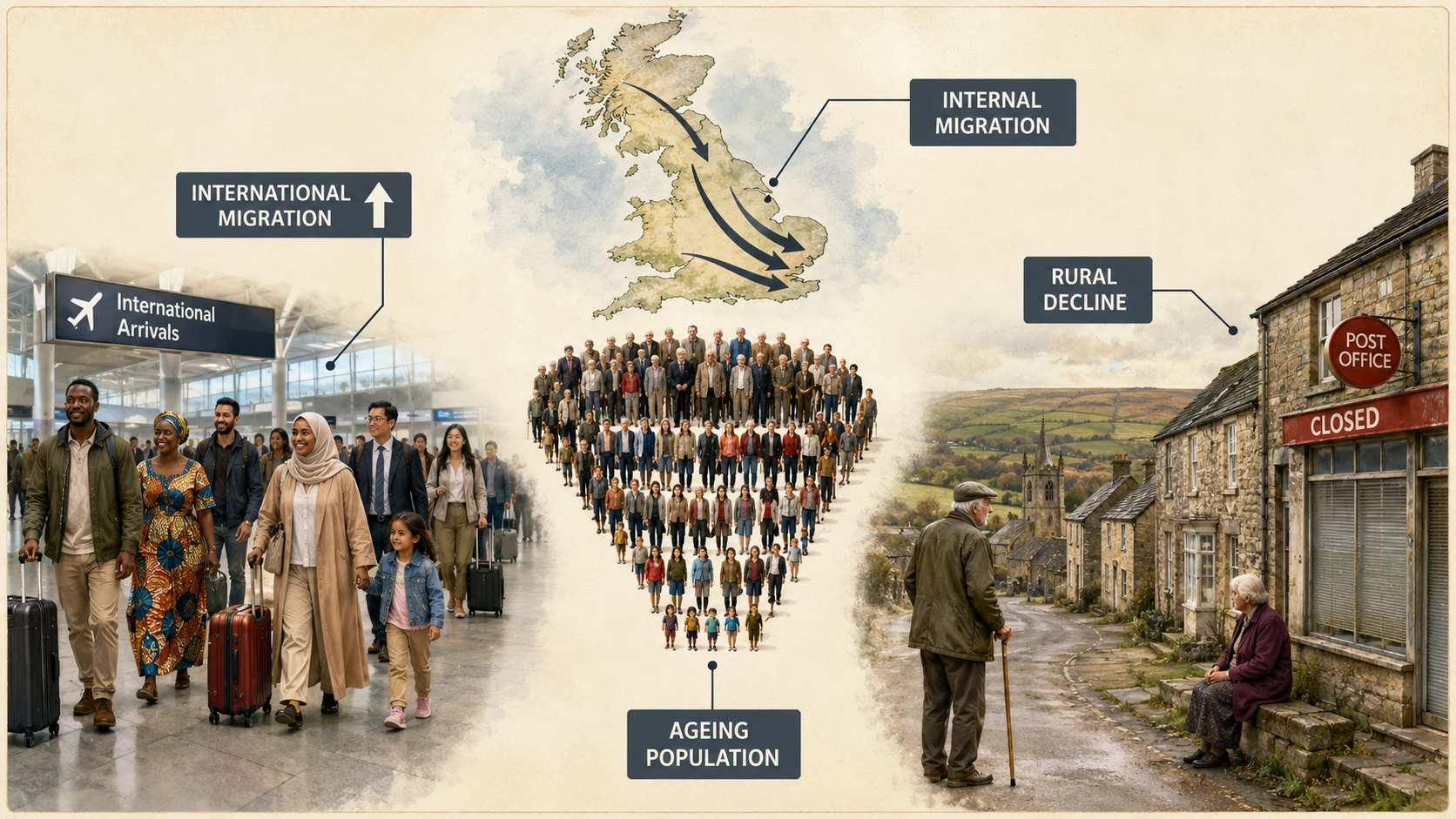
The UK's population reached about 69 million in mid-2024 (ONS), up from about 50 million in 1950. This growth has not happened evenly or for simple reasons. It results from three interacting forces: natural increase, net migration, and changing life expectancy.
Natural Increase
For most of the 20th century, the UK's birth rate exceeded its death rate, producing natural population growth. However, the birth rate has been falling steadily. In 2022, the total fertility rate in England and Wales was 1.49 children per woman (ONS), and it has fallen slightly since. This is well below the replacement level of 2.1 needed to maintain population without migration. Women are having fewer children, and having them later in life, as education, career opportunities, and the cost of housing change life choices. Without immigration, the UK's population would eventually begin to decline.
Net Migration: The Major Driver of Recent Growth
Net migration peaked at about 900,000 people a year in the year to June 2023 (ONS estimates), the highest level on record, and has since fallen sharply. Net migration is the difference between people arriving in the UK and people leaving. Migration brings workers, students, and families from countries across the world. It has significantly boosted the UK's working-age population, providing labour for the NHS (nurses and doctors from India, the Philippines, and Nigeria), hospitality, construction, and professional services.
Immigration is also one of the most contested political issues in the UK. The 2016 Brexit referendum result was driven significantly by concern about EU freedom of movement, which had enabled large-scale migration from Eastern Europe (particularly Poland and Romania) after 2004. Post-Brexit, the UK replaced EU freedom of movement with a points-based immigration system in January 2021. Even so, net migration rose to its highest recorded level within about two and a half years of that change.
An Ageing Population
The UK has an ageing population: currently 18% of the population is aged 65 or over, and projections suggest this will reach 25% by 2045. This results from falling birth rates (fewer young people entering the population) combined with increasing life expectancy (people living longer through better healthcare, diet, and living conditions).
An ageing population has profound consequences:
- NHS pressure: older people require more healthcare, and demand for hospital beds, social care, and dementia services is rising steeply. The NHS in England already has a budget of well over £150 billion a year.
- Pension costs — the state pension is funded by current workers through National Insurance; as the ratio of workers to pensioners falls, funding the pension bill becomes increasingly difficult. The UK already spends over £100 billion per year on state pensions.
- Housing demand — smaller households (fewer children, more single elderly people) mean more homes are needed even without overall population growth. The government acknowledges a need for approximately 300,000 new homes per year, yet consistently delivers fewer.
- Labour shortages — a shrinking working-age population creates skills gaps in healthcare, construction, and engineering; one reason immigration is economically important to the UK even when politically controversial.
Quick Check: Why is the UK's population growing despite a birth rate below replacement level (1.49 per woman)?
The UK's population is growing primarily because of net migration — more people are arriving than leaving. Net migration peaked at about 900,000 in the year to June 2023 (ONS), the highest on record, before falling sharply. Immigration provides workers for the NHS, hospitality, construction, and professional services. Without net migration, the UK's below-replacement birth rate (1.49 vs the 2.1 needed for stability) would lead to population decline over time. Also accept: increasing life expectancy means people live longer, keeping the total population higher than birth rate alone would suggest.
This deep dive covers Population Change: Growing, Ageing, and Diversifying within A Changing UK in the 21st Century for GCSE Geography. Revise A Changing UK in the 21st Century in UK in the 21st Century for GCSE Geography with 15 exam-style questions and 20 flashcards. This is a high-frequency topic, so it is worth revising until the explanation feels precise and repeatable. It is section 2 of 15 in this topic. Use this deep dive to connect the idea to the wider topic before moving on to questions and flashcards.
Practice questions for A Changing UK in the 21st Century
Which of the following best describes why the UK's population is aging?
Define the term 'aging population' and give one consequence for the UK.