EnergyKey Facts

⬛ What is a Black Body?

Part of Black Body Radiation · GCSE GCSE Physics revision

This key facts covers ⬛ What is a Black Body? within Black Body Radiation for GCSE Physics. Revise Black Body Radiation in Energy for GCSE Physics with 16 exam-style questions and 5 flashcards. This topic appears regularly enough that it should still be part of a steady revision cycle. It is section 2 of 7 in this topic. Use this key facts to connect the idea to the wider topic before moving on to questions and flashcards.

Topic position

Section 2 of 7

Practice

16 questions

Recall

5 flashcards

⬛ What is a Black Body?

Definition: A black body is a theoretical perfect absorber and perfect emitter of radiation.

  • Perfect absorber: Absorbs ALL radiation that hits it (reflects none)
  • Perfect emitter: Emits the maximum amount of radiation at every wavelength
  • Called "black" because a perfect absorber appears black at room temperature
  • Real objects approximate black bodies (e.g., soot, stars, planets)
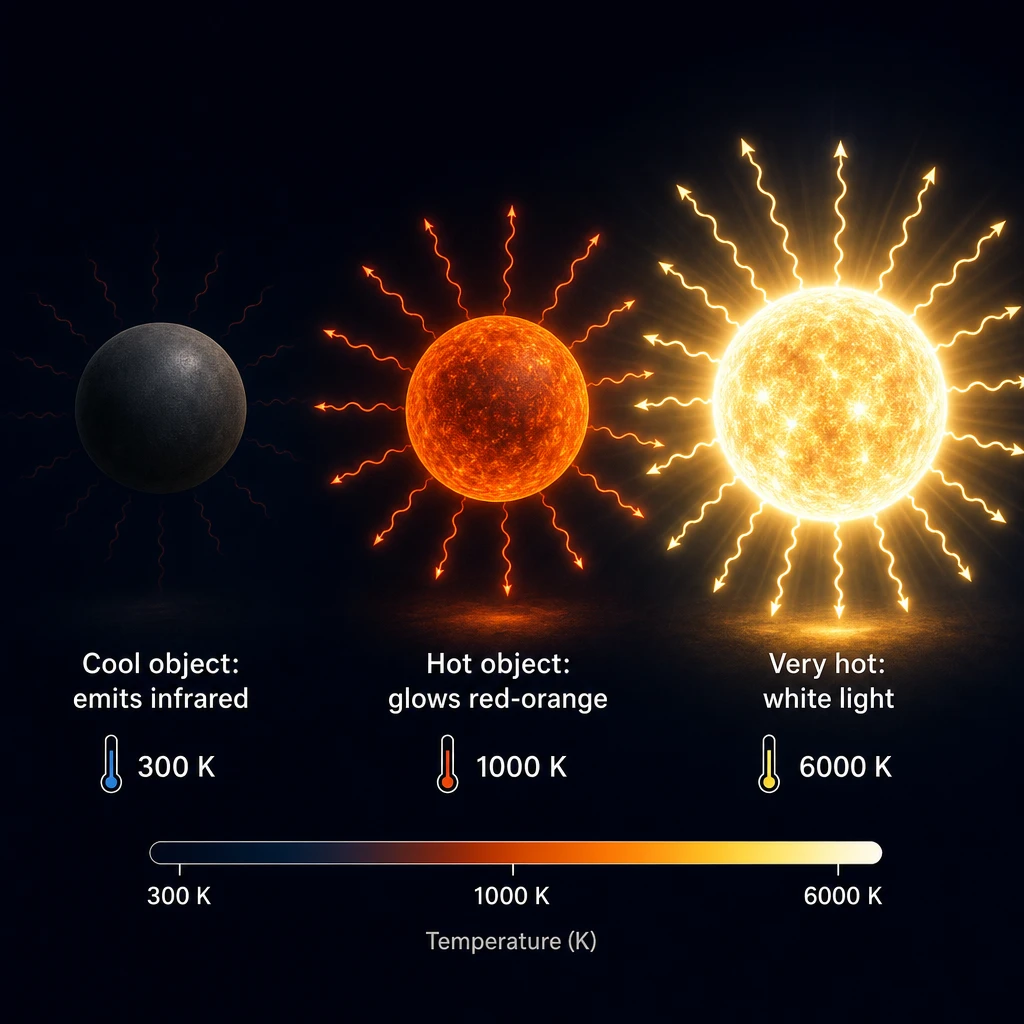
Three spheres at progressively higher temperatures against a dark studio backdrop, each surrounded by a glowing halo of emitted radiation. The left sphere at 300 K (room temperature) is dark with a barely visible faint infrared glow. The middle sphere at 1000 K glows visibly red-orange with a moderate warm radiation halo. The right sphere at 6000 K blazes brilliant white-hot with an intense radiation halo spanning the full visible spectrum. Temperature labels below each sphere. The halos grow dramatically in size and brightness from left to right, showing that total radiation emission increases with temperature.

Figure 1a: Three objects at 300 K, 1000 K and 6000 K — the hotter the object, the more radiation it emits and the shorter its peak wavelength.

Side-by-side comparison of two identical beakers at the same temperature. The left beaker has a matt black surface and glows with a visible warm orange-red glow, showing it is a good emitter of thermal radiation. The right beaker has a shiny silver surface and emits almost no visible glow, demonstrating it is a poor emitter. Labels confirm: matt black = good emitter, shiny silver = poor emitter.

Figure 1b: Good vs poor emitters — a matt black surface emits far more radiation than a shiny silver one at the same temperature.

Keep building this topic

Read this section alongside the surrounding pages in Black Body Radiation. That gives you the full topic sequence instead of a single isolated revision point.

Practice Questions for Black Body Radiation

What is a perfect black body?

  • A. An object that reflects all radiation that hits it
  • B. An object that only emits visible light
  • C. An object that absorbs all radiation that hits it and reflects none
  • D. An object that is black in colour and absorbs only visible light
1 markfoundation

Explain how the radiation emitted by an object changes as its temperature increases.

3 marksstandard

Quick Recall Flashcards

Perfect emitter
Emits the maximum amount of radiation at every wavelength
Define:
A black body is a theoretical perfect absorber and perfect emitter of radiation.

16 questions on Black Body Radiation — practise free

Instant marking, adaptive difficulty, and 5 spaced repetition flashcards. Free until your GCSEs.

Try PrepWise Free