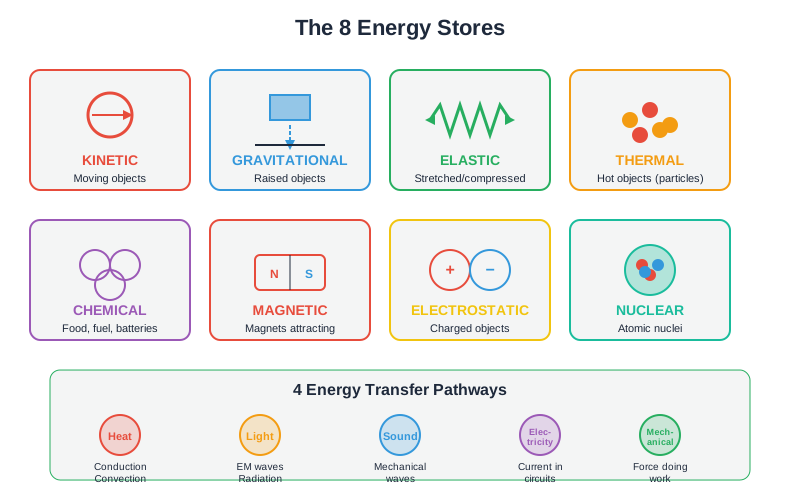
The 8 Energy Stores Overview

Part of Energy Stores & Systems · Section 3 of 20

DiagramUnit: EnergyGCSE

This diagram covers The 8 Energy Stores Overview within Energy Stores & Systems for GCSE Physics. Revise Energy Stores & Systems in Energy for GCSE Physics with 14 exam-style questions and 30 flashcards. This is a high-frequency topic, so it is worth revising until the explanation feels precise and repeatable. It is section 3 of 20 in this topic. Focus on the labels, the relationships between parts, and the explanation that turns the diagram into an exam-ready answer.

📊 The 8 Energy Stores Overview

Diagram showing all 8 energy stores with icons: Kinetic (movement), Gravitational (height), Elastic (stretch), Chemical (bonds), Thermal (heat), Magnetic (magnets), Electrostatic (charges), and Nuclear (atoms), connected by the 4 transfer pathways: Mechanical, Electrical, Heating, and Radiation

Figure 1: The 8 energy stores and 4 transfer pathways. Energy is never created or destroyed — only transferred.

REMEMBER: Energy is NEVER created or destroyed — it only transfers between stores. Always describe WHERE energy comes from and WHERE it goes!

Practice questions for Energy Stores & Systems

Which energy store is associated with an object that is moving?

  • A. Gravitational potential
  • B. Elastic potential
  • C. Kinetic
  • D. Chemical
1 markfoundation

Explain what is meant by a 'closed system' in terms of energy.

2 marksstandard

Quick recall flashcards

What is kinetic energy?
Energy stored in any object that is moving
What is thermal energy?
Energy stored due to the random kinetic energy of particles (temperature)

14 questions on Energy Stores & Systems — practise free

Instant marking, adaptive difficulty and spaced-repetition flashcards — all aligned to your exam board.

Start revising free →