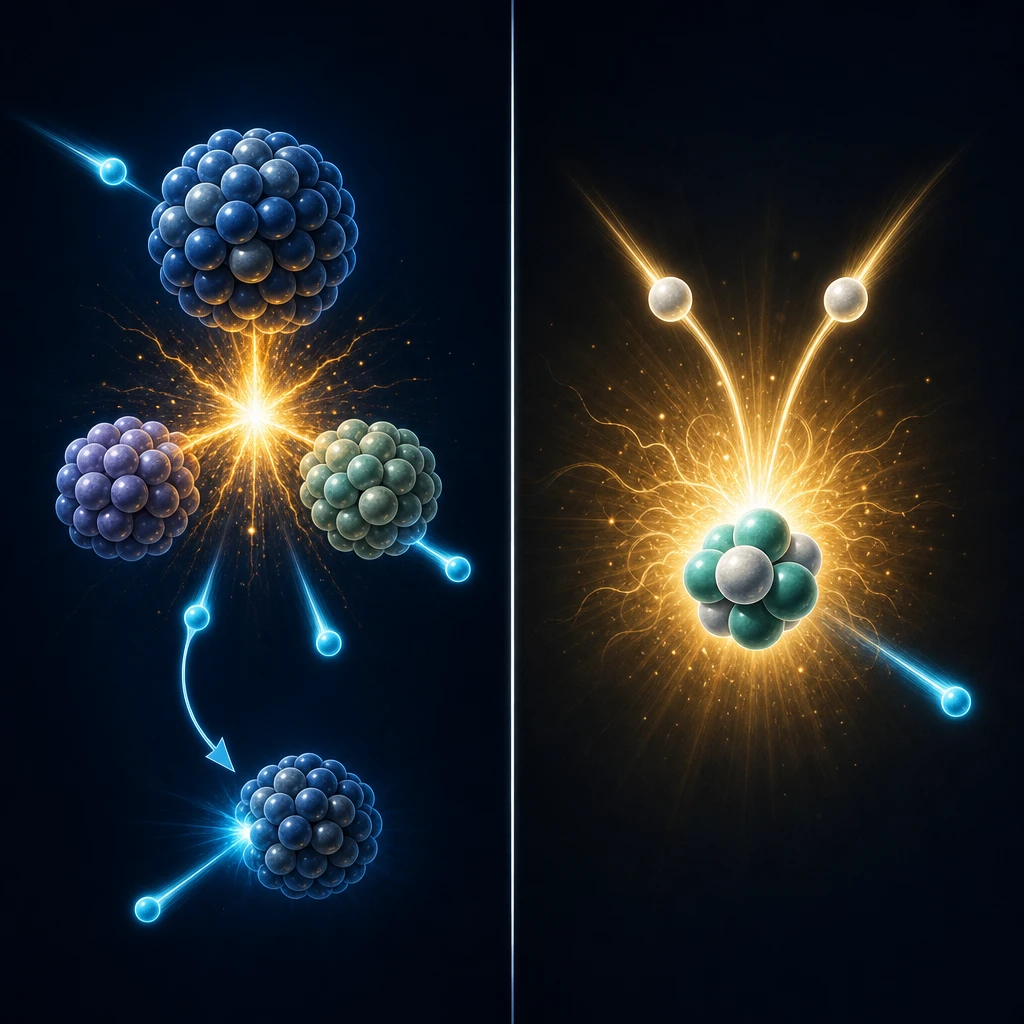
Figure 1: Fission (left) splits a heavy nucleus releasing neutrons that trigger a chain reaction; fusion (right) joins light nuclei releasing far more energy per kilogram.
This diagram covers Nuclear Fission vs Fusion within Nuclear Fission & Fusion for GCSE Physics. Revise Nuclear Fission & Fusion in Atomic Structure for GCSE Physics with 13 exam-style questions and 25 flashcards. This topic appears less often, but it can still be a useful differentiator on mixed-topic papers. It is section 10 of 18 in this topic. Focus on the labels, the relationships between parts, and the explanation that turns the diagram into an exam-ready answer.
Practice questions for Nuclear Fission & Fusion
What is nuclear fission?
Explain what is meant by a chain reaction in nuclear fission.
Quick recall flashcards
What is nuclear fission?
The splitting of a large, unstable nucleus into two smaller nuclei, releasing energy and neutrons
What is nuclear fusion?
The joining of two small, light nuclei to form a larger nucleus, releasing energy