ForcesDiagram

Impulse and Force-Time Graphs

Part of Impulse & Collisions · GCSE GCSE Physics revision

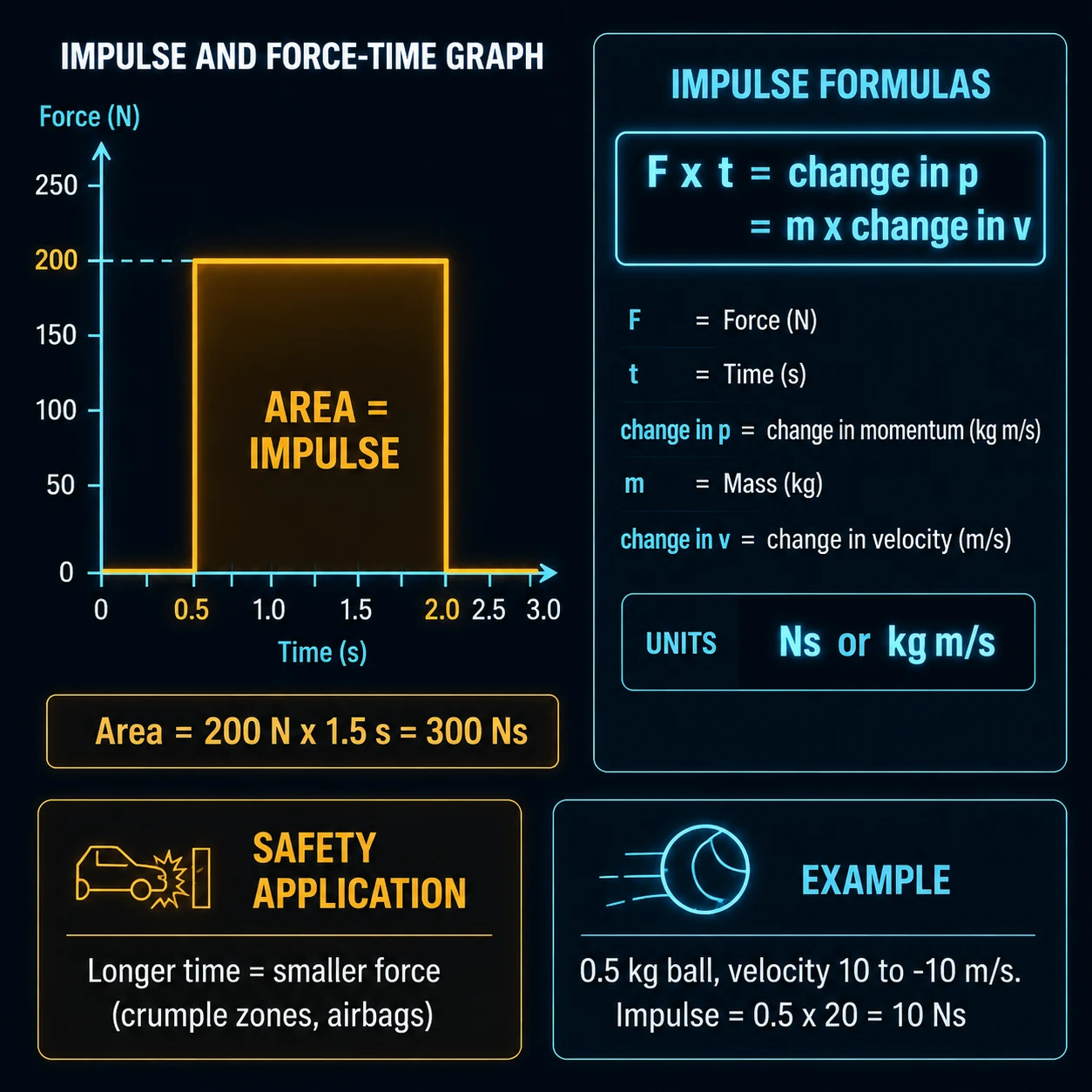
This diagram covers Impulse and Force-Time Graphs within Impulse & Collisions for GCSE Physics. Revise Impulse & Collisions in Forces for GCSE Physics with 13 exam-style questions and 10 flashcards. Use this page as part of a wider topic revision path rather than treating it as an isolated fact. It is section 3 of 7 in this topic. Focus on the labels, the relationships between parts, and the explanation that turns the diagram into an exam-ready answer.

Topic position

Section 3 of 7

Practice

13 questions

Recall

10 flashcards

📊 Impulse and Force-Time Graphs

Studio Render impulse and force-time graph on dark backdrop. Left: force-time graph with cyan axes, amber rectangular pulse (200 N from 0.5 s to 2.0 s), shaded area labelled AREA = IMPULSE, calculation 200 N x 1.5 s = 300 Ns. Right: impulse formulas panel F x t = change in p = m x change in v, variable key, units Ns or kg m/s. Bottom: safety application (longer time = smaller force) and worked example.

Keep building this topic

Read this section alongside the surrounding pages in Impulse & Collisions. That gives you the full topic sequence instead of a single isolated revision point.

Practice Questions for Impulse & Collisions

Which equation correctly defines impulse?

  • A. impulse = force / time
  • B. impulse = force x time
  • C. impulse = mass x acceleration
  • D. impulse = mass x velocity
1 markfoundation

Explain how an airbag reduces the risk of injury to a driver in a collision.

3 marksstandard

Quick Recall Flashcards

Understanding Impulse
Impulse = Force × time (F × t) — measured in N s
Understanding Impulse
Impulse = Change in momentum (Δp = mΔv) — measured in kg m/s

13 questions on Impulse & Collisions — practise free

Instant marking, adaptive difficulty, and 10 spaced repetition flashcards. Free until your GCSEs.

Try PrepWise Free