WavesDiagram

Oscilloscope Sound Wave Traces

Part of Sound WavesGCSE Physics

This diagram covers Oscilloscope Sound Wave Traces within Sound Waves for GCSE Physics. Revise Sound Waves in Waves for GCSE Physics with 13 exam-style questions and 15 flashcards. This is a high-frequency topic, so it is worth revising until the explanation feels precise and repeatable. It is section 4 of 13 in this topic. Focus on the labels, the relationships between parts, and the explanation that turns the diagram into an exam-ready answer.

Topic position

Section 4 of 13

Practice

13 questions

Recall

15 flashcards

📊 Oscilloscope Sound Wave Traces

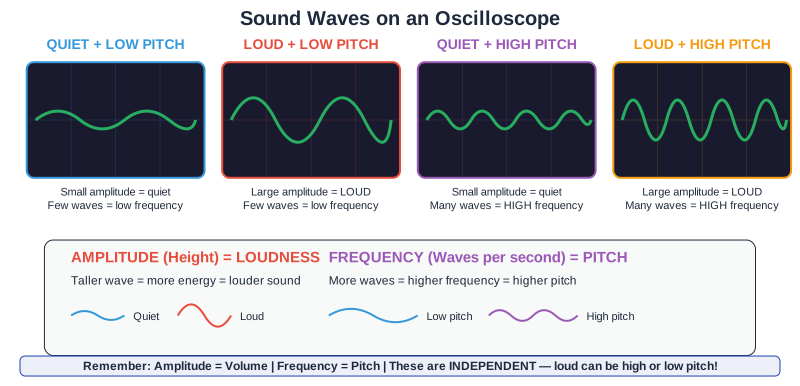
Four oscilloscope displays showing how amplitude affects loudness and frequency affects pitch of sound waves

Figure 1: Oscilloscope traces comparing loud/quiet and high/low pitch sounds

KEY CONNECTIONS: Taller waves = LOUDER (higher amplitude) | More waves per screen = HIGHER PITCH (higher frequency) | Wave shape = sound quality (timbre)

Keep building this topic

Read this section alongside the surrounding pages in Sound Waves. That gives you the full topic sequence instead of a single isolated revision point.

Practice Questions for Sound Waves

What type of wave is sound?

  • A. Transverse wave
  • B. Longitudinal wave
  • C. Electromagnetic wave
  • D. Stationary wave
1 markfoundation

Describe how a sound wave is produced and how energy is transferred by a longitudinal wave.

2 marksstandard

Quick Recall Flashcards

What is an echo?
Reflection of sound waves from a surface
Sound wave type?
Longitudinal

Want to test your knowledge?

PrepWise has 13 exam-style questions and 15 flashcards for Sound Waves — with adaptive difficulty and instant feedback.

Join Alpha