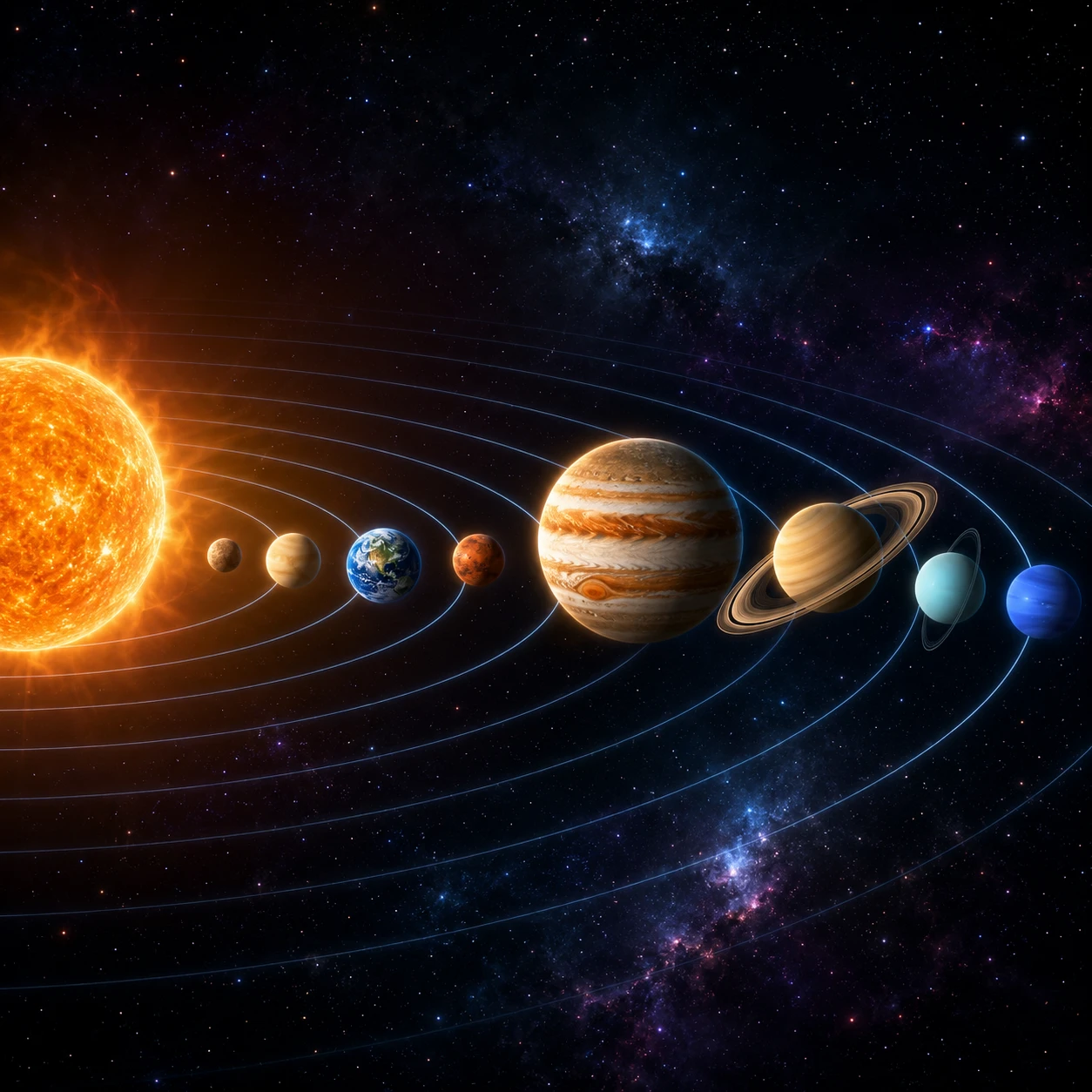
This diagram covers Our Solar System within Our Solar System for GCSE Physics. Revise Our Solar System in Space Physics for GCSE Physics with 13 exam-style questions and 12 flashcards. This topic appears less often, but it can still be a useful differentiator on mixed-topic papers. It is section 2 of 8 in this topic. Focus on the labels, the relationships between parts, and the explanation that turns the diagram into an exam-ready answer.
Practice questions for Our Solar System
Which of the following is NOT an inner rocky planet in our solar system?
Explain how gravity keeps a planet in a circular orbit around the Sun.
Quick recall flashcards
What is a dwarf planet?
A planet-like object that is too small to clear its orbital path. Examples: Pluto, Ceres, Eris
What is a light year?
The distance light travels in one year = 9.46 × 10¹² km. It's a DISTANCE, not a time!