EnergyDiagram

Three Methods of Heat Transfer

Part of Heat TransferGCSE Physics

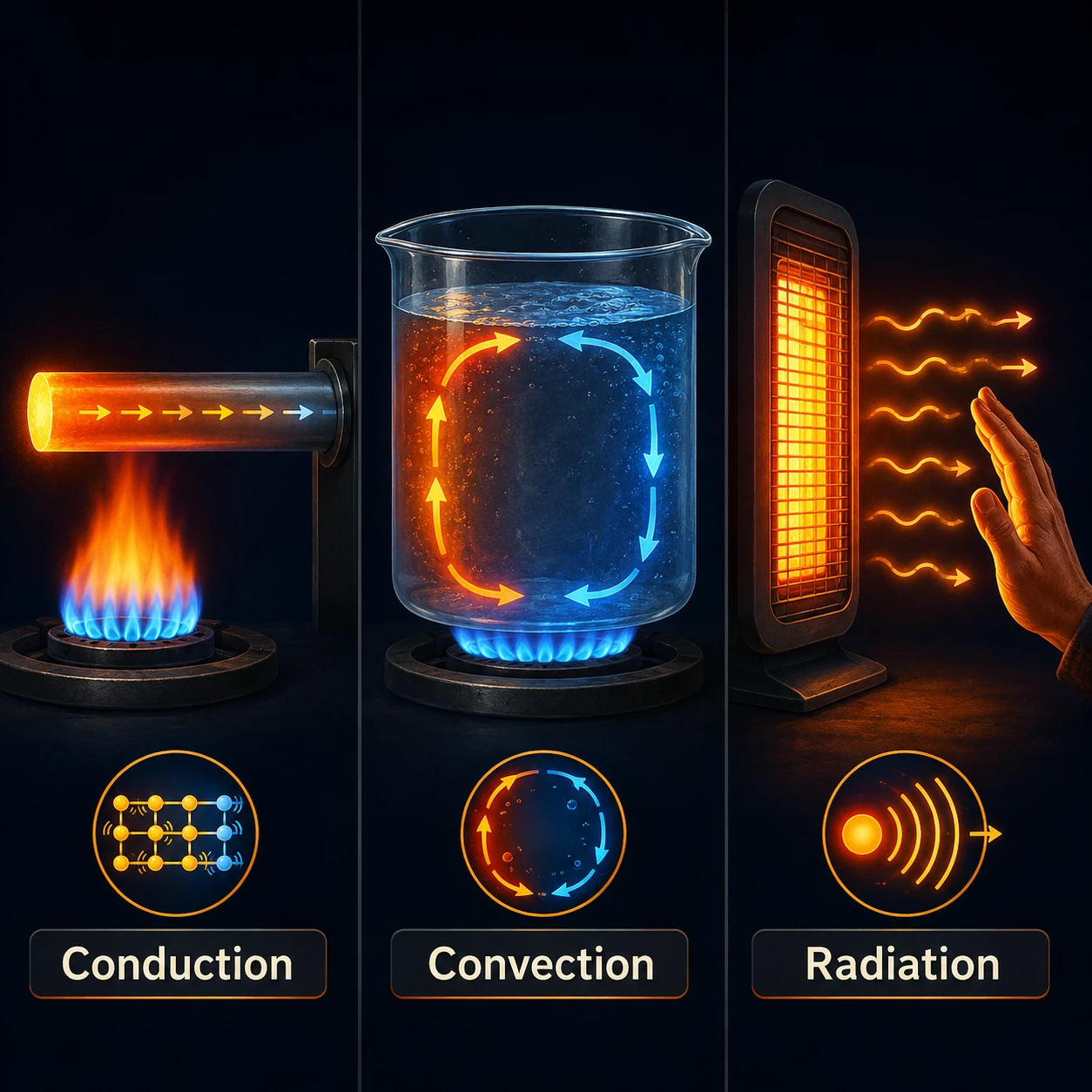
This diagram covers Three Methods of Heat Transfer within Heat Transfer for GCSE Physics. Revise Heat Transfer in Energy for GCSE Physics with 14 exam-style questions and 11 flashcards. This is a high-frequency topic, so it is worth revising until the explanation feels precise and repeatable. It is section 3 of 17 in this topic. Focus on the labels, the relationships between parts, and the explanation that turns the diagram into an exam-ready answer.

Topic position

Section 3 of 17

Practice

14 questions

Recall

11 flashcards

📊 Three Methods of Heat Transfer

Diagram showing conduction (particles vibrating and passing energy), convection (circular arrows showing hot fluid rising and cool fluid sinking), and radiation (wavy lines showing infrared waves travelling from a hot surface)

Figure 1: The three methods of heat transfer. Conduction and convection need particles; radiation does not.

Keep building this topic

Read this section alongside the surrounding pages in Heat Transfer. That gives you the full topic sequence instead of a single isolated revision point.

Practice Questions for Heat Transfer

Which method of thermal energy transfer occurs mainly in solids?

  • A. Convection
  • B. Conduction
  • C. Radiation
  • D. Evaporation
1 markfoundation

Explain how a convection current forms when the base of a fluid is heated.

3 marksstandard

Quick Recall Flashcards

Examples
wood, plastic, glass, air, wool
Fluid is heated
particles gain kinetic energy → move faster → spread out

Want to test your knowledge?

PrepWise has 14 exam-style questions and 11 flashcards for Heat Transfer — with adaptive difficulty and instant feedback.

Join Alpha