ForcesDiagram

Pressure Diagrams

Part of Pressure · GCSE GCSE Physics revision

This diagram covers Pressure Diagrams within Pressure for GCSE Physics. Revise Pressure in Forces for GCSE Physics with 15 exam-style questions and 12 flashcards. This is a high-frequency topic, so it is worth revising until the explanation feels precise and repeatable. It is section 5 of 16 in this topic. Focus on the labels, the relationships between parts, and the explanation that turns the diagram into an exam-ready answer.

Topic position

Section 5 of 16

Practice

15 questions

Recall

12 flashcards

🧭 Pressure Diagrams

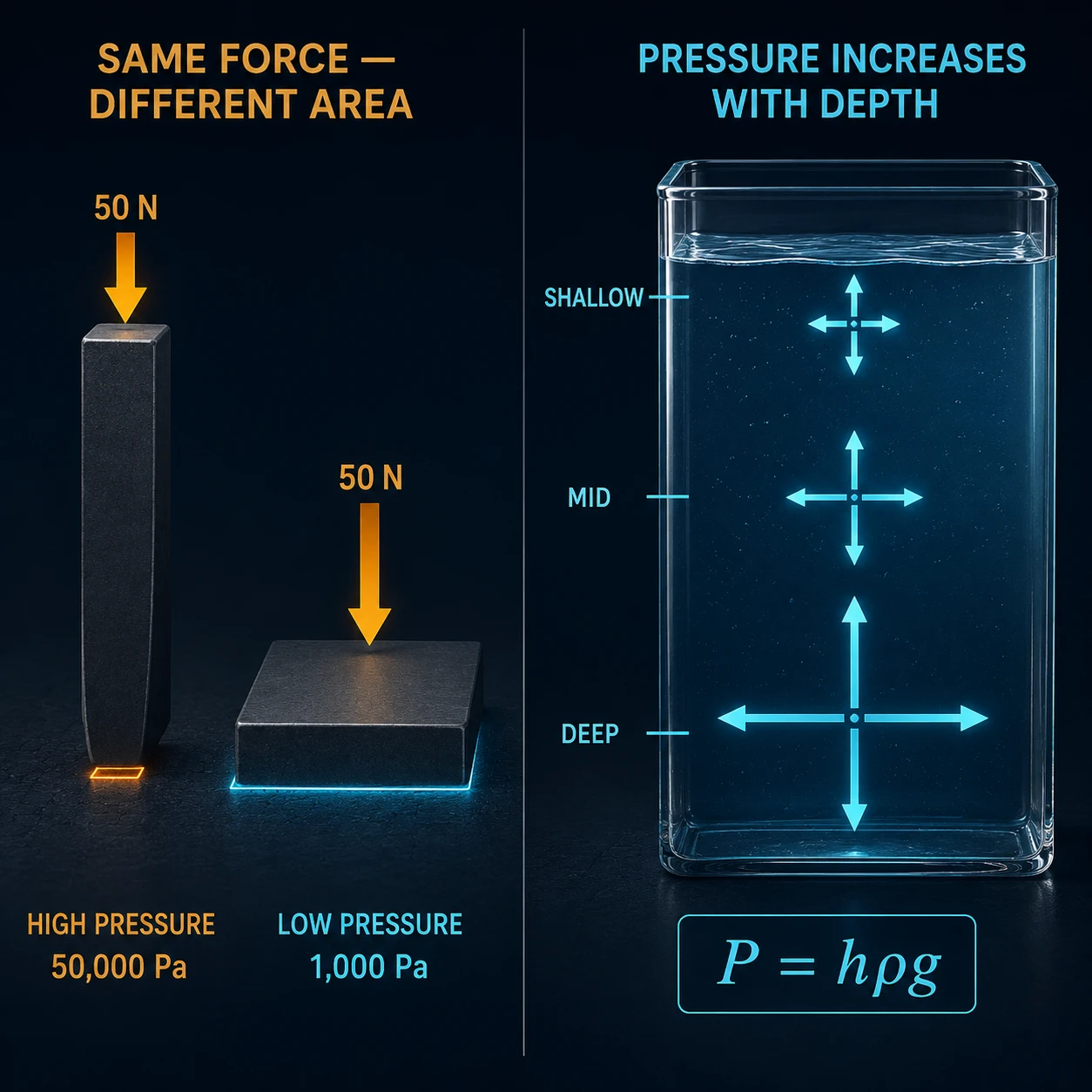
Two side-by-side diagrams on a dark backdrop. Left panel 'Same force, different area': two identical 50N blocks sit on surfaces. The left block has a small contact area (amber, like a stiletto) producing 50,000 Pa — HIGH pressure. The right block has a large contact area (cyan, like a flat shoe) producing 1,000 Pa — LOW pressure. Right panel 'Pressure increases with depth': a water tank shown in cross-section with three depth levels. At each level, cyan arrows point in all four directions (up, down, left, right) showing fluid pressure acts equally. The arrows get longer at greater depth — shallow has short arrows (low P), mid has medium arrows, deep has long arrows (high P). Footer: P = F/A for solids; P = ρgh for fluids.

Figure 1: Left — same force, different area gives different pressure. Right — fluid pressure increases with depth and acts in all directions.

Keep building this topic

Read this section alongside the surrounding pages in Pressure. That gives you the full topic sequence instead of a single isolated revision point.

Practice Questions for Pressure

What is the correct equation for pressure?

  • A. Pressure = Force × Area
  • B. Pressure = Force ÷ Area
  • C. Pressure = Area ÷ Force
  • D. Pressure = Force + Area
1 markfoundation

Explain why a sharp knife cuts through food more easily than a blunt knife, even when the same force is applied to both.

3 marksstandard

Quick Recall Flashcards

What is pressure?
The force acting per unit area on a surface. P = F / A
What is the equation for pressure?
P = F / A Pressure (Pa) = Force (N) ÷ Area (m²)

15 questions on Pressure — practise free

Instant marking, adaptive difficulty, and 12 spaced repetition flashcards. Free until your GCSEs.

Try PrepWise Free