Heating Curve — Temperature vs Time

Part of Specific Latent Heat · Section 3 of 12

DiagramUnit: Particle ModelGCSE

This diagram covers Heating Curve — Temperature vs Time within Specific Latent Heat for GCSE Physics. Revise Specific Latent Heat in Particle Model for GCSE Physics with 13 exam-style questions and 30 flashcards. This is a high-frequency topic, so it is worth revising until the explanation feels precise and repeatable. It is section 3 of 12 in this topic. Focus on the labels, the relationships between parts, and the explanation that turns the diagram into an exam-ready answer.

📊 Heating Curve — Temperature vs Time

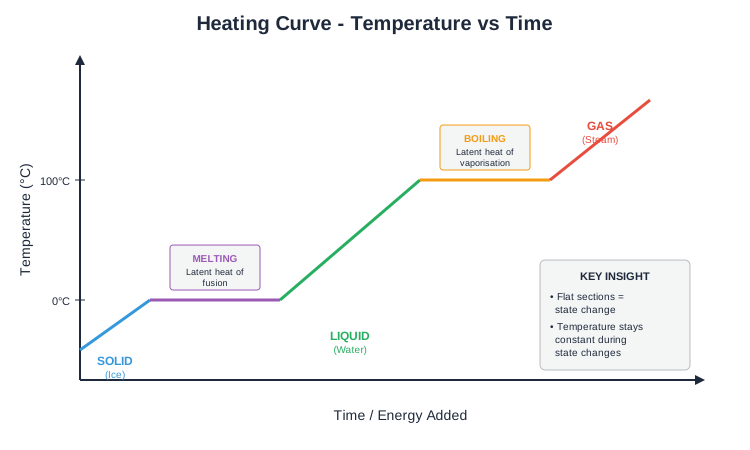
Heating curve showing temperature vs time for water, with flat sections during melting at 0°C and boiling at 100°C where latent heat is absorbed but temperature remains constant, and sloped sections during heating of solid, liquid, and gas phases

Figure 1: Heating curve for water. Flat sections show where latent heat is absorbed at constant temperature.

KEY INSIGHT: During state changes, temperature stays constant because energy goes into breaking bonds (latent heat), not increasing particle speed.

Practice questions for Specific Latent Heat

What is specific latent heat?

  • A. The energy needed to raise 1 kg of a substance by 1 °C
  • B. The energy needed to change the state of 1 kg of a substance without changing its temperature
  • C. The temperature at which a substance changes state
  • D. The rate of energy transfer during a state change
1 markfoundation

During a state change, energy is being supplied to a substance but the temperature does not change. Explain where this energy goes.

2 marksstandard

Quick recall flashcards

Latent heat equation
E = mL
What is latent heat?
Energy needed to change state without changing temperature. 'Latent' = hidden.

13 questions on Specific Latent Heat — practise free

Instant marking, adaptive difficulty and spaced-repetition flashcards — all aligned to your exam board.

Start revising free →