The Greatest Puzzle in Science
📖 The Greatest Puzzle in Science
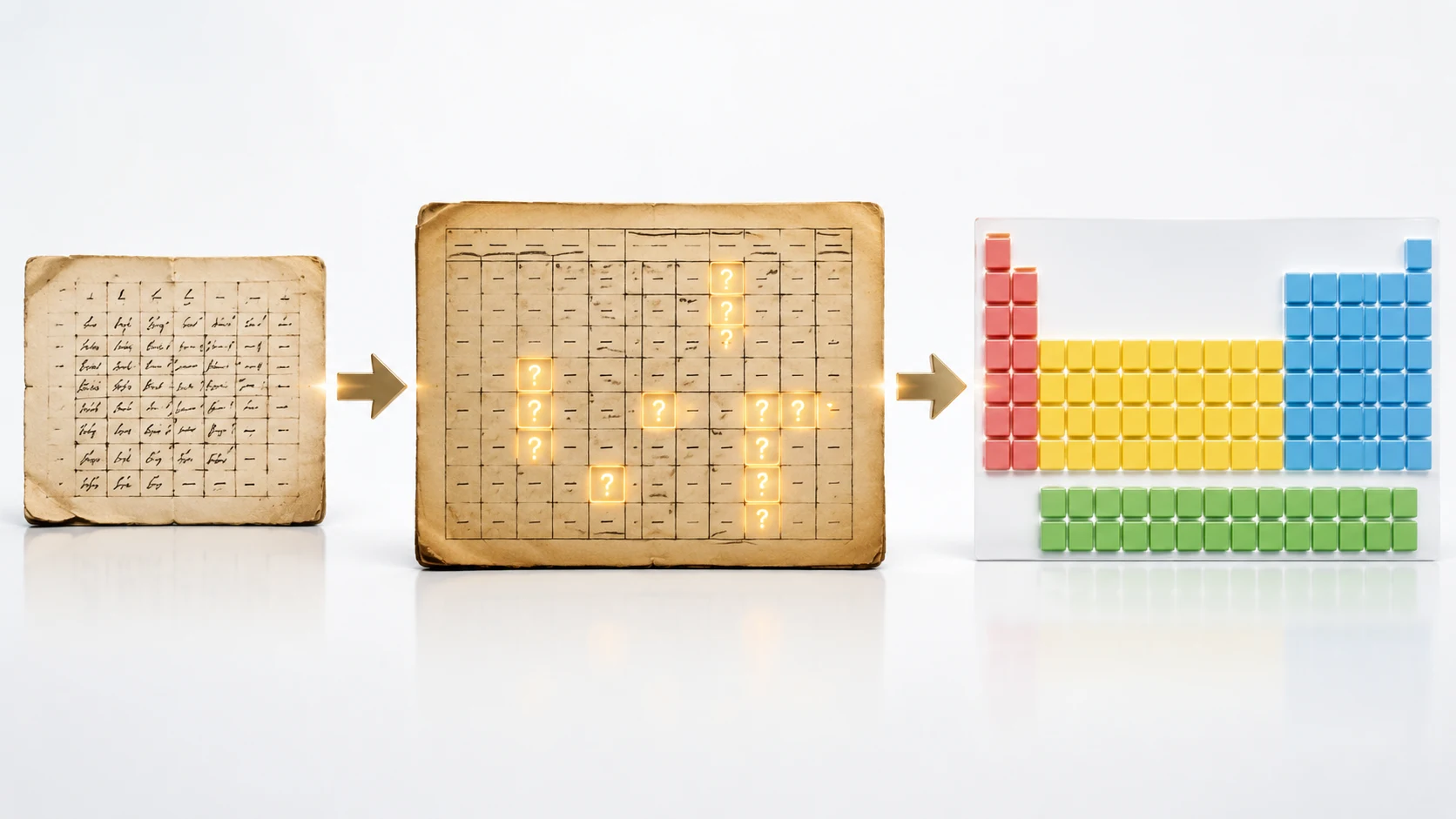
Mendeleev was like someone doing a jigsaw without the box lid. He found pieces that clearly fitted together (same number of outer electrons = same column). When pieces seemed to be missing, instead of forcing the wrong piece in, he left gaps and described what the missing piece should look like. Years later, those exact pieces were found — proving the pattern was real!
- 1Early attempts —
- 2Mendeleev's table —
- 3Modern table —
Chemistry glossary
- When were noble gases discovered?
- 1890s — added as Group 0
Examiners love asking about the development of the periodic table because it shows how science works — how ideas change when new evidence appears.
Earn the mark scheme marks
🧠 Memory Aids
"Mendeleev's Magic Gaps" — The key thing that made Mendeleev's table special was that he left gaps. All other mnemonic detail flows from this: gaps → predictions → discovered elements → proof.
Timeline order: D-N-M-Mo — Döbereiner (1817), Newlands (1866), Mendeleev (1869), Moseley (1913). "Did Newton Meet Moses?" helps remember the order.
Why Mendeleev beat Newlands: "Mendeleev Left Gaps and Predicted" (the four key words: Left, Gaps, Predicted, Swapped).
Quick Check: Why is the modern periodic table arranged by atomic number rather than atomic mass?
Atomic number (number of protons) determines the number of electrons and therefore the chemical properties of an element. Ordering by atomic number means elements with similar properties always fall in the same group with no exceptions. Ordering by atomic mass required some elements (like tellurium and iodine) to be placed out of strict mass order to keep them in the correct group.
Now try it yourself
Quiz · Question 1 of 20
John Newlands proposed the Law of Octaves in 1866. What did he notice about the elements?
Tap an answer to check it
This topic in real past papers
Every real exam question we've found on development of periodic table, with a full worked answer.