We Are Made of Star Stuff
🚀 We Are Made of Star Stuff

Figure 1: Cool nebula gas streams inward under gravity to ignite a hot protostar core — the moment a star is born.
The calcium in your bones was forged inside a dying star. The iron in your blood was scattered by a supernova explosion billions of years ago. The oxygen in every breath you take was created by nuclear fusion in a stellar core. You are not merely living in the universe — your body is literally built from it, assembled from atoms that were cooked inside stars and dispersed across the galaxy.
Stars are not permanent. They are born from clouds of gas, shine for millions or billions of years, and then die in ways that depend on how massive they were. A star like our Sun will eventually swell into a red giant, shed its outer layers in a beautiful planetary nebula, and leave behind a faint cooling white dwarf. A massive star — ten or more times the Sun's mass — will explode as a supernova, one of the most violent events in the universe, creating all the elements heavier than iron and seeding the next generation of stars and planets.
Understanding stellar life cycles is not just about astronomy — it explains where every atom in the universe came from.
Life cycles of stars — click each stage to explore its role
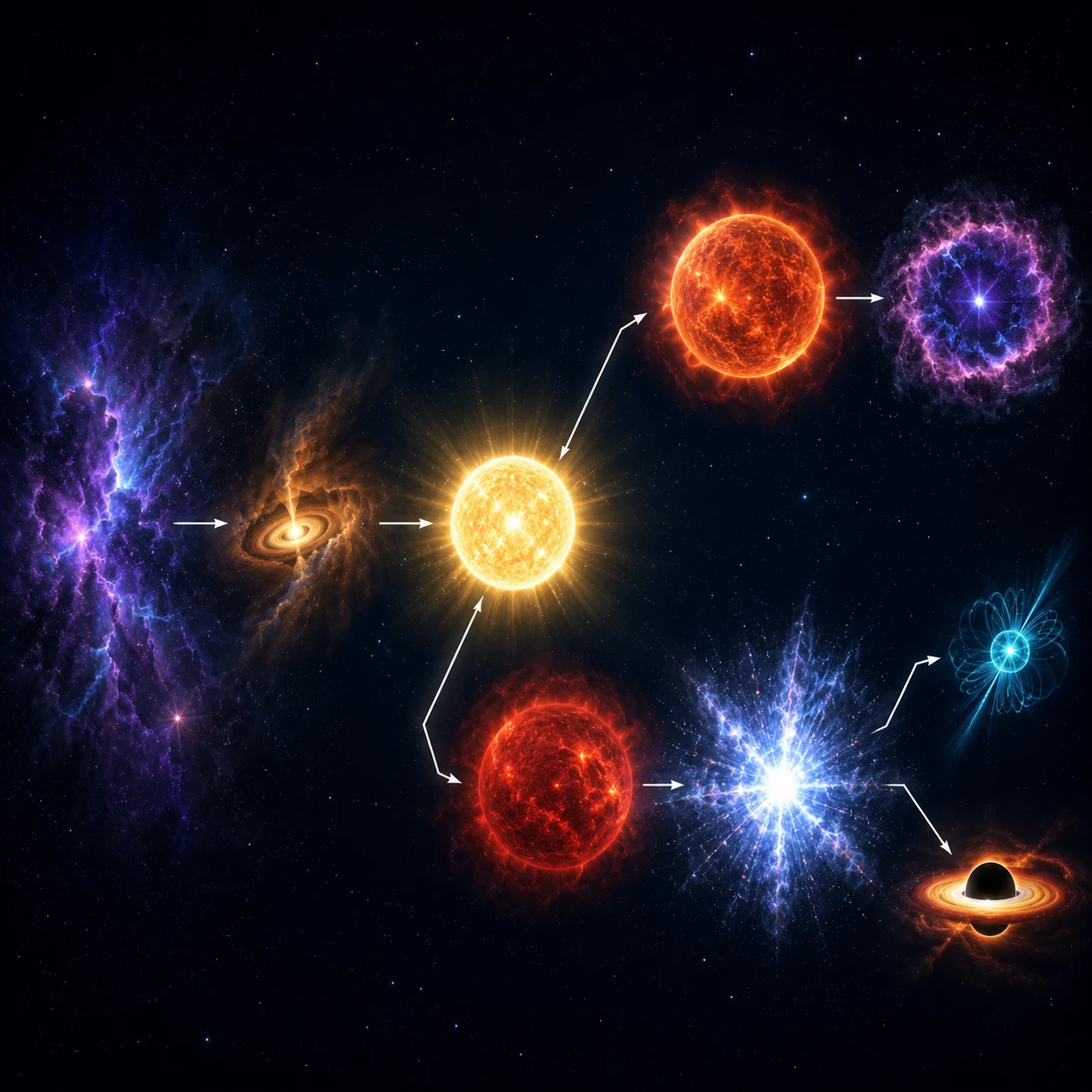
- 1Nebula —
- 2Protostar —
- 3Main sequence star —
- 4Red giant —
- 5White dwarf —
- 6Supernova —
- 7Neutron star —
Figure 3: Life cycles of stars — click each stage to explore its role
Figure 2: The 4 stages of star formation — gravity contracts gas and dust until the core is hot enough for hydrogen fusion to begin
Earn the mark scheme marks
🧠 Memory Aids
Sun-Like Star Path
Use the first letters: N-P-M-R-P-W
Nebula, Protostar, Main sequence, Red giant, Planetary nebula, White dwarf
Memory phrase: "Never Panic Much — Relax, Please Wait"
Massive Star Path
Use: N-P-M-R-S-N/B
Nebula, Protostar, Main sequence, Red supergiant, Supernova, Neutron star/Black hole
Memory phrase: "Never Panic Much — Run, Superstars Nail Big finishes"
Where Elements Come From — "Iron is the Boundary"
Below iron (H to Fe): made by stellar fusion (normal star lifetimes)
Above iron (Cu, Au, Pb, U...): made by supernovae only
Iron (Fe) is the most stable nucleus — fusion cannot release energy from iron or heavier elements.
Quick Check: Why do massive stars have shorter lives than less massive stars, even though they have more fuel?
Massive stars have greater gravitational compression, which means their cores reach higher temperatures and pressures. This makes nuclear fusion happen at a much faster rate. Even though they have more hydrogen fuel to start with, they burn through it so much faster that their total lifetime is much shorter — millions of years rather than billions.
Now try it yourself
Quiz · Question 1 of 13
The light from a distant galaxy is red-shifted. What does this tell us about the galaxy?
Tap an answer to check it
This topic in real past papers
Every real exam question we've found on life cycle of stars, with a full worked answer.