Bonding & StructureDiagram

Electron Transfer: Na → Na⁺ and Cl → Cl⁻

Part of Ionic Bonding · GCSE GCSE Chemistry revision

This diagram covers Electron Transfer: Na → Na⁺ and Cl → Cl⁻ within Ionic Bonding for GCSE Chemistry. Revise Ionic Bonding in Bonding & Structure for GCSE Chemistry with 27 exam-style questions and 20 flashcards. This is a high-frequency topic, so it is worth revising until the explanation feels precise and repeatable. It is section 2 of 16 in this topic. Focus on the labels, the relationships between parts, and the explanation that turns the diagram into an exam-ready answer.

Topic position

Section 2 of 16

Practice

27 questions

Recall

20 flashcards

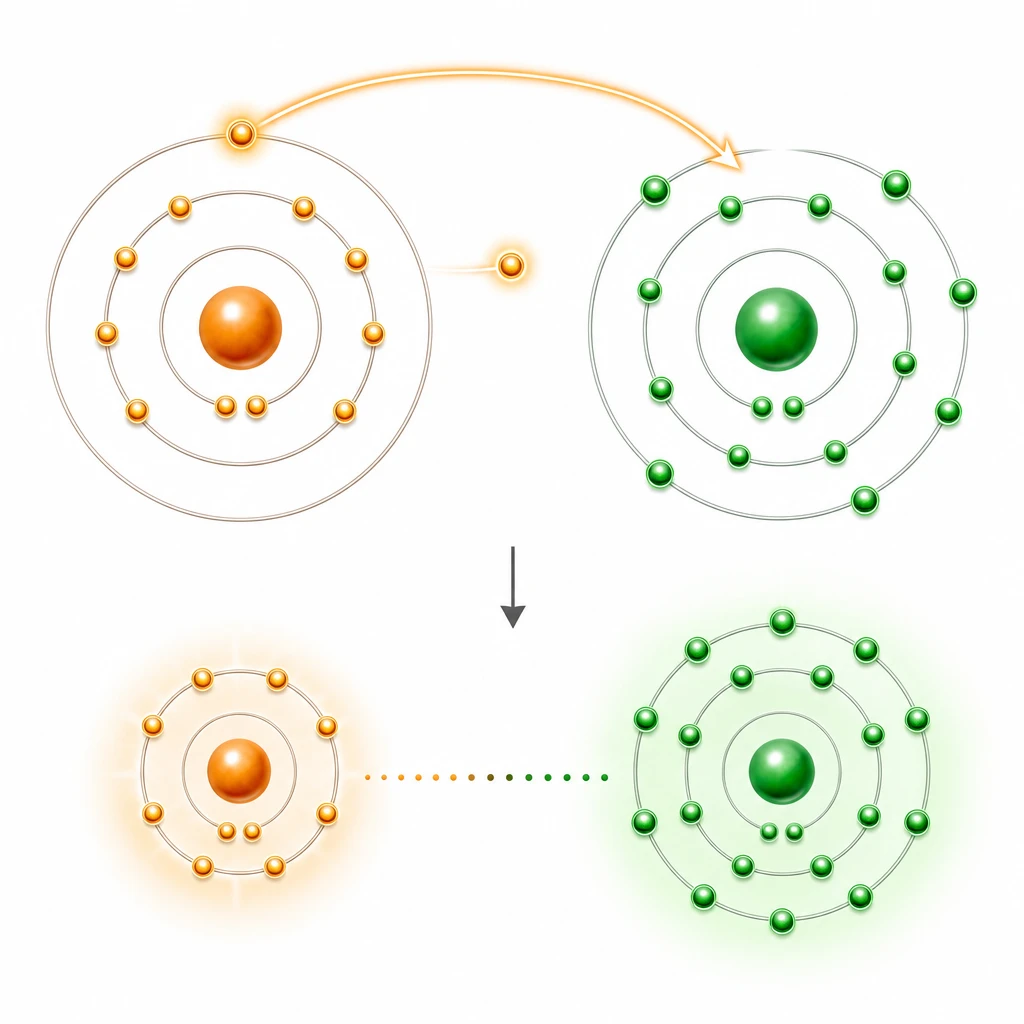
⚡ Electron Transfer: Na → Na⁺ and Cl → Cl⁻

Diagram showing ionic bonding: sodium atom (orange, 2,8,1 shell structure) transfers its outer electron to chlorine atom (green, 2,8,7 shell structure). Below shows the resulting Na⁺ ion and Cl⁻ ion attracting each other. GCSE Chemistry revision — ionic bonding.

Figure 1: Ionic bonding — the outer electron from sodium is transferred completely to chlorine, forming Na⁺ and Cl⁻ ions

Keep building this topic

Read this section alongside the surrounding pages in Ionic Bonding. That gives you the full topic sequence instead of a single isolated revision point.

Practice Questions for Ionic Bonding

Which combination of elements forms an ionic compound?

  • A. Sodium and chlorine
  • B. Carbon and hydrogen
  • C. Nitrogen and oxygen
  • D. Carbon and oxygen
1 markfoundation

Describe the structure of an ionic compound and explain why ionic compounds have high melting points. [3 marks]

3 marksstandard

Quick Recall Flashcards

What is an anion?
A negative ion (formed when non-metals gain electrons)
What is a cation?
A positive ion (formed when metals lose electrons)

27 questions on Ionic Bonding — practise free

Instant marking, adaptive difficulty, and 20 spaced repetition flashcards. Free until your GCSEs.

Try PrepWise Free