Simple Molecular Structures

Part of Simple Molecules · Section 1 of 11

DiagramUnit: Bonding & StructureGCSE

This diagram covers Simple Molecular Structures within Simple Molecules for GCSE Chemistry. Revise Simple Molecules in Bonding & Structure for GCSE Chemistry with 20 exam-style questions and 21 flashcards. This topic appears less often, but it can still be a useful differentiator on mixed-topic papers. It is section 1 of 11 in this topic. Focus on the labels, the relationships between parts, and the explanation that turns the diagram into an exam-ready answer.

🔬 Simple Molecular Structures

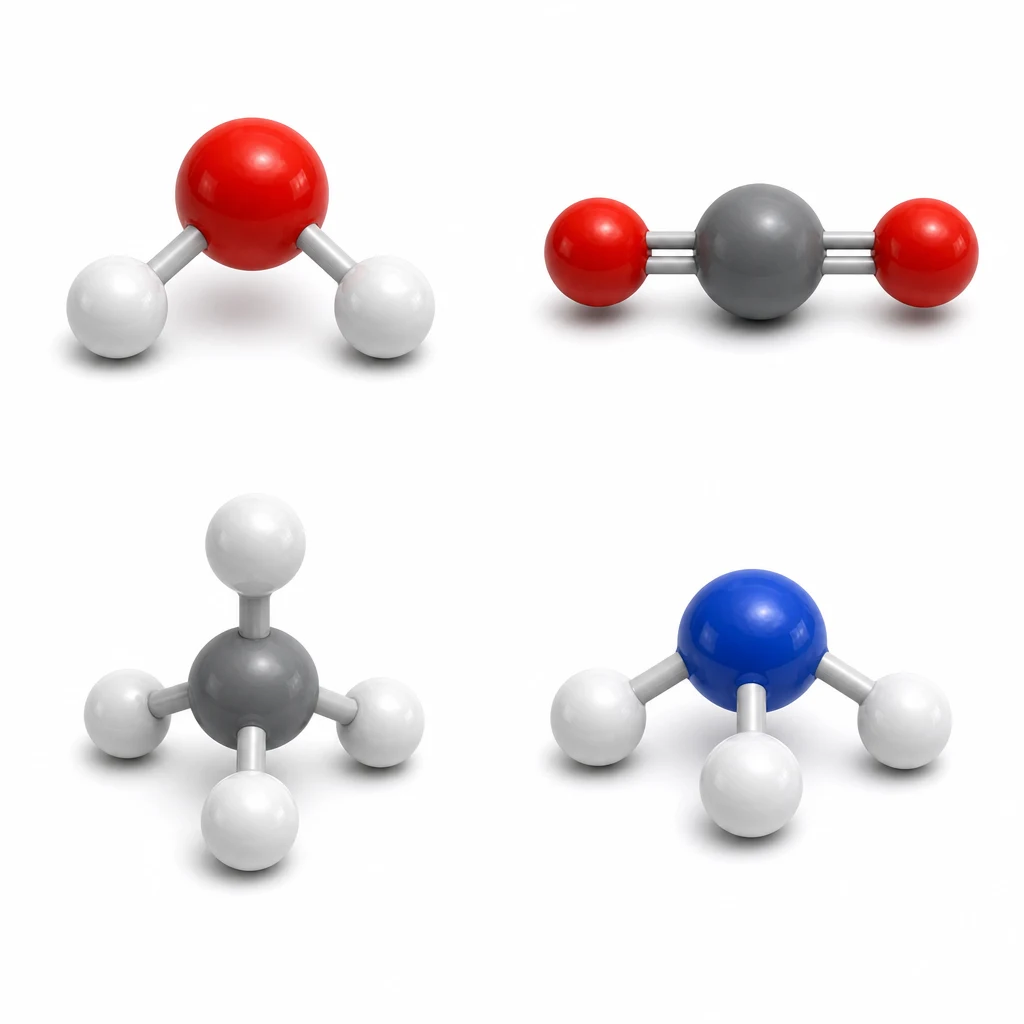
Four simple molecular models: water (H2O, bent), carbon dioxide (CO2, linear), methane (CH4, tetrahedral), and ammonia (NH3, pyramidal) shown as ball-and-stick models

Figure 1: Molecular models of common simple molecules — H₂O, CO₂, CH₄, and NH₃. Each molecule has strong covalent bonds WITHIN it but only weak intermolecular forces BETWEEN molecules.

Practice questions for Simple Molecules

Which type of force holds simple molecules together as a substance?

  • A. Weak intermolecular forces between molecules
  • B. Strong ionic bonds between oppositely charged ions
  • C. Metallic bonds from a sea of delocalised electrons
  • D. Covalent bonds between separate molecules
1 markfoundation

Explain why chlorine (Cl2) has a low boiling point.

2 marksstandard

Quick recall flashcards

What are intermolecular forces?
Weak forces of attraction between different molecules
What does molecular formula show?
Number and type of atoms in one molecule (e.g., H₂O, CO₂, CH₄)

20 questions on Simple Molecules — practise free

Instant marking, adaptive difficulty and spaced-repetition flashcards — all aligned to your exam board.

Start revising free →