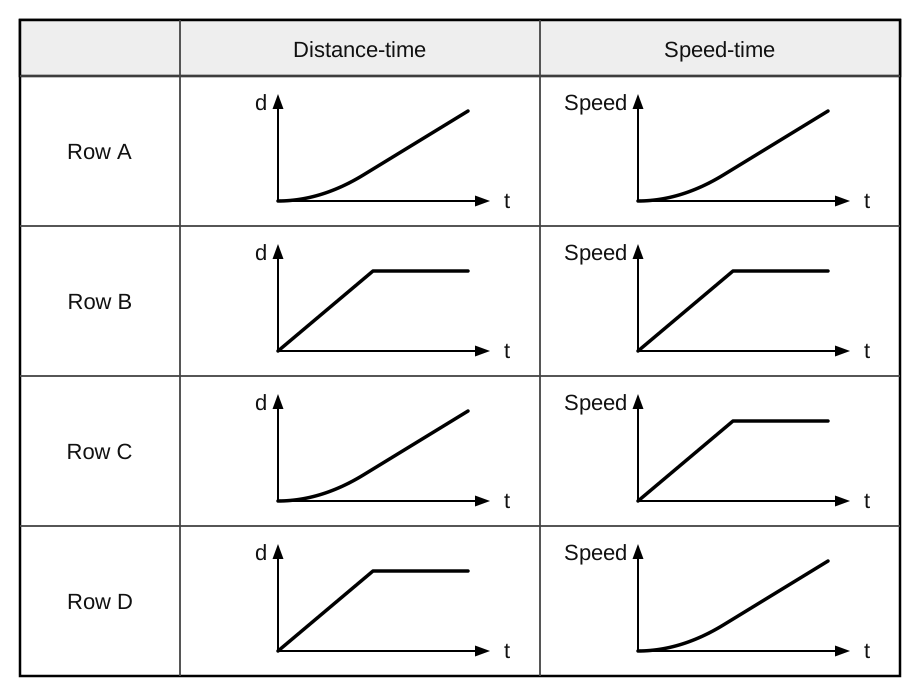
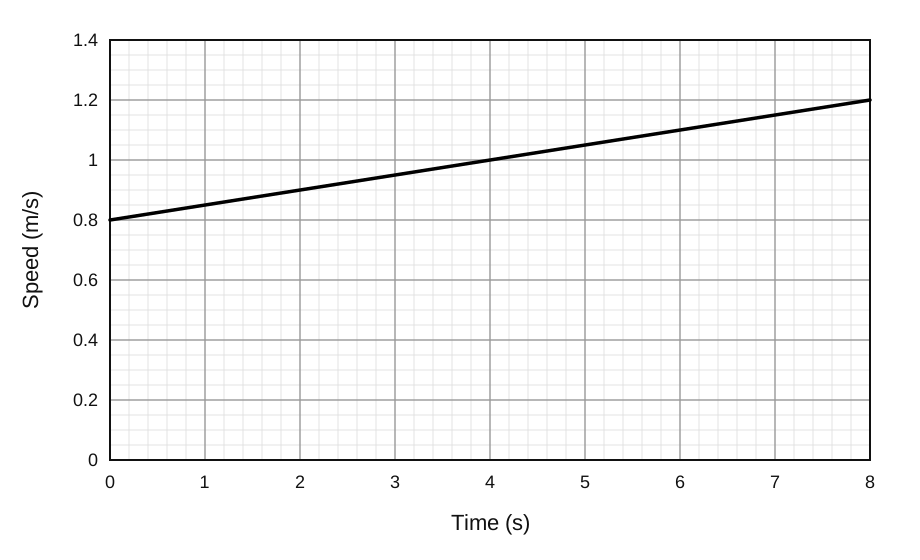
A boat travels along a canal from A to C and passes B on the way. Figure 1 is a scale plan of the canal as a straight line, with a strip of equal divisions beneath for measuring. In total the boat covers 5000 m between A and C. Figure 2 gives four rows of graphs for the boat's departure, and Figure 3 plots its speed over a short spell.
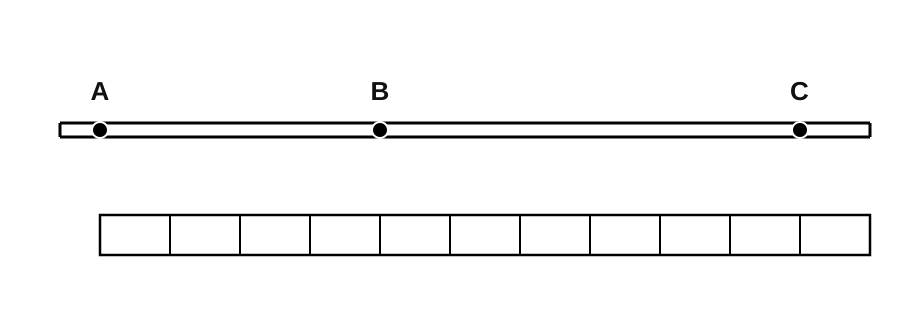
Use Figure 1 and its strip to find how far the boat goes from A to B.
Our own questions on this topic, marked straight away, so you see what to revise. Free now.
Show model answer for 01.1Hide model answer for 01.1
Measure with the strip:. AB = 4 divisions. AC = 10 divisions
Scale the 5000 m by the ratio:. AB = 4 over 10 × 5000. AB = 2000 m
How the marks are earned
- One mark: measure both stretches on Figure 1, A to B and A to C, or write them as a ratio. Readings within 0.2 of a division on either stretch are fine.
- One mark: scale the 5000 m by that ratio to get the A to B distance, which is 2000 m. Any answer from 1670 m to 2370 m is accepted.
- The correct answer, 2000 m, on the answer line earns both marks with no working.
Why it scores
The plan is drawn to scale, so the lengths on it share the same ratio as the real distances. Comparing two lengths needs no unit, so the size of the divisions does not matter.
B is four tenths of the way along the route, so the real distance is four tenths of 5000 m. Writing 2000 m alone, with no working, still earns both marks.
Revise Newton's Laws of MotionThe boat leaves A at 09:23 and reaches B at 09:53. Using your A to B distance, find its average speed in m/s.
See how you would score on Newton's Laws of MotionShow model answer for 01.2Hide model answer for 01.2
Change the time to seconds:. time = 30 × 60. time = 1800 s
Use the rule for average speed:. speed = distance over time. speed = 2000 over 1800
Evaluate:. speed = 1.1 m/s
How the marks are earned
- One mark: change the journey time into seconds. From 09:23 to 09:53 is 30 minutes, so the time is 1800 s.
- One mark: divide your distance from the previous part by that time, for example 2000 ÷ 1800. Using 30 instead of 1800 earns this one mark at most, and no final mark.
- One mark: the speed, 1.1 m/s (1.11 unrounded). An answer of 1 m/s counts only when the working or the unrounded value is shown.
- The correct answer, 1.1 m/s, on the answer line earns all three marks.
Why it scores
Speed in m/s needs the time in seconds. Leaving it as 30 would give a number that is 60 times too big, and the final mark would be lost.
Average speed is the total distance divided by the total time. Your own distance from the previous part is used, so a slightly different measurement still earns this mark.
2000 ÷ 1800 = 1.11, which is 1.1 m/s to 2 significant figures. The right answer alone earns all 3 marks.
Revise Newton's Laws of MotionUse Figure 2 to pick the row for a boat that speeds up at a steady rate, then keeps constant speed.
See how you would score on Newton's Laws of MotionShow model answer for 01.3Hide model answer for 01.3
Row C is the one. Steady acceleration is a straight rising line on a speed-time graph, and constant speed is a flat line. On the distance-time graph the gradient is the speed, so it steepens while the boat speeds up, then stays constant as a straight sloping line.
How the marks are earned
- Tick Row C: its speed-time graph climbs in a straight line and then goes flat, and its distance-time graph curves upwards and then becomes a straight sloping line.
- One box only: two ticks earn nothing.
Why it scores
Row A has a curved speed-time start, which means the acceleration itself is changing. Row B and Row D have distance-time graphs that go flat, which means the boat has stopped, not that it keeps moving at constant speed.
Revise Newton's Laws of MotionFigure 3 plots the boat's speed against time. Work out the boat's acceleration in m/s2.
See how you would score on Newton's Laws of MotionShow model answer for 01.4Hide model answer for 01.4
The slope of a speed-time line is the acceleration:. a = rise over run
Read the line at the start and end: 0.8 m/s at 0 s and 1.2 m/s at 8 s.. acceleration = fraction: 1.2 − 0.8 over 8, end of fraction. acceleration = 0.4 over 8
Evaluate:. acceleration = 0.05 m/s2
How the marks are earned
- One mark: use the gradient method, such as a triangle drawn on the line, or the rule acceleration = change in speed ÷ time. Dividing the speed by the time earns nothing.
- One mark: read two points correctly from the line, to within half a small square, and use their differences, for example (1.2 − 0.8) ÷ 8.
- One mark: the acceleration, 0.050 m/s2. Any answer from 0.045 to 0.055 is accepted.
- The correct answer, 0.05 m/s2, on the answer line earns full marks.
Why it scores
This earns the method mark. Drawing a right-angled triangle under the line, or writing the equation, both show the method. Dividing a single speed by a time would not.
Use points far apart so the reading error is small. Any other pair on the line, such as 0.9 m/s at 2 s and 1.1 m/s at 6 s, gives the same answer.
This earns the final mark. The right answer alone, with no working, earns all 3 marks.
Revise Newton's Laws of MotionA breeze acts on the boat. Choose the everyday wind speed from the four values given.
See how you would score on Newton's Laws of MotionShow model answer for 01.5Hide model answer for 01.5
A typical wind blows at about 12 m/s, which is roughly 40 km/h. Winds of 1200 m/s and 120 000 m/s are far beyond anything the atmosphere produces. A breeze of 0.12 m/s would be almost still air.
How the marks are earned
- Tick 12 m/s, a typical speed for a strong breeze.
- One box only: two ticks earn nothing.