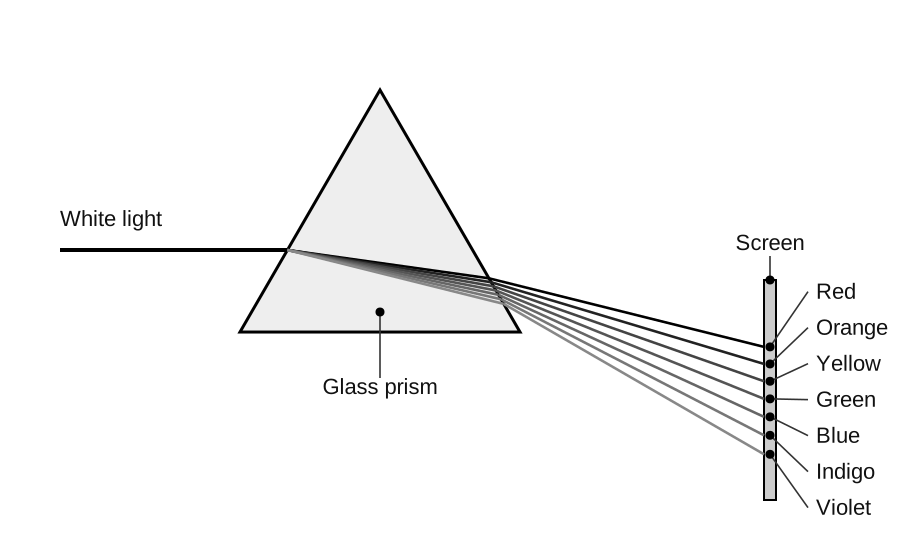
Sound and light are both wave motions. In Figure 4 a white light ray heads for a flat mirror. In Figure 5 white light goes through a glass prism and lands on a screen.
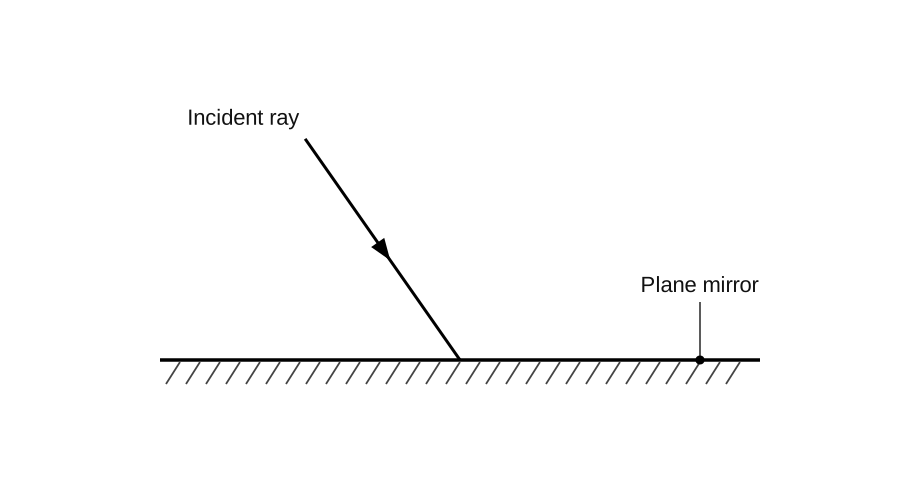
Describe what to add to Figure 4: the normal, the reflected ray, and labels for the two angles.
Our own questions on this topic, marked straight away, so you see what to revise. Free now.
Show model answer for 04.1Hide model answer for 04.1
Add the normal: a dashed line perpendicular to the mirror, starting at the spot the incoming ray strikes, and write N beside it.
Draw the reflected ray from that point, leaning away on the other side of the normal, with the same angle to the normal as the incident ray.
Mark i between the incident ray and N, and r between the reflected ray and N.
How the marks are earned
- One mark: a perpendicular to the mirror surface, standing on the point of impact of the ray. A perpendicular placed at any other point of the mirror earns nothing.
- One mark: the reflected ray leaves that same spot on the other side of the normal, at an angle that looks equal to the incoming ray's angle, by eye. Arrowheads on the rays are ignored.
- One mark: both angles carry a label, for example i and r or θi and θr, and each is marked against the normal. An angle drawn against the mirror surface itself earns nothing.
Why it scores
All angles in reflection are measured from the normal, so it comes first. It must start at the point of incidence, not elsewhere on the mirror.
The law of reflection says angle of incidence equals angle of reflection. A careful drawing by eye is accepted, so no protractor is needed.
These labels earn the last mark. An angle drawn between a ray and the mirror itself does not count, because angles are measured from the normal.
Revise Reflection & RefractionTick the two words that describe light waves.
See how you would score on Wave PropertiesShow model answer for 04.2Hide model answer for 04.2
Light is an electromagnetic wave, and it is a transverse wave, with oscillations at right angles to the direction it travels.
How the marks are earned
- Tick exactly two boxes. One mark for Electromagnetic.
- One mark for Transverse.
Why it scores
Each correct box earns one mark. Compression and longitudinal describe waves such as sound. Radioactive describes unstable nuclei, and seismic describes waves from earthquakes.
Revise Wave PropertiesFigure 5 shows white light through a glass prism. Explain why the light spreads into colours.
See how you would score on Reflection & RefractionShow model answer for 04.3Hide model answer for 04.3
White light is a mixture of colours, and each colour has its own frequency and wavelength.
In glass each colour travels at a different speed, so each bends by a different amount when it enters and leaves the prism, and the colours fan out.
How the marks are earned
- One mark: the colours in white light have different wavelengths or frequencies.
- One mark: each colour travels at a different speed inside the glass, so each is refracted by a different amount. Saying each colour refracts by a different amount alone is accepted for this mark.
- Saying that red has the longer wavelength so is refracted least earns both marks. Saying the colours differ in amplitude earns nothing, and neither does saying red has the shortest wavelength or violet the lowest frequency.
Why it scores
This earns the first mark. It is the frequency and wavelength, never the amplitude, that tells the colours apart.
This earns the second mark. Red has the longest wavelength of the visible colours and refracts least, while violet has the shortest and refracts most.
Revise Reflection & RefractionOrange light has frequency 5.0 × 10¹⁴ Hz and wavelength 400 × 10-9 m in glass. Find its speed in m/s.
See how you would score on Wave PropertiesShow model answer for 04.4Hide model answer for 04.4
Choose the equation:. wave speed = frequency × wavelength
Substitute:. wave speed = 5.0 × 1014 × 400 × 10-9
Evaluate:. wave speed = 200 000 000 m/s. wave speed = 2 × 10⁸ m/s
How the marks are earned
- One mark: choose wave speed = frequency × wavelength. A correct substitution also earns this mark.
- One mark: substitute: 5.0 × 1014 × 400 × 10-9.
- One mark: the answer, 2 × 10⁸ m/s (200 000 000).
- The correct answer, 2 × 10⁸ m/s, on the answer line earns full marks.
Why it scores
This earns the equation mark. It is the rule that links wave speed, frequency and wavelength.
The numbers go in as they are given, with the wavelength already in metres. Writing this line without the equation above it still earns the first two marks.
5.0 × 400 = 2000 and 1014 × 10-9 = 105, so the product is 2000 × 105 = 2 × 10⁸. The right answer alone earns all 3 marks.
Revise Wave PropertiesMatch each medium (air, vacuum, water, steel) to the speed of sound in it, using the four speeds listed.
See how you would score on Sound WavesShow model answer for 04.5Hide model answer for 04.5
Air goes with 330 m/s, vacuum with 0 m/s, water with 1500 m/s and steel with 5000 m/s.
How the marks are earned
- Match each medium to its own speed: air 330 m/s, vacuum 0 m/s, water 1500 m/s, steel 5000 m/s.
- All four matches correct earn 3 marks, three correct earn 2 marks, and two correct earn 1 mark.
Why it scores
Sound is a vibration of particles, so it travels faster where the particles are packed more closely. Of the three media that carry sound, it is slowest in air, faster in liquid water and fastest in solid steel. A vacuum has no particles, so sound cannot travel through it at all, giving a speed of 0 m/s.
Revise Sound Waves