Marie Curie found radioactive elements by taking them out of their ores. Radium has contaminated her notebook, which still gives out radiation. Figure 6 charts a radium sample's activity in counts per second (cps). The curve starts roughly 4000 years before the year 2000, and a dashed line marks the present day.
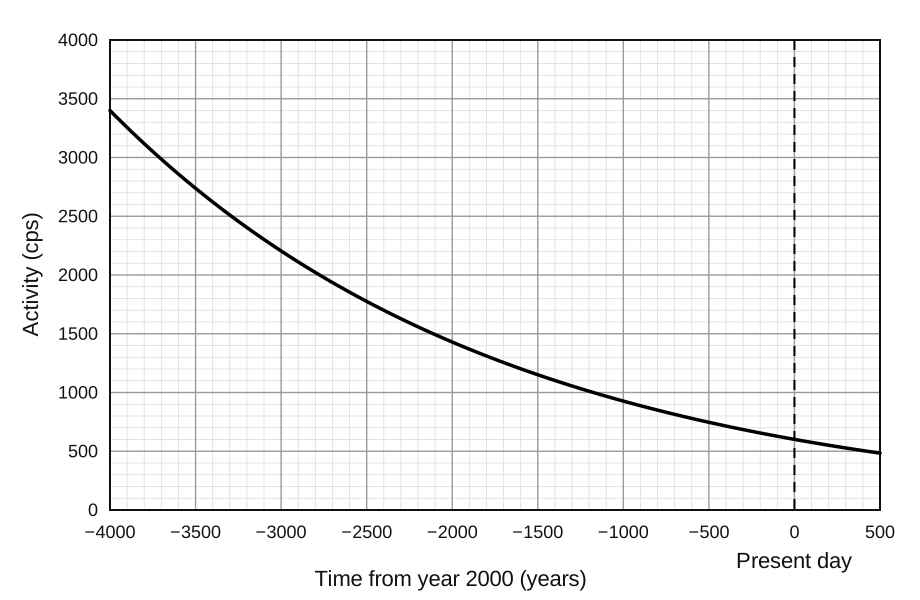
Give radium's half-life in years, working from the curve in Figure 6.
Our own questions on this topic, marked straight away, so you see what to revise. Free now.
Show model answer for 05.1Hide model answer for 05.1
Half-life is the time for the activity to fall to half. Take the activity at the left of the graph, 3400 cps, and half of it, 1700 cps.
Read across to the curve and down to the time axis:. 3400 cps is at −4000 years. 1700 cps is at −2400 years
Find the gap between the two readings:. half-life = −2400 − (−4000). half-life = 1600 years
How the marks are earned
- One mark: read two activities from the curve where one is half of the other, such as 3400 cps and 1700 cps.
- One mark: read the two times that go with them, such as 4000 years and 2400 years before the year 2000.
- One mark: the gap between those times, 1600 years. A correct time gap for any other activity change, such as 4000 years from 3400 cps down to 600 cps, earns one mark. A bare 2400 earns nothing.
- The correct answer, 1600 years, on the answer line earns full marks.
Why it scores
Choose a start where the curve is easy to read. Any start works, because the activity halves in the same time wherever you begin.
The times are measured from the year 2000, so the earlier time is more negative. Read both values to the nearest small square.
The gap between the two times is the half-life. The right answer alone earns all 3 marks.
Revise Half-LifeThe notebook's radium has about 600 cps today. Find its activity after three more half-lives, in cps.
See how you would score on Half-LifeShow model answer for 05.2Hide model answer for 05.2
Three halvings, one after another:. 600 × ½ = 300. 300 × ½ = 150. 150 × ½ = 75
Check with the fraction left, one eighth:. activity = 600 over 8. activity = 75 cps
How the marks are earned
- One mark: working that halves three times, such as 600 to 300 to 150, or the fractions one half, one quarter, one eighth. Halving three times earns this whatever the starting number.
- One mark: the activity, 75 cps.
- The correct answer, 75 cps, on the answer line earns both marks.
Why it scores
Each half-life halves the activity. Writing the three halvings earns the first mark.
Three halvings leave ½ × ½ × ½ = ⅛ of the activity. The right answer alone earns both marks.
Revise Half-LifeFind the fraction of the radium nuclei that decay during those three half-lives.
See how you would score on Half-LifeShow model answer for 05.3Hide model answer for 05.3
After three half-lives, one eighth of the nuclei are left:. fraction decayed = 1 − 1 over 8. fraction decayed = 7 over 8. In decimals that is 0.875.
How the marks are earned
- The fraction is 7/8 (or 0.875). A working such as 525 ÷ 600 is also accepted.
Say how the danger from handling the notebook a century ago compares with the danger now.
See how you would score on Half-LifeShow model answer for 05.4Hide model answer for 05.4
The notebook was about as hazardous 100 years ago as it is now, and only very slightly more hazardous then.
100 years is a small part of one half-life:. 100 over 1600 = 0.0625. So very little of the radium has decayed and its activity has hardly fallen.
How the marks are earned
- One mark: it was about as hazardous then as now, or slightly more hazardous 100 years ago, which is the same as slightly less hazardous today; saying slightly less hazardous today alone is also accepted. Saying only more or less, with no qualifying word, earns nothing.
- One mark: the reason is that 100 years is short compared with the half-life of 1600 years, about 0.06 of a half-life, so the activity has barely changed. Saying both activities are about 600 cps, the activity is the same, or the activity has not dropped much is also accepted, and so is a quoted drop of between 5 and 50 cps.
Why it scores
This earns the first mark. Saying simply that it was more hazardous or less hazardous, with no qualifier, does not.
The hazard depends on the activity, which falls by half only after 1600 years. Saying the activity is about the same, around 600 cps, also earns this mark.
Revise Half-Life