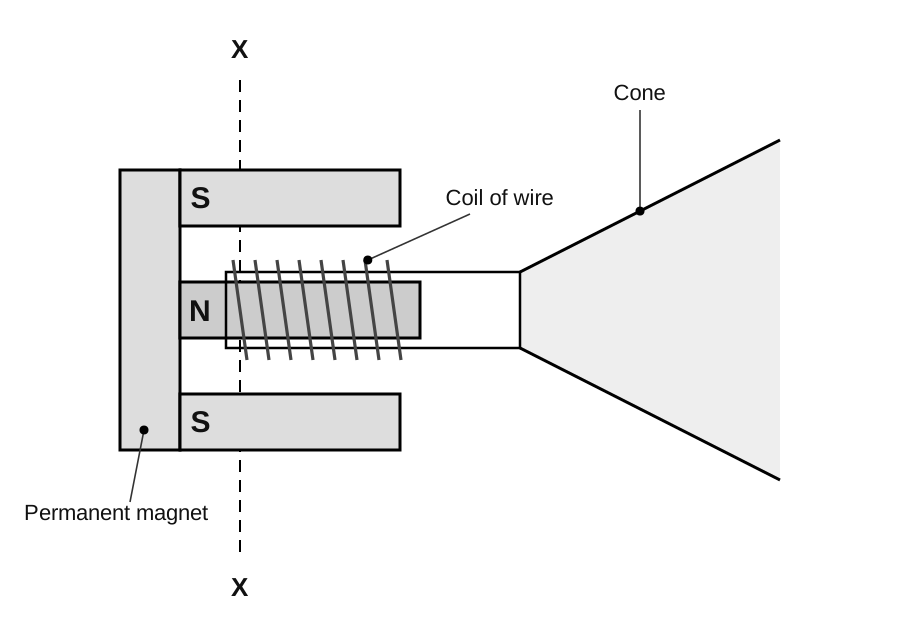
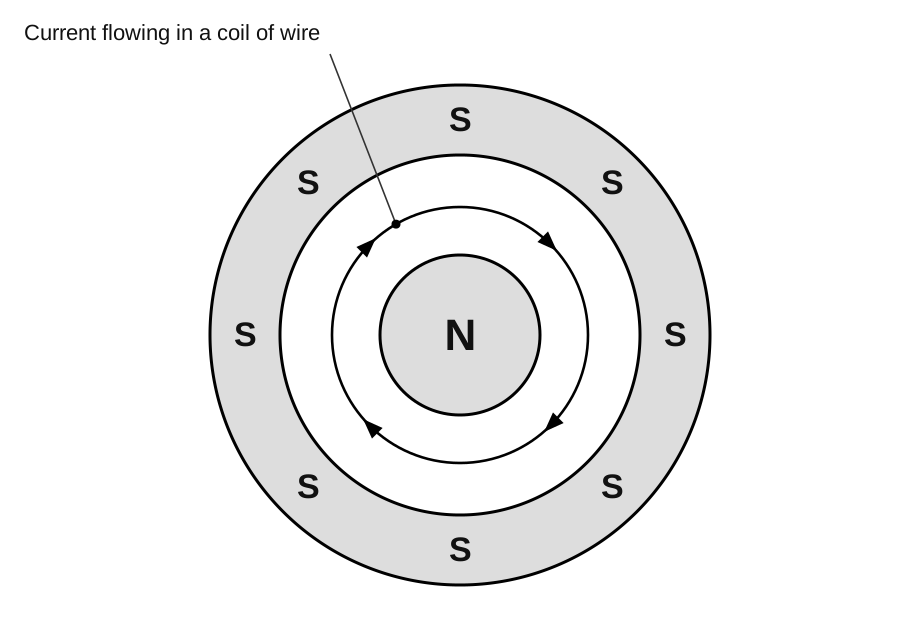
A loudspeaker contains a permanent magnet and a wire coil, drawn side-on in Figure 7. Figure 8 is a cross-section through the magnet, cut across its length, and Figure 9 adds a single turn of the coil near its centre.
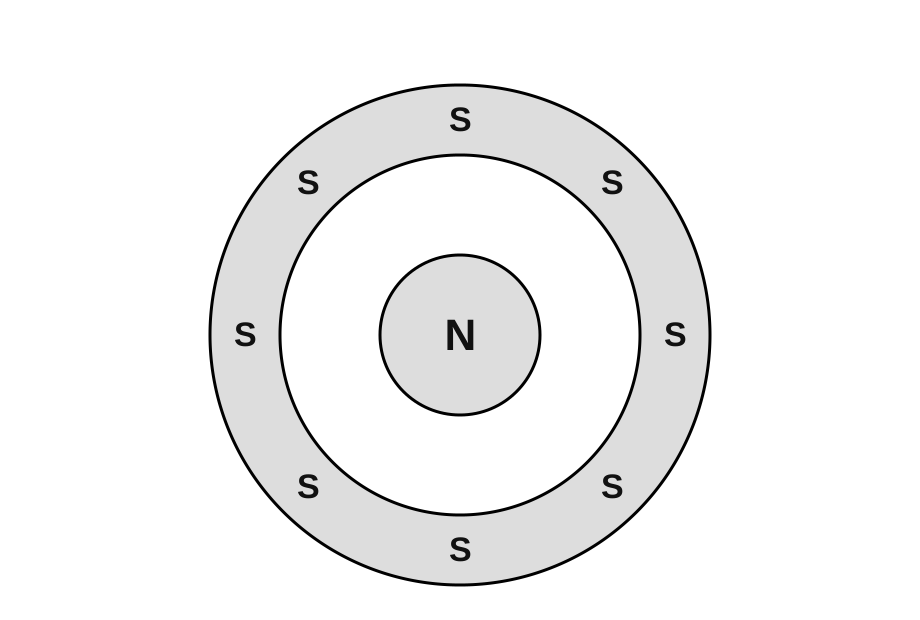
On Figure 8, state what four field lines from the magnet must look like, and which way their arrows point.
Our own questions on this topic, marked straight away, so you see what to revise. Free now.
Show model answer for 06.1Hide model answer for 06.1
Draw four short straight lines like the spokes of a wheel, each running from the central north pole across the gap to the south pole ring.
Put an arrowhead on every line pointing outwards, from the north pole towards the south pole.
How the marks are earned
- One mark: four lines drawn straight outwards from the north pole in the middle to the south pole ring, along radii of the circle. Any curve in a line loses the mark.
- One mark: an arrowhead on each line pointing outwards, from the north pole to the south pole. An arrow pointing away from the south pole earns nothing.
Why it scores
The field in the gap points straight across from one pole to the other. Because the poles are circular and facing, the lines are straight and run along the radii, with no curving.
Magnetic field lines always point from north to south. An arrow pointing in, towards the centre, would show the opposite direction.
Revise Magnetic FieldsAn alternating current runs in the coil in Figure 9; explain what makes the coil experience a push.
See how you would score on The Motor EffectShow model answer for 06.2Hide model answer for 06.2
A current in a wire produces a magnetic field around the wire.
The coil lies in the strong field of the permanent magnet, which acts across the gap.
Because the current crosses the magnet's field at 90 degrees, the two fields interact and push on the wire. That is the motor effect, which Fleming's left-hand rule predicts.
How the marks are earned
- One mark: the current in the wire creates its own magnetic field. The wire becoming magnetised is accepted. Just saying there is a current, that the wire is magnetic, that it becomes a magnet, or that a magnetic force is induced earns nothing.
- One mark: the coil sits inside the magnetic field of the fixed magnet. A statement that the permanent magnet has a field is also accepted.
- One mark: the two fields interact, or the current is at right angles to the field, or the left-hand rule or the motor effect is named. Attraction or repulsion with the permanent magnet is accepted. Any reference to an electric field, or to the interaction creating a current or a p.d. in the wire, earns nothing.
Why it scores
This earns the first mark. It is the moving charges in the wire that make a field of their own.
This earns the second mark. A force needs a wire carrying current inside another magnetic field.
This earns the third mark. Attraction and repulsion between the coil's field and the magnet's field also count. The interaction produces a force, not a current.
Revise The Motor EffectExplain how the coil's push produces sound that matches the supply's alternating current in frequency.
See how you would score on Sound WavesShow model answer for 06.3Hide model answer for 06.3
The alternating current keeps reversing, so the force on the coil keeps reversing too, and the coil moves back and forth.
The coil is attached to the cone, so the cone vibrates and pushes the air, making compressions and rarefactions. These travel as a longitudinal sound wave with the frequency of the current.
How the marks are earned
- One mark: the coil vibrates, moving back and forth.
- Any two further marks from: the field around the coil keeps varying; the push on the coil flips direction each time the current reverses (being attracted and repelled by the magnet is accepted here); the cone attached to the coil vibrates too; the cone drives the air into compressions and rarefactions; the air carries a longitudinal wave; the air particles oscillate at the frequency of the current.
- Vibrations travelling through the air are accepted for the wave. Any reference to induction caps the answer at 2 marks.
Why it scores
This earns the vibration mark. Each reversal of the current gives one reversal of the force, so the coil vibrates at the same frequency as the current.
With the vibration mark, any two of the further points complete the 3 marks. The air vibrates at the cone's frequency, which is why the pitch of the sound matches the alternating current.
Revise Sound WavesFind the force on one coil of the speaker: field strength 1.2 T, current 0.3 A, coil circumference 5 cm.
See how you would score on The Motor EffectShow model answer for 06.4Hide model answer for 06.4
Change the length to metres:. length = 5 over 100. length = 0.05 m
Choose the equation:. force = magnetic field strength × current × length
Put the numbers in:. F = 1.2 T × 0.3 A × 0.05 m
Evaluate:. force = 0.018 N
How the marks are earned
- One mark: change 5 cm into 0.05 m.
- One mark: choose force = magnetic field strength × current × length, F = BIL. A correct substitution also earns this mark.
- One mark: put the numbers in, 1.2 for the field strength, 0.3 for the current and your own converted length for the wire. A correct substitution that uses a wrong conversion still earns this mark and the select-equation mark.
- One mark: the force, 0.018 N.
- The correct answer, 0.018 N, on the answer line earns full marks.
Why it scores
The equation needs the length in metres to give a force in newtons. Leaving it as 5 would make the answer 100 times too big.
This is the equation mark. The length is the wire inside the field, which for one turn is the coil's circumference.
This earns the substitution mark, whichever way round the factors are written.
1.2 × 0.3 = 0.36 and 0.36 × 0.05 = 0.018. The right answer alone earns all 4 marks.
Revise The Motor EffectSuggest three ways to make the force on the speaker's coil bigger.
See how you would score on The Motor EffectShow model answer for 06.5Hide model answer for 06.5
Wind extra turns on the coil, raise the current, and fit a stronger magnet.
How the marks are earned
- Any three from: more turns of wire on the coil; a larger current; a stronger magnet (a stronger magnetic field); an iron core, a magnetic core, or soft magnetic material.
- One mark each. A steel core earns nothing, and neither does an unqualified core. Voltage counts only if linked to a larger current. A larger or wider coil counts only if linked to more wire in the field.
Why it scores
The force depends on field strength, current and wire length, so each change raises one of them. Extra turns put more wire inside the field. Any three correct ways earn the marks, so a soft iron core in the coil, which is magnetised easily and strengthens the field, would also count.
Revise The Motor Effect