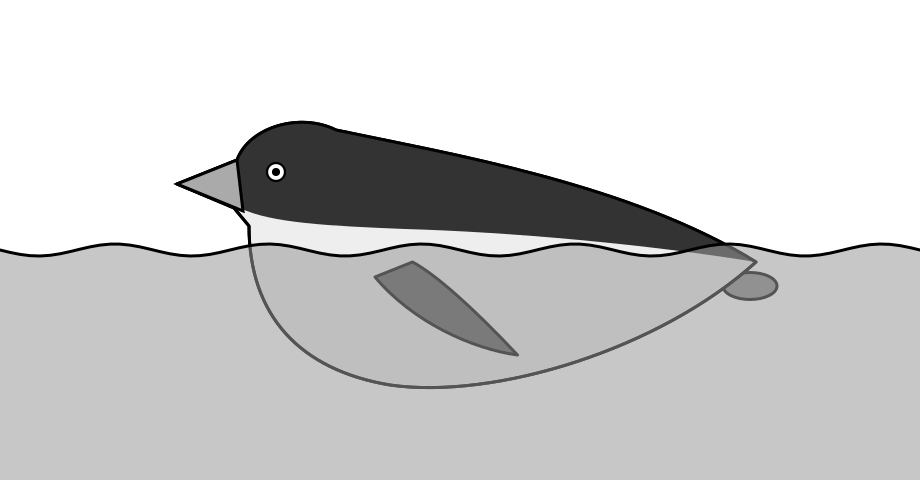
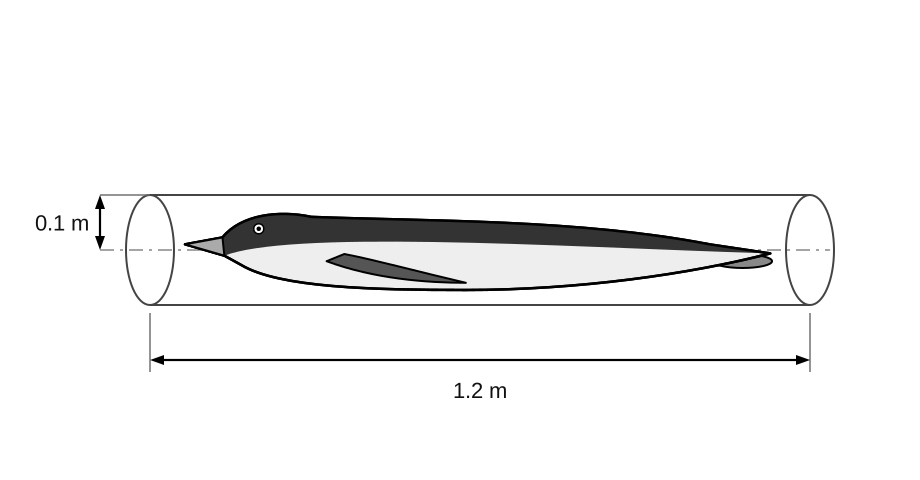
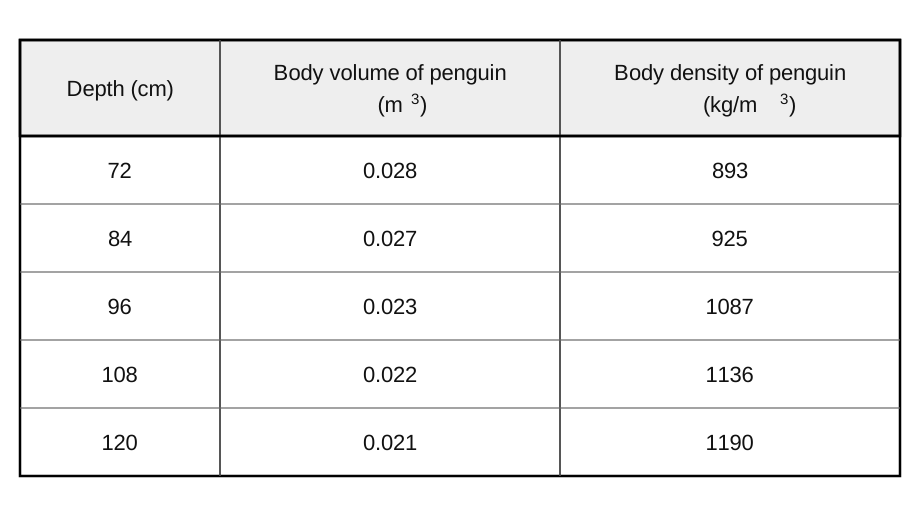
Emperor penguins make extremely deep dives in the sea. Figure 11 shows one at the surface with part of its body submerged. Figure 12 models the penguin's body as a cylinder. Figure 13 gives data for the penguin's body at five depths, with depth in centimetres. Gas-filled sacs inside its body get squeezed smaller as it descends.
Use ideas about force to explain why an object feels more pressure the deeper it goes in the sea.
Our own questions on this topic, marked straight away, so you see what to revise. Free now.
Show model answer for 08.1Hide model answer for 08.1
The deeper the object, the more water lies above it, so a greater weight of water presses down on it.
A greater force acts on the same area of the object. Pressure depends on force and area:. p = F over A. So the pressure is larger.
How the marks are earned
- One mark: a deeper object has a greater weight of water pressing down on it from above. A greater mass of water overhead, a larger force from above, or more particles pushing down, also earns it. Saying only more water earns nothing.
- One mark: that gives a larger force on the same area.
- Saying the water's density increases loses the first mark; the mark for more force on the same area can still be earned.
Why it scores
This earns the first mark. Pressure in a liquid comes from the weight of the column of liquid above, which grows with depth.
This earns the second mark. It links the extra weight to a bigger force over the same area.
Revise PressureA penguin dives to 400 m. Seawater density is 1020 kg/m3 and g is 10 N/kg. Find the pressure in kPa.
See how you would score on PressureShow model answer for 08.2Hide model answer for 08.2
Choose the equation:. pressure = depth × density × gravitational field strength
Substitute:. pressure = 400 × 1020 × 10
Work it out in pascals:. p = 4 080 000 Pa
Change to kilopascals:. pressure = 4 080 000 over 1000. pressure = 4080 kPa
How the marks are earned
- One mark: choose pressure = depth × density × gravitational field strength.
- One mark: substitute: 400 × 1020 × 10.
- One mark: the pressure in pascals, 4 080 000 Pa. This alone, with no conversion, earns 3 marks.
- One mark: convert to kilopascals, 4080 kPa. Clear working that divides a wrong value by 1000 earns this one mark.
- The correct answer, 4080 kPa, on the answer line earns full marks.
Why it scores
This earns the equation mark.
The depth is in metres, the density in kg/m3 and g in N/kg, so the answer comes out in pascals with no unit changes.
400 × 1020 = 408 000, and 408 000 × 10 = 4 080 000. This earns the third mark.
1 kPa is 1000 Pa, so divide by 1000. The right answer, 4080 kPa, alone earns all 4 marks.
Revise PressureColder water is denser. Explain how that changes your pressure answer at the same 400 m depth.
See how you would score on PressureShow model answer for 08.3Hide model answer for 08.3
The pressure would be higher.
The depth and g are the same, but the column of colder water above the penguin has more mass, so its weight is greater and it presses harder.
How the marks are earned
- One mark: the pressure would be higher than the answer to the previous part.
- One mark: any one reason: a greater weight of water lies overhead; pressure scales with density; depth and g are unchanged; or the water overhead has a larger mass; or more particles push down. A reply of just more mass in each unit of volume, or just a bigger downward force, earns nothing.
Why it scores
This earns the first mark. In the equation pressure = depth × density × g, only the density has changed, and a larger density gives a larger pressure.
This earns the second mark. Pressure is proportional to density when the depth and g are fixed.
Revise PressureFigure 11 shows a penguin partly under the surface. Explain why the water gives it a net upward force.
See how you would score on PressureShow model answer for 08.4Hide model answer for 08.4
Pressure grows with depth, so the water pushes up on the underside of the penguin with more force than it pushes down on the upper submerged surfaces. The net result is an upward force from the water, the upthrust.
The size of the upthrust equals the weight of the water the penguin displaces.
How the marks are earned
- One mark: the water's pressure on the penguin gives an upthrust, a net force upwards.
- One mark: the upthrust comes from the weight of the water the penguin pushes aside, or the water displaced pushes up. A net force from the water that does not include the penguin's own weight is also accepted. Naming Newton's third law earns nothing.
Why it scores
This earns the first mark. The forces from the water act on all submerged surfaces, and the larger force on the underside wins.
This earns the second mark. The upthrust comes from the water only. The penguin's own weight is a separate downward force that is not part of it.
Revise PressureUse Figure 12's radius and length, mass 25 kg, and cylinder volume = π × radius2 × length, to find density in kg/m3.
See how you would score on DensityShow model answer for 08.5Hide model answer for 08.5
Read from Figure 12: radius 0.1 m and length 1.2 m.. volume = π × 0.12 × 1.2. volume = 0.0377 m3
Choose the equation and substitute:. density = mass over volume. density = 25 over 0.0377
Evaluate:. density = 663 kg/m3. This is about 660 kg/m3 to 2 significant figures.
How the marks are earned
- One mark: the volume, from π × radius2 × length. Any volume that rounds to 0.038 m3 is accepted, such as 0.037699 m3 or 38 000 cm3.
- One mark: choose density = mass ÷ volume, and use it, for example 25 ÷ 0.0377. This mark is also earned by using a wrong volume of your own.
- One mark: the density, 663 kg/m3, which must come from the correct volume. An answer of 660 at 2 significant figures, or 700 at 1 significant figure, is accepted.
- The correct answer, 663 kg/m3, on the answer line earns full marks.
Why it scores
This earns the volume mark. The radius is squared first: 0.1 × 0.1 = 0.01. Then 0.01 × 1.2 = 0.012, and 0.012 × π = 0.0377.
This earns the select-and-apply mark. Using your own volume here still earns it.
This earns the final mark. The right answer alone earns all 3 marks.
Revise DensityExplain the trends in Figure 13, the penguin's body volume and body density at five depths.
See how you would score on DensityShow model answer for 08.6Hide model answer for 08.6
As the penguin dives deeper, its body volume decreases and its body density increases.
The volume decreases because the greater pressure at depth compresses the air in the penguin's air sacs.
The density increases because the penguin's mass stays the same but occupies a smaller volume. Density depends on mass and volume:. density = mass over volume
How the marks are earned
- One mark: a correct trend, any one of: as depth increases the volume falls; as depth increases the density rises; as volume falls the density rises. A wrong trend earns nothing and can cancel the explanations. Saying proportional or inversely proportional is ignored.
- One mark: the volume falls because the air in the air sacs is compressed.
- One mark: the density rises because the same mass is squeezed into a smaller volume. Repeating the trend as the reason earns nothing, for example saying the density rises because there is more mass in each unit of volume.
Why it scores
This earns the trend mark. Quote the data to be safe: the volume falls from 0.028 m3 at 72 cm to 0.021 m3 at 120 cm, while the density rises from 893 to 1190 kg/m3.
This earns the second mark. Gases can be compressed, while the rest of the body is almost incompressible.
This earns the third mark. A fixed mass divided by a smaller volume gives a larger density.
Revise DensityUse Figure 13 and seawater density 1020 kg/m3 to explain why the penguin sinks at 100 cm when not swimming.
See how you would score on DensityShow model answer for 08.7Hide model answer for 08.7
At 96 cm the penguin's density is 1087 kg/m3 and at 108 cm it is 1136 kg/m3, so at 100 cm it is about 1100 kg/m3. That is greater than the seawater's 1020 kg/m3.
So the penguin's weight is greater than the upthrust from the water, and the upthrust cannot balance it. Without swimming, nothing holds it up, so it sinks.
How the marks are earned
- One mark: the penguin is denser than the seawater at that depth. Saying it is already sinking at 96 cm also earns this.
- One mark: its weight is greater than the upthrust from the water, so the upthrust is too small to balance the weight. Saying that swimming gives an upward force to keep its position is also accepted. Saying only that the forces are unbalanced earns nothing.
Why it scores
This earns the first mark. An object denser than the liquid around it sinks.
This earns the second mark. At 72 cm the penguin is less dense than seawater, so it floats; once it is denser, the upthrust is too small and swimming has to supply an upward force to keep its position.
Revise Density